Why 9/11 Isn’t Really Over
There’s more work to be done on this mystery — and others.
|
Listen To This Story
 |
I don’t usually write anything, or at least not much, about 9/11 anniversaries — although I could, as I literally ran all the way downtown shortly after the planes struck the towers and was present throughout the tragic aftermath. I was traumatized by just being an observer. I can scarcely imagine how it has affected those with personal losses or consequent health issues.
Over the years, I’ve been besieged by people dissatisfied with the official story. Wanting to tell me their insights, sending “research papers,” DVDs, and eventually YouTube links that show “the real story.” A few even asked what I thought.
Still, I have mostly resisted writing about that day of infamy, overwhelmed by those awful memories. But the 25-year mark gave me pause.
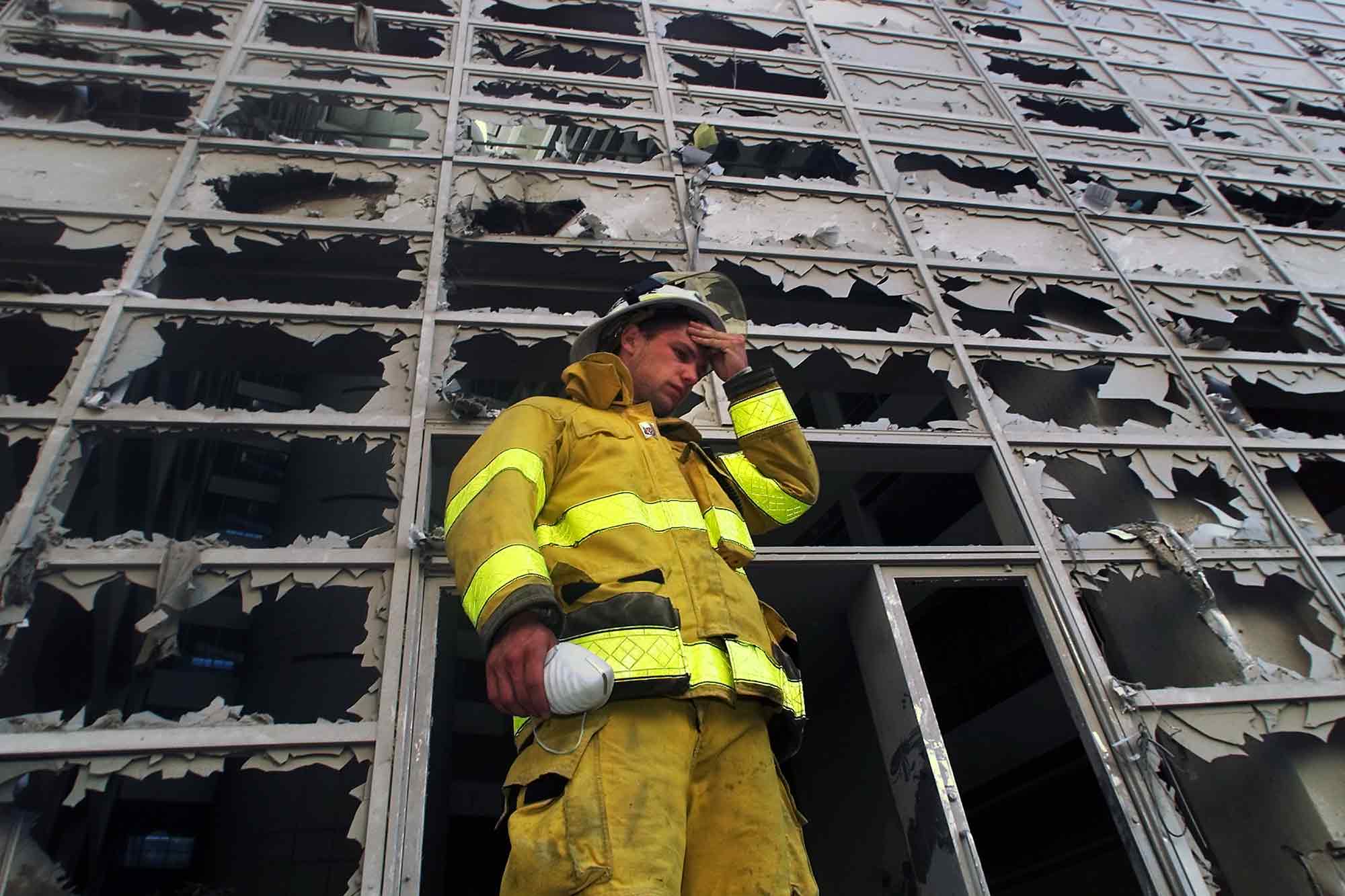
One thing is clear to me: To this day, we know surprisingly little about the operation itself. Yet all of us live with the profound, long-term global impact of those planes hitting the Towers (and Pentagon), along with the unprecedented collapse of steel-constructed Building 7 from fire alone.
Building 7 was known as the “Salomon Brothers Building” for its main tenant, an investment bank. The bottom 10 floors housed Con Edison’s bulk power station. Before collapsing, it burned for seven hours after the north tower fell.
I was there, reporting for the Los Angeles Times, literally standing at the police perimeter and watching that building burn. Then I heard what I took to be a Fire Department official standing near me say to a man with him, “They’re pulling the building.”
Hardly a moment later, I watched along with the crowd — my mouth almost certainly open in amazement — and saw Building 7 come down in mere seconds, the entire 47-story tower dropping as neatly as a pile of flapjacks landing on a plate.
I was on the phone at that very moment with the LA Times’s national desk, and when I described to an editor the building pancaking down, he replied, “That’s a controlled demolition.”
And so that’s what I and others assumed it was — until I realized two things: first, that a controlled demolition of a building like that is not possible without weeks or months of preparation; and second, such caveats stopped being heard once the “news” told us that what we saw was caused by extremely high temperature flames, that “heating of floor beams and girders caused a critical support column to fail, initiating a fire-induced progressive collapse that brought the building down” in its footprint.
Skeptics, some with technical credentials, argue that it could not have happened that way, but the validity of their arguments is hard to verify.
In addition to various corporate offices, that building also housed regional offices of the Department of Defense, the CIA, the US Secret Service, and the New York City Office of Emergency Management — then-NYC Mayor Rudy Giuliani’s command center for emergency response. If there is anything to the suspicions of those who believe people in the US somehow helped 9/11 to happen (presumably to kick-start the unrelenting war, seizure of oil fields, and/or “anti-terror” domestic crackdown that followed) — and I am certainly not saying there is — and if anything in those offices could have revealed such collusion, then it would make sense to ensure its total destruction.
Since then, we’ve had COVID-19 and Black Lives Matter and Trump 1.0 and 2.0 — and we keep on moving right on. Admirable, yes, but isn’t such an attitude also dangerous? Don’t we need to take the time to understand what actually happened and embrace the implications — no matter where they may lead?
To be sure, 9/11 transformed almost everything. Internationally, it led to the wars and geopolitical chaos that characterize our world today, including the odd fact that the US and Saudis, especially via the Trump family, are now closer than ever — despite most of the hijackers being Saudis and substantial evidence that elements of the Saudi government were witting.
Related: Trump, Kushner, Russia — and the Blackstone Mystery
Related: Amid Fresh Saudi Royal Family Scrutiny, Remember 9/11
Related: Revealed: What Bush Said About 9/11 Behind Closed Doors
Related: What Bush Said About 9/11 Behind Closed Doors. Part 2
Related: New: Saudis Used Terrorist Switchboard Prior to 9/11; Q&A with Investigator
Domestically, it birthed the Patriot Act, which to this day has malign consequences in terms of overbearing surveillance, civil rights violations, the apprehension and brutal removal of foreigners without due process, and so much more.
Still, we have indeed “moved on” — periodically pausing for “remembrances” that provide neither insight nor answers for the questions still needing to be asked.
What really happened to Building 7, which wasn’t hit by a plane but still came down? It’s natural to wonder. Yet even now, those pertinent questions rarely get asked, and those who dare to ask them get labeled kooks. We’re told all the important issues were settled long ago by an official commission and congressional investigation, but that is simply not so.
Why did the Bush administration ignore warnings from National Security Council Coordinator Richard Clarke about a planned attack involving pilots and sleeper cells. A 9/11 commissioner said that CIA Director George Tenet and counterterrorism chief Richard Clarke were “running around, as they say, with their hair on fire, in the summer of 2001, knowing something big is going to happen.”
Why did the FBI dismiss 70 warning messages from their Minneapolis office — expressed weeks before 9/11 — about Zacarias Moussaoui? A man with connections to al-Qaeda, who knew about an imminent hijacking plot. The Minneapolis agents tried to get the headquarters team “spun up” about the Moussaoui case so that he “did not take control of a plane and fly it into the World Trade Center.”
What of Vice President Dick Cheney’s stated pre-9/11 lust to seize oil fields, and George Bush’s sense, expressed to an adviser, that he needed a war to attain high poll numbers?
And what of the media’s handling of the matter? Here, from a just-published short Atlantic article about how the government has still not convicted the alleged mastermind Khalid Sheikh Mohammed, in part because of the use of torture to extract a “confession”:
Few serious doubts have been raised that Mohammed was a central planner of the attacks. The 9/11 Commission, which had access to material from some of his interrogations but did not directly question him (and preceded his 2007 confession), nevertheless was able to confidently label him “the principal architect of the 9/11 attacks.” Proving this beyond a reasonable doubt in court is a different matter.
It’s no wonder a sizable contingent of the public doesn’t trust what they’re “officially” told.
Whatever you think happened — and whether or not you accept the official story — I hope we can all agree it is essential that the government conduct fact-based investigations seeking the truth, rather than the kinds of “fact finding” we see when, for example, law firms are hired by companies to issue a report with a preconceived conclusion that seems to provide damage control for government and corporate leadership.
Failure to honestly and fully investigate vital matters (including, more recently, baffling shootings involving the president, Charlie Kirk, and others; the spread of COVID-19; Jeffrey Epstein and his death; and on and on) undermines public confidence and induces people to seize onto any random speculation and scenario that aligns with their politics, no matter how counterfactual or illogical. This mindset is extremely destructive to public trust in our institutions.
I do largely blame the for-profit media for this. In my experience, having worked for a diverse array of news organizations, editors genuinely want “hot,” groundbreaking stories. But outlets could not (and still cannot) afford to be hugely wrong or risk being out there alone, outside the profit-driven consensus, because of legal, competitive, and other institutional risks.
That’s why I tended to shy away from major corporate news organizations even while selling them my stories. I always wanted to maintain the freedom to ask any legitimate question, no matter how uncomfortable.
That, in a nutshell, is why I started WhoWhatWhy. And it’s why I hope you will indulge me on a final point here — self-serving for us all.
Even where there’s a will, it remains difficult to mount ambitious, time-consuming investigations because of the twin challenges of finding the right people and of raising enough money to delve into complex, hidden stories.
So when you are overwhelmed just trying to understand today, let alone what happened on that day 25 years ago, and you feel frustrated that we still don’t know the full story of that enormously consequential event, among many others, ask yourself: What are you doing to support these difficult but ultimately necessary inquiries?
If enough people step up and seriously commit to making this work possible, the work can get done. If you want to do more, and can help with resources, please get in touch.