At the White House, Super Intelligence Is in Short Supply
Donald Trump and the executives of major AI companies decided that it would be best if they policed themselves. What could go wrong?
|
Listen To This Story
 |
It’s been a busy day related to artificial intelligence at the White House. First, the president launched America.gov, a one-stop website meant to help Americans navigate their government. We tried it out, and it works pretty well… but more on that later. Next, he and the leaders of the most important AI companies agreed that it would be best if the industry regulated itself, in a move that will hardly comfort Americans concerned about the impact of the technology on their lives and livelihoods. And, finally, Trump is really going to try to make “super intelligence” happen.
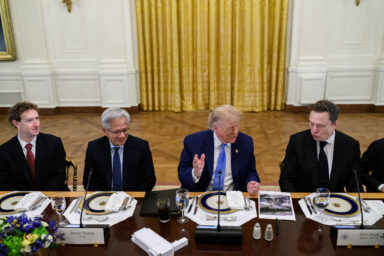
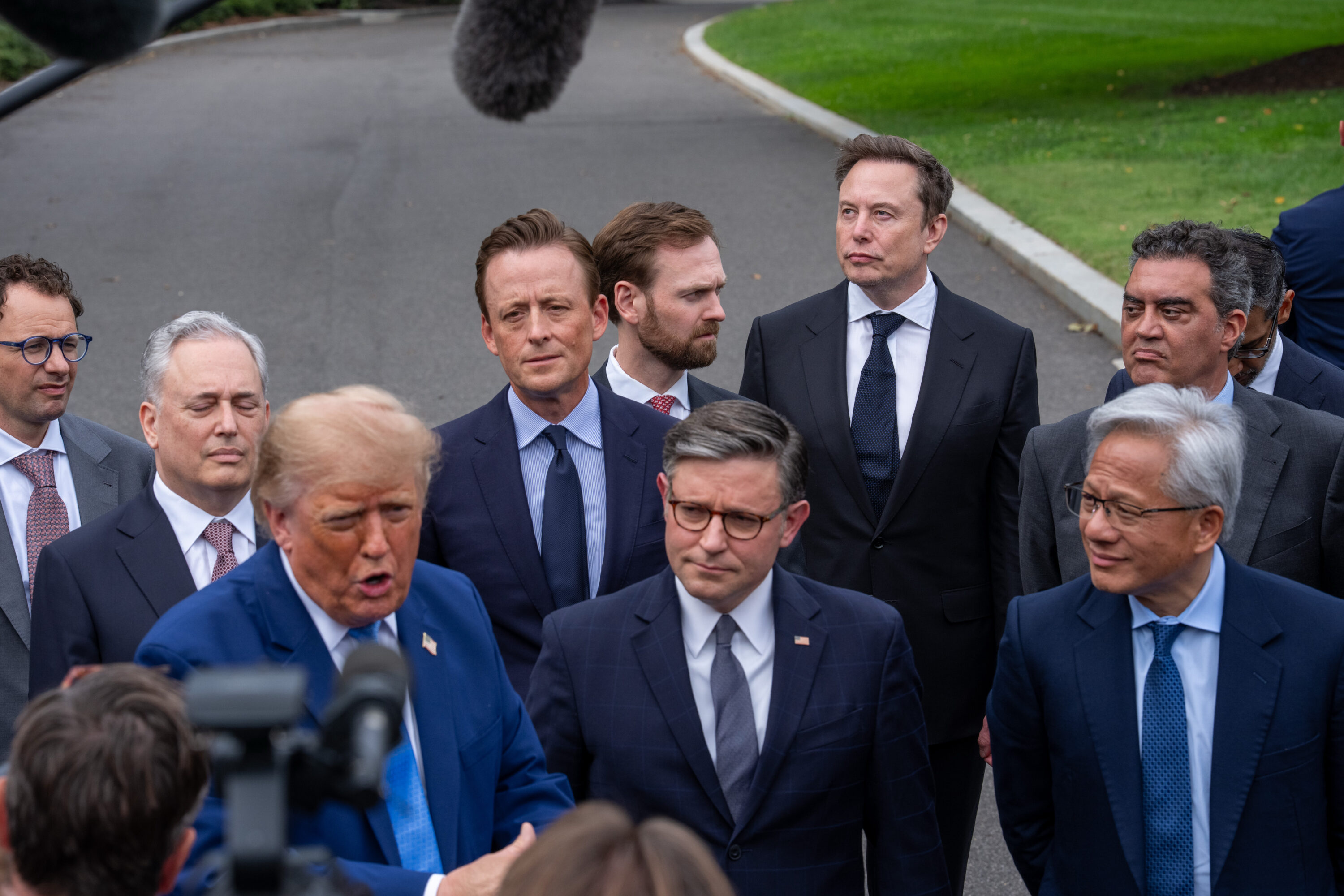
The most significant development was undoubtedly a “White House Accord” on AI, which outlines “four layers of controls and audits” and was signed by the president and executives of Google, Meta, OpenAI, Anthropic, Nvidia, and xAI, aka the guys trying to make billions of dollars off costing millions of Americans their jobs.
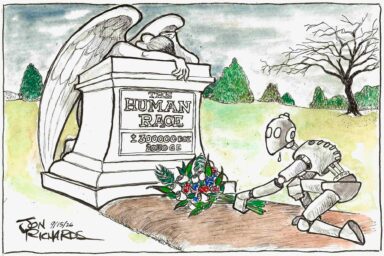
Even though some of them (although not Trump) have expressed great concerns that their technology may wipe out humanity in the next decade, the seven men agreed that no regulation is the best regulation for AI.
To be fair, the president suggested that the document would be “morally binding.” We’ll leave it up to Americans to decide whether they find that reassuring in light of the fact that some of the signatories to the agreement are Trump, Elon Musk, Mark Zuckerberg, and the Anthropic guy who keeps saying that the technology needs to be slowed down or else.
Instead of actually binding constraints, they want to “implement robust internal controls to monitor the capabilities and alignment of [their] models during training and deployment around areas like cybersecurity, biosecurity, and chemical threats, and to ensure that [their] models do not hack or access technical systems in unintended ways.”
Of course, that last part already seems to happen routinely, so whatever safeguards are currently in place clearly aren’t working.
Next, the accord outlines the creation of an “internal team to ensure all of the controls, monitoring, and detection are operating as intended, and that any issues are remediated.”
There is supposed to be an “independent external auditor or evaluator” with the task of assessing that the mechanisms the companies put in place to police themselves are working.
Finally, there will be an “independent committee” consisting of the boards of directors that will receive reports from the self-police force and the auditors.
Essentially, this is like asking Russia to make sure it doesn’t commit any war crimes in Ukraine, or telling toddlers they are responsible for keeping an eye on their own sugar consumption and screen time.
While the accord states that “these steps will give each company, its customers, and the public confidence that the technology is operating as intended,” we wouldn’t be so sure about that.
Polling shows that the public is incredibly skeptical of AI and of the executives who signed onto the agreement. This distrust is especially prevalent among young people, who arguably use and understand the technology the most.
Therefore, we doubt that the concerns of Americans are assuaged by an agreement stipulating that the industry should just police itself.
That being said, not all artificial intelligence is bad, which brings us to America.gov.
Trump unveiled the website at an event earlier on Tuesday, and it seems to be working just fine.
We gave it a test drive, and it correctly stated that inflation is higher now than it was when Trump took office, told us where to find the Epstein files (at least those the Department of Justice isn’t keeping hidden), identified Joe Biden as the winner of the 2020 election, and informed us that only Congress has the power to set the name of federal departments (which may come as a surprise to an administration that has spent tens of millions of dollars on illegally renaming the Department of Defense the Department of War).
While America.gov reached its limits when asked which commander in chief had enriched himself the most during his time in office (although a review of public filings would show it is Trump, who made more money in 2025 than all other presidents combined), it correctly identified the current occupant of the White House as the only felon to have ever been elected to that office.
Speaking of that guy, he is really trying to take his love for renaming things to another level.
Trump concluded a busy day by issuing an executive order directing the federal government to replace the term “artificial intelligence” with “super intelligence.”
While we are certain that his main sycophants will give this a shot, we are just not sure that this is going to catch on.
It will, however, create additional costs for US taxpayers. Those, according to the executive order, will be borne by the Office of Science and Technology Policy, which makes sense. After all, it will be saving money by not having to police artificial intelligence since Claude, ChatGPT, Gemini, and Grok will take care of that.