Trump’s Infatuation With Naming Stuff Has One Major Advantage
What's in a name? In the case of the presidential rebrand of "artificial intelligence," it's the whims of a megalomaniac and the shameless sycophancy of those trying to stay on Donald Trump's good side. But at least we get to find out who they are.
|
Listen To This Story
 |
Donald Trump is not only obsessed with putting his own name and likeness on everything from buildings and money to passports, but also with having the power to rename things — like the Department of Defense, the Gulf of Mexico, and Lake Ontario. While that may appear childish, his latest effort to rebrand something has one massive benefit: It allows us to identify the lickspittles who will do anything to curry the president’s favor to gain an advantage for themselves.
We are talking about Trump’s ridiculous campaign to change the name of “artificial intelligence” (AI) to “super intelligence” (SI) that culminated in an executive order to that effect last week.
Artificial intelligence is such a widely used and well-established term that changing it based on the whims of an old megalomaniac is akin to proclaiming that “vegetables” should henceforth only be known as “greenfood” or that a “ballroom” is a “military complex.”
It’s absurd.
The upside, however, is that persons or companies that now use “SI” can be dismissed as bootlickers who will do anything to get on the president’s good side.
And there are plenty of them around in the tech world.
Like this guy.
No more AI
SI
It’s better— Elon Musk (@elonmusk) October 4, 2026
Elon Musk announced on Sunday that the name of the AI division of SpaceX will be changed to SpaceXSI.
Does that make sense? Of course not. Corporate rebrands usually involve some sort of triggering event — like when cigarette maker Philip Morris became Altria after having to pony up billions of dollars for knowingly killing its customers — followed by extensive deliberations, highly paid consultants, focus groups, etc.
Not in this case.
Here, all that happened was that a thought rattled around in Trump’s head for a while before it was turned into a Truth Social post.
And, because nobody at the time had the good sense to just tell Natalie to print out a fawning article to distract the president, now everybody in his cult and any executive who wants to stay on his good side has to say “super intelligence.”
Musk, who is no stranger to renaming things just because he has a favorite letter, is only one of them.
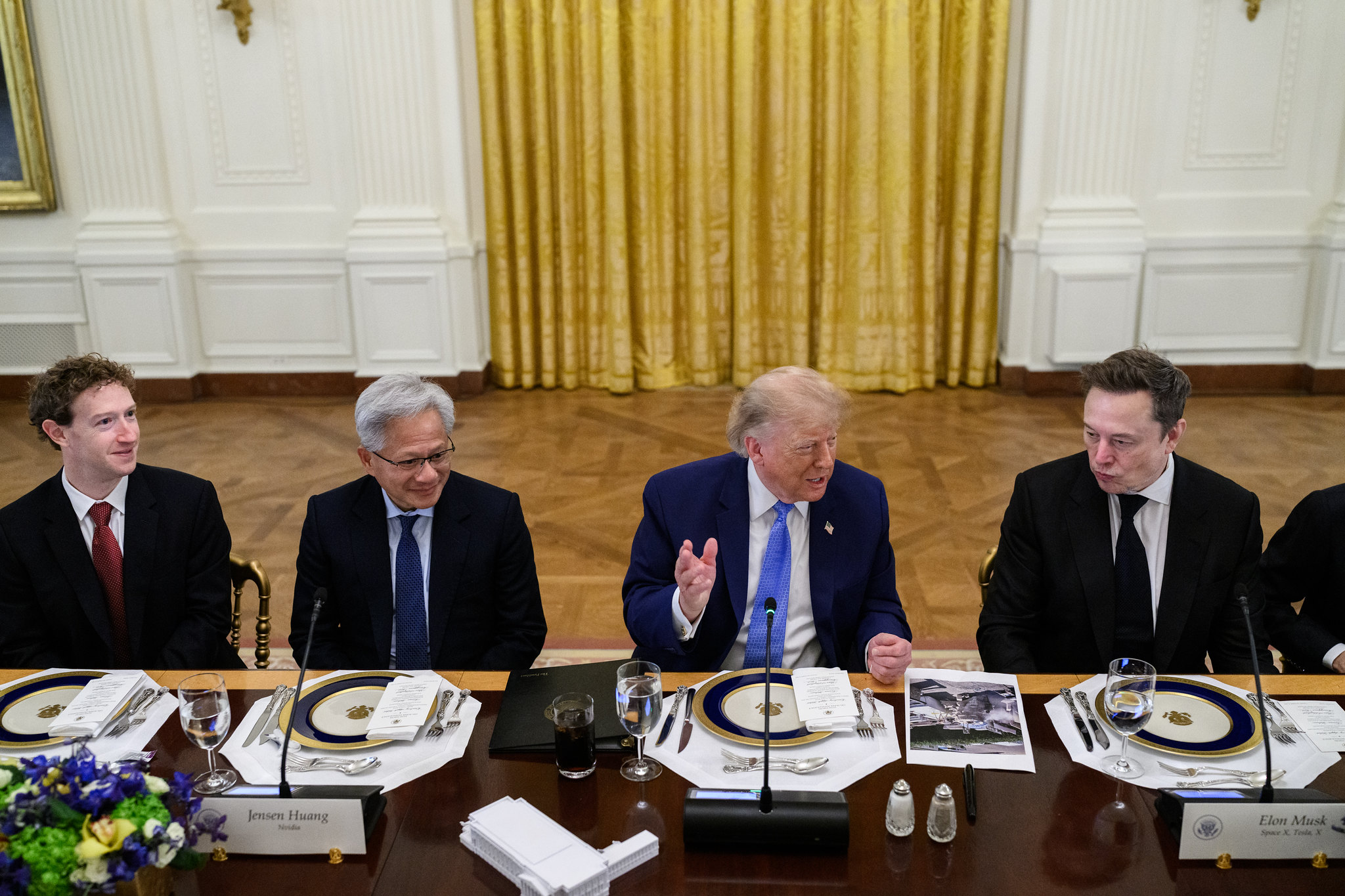
He was actually beaten to the punch by Nvidia CEO Jen-Hsun “Jensen” Huang, who liberally used the term “super intelligence” in a tweet.
“Super Intelligence offers an extraordinary opportunity to advance discovery, productivity, security, health, and prosperity,” he wrote.
While that prosperity part won’t be true for the millions of people losing their jobs to a machine in the coming years, it seems like it will be for the tech bros foisting AI upon the rest of the world.
Which brings us to Mark Zuckerberg. The CEO of Meta, formerly known as Facebook, formerly known as The Facebook, has also been using the term, which makes sense because he is never far away when a presidential backside needs to be kissed in return for a payday.
All of these tech executives have good reasons to butter up Trump. Well, maybe not “good,” but certainly “self-serving.”
Last week the trio were among others who signed an agreement with the president that gives the industry all it wants — i.e., no checks on developing a technology that, if it does what they promise, will disrupt the economy in unprecedented ways, and, if it doesn’t, is going to crash it.
Or, of course, if the predictions of some of the people who are getting rich off of AI come true, it may annihilate humanity in the next decade.
Come to think of it, that doesn’t sound super at all.