Your Field Guide to the New Tech World
Our intrepid correspondent braves Silicon Valley so you don’t have to.
|
Listen To This Story
 |
Although a long-confirmed East Coaster, I find myself drawn back to my California roots and the natural beauty, the idyllic weather, and the sense of unlimited possibility the Golden State has long represented. And now I spend an increasing amount of time in the new Land of Oz — Silicon Valley.
It is now arguably the pulsating center of the world, where a crazy revolution seems to be taking place overnight.
WhoWhatWhy is obviously not Wired, nor The Wall Street Journal. We’re not far from being certified Luddite politics-and-philosophy nerds, and we have drag-em-out debates on whether to fight artificial intelligence, embrace it, or just give up altogether. So if you’re looking to get a leg up technically, or you want tech stock investment advice, I’m not your guy.
However, what I can do is sniff around and report back impressions. Wherever I go, I like to walk around, trying to sense, from little things, what’s happening below the surface — an approach to truth from the outside in.
Here, I wander the gleaming research “parks,” haunt the sports bars, inveigle myself into backyard soirees, and ride the plentiful public transit — buses, streetcars, rapid transit, trains, ferries, plus the bizarre yet dependable self-driving cars.
And I talk to a lot of strangers.
This clearly rattles people in public places because so many here are heads-down, “grinding” on their tech work, and because being sociable and chatty seems to be going the way of the print newspaper.
Though bringing a New York style of inquisitiveness and outgoingness (some call it “pushiness”) to this environment surprises people, in enough cases it works, and I end up having unpredictable conversations that provide me with a number of insights.
Let me pause now to tackle a note from a colleague who tells me she is perplexed by my portrayal of New Yorkers:
We are notorious for having a “get outta my way” attitude. “What’re you lookin’ at?” The tourist who asks the New Yorker, “Could you tell me where Battery Park is, or should I go f*** myself?” Not very open to conversation with a stranger, let alone starting one. Of course we are much more friendly and helpful than we’re reputed to be, but still…
To be sure, I’m just making up an idealized kind of New Yorker. And yet — whenever I travel, people tell me how friendly they find us, so I’ll go with that. Of course, like the cinematic representation of the New Yorker, I can also be a bit of a p*ick when necessary.
One day, while staying in the heart of the tech wonderland, I used the nearly free Palo Alto Link rideshare app to secure a ride; a Tesla (driven by a fellow who barely spoke English) picked me up and deposited me at the Stanford Research Park, a vast area on the northern edge of Stanford’s land, where all manner of technology firm and think tank is holed up, doing who knows what. (SRP, according to my new friend AI, is “700 acres, 10 million square feet of office, lab, and research and development space across 140 buildings, housing over 150 companies and approximately 30,000 to 35,000 employees.”)
I entered the modern glass and steel Coupa Cafe where Mexican workers dish out arepas and salads to ravenous graduate students, inventors, and venture capitalists cooking up deals over Zoom calls.
Nobody was talking to anyone they didn’t work with, but I occasionally tried to strike up conversations with work-obsessed folks deeply buried in whatever they were doing.
Some eyed me with suspicion or even mild panic. Like maybe I’m a mad bomber, a child molester, an idea thief, or, Horrors!… maybe someone asking for money!
On the other hand, a lot of the tech kids I meet are routinely described as being on the spectrum, or autistic. I have no idea, but it’s not always easy to make conversation with them, even if they’re not glued to a screen.
A twentysomething friend of mine occasionally hosts picnics where younger associates are exposed to old fashioned games like relays and the bean bag toss known as cornhole. When I attended one, I would introduce myself and try to start a conversation. Some could barely summon a few words, and a couple literally turned around in the middle of my sentence and walked away. And these are college graduates building our new world.
Nevertheless, hints of what feels to me like a normal life can be found. You’re expected to bus your own dishes, and put things in the bins marked recycle, compost, or landfill. I’m never entirely sure what goes where.
But it’s worth reflecting that the high-tech geniuses wolfing down their tofu tacos, or stuffing paper cups into the designated bin are the Future of the World. The reincarnation of the Gold Rush of 1849.
While these people in down-dressed (or dressed-down) designer duds bear little resemblance to the grizzled miners who found gold in them thar hills, they’re smart, they’re working hard, they’re thinking up cool things, and very very few of them are… MAGA.
***
Another great way to get a sense of where the relentless digital whirlwind is headed is to show up for some of the endless number of events in various specialized venues.
One evening I showed up in a cavernous, nondescript space on the Stanford campus where people with advanced degrees and genius-level IQs dined on greasy finger food.
This was what is styled as an “intellectual salon,” where strangers get together and say whatever is on their mind. Most of the folks were young, a lot were awkward — really awkward, befitting the cultural graces of the hyper-digital age — but here they were, with their obscurely messaged T-shirts and askew hair, trying out wacky ideas that had wormed into their brains, and trying, perhaps, to make friends in a place where that’s even harder than everywhere else today.
Their musings — ranging from far-out philosophical concepts to new visions for next-gen robotics — made your brain feel like a freshly mulched garden.
Silicon Zombies
Last Thursday night I attended a talk at a posh boutique hotel in nearby Menlo Park, given by a leader in medical technology and hosted by a podcast with the great name Silicon Zombies. Almost everyone there was eager to learn, network, and get their new app funded. During the Q&A, some turned their “question” into a chance to pitch their creation.
Medical tech is certainly hot, and more approachable than some other AI-powered disruptions. If a lot of humans are going to be made redundant — as we know they (or we) may soon be — at least we can take comfort in getting our prescriptions filled, instantly, online; making or breaking appointments with a tap of a finger; and, oh — maybe deploying a wearable device to detect diabetes risk or an app that can diagnose and prescribe a personalized cure for an impending life-or-death illness… by analyzing our voice.
At the Thursday event, the speaker, Daniel Kraft, a likable physician-scientist-tech-innovator whose business card says “Democratizing the future of medicine and extending healthspan,” talked about a lot of things that are coming, or likely on their way, including the ability to 3D print at home a single pill that includes all those pills we normally take separately. (Most pills are made up of filler, so apparently we could combine the active ingredients of a whole handful of them into a single easily swallowed capsule or tablet.)
At a $120 per plate dinner following the talk, a bunch of “founders” randomly pitched anyone who looked like potential investors (or were they other founders?) — and swarmed the self-described “VCs” (venture capitalists) and bankers — on the latest “miracle” cures backed by what sure sounded like solid credentials for anything and everything, from osteoporosis to cancer. Many recounted their string of failures, and how their willingness to keep going back to try again is itself a bankable credential.
A day earlier, I had hosted my own salon-ish thing (“buy your own drinks — guac and chips on me”) at a public market/food hall in Los Altos, one of the wealthiest communities in America, and invited a broad mix of random people I’d met, none of whom are billionaire-ish oligarchs, as far as I can tell. Though you cannot always tell.
At such events, I always try to include a diverse mix of ages (19 to 90 or so), ethnicities, jobs, and interests, and I’ve found that folks seem grateful for the opportunity to make new friends in an environment where hard-core pitching and networking is eschewed.
Among those attending were twentysomethings from hot workplaces like Nvidia and Apple, and early Silicon Valley pioneers, whom time and success have mellowed — and who frankly seem bewildered by where things are going and how fast they’re getting there. One tells me he remembers when “the Valley” was mostly a friendly place where you mainly did business with people you liked. Another was an inkjet entrepreneur and longtime Tesla owner who last year distributed bumper stickers that say “I wouldn’t buy a new Tesla because I’m not a Nazi.”
One Valley veteran at the ripe old age of thirtysomething explained to me that you can now divide the Northern California tech contingent into two geographic moieties. One — including most of those doing the coding for AI — is up north, in San Francisco. The majority of these coders are roughly 15-20 years old, he said, and maybe only 20 percent are “white American” — with the rest being from abroad or, like himself, Asian American.
While the AI coders are largely in San Francisco, most of the money for startups is raised and invested down the peninsula, in Palo Alto and the surrounding wealthy towns. What these two groups share — along with assorted founders, scientists, and marketers — is that they are well situated to survive the coming labor apocalypse.
Of course, there are layers and layers to this new aristocracy, and gaining access to the higher levels is not easy. Most of the big-money people are wary in general, don’t move in wide social circles, and avoid invitations to most events, in part because they are besieged by would-be founders, who, my new friend said, include plenty of people who are “not right in the head.”
Another Valley insider observed that people have “business friends” who are not “real friends” — in the sense that you could let your hair down with them or count on them when things get tough.
As in other high-powered social scenes, ambition and anxiety mingle and clash; players struggle to create a bit of balance in their lives — although the industry is not very accommodating on that front. Some also struggle to do what’s right while doing well for themselves. A fellow passenger in a rideshare told me he has worked for Tesla for a couple of years and that quite a few employees have left because they’re troubled by Elon Musk’s values and behavior.
A Surprising Digression
The Park James Hotel is a fancy boutique hotel located in Menlo Park, CA, not far from the Stanford campus. Its “creative director,” who plays a major role in the Valley’s social and business scene, is a gregarious fellow named Hooman Khalili. Wondering how to spell his name, I pulled up his LinkedIn page. And there I found nothing like what I’d expect in the middle of all this deal making and widget designing. It said:
I am Hooman Khalili, and I am determined to become the voice of the voiceless.
As an Iranian-born artist, I am on a mission to revive the cultural and historical ties between Iran and Israel through my murals. Growing up in the Bay Area after leaving Iran at the age of three, my journey has been shaped by the values of resilience and faith. Raised in a Presbyterian church, I later converted to Christianity, that strengthened my belief in the unification of countries and liberation of Iranian women.
My mission is twofold: to celebrate the ancient kinship between Iranian and Jewish people and to highlight the ongoing oppression of women in Iran. To achieve this mission, I have taken upon myself to paint 18 murals in public spaces and raise awareness of Iranian women’s oppression. Through these murals, I aim to inspire Iranian women to keep fighting, showcase Jewish solidarity with their struggle, and remind the world of the 3,000-year-old friendship between Persians and Jews.
Since embarking on this journey, I have painted 13 murals across Israel, collaborating with local artists to bring these powerful narratives to life.
My murals serve as voices for the silenced, telling stories of defiance and hope. Each brushstroke is a testament to the courage of Iranian women and the strength of the human spirit.
I am dedicated to this cause and believe I am destined to bring these stories to light. However, this mission requires support. Funding this initiative alone, I can help it grow to a limit but with your help, it can grow, reach and save millions.
Visit my website to know more about the campaign and join me in this rebellion for justice and equality. Together, we can change the narrative and bring these vital stories to the forefront.
Silicon Valley is full of surprises.
Tech vs. Pope
You’ve undoubtedly followed Pope Leo XIV’s cautionary encyclical on AI. A number of prominent tech people responded to his warnings with a dismissive it ain’t up to him. Some are openly hostile, noting that religion itself has no evidentiary basis. Which is certainly true, though I’d argue that some of the rhetoric touting the new technology sounds more “prophetic” than pragmatic.
If we cannot expect our religious/moral leadership to force a collective reckoning with where we’re headed, can we count on our government officials? If we ever had confidence that Washington would protect us, the Trump gang has pretty much dispelled that. Every day we see new examples of why we shouldn’t expect a rescue, or even a minimal standard of sanity — the latest instance being the performatively macho Health Secretary Robert F. Kennedy Jr. scooping up a bunch of snakes (and seemingly getting bitten by one of them).
Kennedy also announced that Donald Trump is getting tough on super-dangerous “forever chemicals.” But experts say the administration is actually making it easier for corporations to continue releasing the toxic so-called PFAS.
So no, solutions are not coming from the top — at least probably not for a few years. Somehow, we, the people, have to get organized to save ourselves. More about that in future columns.
The Best Influencers Are… Us
When I can’t figure out what’s going on, when I can’t find the answers in our most vaunted news brands, and when what the self-important “influencers” say strikes me as the thinnest gruel — I turn to… the people themselves.
I regularly see observations and critiques from readers and viewers of the internet’s vast offerings that are as good as, or better than, what the storytellers and experts — i.e., the “professionals” — have to say.
Here’s just one example from a few weeks back, in response to an article about the cruise ship whose passengers contracted hantavirus while visiting small islands in the South Atlantic to observe rare birds.
One Maria Braun read a passing mention that one couple who died from the virus had previously been traveling about rural Argentina in a camper, and had a thought:
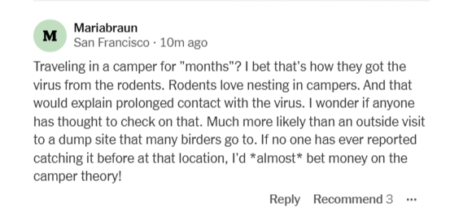
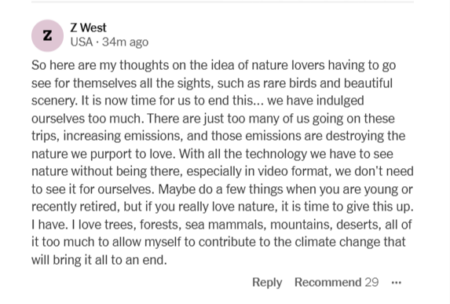
Another commenter, “Z West,” raised the important question of whether exotic tourism is even feasible anymore in the emerging world:
I wonder if one could create a valuable publication featuring the best public comments? Tell me what you think.
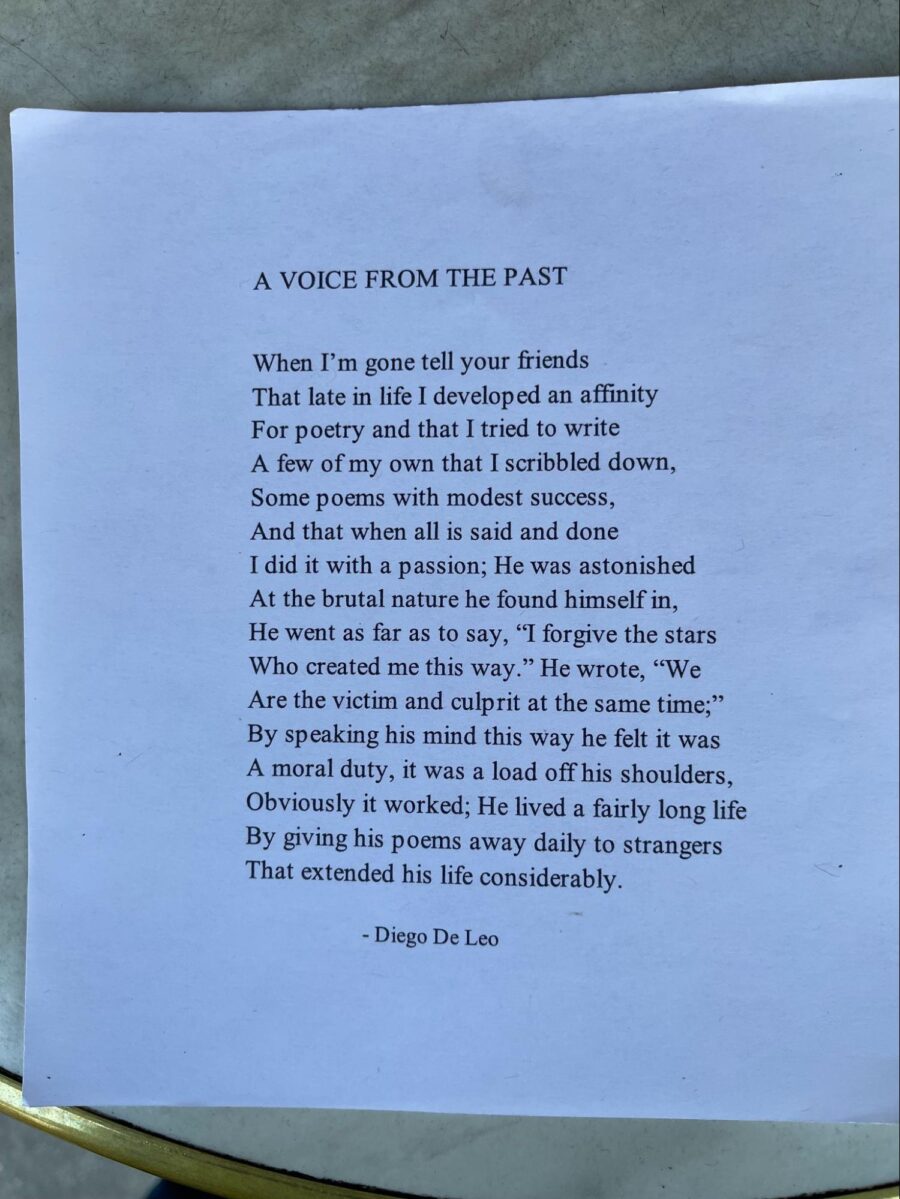
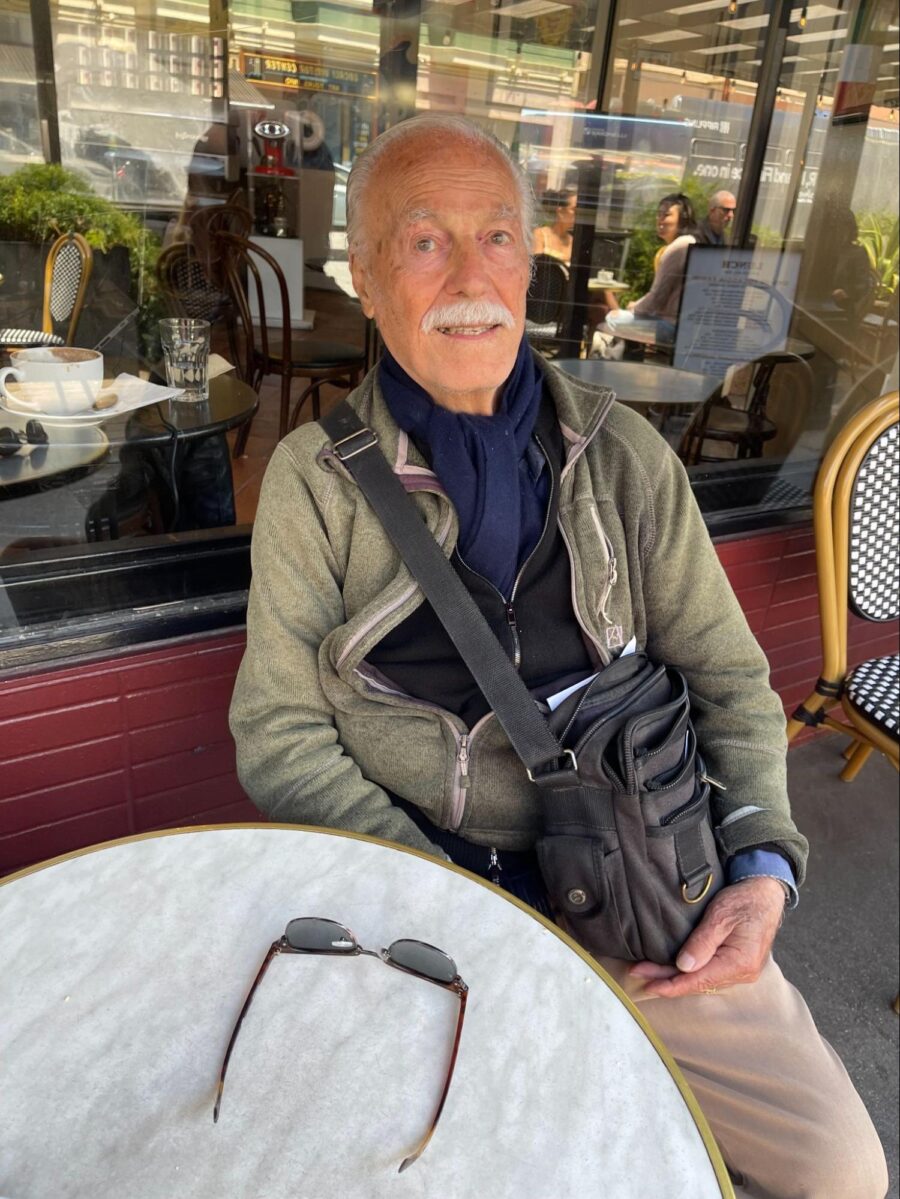
And finally, I recognized Diego De Leo, a dapper, mustachioed gentleman of a certain age, sitting in a cafe in San Francisco’s picturesque and resiliently bohemian North Beach neighborhood where I’d met him last year. He’d shared his poems and we published a few along with a mini-profile. I showed him what I’d written, and he reached into his bag to show me some new poems, one of which I’m pleased to share with you now.
The poet himself.
I also ran into a fellow named Patrick who made this, and I thought you might appreciate it as well: