Why the 10th Anniversary of ‘Black Jeopardy With Tom Hanks’ Matters
Two weeks before Donald Trump was elected for the first time, Saturday Night Live aired a sketch that holds the key to healing the rift between Americans who have a lot more in common than they think.
|
Listen To This Story
 |
The work of Saturday Night Live has become a staple ahead of any election. The show’s sketches often feature impersonators of candidates and government officials, and, thanks to social media, some of them have become iconic.
In 2016, for example, Alec Baldwin’s portrayal of Donald Trump, which was equal parts spot-on and over-the-top, earned rave reviews and the wrath of the man who would go on to win that election.
Just tried watching Saturday Night Live – unwatchable! Totally biased, not funny and the Baldwin impersonation just can't get any worse. Sad
— Donald J. Trump (@realDonaldTrump) December 4, 2016
The skits themselves, however, often went for cheap laughs rather than profound insights masked in comedy — especially when the prospect of a Trump victory still seemed ridiculous.
And, to be fair, that is understandable. Until he got the last laugh on Election Day, when he overcame a popular vote loss and managed to crack the “blue wall” with the help of just enough working-class whites without college degrees, Trump was a cartoonish figure.
Ahead of the election, you can tell that the SNL writers felt there was no way this clown would win… until he did, and the joke was on them.
In retrospect, knowing what was to come both then and now in Trump’s second term, a lot of the sketches seem quaint and naïve.
One, however, has not only withstood the test of time but also offers lessons for tomorrow.
Exactly 10 years ago today, SNL aired “Black Jeopardy With Tom Hanks,” who was hosting that episode.
The skit is the fourth installment of the “Black Jeopardy” series, which spoofs the popular quiz show and imagines what a spin-off geared toward African American audiences would look like. In each episode, two stereotypically Black competitors square off against a player who doesn’t fit in — e.g., a Caucasian professor of African American studies at Brigham Young University; a white woman who “dated a Black guy once”; and T’Challa, the king of the fictional African nation of Wakanda.
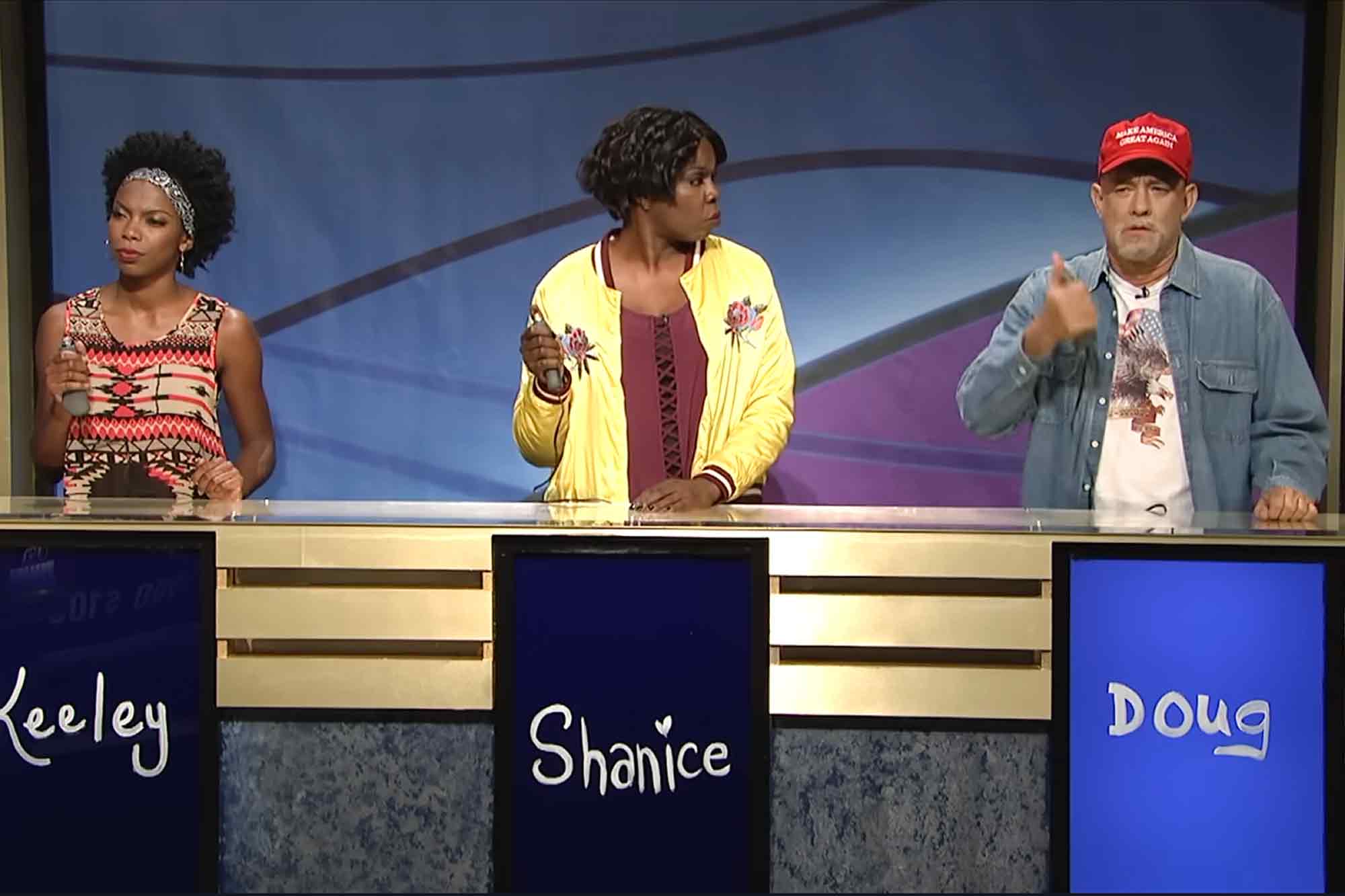
In this episode, Tom Hanks portrays “Doug,” a working-class white man wearing a “Make America Great Again” hat.
The skit begins with host Darnell Hayes, played brilliantly by Kenan Thompson, questioning whether “Doug” is in the right place.
However, Hanks responds that he heard that he could win some money on the show, so “get ‘er done.”
While the three contestants initially eye each other with suspicion, the twist of this episode (as opposed to the previous three, in which the odd person out is clearly in over their head) is that Doug actually fits in really well.
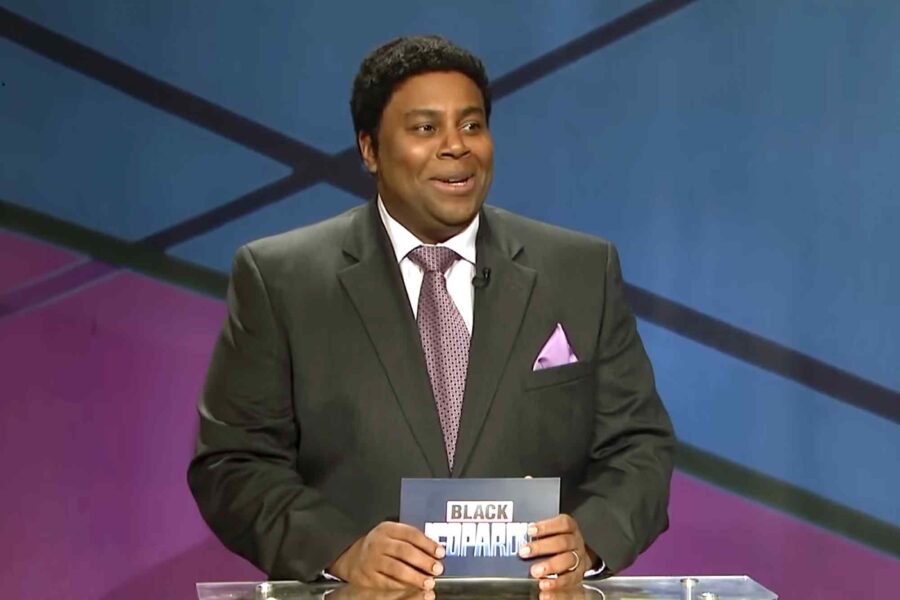
Photo credit: Saturday Night Live / YouTube
First, he professes that he plays the McDonald’s Monopoly Game every week before correctly responding to the clue, “They out here saying the new iPhone wants your thumbprint ‘for your protection’” with the question: “What is: I don’t think so. That’s how they get you.”
That answer immediately gets the other contestants — “Keeley” (Sasheer Zamata) and “Shanice” (Leslie Jones) — to warm up to Doug.
A little bit later, when the clue is, “They out here saying that every vote counts,” he buzzes in again and answers, “What is: Come on, they already decided who wins, even before it happens,” to the enthusiastic approval of the host.
Doug further endears himself to everybody when he states that he loves Tyler Perry’s Madea movies.
“You know, I gotta tell you, I love those movies,” Hanks’s character says. “I bought a box set at Walmart, and if I can laugh and pray in 90 minutes, that is money well spent.”
This gets the host to want to shake hands with Doug, who first gets scared, moves backwards, and puts both of his hands up.
Later, when the clue is, “The mechanic says you owe me $250 for new brake lines,” Doug again hits the buzzer and answers, “You better go to that dude in my neighborhood, he’ll fix anything for $40.”
This gets the host to ask whether Doug knows Cecil, to which Doug responds that his “Cecil’s name is Jim, and he fixed my refrigerator, my air conditioner, and my cat.”
That, in turn, gets Darnell Hayes to proclaim, “Wow, you alright, Doug!”
For his part, Hanks’s character notes, “You people are fun. Can I say that? Is that okay?” to which the host responds “We’ll give you a pass this time.”
Finally, when Doug later says that skinny women can’t do “a damn thing” for anybody, he even gets applause and a high five from the other contestants.
Unfortunately, all good things must come to an end. In this case, the final category is “Lives that Matter,” which gets the host to laconically state “Well, it was good while it lasted, Doug.”
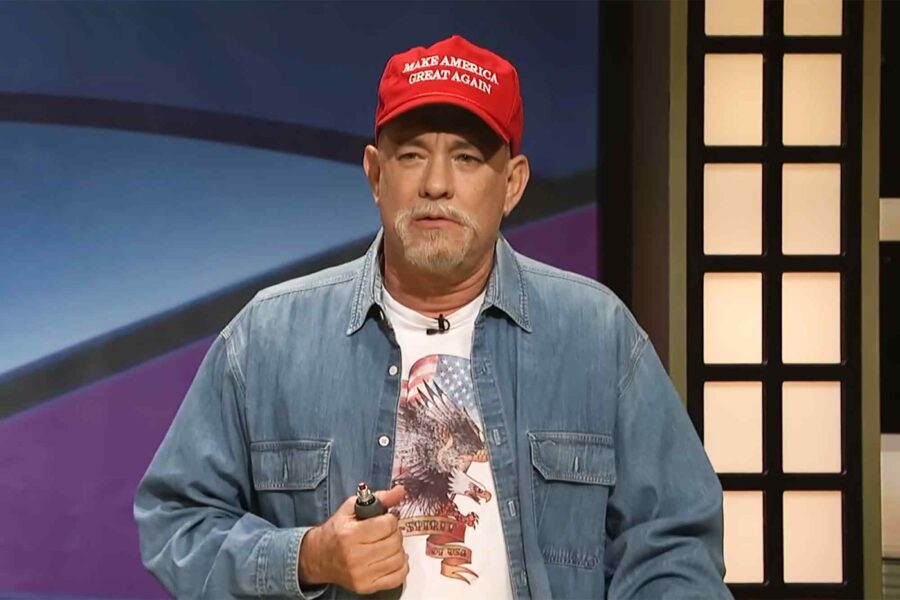
Photo credit: Saturday Night Live / YouTube
He then cuts off Hanks’s character, who says, “I got a lot to say about this,” by stating, “Yeah, I’m sure you do. When we come back, we’ll play our national anthem and just see what the hell happens” — a reference to San Francisco 49ers quarterback Colin Kaepernick, whose career ended after he knelt during the playing of the anthem ahead of NFL games.
While the sketch was ostensibly making fun of blue-collar Trump supporters — i.e., the people who would propel him to victory less than three weeks after it aired — it reveals a deeper truth that is relevant for anybody who wants to win an election now and in the future: There is a lot more that unites those at the bottom of society — which is rapidly expanding as a result of a widening wealth gap and unbridled greed — than divides them.
And the worst nightmare for those at the top is that everybody else realizes that.
“Doug,” for example, has a lot more in common with the other contestants and the host than with Trump or anybody in his administration. To them, he is a useful idiot, and someone whose prejudices can be exploited for their own gain.
At the same time, many Democrats look down on people like the character portrayed by Tom Hanks in the same way that Republicans loathe “others,” such as people of color, non-Christians, or members of the LGBTQ+ community.
It’s that mindset that plays right into the hands of the rich and powerful who really run the country.
To them, the worst thing that could happen is for Doug and Shanice to realize that they are being pitted against each other, and that their biases and prejudices are stoked to prevent them from closing ranks.
The bad news for America is that this strategy has worked so far.
The good news is that more and more people are recognizing that government corruption, which prioritizes the desires of billionaires over the needs of regular people, is one of the nation’s most pressing issues, and that rising prices or the threats from artificial intelligence affect all the Dougs and Shanices equally.
The only question is whether they realize this before it is too late.