Donald Trump Is the Quintessence of Ruthless Capitalism, and He May Be Its Doom
We’ve seen that everything Trump touches dies, but is the capitalism cat on its ninth life?
|
Listen To This Story
 |
The world abounds in threats, including existential ones, but the Republican Party, facing a humiliating defeat in the midterm elections this November, has chosen to hang its chances not on ending the senseless Iran war, or finding a way to improve affordability, or regulating artificial intelligence.
No. Instead they are dragging out the old McCarthyite favorites: the looming threats of Marxism and communism and socialism, even though these have lost most of their sting since Old Joe bellowed about them 75 years ago and tried to sow distrust throughout the land.
Never to be left out, Trump in one of his new ads, paid for by the American taxpayers, promises to protect the country from these perils. America will never be communist, he solemnly intones, as if there we were facing an impending communist takeover rather than the current fascist one.
Old habits die hard, and so do old platitudes. It has long been an article of faith among conservatives and Republicans that capitalism and freedom go hand-in-hand, and that the first is a necessary prerequisite for the second. Without capitalism, so it goes, democracy dies.
Near the end of World War II, the philosopher-economist Friedrich Hayek, in an effort to explain the sources of Nazism, attributed its rise not to any defect in the German character or to any sociopathic cultural proclivities, like antisemitism, but to the evils of socialism. It was socialism, he wrote in The Road to Serfdom, that perverted the German soul by putting the means of production in the hands of the government. Socialism, he posited, inevitably breeds totalitarianism while capitalism breeds individualism.
“When economic power is centralized as an instrument of political power,” Hayek wrote, “it creates a degree of dependence scarcely distinguishable from slavery.”
In many ways, that sentence may serve as the very basis of modern conservatism and of modern Republicanism, as well as the basis for the contention between Republicans and Democrats. Because while Hayek posed as a fierce opponent of totalitarianism, it was really the New Deal that he feared and opposed — not socialism but liberalism. For him, any kind of government interference with free markets, even the relatively mild benisons that Franklin Roosevelt introduced to mitigate the harshness of the Depression, were steps down the slippery slope to dictatorship.
Idiotic as that is, where Hayek led, conservatives have followed, with the same ridiculous warning that slavery awaited those who looked to the government for solace. Hayek’s heir, the economist Milton Friedman, turned free markets into a panacea for any and every economic ailment, and was sainted among Republicans for doing so. And in a more unintentionally comical and loony vein, the self-styled philosopher Ayn Rand, who would become the high priestess of Republican economic nonsense, popularized the idea with her bloated melodramatic novels featuring manly men eschewing anything that threatened to restrain their boundless individualism.
Most highschoolers outgrew Rand, but not the Republicans. Republicans continued to extol economic individualism and vilify any efforts by the government to moderate the hurts of free-market capitalism. They still do.
But whether we realize it or not, this wacky combination of economics, individualism, alarmism, machismo, and Christianity, the last of which Hayek threw in for good measure, has not only been the basis of Republicanism, but of American economics generally — or at least of most Americans’ understanding of economics.
It goes like this: Ours is a proudly capitalistic nation. Anyone can make it here if one has tenacity and discipline — which, not at all incidentally, means that each of us is responsible for his or her own economic fate. Government is always an intrusion into our lives, not a means of ameliorating the harms of life.
Of course, none of it was true — not then, when Republicans first purveyed it, and not now. One had only to look at the Great Depression to see that the vast majority of Americans were in no way at fault for the demise of the economy. Rather, this economic narrative was Republican brainwashing — brainwashing by the wealthiest and most powerful Americans, who stood to gain from it, even as ordinary Americans largely lost from it. But, false or not, it was successful — so successful that the mere mention of socialism made most Americans quake.
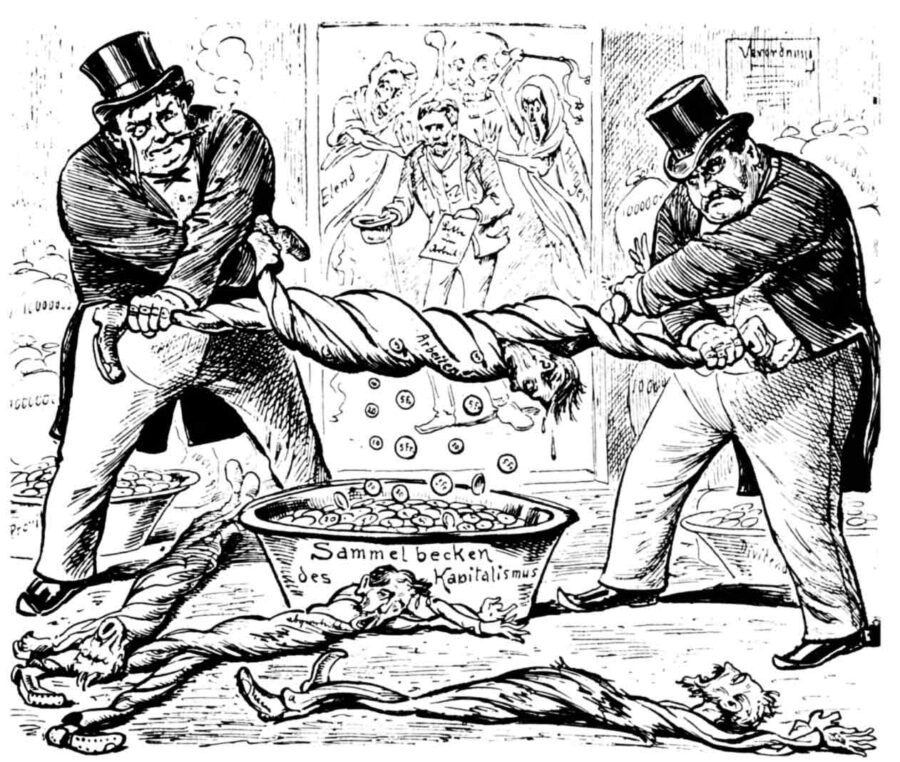
It didn’t matter that capitalism seldom delivered on its promises. Americans accepted the blame the wealthy thrust upon them. They passively settled for crumbs while the rich ate the cake, because they were told that was how the market worked; it rewarded the deserving and punished the undeserving. It was un-American to believe otherwise.
And so it has been since the New Deal. Republicans were the heroic capitalists. Democrats were the dreaded socialists.
Something New and Different
But something has happened in the last year — something rather amazing, though little noticed and remarked upon.
The pundits look at the hardships inflicted by the Trump economy and see economic dissatisfaction, not terribly different from the dissatisfaction Americans expressed toward Joe Biden’s economy when inflation hit. People complain about the price of groceries and the price of gasoline, as they did then. They say that their wages can’t keep pace with inflation, as they did then. The University of Michigan consumer satisfaction index sinks, as it did then. Again, it is all fairly familiar.
And yet it isn’t — not this time. Consumers are not only complaining about the current economy; polls show that they also have little expectation conditions will improve for them. For several years now, surveys have indicated that parents also have no expectation that their children will enjoy the same economic benefits they enjoyed.
The gap between the richest Americans and everyone else continues to grow, as The Wall Street Journal, of all publications, just pointed out this week. We live within the unfairness.
And then there is this: A new Gallup poll reports that 43 percent of Americans now have a favorable view of socialism.
Further, in another Gallup poll last year, more Democrats had a favorable view of socialism than of capitalism, and in the recent Gallup poll cited above, 57 percent of Gen Zers, ages 18–34, viewed socialism positively, while a CATO Institute poll put the number at 53 percent. This is literally unbelievable.
How much of it has to do with grievances against capitalism and how much with the appeal of socialism is impossible to say, though one might guess it is more the former than the latter.
Which brings us, as most things do, to Donald Trump.
Capitalism’s Avatar Queers the Pitch
In many ways, Trump seems the very quintessence of capitalism. He seems largely motivated by self-aggrandizement and greed, the latter of which puts him squarely in the capitalist camp. And, in fact, many of those who voted for him professed to do so because he was a businessman who was thought to understand the mechanics of economics; and some, no doubt, voted for him out of a sense of admiration bordering on adoration because he claimed he knew how to game the system and make capitalism work for him. (Only “suckers” pay taxes, he insinuated.)
One of his big promises was that he would remove the shackles of government regulations from business, and a Golden Age would ensue. Remember that?
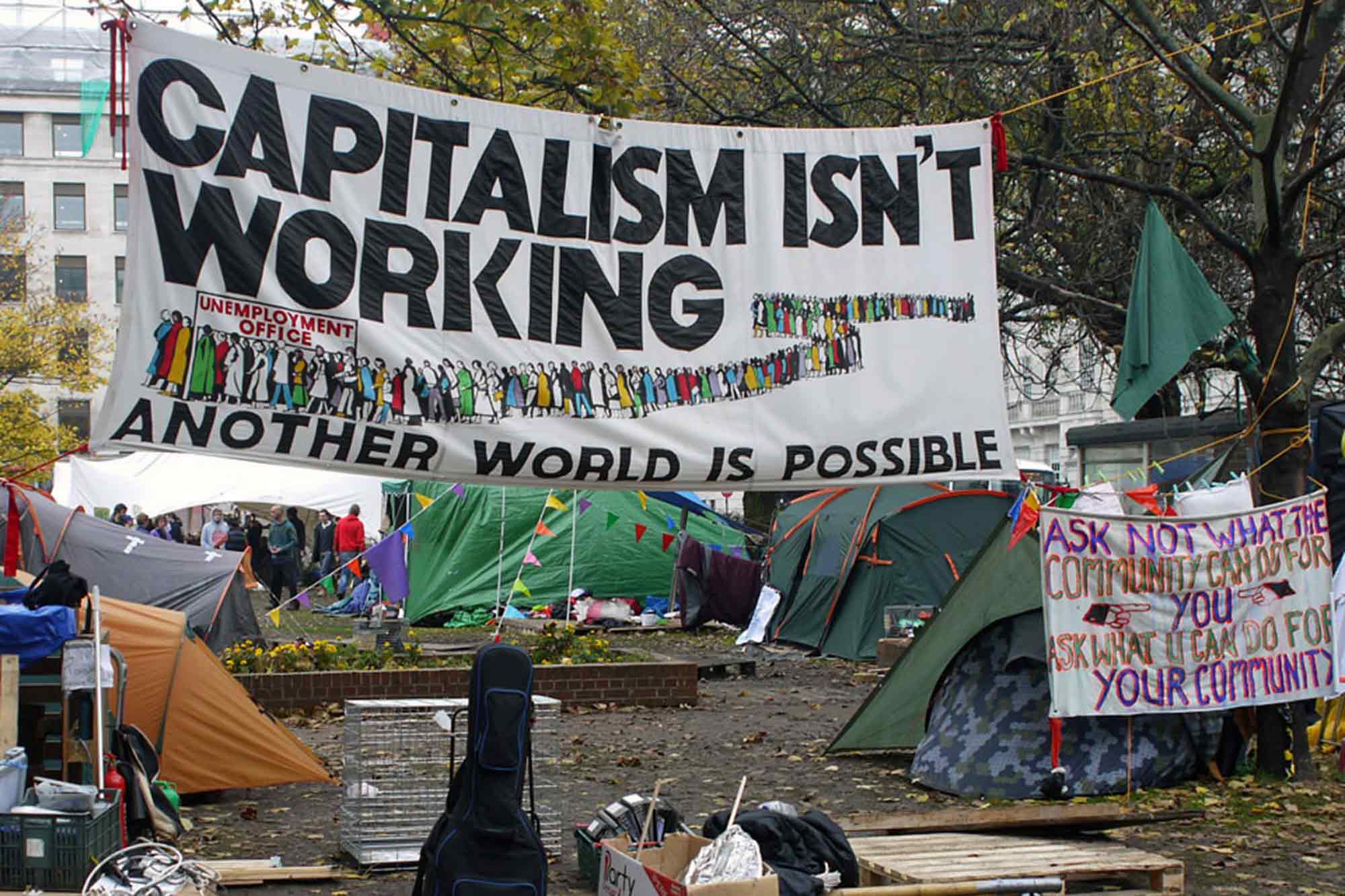
This isn’t your ordinary set of consumer gripes about an economy that isn’t working for them. This is larger — much larger. This is America finally tossing away the Hayek/Republican formulation that really had kept Americans in a form of bondage. This is America saying that capitalism isn’t what it was cracked up to be.
But then you fast-forward to 2026 and you get the inflation he was supposed to have tamed on “Day One,” and the bond markets he can’t control, and the unprecedented graft that no longer makes him seem heroic but a chiseler, and his cryptocurrency windfall, and the skyrocketing mortgage rates, and — well, one could go on. This quintessence of capitalism, this walking (or sleeping) embodiment of ruthless, rapacious economics, through his mismanagement and his overwhelming avarice, ends up exposing capitalism’s capacious holes.
So, no, this isn’t your ordinary set of consumer gripes about an economy that isn’t working for them. This is larger — much larger.
This is America finally tossing away the Hayek/Republican formulation that really had kept Americans in a form of bondage. This is America saying that capitalism isn’t what it was cracked up to be. This is America calling for accountability from the oligarchs who command the economy and the political sycophants who serve them, and turning on them when they had once lionized them. This is America insisting that it won’t settle for the crumbs anymore.
One might even say this is an attitudinal revolution that may be the birth pangs of a real economic revolution — a war on the foundational beliefs in our economy.
Or put simply, Donald Trump, the seeming quintessence of capitalism, may have so discredited capitalism that he now could be its doom.
From Adam Smith to Ayn Rand to Donald Trump: The Cruelty Becomes the Point
The reason this matters is that the premises of capitalism and the effects of capitalism have shaped this country every bit as much as have the politics of America, with which they conjoin.
The basic premise, as the 18th-century economist Adam Smith first propounded it, is that the engine of the economy was self-interest — the sort of individualism conservatives would later celebrate. In one of his most famous pronouncements in his classic The Wealth of Nations, Smith declared, “It is not from the benevolence of the butcher, the brewer, or the baker that we expect our dinner, but from their regard for their own interest.” Acquisition drove humanity, and acquisition fueled the economy. There was little or no room for altruism as an economic force.
But Smith then tempered his rather cynical and misanthropic view with his notion, taken from the belief of divine design, that there was an “invisible hand” that controlled the economy and worked to the benefit of everyone in a benign distribution of money and goods. Working in tandem, the self-interest of individuals and the invisible hand, which largely obviated the need for government supervision of the economy, provide an effective management for the whole economic apparatus. This is a simplification of a thousand-page book, but not much of one.
Advocates of capitalism would say, and still do, that self-interest is the great driver of nearly all advances, and that in America particularly, where there have traditionally been few restrictions on personal initiative and on business and where the cowboy ethos prevails, the country has prospered precisely because of self-interest.
The Virtue of Selfishness, Ayn Rand titled one of her books, but it might as well have been the slogan of the entire Republican Party, if they had the guts to put it that way instead of framing it as freedom from the yoke of any supra-individual force, besides, of course, God. In the conservatives’ version, intrepid men, men out for themselves, men who didn’t give a damn about social obligations, Ayn Rand’s kind of men — or, in the latest iteration, white, heterosexual, Christian men — built this country and made it great. Society’s job was to keep out of their way.
While there may be some truth to this idea of the potency of initiative, and while the benefits of capitalism are not to be wholly denied, there is something also obviously pernicious about this view of man and of its description of progress — both beneficial and pernicious at the same time and for similar reasons. Even if one were to accept that self-interest helps drive progress, self-interest unbounded, self-interest without some constraints, doesn’t necessarily lead to freedom, as Hayek and his followers thought, but to the exact opposite — to the Robber Barons of the 19th century, and to the heedless bankers and industrialists of the 20th, and to the tech oligarchs of the 21st, who care so little about the rest of humanity that they are only too eager to put all of us at risk.
It leads to social and economic inequality. It leads to division and despair. It leads not to an efficient society of happy citizens, but to an ugly one in which people really are, in a manner of speaking, enslaved. And it leads to a justification of many of the worst impulses of human character.
One might even contend that capitalism is the ultimate conservative justification for the injustices, economic and otherwise, in this country.
This is not a caricature of capitalism, though it may sound like one. This is how conservatives and Republicans themselves actually think of capitalism, and they have worked hard to keep capitalism itself free of the kinds of controls that would actually make it serve the public good. For them, regulation is a way to harass honest business, not a means to protect consumers from business.
Capitalism at its base is really the economic form of Social Darwinism. Heather Cox Richardson often writes of how the antebellum Southern gentry justified slavery because they saw themselves as superior beings to the slaves. It was natural selection. Capitalism is no different. It also incorporates the idea of superiority, with the wealthy superior to the drones who work for them. Capitalism is a way of rewarding those übermenschen for being über.
But it is even worse than that. It is a way not merely to justify why the few are allowed to hoard the riches, but also a way to justify the cruelty the economic elites mete out to the most vulnerable members of society — which is why conservatives and Republicans extol it.
There is nothing natural about it. They like that feeling of superiority. They like the cruelty.
Cruelty is at the very heart of capitalism. Their leader Donald Trump personifies it.
‘Socialism’ Keeps Rescuing Capitalism
One might think that Americans would have caught on to this scam long ago.
But conservatives, beyond tying capitalism into America’s sense of rugged individualism and thus hoodwinking people into thinking that capitalism was intrinsic to Americanism, have been fortunate that just when capitalism’s missteps and excesses and evils threatened to take down the whole enterprise — the periodic depressions of the late 19th and early 20th centuries, the Great Depression, the Great Recession, poverty generally, and, of course, ongoing inequality — something or someone intervened to save it, sometimes by self-preservation, sometimes by accident, sometimes by ministration of those alleged socialists.
Conservatives vilified Roosevelt as a would-be dictator, but, by introducing government controls that softened the self-interest and substituting a helping hand for an invisible hand, he probably did more to save capitalism than any other American.
In the end, Hayek was wrong, though conservatives refused to admit it. Roosevelt’s interventions didn’t lead to slavery. They led to a better, fairer nation — capitalism lite.
And the mixed economies of most industrialized nations, economies that blend capitalism with socialism, haven’t led to enslavement either. They were every bit as free and as democratic as America — now even more so.
Those economies not only provide advantages like national health care and free education and child care and a strong social safety net, they also provide higher standards of living than America’s, where the capitalist troglodytes still deny Americans those benefits that every other industrialized country has. It was the Republicans’ devotion to capitalism, their invocation of the bogeyman of socialism, that has kept the richest and most powerful nation in the world in the backwaters of social service to its citizens.
And, as I wrote earlier, they are still at it.
In fact, as we can see now, Hayek was not only wrong, he was dead wrong. And even the most devout capitalists would eventually come to agree.
Economic ‘Freedom’ OR Democracy?
It was Donald Trump’s great friend, and JD Vance’s primary mentor, the venture capitalist Peter Thiel, who in the wake of 2009’s Great Recession, admitted what should have seemed like conservative perfidy. Writing in the libertarian Cato Institute’s journal, Thiel emphasized his libertarian bona fides: “I stand against confiscatory taxes, totalitarian collectives, and the ideology of the inevitability of the death of every individual.” In short, he stood for the wealthy.
But then he went on with his startling confession: “I have changed radically on the question of how to achieve these goals. Most importantly, I no longer believe that freedom and democracy are compatible.”
And now the cat was out of the bag. Capitalism may lead to freedom — at least for him and his fellow oligarchs. But it wouldn’t lead to democracy. More than implied, it shouldn’t lead to democracy — because democracy was based on equality, and Thiel and his brethren didn’t see the rest of us as equal to them.
Thiel saying this is one thing. Americans believing that economic freedom and democracy are not compatible is quite another. The latter took someone who so reviled ordinary people, someone who was so shamelessly narcissistic, someone who not only saw capitalism as Social Darwinism in which he was the winner, but also saw it as solipsism in which no one else and nothing else mattered.
It took Donald Trump.
Whether Trump is a capitalist or not is debatable. He might be more accurately characterized as a National Socialist or Nazi.
He certainly believes that untrammeled economic behavior is acceptable, even exemplary. He certainly believes that whatever capitalism lets you get away with, you are entitled to get away with. He certainly believes that the system should be rigged for the wealthy, and that the invisible hand should be stuffing billions of dollars into his pockets. He certainly believes that avarice, at least his, is a good thing. He certainly believes that government should never intervene in the conduct of business, unless it is in the service of adding to his own wealth. He certainly believes that everyone is self-interested — only out for themselves, as he is.
On the other hand, Trump’s capitalism is modified by his own overwhelming self-interest, of the sort Adam Smith could never have foreseen.
Forcing companies to give him a piece of their swag, as he always does, is not really Smith’s notion of capitalism. Slapping tariffs on other nations just to prove he can bully them doesn’t fit the capitalist textbook either. Tyrannizing businesses for his own pleasure, not even for any economic purpose, isn’t capitalism.
Destroying the environment isn’t necessarily averse to capitalism — capitalists do it all the time — but there are countervailing forces that are also capitalist, namely green energy, that Trump doesn’t admit. Basically, he likes the parts of capitalism that enrich him and his ego and feeds his appetite for cruelty; he dislikes the parts that don’t.
Right Out in the Open
But the thing about Donald Trump is that he never really operates sub rosa. He likes people to see his depredations, even when they so obviously work contrary to the public interest. He is a show-off that way. He gloats over his corruption. Even the ordinary monstrosities of capitalism aren’t enough for him. He has to invent new ones.
Most capitalists pretend that they are really social benefactors. After all, they are saving us from socialism. They disguise their selfishness and lack of interest in the general weal. But not Donald Trump. He can’t help himself. If he ruins the economy, if he makes life more difficult for the great majority of Americans, he simply denies he has done so.
And that is the catch.
So when Trump takes graft, it is right out in the open.
When he cuts private deals with the leaders of other nations at the expense of the national interest, it is right out there in the open.
When he steals taxpayers’ dollars, it is right out in the open.
When he directs government contracts to his sons and son-in-law, it is right out in the open.
When his associates use their insider knowledge to cash in on the betting markets, it is right out in the open.
When he steals oil and gold from Venezuela, it is right out in the open.
When Melania seals a deal with Amazon to produce a $40 million movie, it is right out in the open.
When he terminates regulations to stop air and water pollution, to make cars fuel efficient, to protect endangered wildlife, to prevent drilling in national parks, to police anti-corruption, it is right out in the open.
He is lawless. He is valueless. And he thinks we don’t care.
This time, however, he is wrong.
Because here is the thing. You can’t keep wolfing down the cake, if you don’t pass out those crumbs. And Donald Trump is no longer passing out crumbs. Even his promise to give us all $5,000 checks if Republicans win the midterm elections is clearly a lie. Nobody expects them.
The Metastasis of Shamelessness
But here is another thing about Trump and his relationship to capitalism. I said that oligarchs generally tried to hide their greed and peddle themselves as noble. Trump, however, has emboldened them to follow his example. There is a shamelessness to our oligarchs now, too. Trump has given them license to be overtly self-serving — has convinced them that in his obscene version of capitalism what doesn’t matter for him, doesn’t matter for them either.
There may be no more glaring example of capitalism’s new myopia than artificial intelligence, recently renamed “super intelligence” by our president, as if to underscore the Social Darwinian aspect.
By the old capitalist playbook, these oligarchs, now in control of the most powerful and dangerous technology in human history, wouldn’t be held accountable. But they wouldn’t have flaunted it. And, sure enough, now they do.
Reportedly, Meta’s Mark Zuckerberg, certain to be regarded as one of the most evil figures of our time, actually wrote the new “settlement” between Trump and the AI moguls in which those moguls will police themselves!
This, even though some of them admit that AI poses an existential threat to humanity. Not a minor matter, though a minor one, apparently, for them since — as two recent books, Gil Duran’s The Nerd Reich and Naomi Klein and Astra Taylor’s End Times Fascism, report — the oligarchs are already planning ways for them to escape the holocaust they may cause. We die. They burrow into silos or fly to Mars.
Related: God Damn AI
Related: After Trump the Deluge: The Very Real Danger of Going From Bad to Worse
I say this illustrates AI’s myopia not because this might constitute the most egregious effect of unbridled capitalism, but because these oligarchs don’t seem to have caught on that the public is terrified of AI; that the public doesn’t want AI, certainly not an unregulated AI; that the public doesn’t want the data centers necessary for AI — either haven’t caught on or don’t care. (For Trump himself, it is certainly the latter; if there is money to be made, Trump the capitalist will make it.)
In the past, the public would have settled. In the past, business would have had its way, which was the capitalist way. In the past, the oligarchs’ self-interest would have trumped the public interest. It always did. If you think Elon Musk or Mark Zuckerberg or Sam Altman or Peter Thiel or Jeff Bezos cares one whit about you, I have a rocket ship to Mars I’d like to sell you.
Trump as the Face of Capitalism’s Moral Void
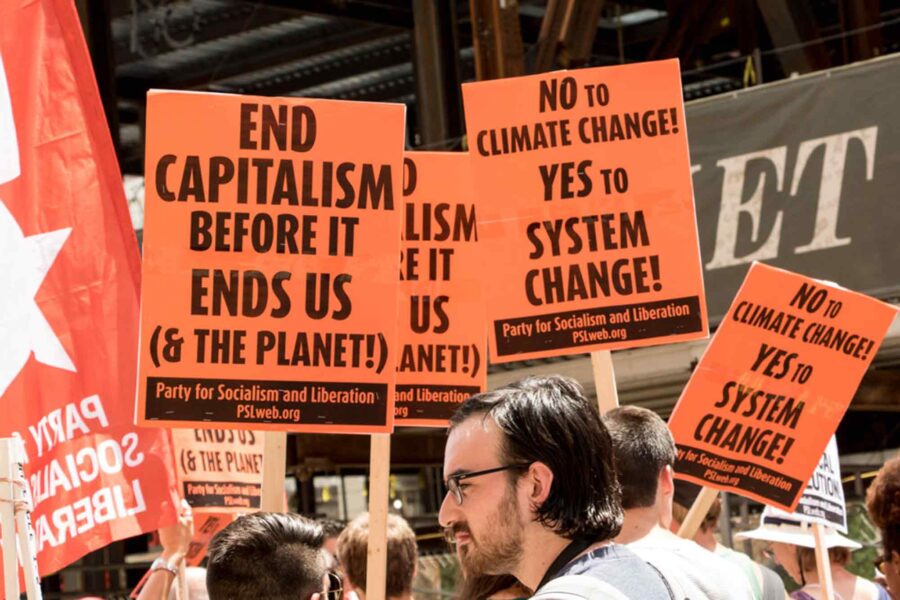
But not now. There is a revolt brewing; I see it right here in my own community where there are moratoriums on data centers. And it isn’t just a revolt against AI. It is a revolt against the recklessness and irresponsibility of capitalism itself that promotes AI. Capitalism can’t escape entirely this time. Because capitalism is the problem.
And this is what the conservatives, no less than their oligarchic allies, were always careful to hide from the public as those conservatives cheered on the ruthless march of capitalism: Capitalism has no morality. None.
As Milton Friedman answered approvingly when asked about where virtue lies in his capitalist utopia: “Who rewards virtue?” Certainly not capitalists. Capitalism is decidedly amoral.
What Trump has done is not only expose the enormous failings of capitalism, he has also exposed the secret that made most of those failings possible. He exposed the secret that capitalism is a moral void. It never could really serve us without our imposing tremendous mitigations. It never could really contribute to freedom, much less democracy. It exists in opposition to freedom and democracy and, more importantly, morality, on which freedom and democracy rest.
You can’t hide that, though, when Donald Trump becomes the face of capitalism. We know he is amoral.
And so what Trump has done is not only expose the enormous failings of capitalism, he has also exposed the secret that made most of those failings possible. He exposed the secret that capitalism is a moral void. It never could really serve us without our imposing tremendous mitigations. It never could really contribute to freedom, much less democracy. It exists in opposition to freedom and democracy and, more importantly, morality, on which freedom and democracy rest.
And so, in some ways, we stand at the brink of that revolution I referenced. The catastrophe of Trump’s capitalism has created an opportunity to revise capitalism — a way to change it to work in the public interest.
AI as Opportunity
And AI, as possibly the biggest fruit of capitalism but one so far with no regard for us, becomes an object lesson in why we must change capitalism.
It can and has been modified in the past. It can be modified now to deliver what European economies, unburdened by the suffocating idea of American individualism, deliver to their citizens, which is a better life. It needs a good shot of morality and a new, potent sense of community.
Donald Trump has given this nation little but grief. I have no doubt history will judge him as one of the worst human beings ever to live — pure evil, as I wrote of him recently.
But he may have given us this. He may have shown us, finally, how the system the wealthy devised to keep us enslaved no longer functions. He may have begun the process of our emancipation from it. He may have made us quake at capitalism as we had quaked at socialism. And that is a good thing.
Neal Gabler is a contributing editor at WhoWhatWhy. More of his commentary can be found on his substack, Farewell, America.