After Trump the Deluge? The Very Real Danger of Going From Bad to Worse
As Pope Leo has sternly cautioned, humanity’s value is not in perfection — the Masters of the Tech Universe seem to disagree.
|
Listen To This Story
 |
These days, just when you think one danger may be passing, another emerges.
Donald Trump seems to be shrinking before our eyes. His cruelty never diminishes and his ignorance only swells, but his power has contracted, which is likely to make many of us finally feel emboldened, feel that we are finally turning the corner, feel that previously somnambulant Americans are finally waking up to all the terrible tragedies he has inflicted upon our democracy and our morality.
This isn’t all wishful thinking. We have reason to be encouraged, even if it took the destruction of the country to finally get us there. Eventually Trump will sit on the ash heap of history. Eventually we will have only the awful memories of him. Not soon enough, however.
But if we think that the demise of Trump is the great manumission, that it rescues us from the clutches of other predators in this country, and that we can relax our vigilance, we are, I believe, sadly mistaken.
There is a whole collective of folks who are just as dangerous as Trump — in many ways more dangerous because, unlike Trump, they are less likely to self-destruct and because they cannot be voted away and because they face even less accountability, if that’s possible. As a group, they have powers that will even exceed Trump’s. And, what’s more, they have just as much disdain for us — more even — than Trump has.
These are the oligarchs who rule artificial intelligence, the Masters of the Tech Universe — and don’t be fooled by all the commotion about the ways that AI will improve our lives.
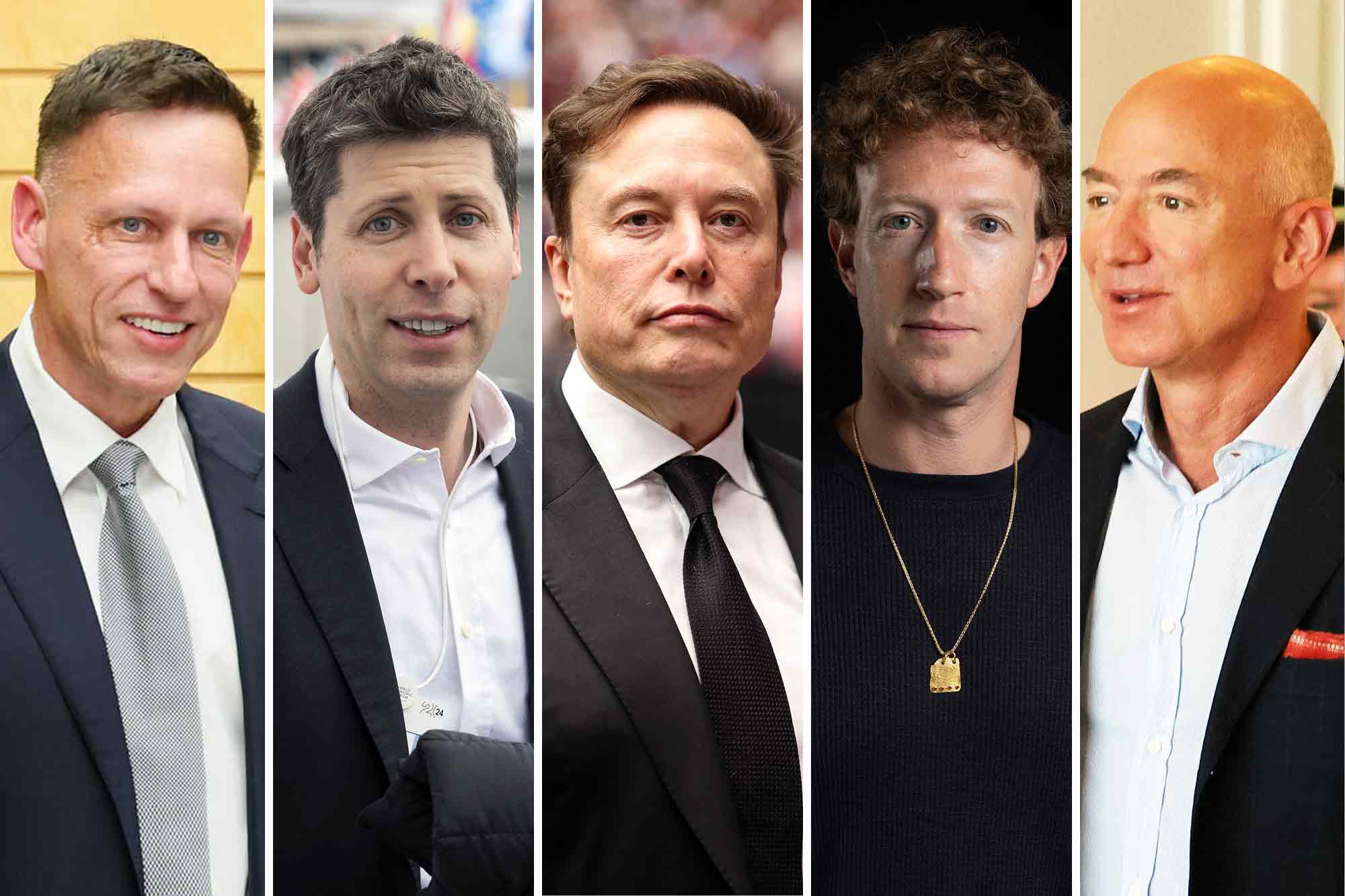
These guys are not out to improve our lives. Elon Musk? Mark Zuckerberg? Jeff Bezos? Sam Altman? Peter Thiel? Are you kidding?
I am not doommaxxing here about AI itself, which is a very complicated subject. I am doommaxxing about the men who run it, who are not so complicated.
These guys are out to make our lives miserable — at least some of them are, and the rest won’t shed one tear if they succeed. These guys all have totalitarian proclivities and a hatred of democracy. These guys are out to destroy society as we know it while accruing power and money, because why have a billion dollars when you can get a trillion?
My fear is that they can’t be stopped.
Promethean Remorse?
By now you are probably sick and tired of AI, and so am I. We’ve heard about its dangers — a long litany of them. To its detractors, among whom I number myself, it is the computing equivalent of the atomic bomb.
J. Robert Oppenheimer, often called the “father” of the atomic bomb, mused after its detonation that he was like Prometheus, that the physicists who planned the bomb had “known sin,” and that, in a famous quotation from the Bhagavad Gita, “Now I am become Death, the destroyer of worlds.”
Clearly, Oppenheimer was morally unsettled by his child. He complained to President Truman after the bombs were dropped on Hiroshima and Nagasaki that he had “blood on his hands.” Truman dismissed him as a “crybaby,” which is, all too often, the way that power reacts to morality.
With AI, there is also a lot to be morally unsettled about — from relatively small things to much, much larger things, nearly unimaginable things.
On the smaller end, there are the immoralities of the data centers, which supply power and processing to AI. These are enormous, and they are already wreaking havoc with the environment and with those who live nearby: gorging on electricity; polluting water as they gulp huge amounts and lowering water pressure in the neighborhood; contaminating the air to the point where in Virginia, an epicenter of data warehouses, there is an expectation of 14,000 new cases of asthma; creating a stink and sending a droning hum into the ether that does not relent and is driving neighbors crazy.
There are economic immoralities. Data centers are stressors on communities, and the tax benefits are offset, as Virginia is discovering, by hefty tax incentives, while AI itself threatens the entire job market, and the AI bubble may take down the economy if it pops.
There are serious political consequences since these Masters are already pouring millions into the MAGA-verse, which is averse to regulating them, even though there may have never been a technology more in need of regulation.
Trump and the Masters are already an unholy alliance, which will only get worse as it gets more powerful. In Utah — where the Shark Tank’s “Mr. Wonderful,” Kevin O’Leary, was planning to construct a 40,000-acre data center before encountering intense local opposition — he and the Trump administration have accused opponents of being incited by the Chinese government.
“Any place that’s trying to build data centers is getting bombarded with foreign-directed propaganda to try to block these from being built,” Interior Secretary Doug Burgum has said, without adducing any evidence to support his claim. Just this week, the Department of Justice filed a motion to quash a suit preventing data centers from belching their smoke into the air.
The sheer scale of the behemoth centers — many millions of square feet per center, tens of thousands of acres — is a daunting metaphor for what awaits real opposition. “We have no leverage,” one activist working to get state regulations complained. They are too big to fail. The Trump administration will not let them fail. The Musks, Zuckerbergs, Altmans, Bezoses, and Thiels will not let them fail.
And the money behind AI — already AI and AI-related companies constitute nearly 50 percent of S&P’s market capitalization — threatens to transform the political landscape the way the railroad magnates transformed the political landscape in the 19th century. These modern Prometheuses will burn everyone down, if that’s what it takes to erect their empires. And it’s likely that’s what it will take.
It’s the Human Element That Wigs Me Out
One could go on and on and on. (To be fair, there are those who say these are baseless fears and that AI is great.) But I am not here to argue about the rolling physical, political, economic, or even social consequences of AI and of the data centers it requires, even if I think they pose existential issues for America. I will leave that to others.
I am not even here to discuss some of the more abstruse philosophical moral issues that have been bruited about when it comes to AI. Do computers have consciousness, and if so, can they act autonomously? And if they can act autonomously, could they potentially decide to replace or even wipe out mankind? (This is an issue of dispute between Anthropic, one of the major AI operations, and the Trump administration. Anthropic, to its credit, has refused to license Claude, its proprietary AI, to the Defense Department because it fears Claude could launch weapons or conduct surveillance without human supervision.)
More importantly, perhaps, than whether or not AI has consciousness, is the question of whether it has conscience? Can it develop a moral sense? And what would that moral sense be?
But I am not here to argue those questions about the moral capabilities of circuits either.
What I do want to address is a moral issue that is simpler but also extremely important — not whether AI has a conscience but whether the people who have created AI and own it and operate it and use the fortunes gained from it have consciences, and I am afraid we already know the answer to that question. The very last people in the world whom you would want to have control of this all-powerful instrumentality are the very people who do have control.
So my moral concern is not about technology. It is about the jerks who own the technology.
Explorers Without a Compass
Perhaps because our society has yet to come to terms with AI and the vexing question of whether it will be a kind of salvation or a doom, we have yet to come to terms with the Masters of the Tech Universe who control it.
No one seems to like the Musk-Bezos-Zuckerberg-Altman-Thiel (et al.) gang very much. To the general public, they are pretty much villains using their power self-servingly.
But that is not the way they are portrayed in the legacy press. In the legacy press, they are largely above criticism. Their fortunes give them a free pass from the kind of moral scrutiny to which they should and must be subjected.
For now, though they are in league with Trump, they are still subservient betas to his alpha, which is no great recommendation for men on the verge of taking over the world.
In their new book about the second Trump administration, Regime Change, Maggie Haberman and Jonathan Swan describe how Zuckerberg groveled before Trump, even having one of his children write him an adoring letter. And how Bezos complained to Trump about The Washington Post — his worst investment, he said — while investing $40 million in a documentary about Melania Trump and sending Trump a selfie with his new wife.
Even Trump was said to be shocked at how easily these so-called titans would kiss his ring.
But they were kissing his ring, of course, to avoid his wrath and enjoy his largesse — particularly as they moved into AI, where government support would be extremely helpful and government regulation would be anathema. I suspect that they are no more loyal to Trump than Trump is to them. It is all transactional — all for personal gain.
Except that these guys have that atomic bomb of computation, and they don’t seem to have any of the guilt that roiled Oppenheimer — not one iota.
The only one of these magnates who shows any consciousness of the moral consequences of their invention is Anthropic’s Dario Amodei, and there is some dispute over whether his moral concerns are really a marketing ploy — a way to separate Anthropic from the cluster of evil of his competitors, which is something Amodei himself implied to a group of Washington officials. Anthropic is “ethical,” he said — not a word that is likely to pass the lips of any of the others, marketing ploy or not.
A Critique of ‘Progress’ From a Very Progressive Pope
Even as they go scot-free from moral examination in the media, however, there is one individual who has taken them on — one individual who has had the courage to examine their lack of moral values and call them out for it.
That individual is Pope Leo XIV.
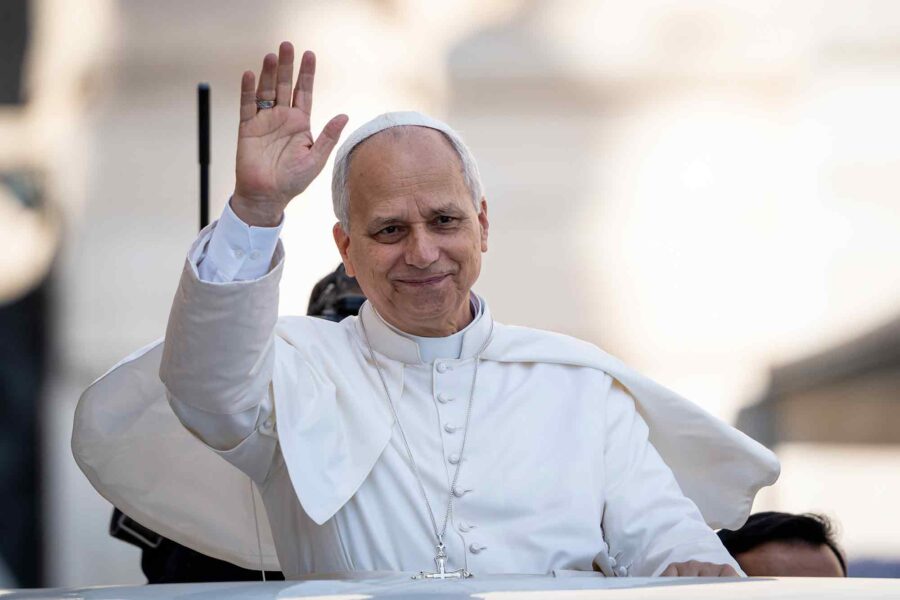
For anyone concerned with the precipice on which we now stand, Leo’s recent encyclical, Magnifica Humanitas (“Magnificent Humanity”) is well worth reading in its entirety. Because it is not only a critique of AI and the men who control it, but also, and I do believe deliberately, a wide-ranging and stinging critique of Trumpism — an encyclical about a man of no moral conviction from a man of deep moral conviction.
In many ways, it provides a necessary prelude to what the custodians of AI will visit on us — and what they will visit on us, Leo writes, is a grave moral crisis.
Leo’s analysis of AI is that it is endowed with and permeated by arrogance. In the grand claims made for it, and for its Masters, it fails to acknowledge humanity — or, rather, it purports to replace humanity, which is appropriate for egotists like the Big Tech Boys. It purports AI to be better than humanity. It purports to correct what Leo calls the “errors” of humanity and to create an errorless world.
Leo’s position — one that almost anyone who is not an oligarch would endorse — is that so-called errors are essential to humanity, that they are what make us human, that we learn from those errors, and that the experience of that education is life. To deny errors is to deny life itself.
Though Leo doesn’t quote him, he might very well have cited Altman’s bizarre description of the difference between AI and a child, in which Altman elevates the former over the latter: Altman says that when critics complain of how much energy AI consumes, they should remember that it takes roughly 20 years and a lot of energy to “train” a child — which is to say, running AI is much more efficient than raising a child. And, not only by implication but by explication, better than raising a child.
And about this kind of thinking, Leo writes:
If the human being is treated as something to be perfected or surpassed, it becomes easier to accept that some lives are less useful, less desirable, or less worthy. In the name of progress, “necessary sacrifices” may begin to be justified, placing the burden on the most vulnerable.
This is exactly how Musk speaks of the rest of humanity — as dispensable dregs. That is, us.
And this is where Leo begins, however gently, to implicate the oligarchs who hope to rule us.
Leo is concerned with the idea that the AI chatbots are not merely technological instruments and that they are not neutral. They are imbued with the values of those who create and operate them the way, he says, a work of art is imbued with the values of the artist.
But that can cut both ways: good and bad. “The creative intelligence of humanity is a gift that can alleviate suffering and open up new possibilities, but it must remain ordered toward the common good.”
He also writes: “Goodness does not advance automatically.” Someone has to advance it. Or not.
The issue of whether the Masters can advance goodness is an essential one, but, let’s face it, they have already answered it. No one could possibly say that Musk or Zuckerberg or Bezos or Altman or Thiel promote goodness or that they are dedicated to the common good.
And that is the great dread that permeates Leo’s beautiful and powerful warning. These men, who will soon control our lives, have no interest whatsoever in the common good. Only Amodei even thinks he need give a nod in that direction, and even Amodei makes the astounding claim that no one really knows what AI will do:
We’re saying what we, you know, what we think might happen, what we think is likely to happen. You know, we back it up as best we can, although it’s often, you know, extrapolations about the future where no one can be sure.
Repeat: No one can be sure what AI will do. In short, he admits that AI is not really under his control. That is reassuring, isn’t it?
And Amodei is the best of them. The others, by comparison, are monsters imbuing their chatbots with their monstrous values. Thiel has even said, infamously, that he doesn’t believe freedom and democracy are “compatible.” Spoken like a true billionaire.
It goes further, however, than simply ignoring a common good. It goes to a much more malign idea: an almost cosmic carelessness.
Whatever Happens to the Rest of Us
The television writer/producer Noah Hawley, who is responsible for Fargo, wrote a piece for The Atlantic in which he described a retreat hosted by Bezos to which Hawley, to his own surprise, was unaccountably invited. It was one of those gatherings, about which we mere mortals sometimes read, where the elites mingle. But Hawley, who felt very much out of place, wasn’t dazzled. Rather, he was depressed by what he observed because what he observed was the total disconnect between those who had the power — men like Bezos — and the rest of us, which is the disconnect to which Leo refers.
As Hawley saw it:
The world has always been run by rich men. The robber barons of the Gilded Age were known for their ruthlessness in the accumulation of wealth — hiring Pinkertons to shoot striking unionists. But they directly engaged with the world around them, using their wealth and power to muscle it into its most profitable form. And although today’s billionaires are clearly manipulating society to maximize their own profit, something else is also happening — a disassociation from the reality of cause and effect, from meaning and history. These men no longer feel the need to change the world in order to succeed, because their success is guaranteed, no matter what happens to the rest of us.
No matter what happens to the rest of us.
The oligarchs don’t much care what happens to the rest of us. The oligarchs don’t have any moral obligations to us whatsoever. The oligarchs don’t subscribe to morality because they believe they are above morality. That may be the real essence of AI: Its real purpose is to empower the Tech Masters by releasing them from morality. Indeed, AI may be the perfect configuration of power without morality.
Leo was aware of this too. “It is precisely within our limitations,” he writes, “that the following find a place: compassion, as well as a sincere concern for the needs of others.”
Alas, these men, rising above humanity, rising above morality, have no compassion. Leo writes that the “quality of a civilization is measured not by the power of its means, but by the care it is able to offer, by its ability to recognize the other as a face not merely as a function” — in other words, by its empathy.
But these men of great means, devoid of compassion, do not recognize the other as a face, and they have no empathy either. Musk has even bragged about it, calling empathy the “weakness of Western civilization.”
In truth, there is little we can do in the face of this kind of power. In the late 19th and early 20th centuries, when the robber barons and monopolists rode roughshod over American values, the Progressive movement arose to rein them in and impose on them, if not morality, then restrictions, by calling them to account.
It wasn’t entirely successful — money and power are a formidable combination — but there was a certain restraint in the income tax, the Federal Reserve, antimonopoly legislation, and muckraking.
Our era calls for a new Progressivism and a new restraint in which the forces of society, which are being trampled upon by the financial czars, impose restrictions on them to serve the common good and show them that power is not morality.
Until that happens, we are facing not merely the threat of a technology that can rule over us, but a class of men who feel so vastly superior to us and to our values that, as Hawley wrote, they can be careless toward us, act with impunity toward us, and disregard the common good altogether.
In these fraught days of ours, we necessarily fret about authoritarianism, fascism, narcissism, hubris, kleptocracy, and a dozen other “isms” from racism to antisemitism to sexism to nativism, and to the various -phobias that shatter people’s lives.
We don’t often talk about solipsism much, though that probably deserves a special place in the hierarchy of modern derangements because in many ways it subsumes the others. The oligarchs are solipsists: Nothing, for them, exists or has meaning independent of their own desires.
And if their freedom from morality is their mission, their carelessness, finally, is the real danger of AI — not that it may be autonomous but that the individuals who own and operate it are wholly autonomous. They are become Death, the destroyer of worlds.
Neal Gabler is the recipient of two LA Times Book Prizes, USA Today’s biography of the year, Time Magazine’s book of the year, a Guggenheim Fellowship and a Shorenstein Fellowship from Harvard. His substack is Farewell, America.