Trump’s Efforts to Suppress Mail-in Votes Suffer Another Setback
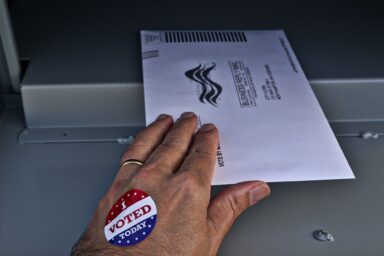
With 50 days to go before the midterms, Donald Trump's attempt to prevent millions of Americans from voting by mail is on life-support after a second federal judge, this time one he appointed, blocked the United States Postal Service from deciding who is eligible to get their ballots in the mail.
|
Listen To This Story
 |
A second federal judge, this one nominated by Donald Trump himself, has thrown another wrench in the president’s plans to usurp the authority to determine who is eligible to vote by mail and thereby potentially disenfranchise millions of Americans.
In a ruling issued late Sunday evening, District Court Judge Carl Nichols blocked the United States Postal Service (USPS) from implementing the key parts of a controversial regulation that would give the executive branch, which was intentionally not given a role in administering elections, a say in which voters would be allowed to receive and send their ballots by mail.
Trump has long blamed mail-in voting for his 2020 election loss to Joe Biden and, without ever providing any evidence, claimed that it is subject to fraud.
However, in his ruling, Nichols notes that the administration “does not point to any record evidence that there will be significant fraud in the upcoming elections” if he were to block the regulation from being implemented.
On the other hand, he wrote, the plaintiffs, i.e., civil rights groups and the Democratic Senatorial Campaign Committee, “have demonstrated that, absent an injunction, there is an increased risk that a significant number of otherwise appropriate absentee or mail-in ballots will ultimately not be counted in the upcoming elections.”
Earlier this month, District Court Judge Indira Talwani had already blocked the rule from being implemented.
The administration appealed that ruling, and is also expected to appeal this one, which means that the Supreme Court will ultimately decide if Trump will be allowed to meddle in who gets to vote by mail.
And while the high court has a dismal record when it comes to protecting the voting rights of Americans, it is increasingly tough to see how, a mere 50 days before an election for which some ballots have already been sent out, it could allow a blatantly unconstitutional regulation to take effect that is certain to cause chaos and confusion.
It is not helping the government’s case that a whistleblower has recently come forward and alleged that the administration ignored a previous restraining order in pursuit of its mail-in ballot suppression scheme, and that USPS rushed to complete a shoddy and untested verification system for scanning the ballots.
In addition, as Talwani and Nichols point out, the administration’s arguments for why this regulation is needed are more than weak.
“The Defendants — and the public — certainly have an interest in ‘strengthening public confidence in mail voting,’ and ‘enhancing the efficiency of postal operations,’” as USPS stated in the preamble of its regulation, Nichols writes. “But there is no indication in the record before the Court that preliminarily enjoining the Ballot Mail Rule would actually harm those interests. And those harms are significantly outweighed by the risks of disenfranchisement to absentee and mail-in voters identified by Plaintiffs.”