Russia’s Descent Into Madness: Slowly, Then All at Once
Putin didn’t seize a democracy — he hollowed one out. Twenty-five years inside Russia’s slow spiral, and what it tells us about our own moment.
Russia has fallen off the front page. The global conversation has moved on — to China, to trade wars, to the Middle East, to whatever is consuming the news cycle this week.
But Russia hasn’t gone anywhere. It’s still there, still fighting a war it started, still governed by a man who controls the world’s largest nuclear arsenal and who, a former Kremlin adviser says, appears to be reacting to pictures in his own head. And it’s getting closer, not farther, from becoming the kind of state the world has spent 80 years hoping never to see again.
Our guest on this week’s WhoWhatWhy podcast, Marc Bennetts, arrived in Moscow in January1997, before most of the world had ever heard of Vladimir Putin. He stayed for 25 years. He watched Putin rise, the economy boom and bust, and freedoms quietly disappear. He watched the propaganda machine get built, piece by piece, until it was powerful enough to turn his own mother-in-law against him.
He was in Moscow the morning after the full-scale invasion of Ukraine began, and he says he arrived back in a city that had transformed overnight — from authoritarian to something closer to Stalinist terror.
Three months later, he was arrested at an anti-war protest. The Times of London, his employer, pulled him out for his own safety.
We tend to think of Russia in abstractions — Moscow as a wintry idea, Putin as a caricature of villainy, the whole country reduced to a series of talking points on cable news.
What Bennetts offers is something different: the actual texture of the place, the real people, the mother-in-law who stopped speaking to him, the taxi driver who waited an hour for Putin’s motorcade to go by and found it perfectly reasonable, the shaman consigned to a psychiatric ward for trying to exorcize the Kremlin.
A country of 145 million people, with its own history, its own psychology, its own slow drift toward madness — and its own lessons for anyone watching from the outside.
What Bennetts brings to this conversation is not only a story about modern Russia, but also, uncomfortably, a story about how democracies come apart — about the conditions that make people willing to trade freedom for the feeling of order, and about what happens when the institutions meant to prevent that cease doing their job. Americans paying attention right now will find it instructive.
Marc Bennetts is a foreign correspondent for The Times and The Sunday Times. His book is The Descent: Witnessing Russia’s Spiral into Madness Under Putin.
 Apple Podcasts
 Google Podcasts
 RSS
RSS
Full Text Transcript:
Jeff Schechtman: Welcome to the WhoWhatWhy podcast. I’m your host, Jeff Schechtman. Think about what it means to watch someone lose their mind. Not a stranger. Someone you know, someone sitting across the table from you. Someone whose voice you recognize, whose history you share, and you watch it happen — not all at once, but in the slow accumulation of small distortions, each one almost reasonable on its own — until one day, the person looking back at you is someone you no longer know. My guest, Marc Bennetts, watched that happen to an entire country. He arrived in Moscow in the mid-1990s, when Russia was chaotic and loud and intoxicated by something they barely had words for. He stayed for 25 years. He married a Russian woman; he raised a daughter there; he reported from the Arctic to the depths of Siberia. And over those 25 years, he watched the thing that had drawn him there — the noise, the possibility, the human wreckage of a society trying to reinvent itself — get swallowed piece by piece by something darker and more deliberate. It didn’t happen overnight. It never does. It happened in the way that propaganda always works. Not by telling people what to think, but by making it harder and harder to think anything else. It happened when his own mother-in-law, a woman he knew and loved, began repeating the things she heard on television and eventually stopped speaking to him altogether. It happened when a Siberian shaman, who tried to exorcise Putin from the Kremlin, ended up in a psychiatric ward. It happened when newscasters looked into cameras and told their audiences that Ukrainian soldiers had crucified a toddler, and people believed them. Orwell wrote that “to see what is in front of one’s nose is a constant struggle.” Bennetts took on that struggle, and he saw clearly. That’s what made him dangerous to the people in power. And that clarity is what makes his book unsettling in ways that extend well beyond Russia. Three months after Russia’s full-scale invasion of Ukraine, Bennetts was arrested at an anti-war protest in Moscow. The Times of London pulled him out for his own safety. He went to Ukraine next, to the villages, to the people living in the wreckage of what the propaganda had built. What he found there is where his book ends and where the reckoning begins. Marc Bennetts is a foreign correspondent for The Times and The Sunday Times, and his new book is The Descent: Witnessing Russia’s Spiral into Madness Under Putin. It is my pleasure to welcome Marc Bennetts here to the WhoWhatWhy podcast. Marc, thanks so much for joining us.
Marc Bennetts: Thank you. Thanks for the introduction. It was amazing.
Jeff: Thank you so much for joining us. Talk first about what Russia was like when you first got there.
Marc: I arrived in Russia in January 1997. This was before President Putin came to power. This was actually before anyone had even heard of Vladimir Putin, unless you were looking very granularly at Russian politics and Russian officials. I mean, the outside world didn’t know who he was and most Russians didn’t know who he was. In 1997, this was six years after the collapse of the Soviet Union. And Russia was in a state of chaos and anarchy, essentially. There was poverty, there was widespread crime. But it was also, probably, the period when Russians could say and write what they wanted the most in their history. I mean in that sense, they were the freest they’d ever been. It was incredibly chaotic. I would do things like go to parties at nuclear power stations and end up driving around in the middle of the night with drunken truck drivers who tried to teach me how to drive around the perimeter of a nuclear power station’s fence, etc., etc.
Jeff: But there was a sense of possibility, a sense of excitement almost, as to what could come next.
Marc: Looking back on it, of course, that kind of Russian liberals and opposition figures, most of them, lots of them, see it as a time when they could express themselves, when they wouldn’t be arrested, usually, for saying the wrong thing. But I think the period of excitement was in the years immediately after the breakup, in the two or three years. I think by 1997, it was clear that the security services — or it was clear that there was massive crime, there was corruption. And while the Kremlin wasn’t interfering with media to the extent that Putin would later, there was also a kind of great disappointment in democracy or, as the Russians have started to call it, “shitocracy.” And I don’t really think it would be fair to say that people were looking to the future with this great sense of hope. I think there was a lot of despair, poverty, and this kind of feeling that maybe they’d been conned was what gave Putin such an appeal when he finally came to power. I mean, in the 1990s, the Russians would say everything that our leaders told us about communism was a lie, but everything they told us about capitalism was true. Such was the kind of disillusionment with the capitalist system. It was a flawed version of democracy, bandit capitalism. And lots of people were just yearning for a kind of iron fist to come and introduce some stability, at least.
Jeff: Talk about your decision to stay there and to spend more time there.
Marc: I mean, I initially planned to stay for a year or so, get to know the country. I had always been interested in Russia and the Soviet Union since I was a child. So I initially went there, not as an academic or a journalist, I went there to teach English. I mean, it would be fair that I taught English to go to Russia. It wasn’t really my aim, my career aim or anything. But I was very interested in the country, and it was a way to get there and see it for myself. And, of course, I didn’t plan on staying for a quarter of a century, but Russia kind of has a way of getting under your skin, in a good way and a bad way.
Jeff: Talk about that good way. What was it about the country that got under your skin, that fascinated you?
Marc: Russia in the 1990s? I think firstly, I would like to underline that I never believed in this kind of idea of a mysterious Russian soul, or that Russians are somehow unique. I think all people are unique in their own way. And I never believed in Putin’s idea that Russians have a unique destiny. I thought all that was… I was very cynical about all that. But, I mean, Russia is the biggest country in the world, so even Moscow itself is fascinating. But once you get outside the country, you go to Siberia, to deepest Siberia, where people speak their own language. For example, in the Yakuts region, where people — they’re not ethnic Russians, they’re Yakuts. They speak their own language; they have their own culture. You go to the Altai, in the south of Siberia, where people still believe in shamanism. You go to the far north of Russia, where you have the Arctic nights. And, of course, it’s not just a kind of geographical variety, but a large… just people, just the people are very different. I mean, in the West, there’s this idea that it’s just very similar, or across Russia, Russians are Russians. But that’s not true. I mean, there are lots of different nationalities, from the Russians themselves to, again, the Altai people, to the Chechen people, and on and on and on. And there was also the appeal in the 1990s, of course, that history was in a sense being made every day. And I was coming from Britain, which at the time was under Tony Blair. And it was a very bland kind of time. Nothing much was really happening. And so it seemed to me to be far more interesting, to use a banal word, just to stay in Russia for a bit. That’s what happened.
Jeff: And talk a little bit about the changes that were taking place and Putin coming to power, and the way he was able to exploit that sense of the people that you were talking about earlier.
Marc: Yeah. I mean, after Putin came to power, whenever I would say to an ordinary Russian or talk to them about why I disliked Putin, why I hated Putin, because he was a kind of crook and a liar and a killer, they would say, but we remember what it was like here in the 1990s. And for them, this kind of Putin taking control and not being any democracy, it was a fair kind of exchange. Because in the early 2000s, oil prices rocketed in Russia, and so Putin was very lucky in that sense. And the living standards of ordinary Russians soared and became higher than they’d ever been in their history. Russians could take foreign holidays with ease for the first time, loans were available at banks at the drop of a hat. People had money to spend, and there were things to spend it on, restaurants being built all over the place, new shopping malls being built everywhere. So Russians have money, something to do with this money. And for a lot of people, they were like, yeah, sure, he’s ex-KGB, but we’re doing okay. And if the Democrats, as they were sort of come to power again, things might get even worse, so let’s just stick with Putin. And he just rode that wave. And then over the years, this enforced his rule through destroying the opposition, often physically.
Jeff: And to what extent did the Russian people have a sense of the way it was changing, that the appreciation of Putin was economic at first, as you talk about. But then things started to change. It was a little like the frog in boiling water. Talk about that.
Marc: Yeah. The propaganda didn’t really go entirely overboard until 2014, when Russia annexed Crimea and Putin sent troops into eastern Ukraine. But I think that Russians were willing to abandon what we would think of as a kind of Western-style democracy because they just had such a bad experience of it in the 1990s. And there became this… In around 2011, there were pro-democracy protests over rigged elections. And this was kind of the moment when it might have been possible to bring down Putin. For a few days, weeks, he looked as if he might be in trouble. But then the propaganda campaign kicked in. Not to the extent, again, as it would with the Ukraine situation. And they began to arrest opposition leaders again. It wasn’t the same kind of scale of repression as we saw later, they were being jailed for two weeks, three weeks, things like this. But Kremlin propaganda was pushing the idea all this time that Putin is the only person who can keep Russia out of danger, who can ensure that Russia doesn’t collapse. I think that pro-Kremlin supporters would tell me at the time, when I asked them, they would say, if not Putin, then who? This is a country of 145 million people, but the argument, which was repeated by a lot of Russians, was ‘there is no other person in the entire country who can rule us, it’s only Putin.’ Which obviously had been pushed relentlessly by Russian propaganda. And then this just took on a ludicrous scale when you have Russian officials such as Volodin, who is now the speaker of Parliament, but at the time was a very influential Kremlin aide. He would say things like, “If there is Putin, there is Russia. If there is no Russia, there is no Putin.” And he obviously felt secure enough in the belief of the Russian people in Putin that he could get away with this and not be laughed out of the room.
Jeff: Beyond the propaganda, was there some kind of mystical hold that you talk about, the hold that Putin seemed to have on the population? Was it only the propaganda, or was there something else going on?
Marc: Well, there’s always been this reverence in Russia for the man at the top, for the czar. But again, that goes back to the lack of a real democratic tradition or any real experience of genuine democracy. I remember once I was in a taxi in Moscow while Putin’s motorcade was going past. And on occasion, you would have to wait for up to an hour, maybe a little bit more, whilst his motorcade sped past and everyone was just sitting in their cars waiting. And I said to a taxi driver, “It’s ridiculous. Why do you have to wait for like an hour just to go somewhere just because Putin’s driving past?” And he looked at me and said, “But he is one and we are many,” which was just the exact reverse of what someone in the West would probably say. Like, there’s loads of us… Someone in England, for example, would say, there’s loads of us sitting here, why do we have to wait for Putin? But he just saw it as completely normal that hundreds of cars would have to wait for the president’s car. Because he is one, or The One, although there’s no articles in Russian, so he couldn’t have said that. I mean, I don’t think there’s anything mystical in the otherworldly kind of sense over his hold on Russians. Although Russians do have a very unreported fascination with the occult. I mean, obviously everyone knows about Rasputin, but that continues even to this day. The cottage industry in urban witches and urban wizards is worth billions every year in Russia. But that wasn’t really why Putin was able to stay in power for so long.
Jeff: But there was this almost medieval mindset that seemed to take hold.
Marc: Yeah. Throughout history, Russians have had this very kind of, I guess you would call it servile attitude toward the man at the top. There are Russian proverbs from the Tsarist era, such as, “When they beat you, say thank you for the lesson.” “Do the work of seven but obey only one,” on and on like this. So yeah, in that sense, there’s something kind of medieval about Russians’ belief in Putin. But I think it’s also important to point out that this doesn’t concern everyone, that there are vast numbers of Russians who hate Putin and who would like to see Russia as a normal democracy. But at the start of the war in Ukraine, the Kremlin introduced a law, essentially making it a crime punishable by up to seven or 15 years in prison to report the truth on what Russia was doing in Ukraine. So the people who would have spoken out, they left the country, hundreds of thousands of them. So in a sense, Putin has purged Russia now of the very people who would lead any protests if they were to start in the future.
Jeff: And was it the purging? Was it that medieval mentality? How did all of these things, they created a kind of perfect storm for Putin’s totalitarian rule to just get stronger over time.
Marc: Well, he was always authoritarian, and obviously it wasn’t a democracy up until 2022, when the full-scale invasion of Ukraine happened. But overnight, literally overnight, Russia transformed into a neo-totalitarian state where any dissent became dangerous, where all opposition media was banned. Before, they tolerated some opposition media up until 2022. But it was literally closed down overnight. Opposition journalists had to flee the country. Opposition activists had to flee the country, which the Kremlin portrayed as wartime measures necessary to ensure security. But there was a big difference between Russia until February 23, 2022, and Russia on February 24, 2022, when the war in Ukraine started and the crackdown began and Russia kind of… Putin introduced the kind of political terror that we hadn’t seen in the country since Joseph Stalin’s days. I was on the border with occupied Ukraine, when the war started. And I’d been there for seven or eight days monitoring Russian troop movements, etc., etc. After the war started, I took a train back to Moscow, and when I arrived, it was… It’s the old cliche, but like literally I arrived in a different city. There was a completely different mood. People were being very careful about what they would say. There were police everywhere. And it genuinely felt as if the whole city had just transformed overnight.
Jeff: Why hadn’t more of that happened after the Crimea invasion in 2014?
Marc: Because the Crimea invasion wasn’t the full-scale invasion of Ukraine. Putin wasn’t trying to capture Kyiv. His troops weren’t involved in gun battles. And to an extent, the annexation of Crimea was even welcomed or at least tolerated by some members of the Russian opposition who saw it as the region kind of coming home to Russia. There wasn’t the confrontation with the West that happened in 2022. I mean, obviously the annexation of Crimea was illegal. But there was a vast difference in scale of taking one region of Crimea and launching the biggest military conflict in Europe since 1945 and the defeat of Nazi Germany to try and capture all of Ukraine, to try and capture Kyiv, to try and remove President Zelensky. So just the scale of the war itself, the scale of the military operation itself was a lot bigger. And therefore the scale of the crackdown was a lot bigger.
Jeff: Talk about your own experience being arrested at this anti-war protest.
Marc: This was February 28, 2022. I’d just got back to Moscow and that date was the anniversary of the murder near Red Square of Boris Nemtsov, who was a Russian opposition leader who was gunned down just as he was about to lead a march against Putin’s move in Crimea. So I went to cover what was initially a rally in memory of Nemtsov. But given what had happened in the last few days, it kind of transformed into a slight, into a small anti-war protest. At one point, I saw a woman flash a tiny, tiny little piece of paper, basically, and it said, “No war.” And the police just grabbed her, threw her in the police truck. And in the past, when such things had happened at the protests, I had shown my press accreditation and asked why people were being arrested. And sometimes they could manage to get away or whatever.
On this day, they weren’t in the mood and they just grabbed me as well and threw me in the police truck. And then they drove me to a police station in the north of Moscow, where I was separated from the Russians and taken into a room where there were two guys in plain clothes. When I asked them if they were FSB, which is the successor agency to the KGB, they went, “No, no, no, we’re kind of from the Foreign Ministry,” but they wouldn’t say who exactly they were. And I’m pretty sure that they were the FSB, but it was just surreal. I mean, obviously a little bit worrying because I wasn’t sure what they were going to charge me with. And also, I mean, this was probably the worst time to be arrested in Russia as a British journalist since the height of the Cold War. So they just started grilling me. But the questions were just ludicrous. One of the first things they asked me was, “What do you think of Putin?” And I was like, “What does it matter to you what I think of Putin?” And they were like, “Well, you have to tell us if you want to get out of here.” So I’m thinking, what can I say to them? You know, I mean, I can’t tell them the truth that I hate him and that he’s destroying Ukraine and he’s destroying Russia. It probably wasn’t a very good idea because I wanted to go home in the next 10 years. But then equally, I wasn’t going to say something like, “Ah, no one understands him in the West.” So I sat there for about two or three minutes, literally trying to think of what I could say, and they were like, “Come on, come on. What do you think of Putin?” And eventually I just said, “It must be very hard to effectively manage such a large country.” And they were like, “Oh yeah, it is really hard.” And then they asked me some other stupid questions about like, “What do you know, what do you know about Russia?” And I was, “I’ve been here for 25 years, quite a lot.” And they were like, “Well, tell us something.” And I was like, “Moscow is the capital of Russia.” And “Oh, tell us some more.” So I just told them, give them a potted history of Russia since Putin came to power. And they’re like, “How’d you know all that?” It’s like, “I read Wikipedia just before I went out.” And they weren’t really in the mood for humor. But eventually I was allowed out.
And then shortly after that, Russia introduced a law banning what they called fake news on the war in Ukraine. And in their definition, fake news was anything that wasn’t published by the Russian Ministry of Defense website. And they also said it would apply to Western journalists. And The Times said I should leave. But I’d been there for 25 years. My wife is Russian. My child was born in Moscow. And initially we decided to stay until I was told to leave because they feared I would get arrested. And at the time I thought perhaps it wasn’t necessary. But as history shows, as the next few months showed, it actually probably was a good idea.
Jeff: And were there other journalists that were arrested around that time?
Marc: There were Russian journalists being arrested all the time. Yeah. But it wasn’t until 2023 that Evan Gershkovich, the Wall Street Journal journalist, was arrested. I knew him in Moscow, but I was already out of the country at the time he’d gone back. And yeah, that was a massive shock. And it made me realize that, I guess, The Times was correct to pull me out.
Jeff: Why was Russian propaganda, at least for a while, so effective that people even like your mother-in-law believed what she was hearing?
Marc: Oh, firstly, because it was relentless. And they had complete control of national television, at least. So, I mean, in my mother-in-law’s case, for an elderly woman stuck in the provinces, with a pitiful pension, with television as one of her main means of entertainment, it just literally brainwashed her. I mean, there’s no other word for it, but it wasn’t just national television. I mean, the message was everywhere. It was in newspapers, it was online. And it became quite common to hear Russians say, “I never watch state television.” And then they would repeat the arguments on state television, almost word for word. It was almost as if the propaganda had had this kind of trance effect, I think, on many people. And it kind of built, tried to convince them that Russia was endangered, it was surrounded by enemies. And again, this notion that Putin is the only person who can save you. But it was just some of the things they would push would were… for example, that Ukraine is ruled by Nazis, which clearly isn’t true, that in the West it’s illegal for children to call their parents mother and father, they have to call them parent number one and parent number two, that in Scandinavia there are brothels for animals, and the animals have their limbs broken for the enjoyment of zoophiles. Just ridiculous things, but it was just relentless, like on and on and on and on and on. And you could see that it was driving people insane.
My mother-in-law, for example, when I first met her, she told me and my wife, “Why are you living in Russia? Nothing good is ever going to happen here. You should leave. Set up in England.” Then, after becoming a victim — I don’t think there’s any other word for Kremlin propaganda — I just grew in her mind into this kind of demonic figure from the West, and I couldn’t have a five-minute conversation with her without her screaming about the evils of the West or Ukrainian Nazis. And so eventually we just stopped talking, unfortunately.
But she wasn’t the only one who was driven out of her mind. I remember there was this kind of clip that went viral in, I think, about 2016 or 2017 of this middle-aged woman telling an opposition journalist how bad life was in Europe. And she said, “There aren’t enough women in Europe, so they rape animals. And if you walk along the streets in Germany, and it’s awful, you can hear the dogs screaming because they’re being raped.” Just this kind of nightmarish vision of Europe that had been pushed by Russian state media constantly to people who had never left Russia.
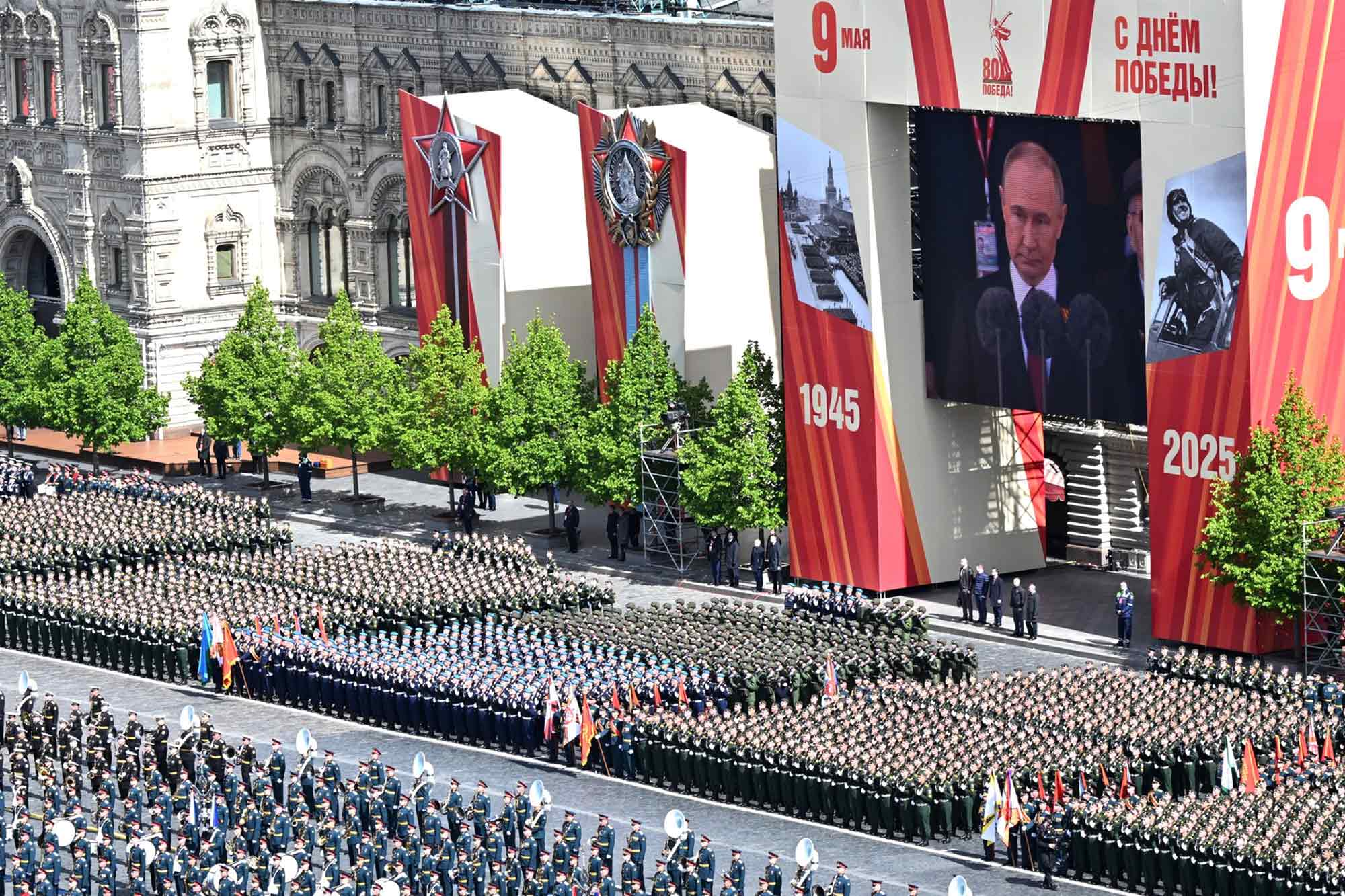
There was the kind of obsession that Putin had with Victory Day, the public holiday in honor of the defeat of Nazi Germany by the Soviet Union. I think that also drove a lot of Russians out of their minds as well, because it was just, again, so relentless, and almost became rather than a secular holiday, there was always something religious about it, this kind of glorification of the Soviet Union, and which was also linked by the Kremlin to the growing confrontation with the West. So I remember one year, an 11-year-old, a 12-year-old sorry, Russian girl, dressed in Soviet military uniform and stood on a bed of nails, barefoot on a bed of nails, for 75 minutes, singing Soviet Red Army songs to honor her grandfathers who had fought in the Second World War. I didn’t even know how to react to that. I mean, obviously, the Soviet defeat of Nazi Germany and the sacrifices made by the Soviet people to defeat Nazi Germany is something worth remembering, something worth commemorating. But I don’t think the correct way to do it is for 12-year-old girls to stand barefoot on a bed of nails for 75 minutes. I just didn’t see the link.
So yeah, there was a lot that was going on, and sometimes it would affect even kind of intelligent people. I remember we had a friend who’s very well educated. She studied in America, spoke a number of languages, who in 2020 told me that there was no one else in Russia who could ensure that the country remains sovereign apart from Vladimir Putin. This was at a time when the Kremlin was rewriting the constitution to allow him to stay in power for another 16 years. So yeah, it was frightening. And the power of propaganda was frightening. And the people pushing it were doing it deliberately, for money essentially. I don’t think maybe some of them believe it now, but I’m pretty sure at the start they didn’t believe it. They just did it to promote their careers and for money.
I remember once I was at a protest, again against the war in Ukraine, and there were maybe 30, 40 thousand people. This was 2014 after Crimea. That scale of protest wouldn’t be possible now. And I saw a journalist from Russian television, Kremlin-controlled television, there was no other. And she was standing in front of an almost empty road close to the protest. So this wasn’t where the protest was taking place. It was close to it. And there were a few people making their way up that road towards the main protests. And they turned the camera and she did her stand-up and she said, “As you can see, there are very few people here today, just a few kind of misguided crazies.” And that was the message. And then afterwards I walked up to her and said, “But you can see with your own eyes there are 30, 40 thousand people over there. Why did you lie?” And she just looked at me and said, “Look, you do your job and I’ll do mine, okay?” I walked off, which I thought just summed everything up about Russian propaganda.
Jeff: To what extent do you think that Putin changed in this period of time? I mean, obviously, he tightened the screws after the invasion of Ukraine, but was there a sense that he was changing, becoming more authoritarian, becoming more demanding of control? What was going on with him?
Marc: He’s been in power now for 26 years, right? And it’s my view that power not only corrupts, but it also drives you out of your mind. And I think that he became, I mean, we can’t really call him a victim, but he… State propaganda is taking its message from Putin. I mean, not always literally. He’s not calling them every day and saying, okay, today you should report on this, today you should say this, but they know what they have to say. And then Putin watches state television. So he’s trapped, again not trapped because he created it, but he’s in his echo chamber where his own thoughts are literally being broadcast on a screen back to him. And during the coronavirus pandemic, he was locked up in his residence with his gang of kind of hardline former KGB allies. And they just spent the entire time ranting about Ukraine, as far as we know, and filling each other’s heads with kind of horror stories about the West. And that’s almost certainly why he decided eventually to launch his full-scale invasion. I spoke to a former, very influential former Kremlin advisor, Gleb Pavlovsky, who helped secure Putin in power in the early 2000s, and then started to oppose him because he thought that Putin should stand down, or shouldn’t return to power for a third term. And I asked him, do you recognize Putin now? This is in 2022, a couple of days after the full-scale invasion had begun. And he was like, “not at all. He was, in the early 2000s, a very kind of sane, thinking man. But now I can’t, don’t recognize him at all. He looks to me as if he’s reacting to pictures in his own head”, which is an image that stayed with me or has stayed with me since the start of the conflict. You know, this guy who controls the world’s largest nuclear arsenal, reacting to these images which are being generated by his own paranoia and complexes and what is, I think, essentially madness, which I think is an appropriate word to use.
Jeff: And ultimately, what does this tell you about the future of Russia right now?
Marc: I mean, there is no future for Russia right now. Well, there’s a future, but it’s very dark and dystopian. I mean, we know that at least two hundred… Well, we know that we know the names of at least 220,000 Russians who have been killed in the war, 220,000 Russians who have been killed fighting in Ukraine. It’s looking at excess mortality figures because the Kremlin doesn’t give a death toll, right? So there’s no official figure, but looking at excess male mortality figures, it seems as if it’s at least 325,000. Other people say it could be even higher, up to half a million. But it’s a fact that hundreds of thousands of Russians have been killed in this war, which is this senseless war for nothing. I mean, one of Putin’s justifications for the war was that Ukraine would become a threat, that NATO would launch an attack on Russia from Ukraine. But Ukraine still, now, hasn’t even been invited to join NATO. And if NATO was planning to attack Russia from the territory of Ukraine before the war, why hasn’t it done it now? I mean, we’d have the perfect kind of excuse, as it were. I mean, there’s a conflict going on. There’s a war going on. But until Putin leaves office in whatever way, either he dies or is removed from power, which I can’t see happening right now, then he’s just going to continue the war in Ukraine. And he’s just going to continue to transform Russia into something which is not quite yet North Korea, but it’s getting there.
Jeff: Marc Bennetts. His book is The Descent: Witnessing Russia’s Spiral into Madness Under Putin. Marc, I thank you so much for spending time with us today.
Marc: Thank you very much. Thank you.
Jeff: Thank you. And thank you for listening and joining us here on the WhoWhatWhy podcast. I hope you join us next week for another WhoWhatWhy podcast. I’m Jeff Schechtman. If you like this podcast, please feel free to share and help others find it by rating and reviewing it on iTunes. You can also support this podcast and all the work we do by going to WhoWhatWhy.org/donate.