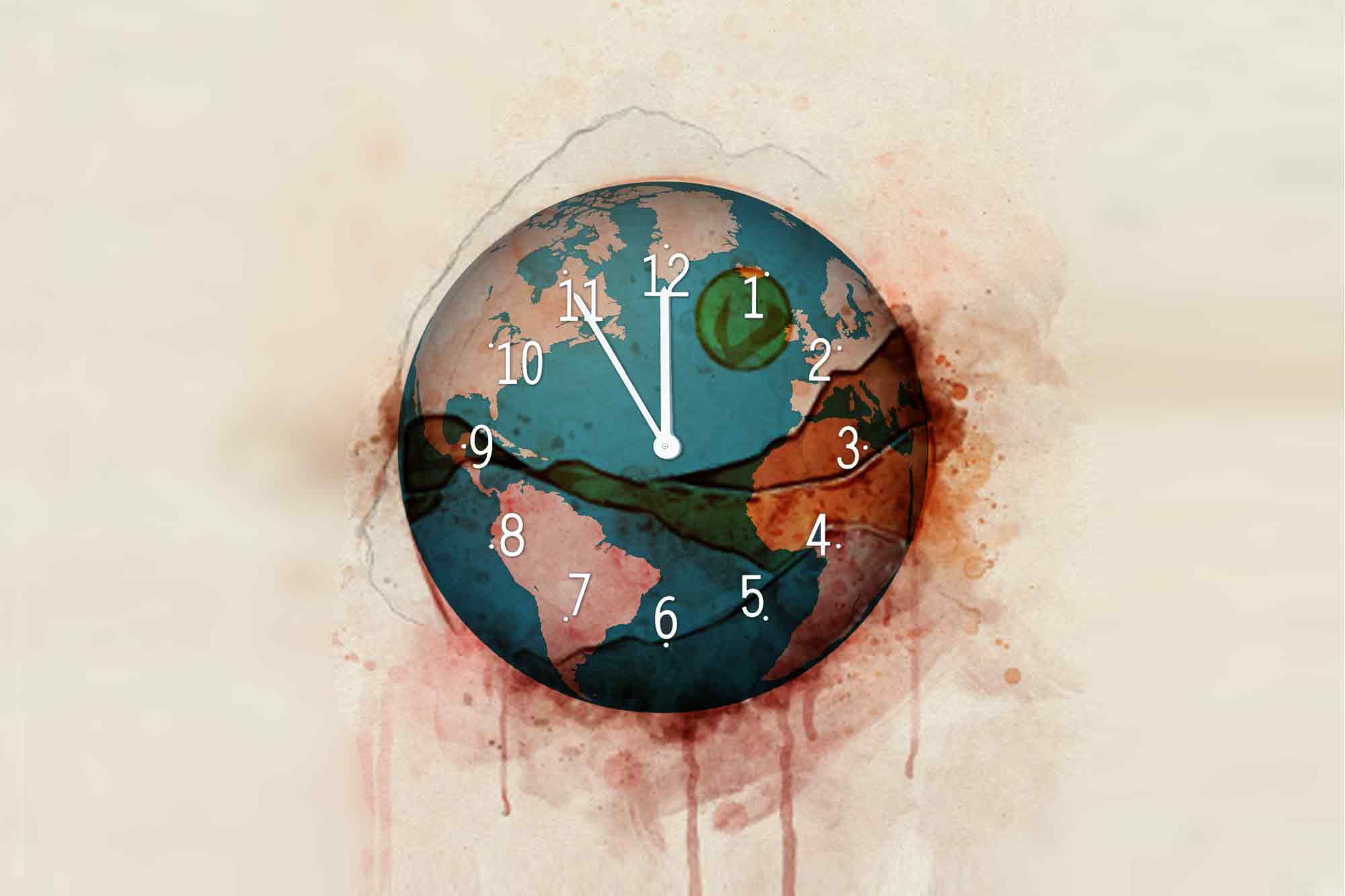
No Rules, No Order: The World on a Knife’s Edge
From Beijing to Washington to Cuba, the old world order has collapsed. Is this the most dangerous moment since 1945? One man says yes, and the clock is ticking.
The world is more dangerous right now than at any point since the end of World War Two. More dangerous, in fact, than the Cold War — because at least then we knew the rules.
Today there are no rules. The old order is gone, and what has replaced it is something most of us can barely bring ourselves to look at directly: a world of permanent polycrisis, where Ukraine grinds on against Russia, where Iran has absorbed an American and Israeli strike and survived, where China watches and waits, and where a new generation of weapons — drones, AI, hybrid attacks on the invisible infrastructure of modern life — has rewritten the rules of conflict faster than the great powers can absorb them.
And at the center of all of it, making the decisions that will determine whether this century becomes the century of global catastrophe, are a handful of aging men — Vladimir Putin, Xi Jinping, Donald Trump — whose grip on power is tightening even as their judgment grows harder to predict. And when they go, no one knows who or what comes next.
Our guest on this week’s WhoWhatWhy podcast is Peter Apps. As Reuters’s global defense commentator, he has spent two decades in the rooms and on the roads where history is actually made. His new book, The Next World War, puts the odds of major war within the next 10 years at 1 in 3.
The assumption that kept the peace for 80 years — that great power conflict would instantly go nuclear — has quietly dissolved. Ukraine can hold off Russia. Iran can absorb a US strike.
The unexpected, it turns out, is quite possible.
And Apps knows something about the unthinkable. In 2006, covering the civil war in Sri Lanka, a road crash left him paralyzed from the shoulders down. He went back to work nine months later, in a wheelchair, and has reported from conflict zones across the world ever since.
A man who has already survived what most of us can’t imagine has a different relationship with catastrophe. He knows the world doesn’t stop. And he knows, better than most, what it takes to face it clear-eyed.
 Apple Podcasts
 Google Podcasts
 RSS
RSS
Full Text Transcript:
Jeff Schechtman: Welcome to the WhoWhatWhy podcast. I’m your host, Jeff Schechtman. Somewhere in the back of our minds, most of us carry a quiet assumption that the arc of history bends away from catastrophe, that the structures built after 1945 — the alliances, the treaties, the deterrence calculations, the whole elaborate architecture of “never again” — that it holds, that it has to hold because the alternative is unthinkable. My guest, Peter Apps, has spent 20 years making himself think the unthinkable. As Reuters global defense commentator, he has sat with the commanders and the diplomats, and the nervous conscripts, and the civilians stockpiling food and water, because their governments told them to. He has watched in real time as the fault lines widened: Ukraine, Taiwan, the South China Sea, the replicated airports being built in Chinese deserts to rehearse the invasion of a neighboring island. He has tracked the emergence of what he calls an axis of upheaval: China, Russia, Iran, and North Korea. Not a formal alliance, but a convergence of powers with shared interest in tearing down the world the West built.
And his conclusion in what may well be one of the most clear-eyed and unsettling books of 2026, is that we are living through the most dangerous moment in international relations since the end of the Second World War. Not approaching it: living through it. Perhaps our problem is proximity — too close to our own comfort, too close to our own assumptions, too close to the seductive belief that the worst won’t happen because it hasn’t happened to us. We have not had proximity to danger, to denial, to the illusion that the architecture of peace is permanent simply because it has held. Peter Apps has a different relationship with all of that. He has spent two decades in the rooms and on the roads where history is actually being made. And in 2006, on a road to Sri Lanka, a crash left him paralyzed from the shoulders down. And he went back to work nine months later in a wheelchair. Covering conflicts. A man who has already survived the unthinkable has a different relationship with it. He knows it happens, and he knows it can happen again.
Peter Apps is the Reuters global defense commentator and author of the new book, The Next World War. And it is my pleasure to welcome him here to the WhoWhatWhy podcast. Peter, thanks so much for joining us.
Peter Apps: It’s great to be here, Jeff.
Jeff: Well, it is a delight to have you here. When we look at other periods of danger, the periods leading up to the Second World War and really the period throughout the Cold War, when we faced so many danger points along the way. Most of those dangers came from the way geopolitical forces moved and events that transpired within the geopolitical chessboard. It seems that so much of the danger that we are looking at today is self-imposed. Talk a little bit about that.
Peter: I think that’s right, but I think you could probably say the same of the previous periods before significant conflict, or indeed the run-up to the Cold War. So, you know, the first part of the 20th century, where you had these great European empires, you know, about to clash with each other and not necessarily being particularly clever about it. You saw it certainly in the run-up to the Second World War. There’s a great line in a book called Anatomy of Courage by Lord Moran, who was Churchill’s doctor. So he was a regimental medical officer in the trenches of the First World War, and then he was accompanying Churchill on the second. And he talks about how the young men and women growing up in the ’30s had been taught that war achieves nothing because they’d been told the stories of the First World War, but they also grew up, you know, in the latter half of the ’30s, believing they would have to go through a massive war before they were allowed to get on with their lives.
So I don’t think either of those moments felt particularly sensible. I think we owe a huge debt of gratitude still to the individuals like Dwight D. Eisenhower, Harry S. Truman, Winston Churchill, Clement Attlee, those who founded NATO at the end of the 1940s, beginning of the 1950s, and stopped that war from going hot, obviously, in Cuba and beyond. But, you know, we have gradually sort of walked back into that kind of threat. And I think we are, you know, when I take a long view, I look at my last five generations of my family. My great-grandfather was in the trenches of the First World War. All my grandparents were in the Second World War. My parents grew up under 70 years of peace, the baby boomer generation. You know, I’ve voluntarily went off to war as a correspondent and I’ve voluntarily worn a uniform as a British Army reservist. And now the question is, what’s going to happen to my nieces and my nephew and that generation coming up? And I think there is a question mark over it.
I mean, I don’t think it’s inevitable. I don’t think we need to all go off and bury ourselves in caves. I don’t think that would be helpful. But I do think we need to think very seriously about what deterring that means. A lot of people are thinking seriously about that. And there are no easy answers because the difference between this period and those earlier periods is that there are many more moving parts. And that means that there are more places where things can go wrong. But still, as in the 1930s, we only really had a war in 1939 because Hitler invaded Poland. You know, again, there are two or three key decision makers who have, you know, who will make the decisions as to whether it’s peace or war. And providing they don’t go over the edge, providing they exercise the same amount of restraint that people like Nikita Khrushchev did during the Cold War, we might be okay. But it’s still a risky and very volatile period of time.
Jeff: Is there a danger that we are taking actions today that are really based upon the lessons we’ve learned from other similar periods, and that they don’t really apply to the reality today?
Peter: I think you’re right. I think if you look particularly at what’s going on in the Gulf, the aftermath of Operation Epic Fury, this attempt at regime change by the US and Israel. I think there was an element of thinking and still is an element of thinking in Washington in particular, particularly in the Pentagon, that showing the strength of the US military, showing the unique abilities of the US military, would keep other nations deterred. And I think that there is an element of truth to that. I think China and Russia are looking at what the US has been able to do in Iran and going, we’d rather not be on the receiving end of that.
But of course, what’s happening simultaneously is an erosion and sometimes even a tearing up of America’s relationship with its allies. And that brings us to a new and much more dangerous sort of point, maybe further down the line. So maybe when fighting ceases in Ukraine and Russia is ready to have a go at Eastern Europe, or when China is ready to have a go against Taiwan. Because I think one of the reasons why we’re seeing the stuff we’re seeing happen in the Gulf is the Chinese: they spent a lot of money on their military, but they’ve realized it’s not as ready as they’d like it to be. Xi Jinping has had a lot of his generals arrested because he’s not happy with what’s been going on. And that means we’re in a window of time before China is ready to invade Taiwan and the US is burning a lot of weapons stocks, but it’s also burning a lot of political equity. And of course, the more disunited the world looks when we get the next president in 2029, the more complicated it’s going to be to try and keep Russia and China deterred.
Jeff: Is there a reality, though, that we’re not, or that some are not acknowledging completely, with respect to the nature of warfare today? We see it in the way that Ukraine is having the success that it’s having against Russia, and in the way that the US is failing with respect to what’s going on in Iran today. The way war is conducted is changing so dramatically.
Peter: Yes. I mean, I think that we’re definitely in a period of change. When I started writing this book, there were still a lot of military thinkers who were very skeptical over Ukrainian claims that drones were causing the majority of casualties. It’s been artillery going back to about the American Civil War. And there were lots of people saying, well, maybe it’s not true. Drones aren’t killing as many people as all that. That is now gone, out the window. Everyone accepts that drones in both the current conflict in Iran and in the conflict in Ukraine have been game changers.
I mean, to an extent, a missile is just a drone, right? I mean, you guided missiles have been doing this for a very long time, going back as far as World War II. But there is no doubt that because there’s been a shift in technology that hands an advantage to the new builders, whether that is Ukraine or Iran, and means that the US, and countries like Britain — I mean Britain, people forget this, but Britain spends more money on defense than Israel does. And what we’ve actually done is spent an enormous amount of money, we’re the fifth or sixth largest defense spender in the world, on a whole bunch of kit that doesn’t quite work and is costing more than we thought it would do. So, for example, you know, we’ve just tried to spend £150 million reconditioning a frigate and then had to give up. So, you know, you can end up spending the money on the wrong things.
I think the US is rather more clear-eyed on that than some others. I think Britain has got itself into a particular hole on that front. But yes, it’s difficult to deal with these changes in technology. Having said that, it always has been. You know, everyone wasted lots of resources on cavalry in the First World War. Everyone wasted lots of resources on maybe long-range bombers in the Second World War that didn’t make as much difference as they might have done. So it’s always been difficult. But yes, this is a really hard time to get those things right.
Jeff: Does the fact that we are that there are so many conflicts and potential conflicts going on right now, that we live in this polycrisis world? To what extent does that up the potential for danger?
Peter: Yeah. I mean, I thought for a minute, you’re going to use the word protagonist because we’ve got so many protagonists, because I think that is really what’s going on here. And so, obviously, you know, it’s quite, it’s not easy to get your head around what’s happening with the US and China, because that relationship itself is incredibly complicated, includes all kinds of risks of peace and war and whatever. You know, the Russia-Europe relationship is also incredibly complicated. But actually, you know, once you start getting into the United Arab Emirates and its relationship with those big powers, but also smaller places like Sudan, you know, there’s a whole bunch of stuff going on in Armenia, Azerbaijan, Central Asia, Latin America, all of which you could write a whole book on. And it’s almost impossible to keep track of all those things.
The US, I think, is probably the only nation that is just about able to. But of course, as you see the stripping back of the State Department, as you see the stripping back of some of the combatant commands like Africom, it gets harder and harder to stay on top of all these things. And again, the question is, are these conflicts? And in some cases, they definitely are, but they’re also very complicated confrontations. And so if you look at, for example, the way that Turkey interacts with Russia, occasionally there’ll be outright conflict. Occasionally they’ll literally kill each other’s forces somewhere like Syria, or they’ll shoot down each other’s aircraft. But there’s also a business relationship. There’s also a complicated diplomatic relationship — and also, paradoxically, a relationship of respect. So sometimes these relationships of respect and hatred sort of operate alongside each other. Think of Israel’s relationship with the Gulf states.
So there’s a huge amount going on here. And it’s very difficult for anyone to navigate it. And of course, bits of these things flare up as conflicts. Sometimes they give you your routes to solve it. I don’t think anyone anticipated the Pakistanis would be the way out of the Gulf crisis, but there is just so much going on that it’s very difficult for things to end the way in which people imagine, unless they’re very bounded wars like that kind of four-day war between India and Pakistan we saw last year, or that 10-day set of strikes between the US and Iran. Once you go past that, you end up in what I call a diplomatic and military minefield. And both sides end up struggling to get out of it. And that’s what’s happening in the Gulf. And to an extent, that’s what’s happening now in Ukraine.
Jeff: And is there a central thread that you see that runs through all of these different conflicts?
Peter: Yeah, I think there’s probably about three. So the first is that in direct contrast to the assumption of the 2000s, nation states are increasingly looking to solve their problems by either military posturing or military action, and on occasion, they are taking very big gambles — sometimes of which play off and sometimes of which don’t. I think the second is the end of the assumption that great power war would immediately go nuclear. So that thing that allowed people my parents’ age, for example, to grow up throughout the Cold War without a war was the assumption that if the US started fighting Russia, it would immediately go nuclear. I think that is now gone. There is an assumption that great powers could fight each other for weeks or months, or even years without going nuclear, and that may or may not be right, but it leads to a whole reconsideration of weapons, stocks and warfare. And I think the third point is this weird cognitive dissonance where particularly decision makers… So I’m 44, so increasingly the sort of mid-level officials are about my age. They grew up with the assumption that this was in the past, and they often still have the assumption that it’s in the past. Whereas actually, if you’re someone like me who’s been, as you said, sort of around on the front lines of this or watching it… So I was at school during the Kosovo crisis. I was 18, and I was watching the face-off between the Russians and the British at Pristina airport. So to me, I’ve been watching this escalating for 25 years, and it doesn’t feel that surprising. We are where we are, particularly when you look back at my family history. But that simply isn’t the way in which most people’s careers have functioned. You know, they haven’t functioned with, you know, if they’ve been in the military, they’ve functioned in a counterterrorism dynamic. The assumption that the enemy will never have air power, for example. And suddenly they’re being jolted out of that, and they’re really struggling with it.
So I think a lot of people, both ordinary people and decision makers, are struggling with this reality and haven’t quite worked out how to adapt to it. And you see this in Epic Fury, where the Pentagon has used up considerable weapon stocks in Iran because it felt it needed to, to make a point, but is therefore buying itself into an area where it may have trouble in having enough weapon stocks to keep China deterred.
Jeff: Talk a little bit about China and how you see its role in this multi-crisis world right now.
Peter: So I think China is either the problem or at least part of the solution. So I think it is just about possible that we could sleepwalk into a global conflict through things like Iran escalating and maybe Ukraine escalating and maybe Vladimir Putin starting a war in Europe. But fundamentally, just as Hitler started World War II really with his invasion of Poland — or you could argue Imperial Japan did with its invasion of China — China really needs for a war to happen. China needs to risk a conflict. And it is very unclear that Beijing is in a position to do that. Xi Jinping has just fired all of his generals. He just sentenced two defense ministers to death, although that sentence is suspended, they’ll probably just spend life imprisonment. He’s just fired one of his oldest friends, Zhang Youxia, who is the most senior Chinese military officer. He’s also been fired. And that really tells you that Xi Jinping has grown up around the military a long time. His father was a PLA soldier. He really doesn’t believe the military is ready for whatever he wants to do with it. And it’s basically limited to pressuring Taiwan, but not actually invading it.
Now, that could change. I think also, if you’re Xi Jinping or anyone else in China, you look at the world, you look at the mess that the US has got itself into in Iran, and the mess Russia has got into in Ukraine, and you’ve got to wonder whether you want to do the same thing. So I think the reason why there probably won’t be a war, I give it about one chance in three — so, you know, two-thirds chance it won’t happen — is that I don’t think China is stupid enough to pull the trigger. But, you know, people change. Xi Jinping is getting older. We don’t know who’s going to replace him in power. If China does pull that trigger with an invasion of Taiwan, then whether we like it or not, that may kickstart a larger war. And the other thing is that it becomes harder and harder to predict whether the US will intervene to protect Taiwan. If China believes the US won’t, it’s more likely to risk an invasion. And as we saw in Ukraine, that doesn’t necessarily give you an easy outcome. So, you know, if China invaded Taiwan and the US did nothing immediately, Japan might still be drawn in, the Philippines might still be drawn in, the US might still be drawn in eventually, in fact, possibly very quickly. So I think the more unpredictability there is, the more likely it is people make mistakes, particularly whoever is running China.
Jeff: What about China’s role that it seems to be embracing right now, particularly with respect to the way the US is handling itself, as you indicated, and the mess that Russia is in. That they want to be the grown-up in the room.
Peter: Yeah, they want to be the grown-up. And they also want to be one of the dominant powers, if not the dominant power, in the world for centuries to come. And I think the Chinese — or a lot of Chinese — are very aware of what happened to Imperial Japan, which very nearly became a, I mean, probably will eventually become a dominant economic and military power, but would have done so in the ’40s and ’50s had it not risked a war. So, you know, the one thing that could stop China’s emergence as a great power is a disastrous war. And I think there are plenty of people in China who believe the one thing that will stop America being a great power is that it’s done too many wars.
Now, there is a counterargument to that, which is that the level of experience the US military has is what makes America a superpower. And only when the Chinese military embraces a similar approach can it match it. And I’m sure there are some people within the People’s Liberation Army who go, actually, you know, we should be doing the same sort of stuff that America does. We should be doing stuff all the time. And that, I think, is going to be the argument.
But don’t forget this is a long game for China. If you look at China, they think they’re looking at space in a way that America is also looking at space, but with a real long term… They want to get to the moon with drones. They want to get to Mars with drones. They want to get out into, you know, they want to find planets and colonize them, while China still is run by the Communist Party of China. So, they want to play a long game. Taiwan is an embarrassment to them, as a Chinese-speaking democracy. The question is whether they’re willing to risk everything to bring Taiwan under control. And most people I know who watch China closely think they probably won’t. But on the other hand, there were also plenty of people who made that judgment about Nazi Germany in the 1930s, and of course, they were proved wrong.
Jeff: Talk a little bit about Russia and their declining role or seemingly declining role in all of this.
Peter: So I think Russia has discovered one thing again and again, which is that Russia is a great military power and a superpower when it comes to nuclear weaponry and increasingly other weaponry, as is Ukraine. Frankly, they are military superpowers in the same way that Israel is a regional military superpower, right? And interestingly enough, like Israel and perhaps like North Korea, it’s their military clout that means that other people listen to them. So Russia is definitely a beneficiary from this world with no rules, where violence is how you get things done.
Having said that, they’ve got a declining population. They have this very interesting relationship with China, which I think they’ve always seen coming. In the first Cold War, Russia went to great lengths to try and keep China as the junior partner. They know that’s not an option now, but they can definitely see advantages as being China’s primary military ally in Europe, because that allows them to intimidate Europe in a way they couldn’t if they didn’t have China on their side. So there’s a whole bunch of stuff going on. And I think what Russia would really like is a more chaotic Europe. The question is whether China would like the same thing. And Russia and China are prepared to work together on it. But the question to me, where there’s danger, is that if Russia or China or both decide they would like to make a whole country disappear, and that they want that country to be somewhere like Estonia, Latvia, or Lithuania, then we are standing into a lot of danger. The Russians wanted to make Ukraine disappear, but it’s the second largest country in Europe and they couldn’t. Taking all the Baltic states is very different, if you think NATO can’t fight, and NATO is currently sending very mixed signals about its ability to defeat a Russian invasion of the Baltic states. And if it’s mixed signals on its ability to defeat Russia, then inevitably that makes it harder to deter.
Jeff: And yet there seems to be this growing closeness, I guess, for lack of a better word, between Europe and China. You see Macron going to Beijing, you see Starmer going to Beijing. There seems to be these emerging relationships between Europeans and China.
Peter: Yeah. And a lot of that is down to the Trump presidency, and also the way in which China has deliberately taken advantage of it. So there is a lot of nervousness of China in Europe, and there’s a lot of nervousness over it economically, dumping cheap goods, over it as a commercial rival, stealing secrets and so forth. But there’s also an awareness that if this big war does kick off, we are going to suddenly lose access to the Chinese components that are key to various things in Europe, most of Europe’s manufacturing, but also Ukraine’s fight for survival. So while China doesn’t sell weapons to Ukraine, a very large number of Ukraine’s components ultimately come from China. And that’s before you get into rare earths and solar panels and a bunch of other things. So European powers want to be closer to China, but they do not want to be, in most cases, beholden to China. There are exceptions. Places like Serbia, I think, see real advantage to being China’s closest friend in Europe and playing a much more sort of three-way game between China, the European Union, and Russia. And certainly, once you get to Central Asia or the Caucasus, countries have very different relationships with Beijing. But in terms of sort of Western and Eastern Europe, there’s a kind of a real discussion taking place over how close you can get without it being dangerous. And everyone comes to very different conclusions on that front.
Jeff: When we look at this landscape that’s out there, leadership is certainly a big part of it. And we have a world of aging leaders. We have Putin, questionable in terms of what his health is. As you mentioned a little while ago, Xi Jinping is getting on in years, and Trump will be gone in the not too distant future. We have a world where the leadership class could change dramatically in the next five to 10 years. How does that impact the way all of this evolves?
Peter: I think to look at that, you need to look at Emmanuel Macron, and maybe a bit Marco Rubio when he was sort of, you know, play gaming being president from the dispatch box this week. You know, I think there is a type of character that, you know, the Macron-Rubio dynamic, particularly when it comes to presidents. So someone like a prime minister, Keir Starmer, or even a chancellor like Friedrich Merz, they’re not the head of state, and so they have a sort of more managerial type approach. People can break through it, I mean, Margaret Thatcher and Winston Churchill were sort of presidential-type figures, but they are not that usual as prime ministers in any democracy. You know, someone like Macron, you know, JD Vance, I think would probably regard himself as an ideological Macron-type figure, but with very different ideas. You know, the question about China and Russia, of course, is are they replaced by businessmen or spies or soldiers because they all have slightly different archetypes? Or are the people who have been all of the above in Russia and China? Of course, Xi Jinping and Putin have spent 25 years trying to get rid of anyone who might be a rival, and now they must be looking down to try and work out who their successors are going to be. And we won’t have much visibility of that. But we can get an idea of what it’s like. So there must be stuff going on in China and Russia, which feels a bit like the overlapping relationships between Vance and Rubio and Pete Hegseth. Right? Three big sort of alpha males, believing slightly overlapping but different things, competing in plain sight for the big prize. You know, that must be going on behind the scenes in Russia. That must be going on behind the scenes in China. But it’s a very dangerous game in those places because the risk of death is quite high.
And the other question is — and this is where you get into what you might call the Julius Caesar dynamic, this is where I think we are standing into danger in Russia or China — is, are there any up-and-coming military commanders whose only route to being king, or president or whatever, is through military success? Because those men, they probably will be men, although not absolutely necessarily and you can never guarantee that, you could get a female Chinese defense minister or something. You know, those individuals will be highly incentivized to try and find an excuse to win military glory. So they’ll do the opposite of what Dan Caine was trying to do over Iran, he’s trying to persuade Trump not to do it if you believe The New York Times. They’ll be whispering in their chief’s ear, ‘go for it, go for it, go for it,’ because they will regard that as the path to the presidency. I think Dan Caine probably has got presidential ambitions — quite a lot of generals do — but he has clearly felt that having a reputation for being effective but cautious is more likely to get him, you know, at least kept on and possibly open up future careers to him. So I think that’s a really interesting dynamic and how that plays out in Russia and China, and also the new places like France and Germany, that may be taken over by the far right, and places like India, is really going to decide what the 2030s look like and the 2040s and probably all the way out to 2050.
Jeff: And what happens as the far right gets an even stronger toehold in Europe, as we’re clearly going to see in France, for example, in the next election?
Peter: I think the story of Viktor Orbán is probably a cautionary tale for everybody. So it turns out the Hungarian democracy was fine. He tried to do things to kind of gerrymander his way into keeping power, as political leaders often do. It wasn’t enough. He lasted for, you know, best part of two decades and he was ousted. And actually, how much difference has he made to the makeup of Hungary? I mean, a lot, but not as much as people thought. So, you know, that is the optimistic approach to the far right taking power in France and Germany.
Having said that, that was also the optimistic approach to France and Germany in the 1930s. And obviously in Germany, it played incredibly bad — Germany, Italy, it played incredibly badly. And so you can never really tell and you can never really tell which countries will go sort of above and beyond. In Europe, there are certainly some people in Poland and France who are looking very nervously at the fact that Germany’s defense spending will be twice that of, sorry, more than France and Britain combined. European defense spending is twice what it was. Germany is already producing more artillery shells than the United States. And that has, again, historically, been ‘problematic’ is probably the best way of putting it. So, you know, there are question marks. On the other hand, I would be surprised… I mean, we could see Germany and France as right-wing powers together attempting to take over the world. I think it’s quite unlikely.
Jeff: And what about anyone that might emerge in terms of providing a kind of global leadership, charismatic leadership, if not literal leadership?
Peter: And I think you’re going to see more Obamas from time to time, and possibly like America’s Obama, they will have less effect than people hoped for. So, I mean, I guess Tony Blair would be that, if you go back before Obama, Obama was definitely that. Bill Clinton was that in the ’90s. I would be surprised if America doesn’t have another president like that in the next 25 years. As to whether there’ll be an FDR-type changemaker is another question. I mean, one of the interesting things that could happen is that Trump and those around him might change the Constitution to allow a third presidential term. And then a wildcard sort of FDR figure comes in and really changes how things work, from the left or the right. But I think those are very difficult to model. I mean, the truth is these people will come and go. And yes, with hindsight, if we come to the edge of a clash, we may go, “This person was an FDR.” But actually, you know, how much difference did it make that JFK was in the White House rather than, say, Richard Nixon during the Cuban Missile Crisis? Probably not that much. Nixon might well have done the same things. We’d remember it all very differently, because Nixon would have saved the world in Cuba and then been ousted in Watergate. That would be a very different memory. But, you know, it’s certainly not impossible to imagine a world where that happened.
Jeff: You wrote a previous book on NATO. How do you see the state of NATO today?
Peter: Writing a book about NATO is very tiring because it’s writing a book about permanent crisis from after the Second World War to today. And there’s always a disagreement over the Middle East, Suez or Iraq or whatever. There’s always, you know, the first Trump presidency was wild enough anyway.
Having said that, I do think there’s a problem. The problem is pretty simple. It is that ever since Dwight D. Eisenhower was NATO’s top commander and in fact, ever since D-Day — so ever since my grandfather flew the Channel in his Pathfinder bomber to drop flares for airborne on D-Day and came back watching the invasion fleet come across — we’ve worked under an American power structure in Europe, and that means a command structure. And that means everything we do is based on the fact that there’ll be American systems all the way up the chain of command, and that is still the way in which we’re planning to fight if the Russians come. And we’ve got very charismatic leaders, US military leaders in Europe, Alexis Grynkewich, who’s here, Chris Donahue is head of US Army Europe, and they are totally ready to fight to defend the continent if they want. And unfortunately, they’re being totally successful in being the only plan in town. Very unclear that it’s going to work that way in practice, and that is making it a lot harder, despite lots of efforts to the contrary by the US and others, to train people up. So, for example, even as the relationship between Germany and the US is getting worse, the Germans and the Americans are embedding more officers in each other’s training systems so they can work together.
But the truth is, as things stand, I don’t think many German or British or French generals have the ability to fight a coordinated defence of Europe with an eighth of the ability of an American general. The experience is just totally different. What that means, essentially, is that Europe will have to learn from the Ukrainians as to how you do this rather differently with a lot more people. And we know it’s a much bloodier solution. So I think the European Union is going to step forward as more of a body, not least because that controls the funding. It also potentially controls conscription, if we decide to conscript people into a European army. And of course, if it brings in Ukraine, it has a war-winning model that works. So a grand army of the European Union commanded by Ukrainian general, we could probably build that pretty quickly if we really had to. Well, Europe could. And I wouldn’t bet the farm on the Russians beating that, you know, that would be a very dangerous force for the Russians to take on. And don’t forget, the Ukrainian army of summer 2022 did not really exist in January of 2022. So some of these things can be built very fast, but probably not through NATO.
Jeff: What are we ignoring? What do you think is the thing that we’re not paying enough attention to that gets overlooked in some of these larger issues and larger conflicts that we’re talking about right now?
Peter: Societal resilience. I mean, if the war on terror had been real, we would have lost it, I think is one of my growing takeaways. So, for example, one of the things that I’m trying to get involved with in Britain, but I think it’s also true in the US, is people need to be trained at school and as part of their jobs to a level of civil resilience. That means that if you are in a tower block that half collapses, or a building in Whitehall where half the roof comes down because a Russian missile or remote-controlled truck bomb is detonated outside your front door, people should be trained well enough to be able to say to each other… Everyone in San Francisco should be trained in heavy rescue because there’s bound to be an earthquake one day. We’ve fallen catastrophically short on that.
You know, I was lucky in that my psychological resilience was built by what I read when I grew up. My grandparents, you know, I was a military cadet from the age of 13. From the age of 18, I was on the equivalent of the ROTC program, including an exchange with the US after 9/11, and then I became a war reporter at the age of 24. I broke my neck at 25. Then when I woke up, only able to feel anything on my shoulders, I knew I didn’t like it, but at least I felt I could get through it. At least when I realized I wasn’t going to have any other way out.
I think we need to work a lot harder on making everyone a lot more resilient, both societally and otherwise. I think in Europe that probably means a degree of national service. You know what I would like to see, a bunch of these countries doing what Poland does, you know, that Poland is now training anyone who wants it in military skills. I would like to see 2,000 Britons a year volunteer to spend a year in Estonia defending it, to keep peace in Europe so that their own children don’t have to fight, so that war doesn’t come. I think if we took a more resilient approach to life, we would keep the bad guys deterred. I think we lost that during the Cold War when nukes did the job for us. And I think that’s the big, big issue.
We can handle this stuff. We can handle these bad guys. China’s got a population of a billion and a bit. Russia’s got a population of 180 million. The European Union has a population of more than 300 million. America’s got the same. We’ve got more money. India has 1.5 billion people — and world wars are always won by whichever side gets the most Indians to fight for them. We did that in World War I. We did it in World War II. I suspect if there’s a Third World War, the same thing will happen if we don’t burn the world down. So I think we can. The democracies can handle this. We just need to tell ourselves we can and actually get people to the stage that they can feel they can handle it. I mean, if I can handle being paralyzed from the shoulders down for 20 years, then, you know, the society that raised me should be able to deal with a couple of unpleasant dictators.
Jeff: And you mentioned Finland as an example of a country that gets some things right. Talk about that.
Peter: Well, I think it’s partly because the weather can kill you. So if you are Finnish… I’m sitting in Florida. The weather can kill you in Florida as well, but they’ve got kind of ways of dodging that. Now in Finland, you can’t really avoid that. You know, they have this thing called sisu, which is basically like a berserker psychotic rage, but you use it against both invaders and also that moment where you realize your car has broken down and you weren’t wearing enough warm clothing, and you’re just too far from the next village. And the only thing that will get you there is running so fast on the road that you stay warm enough not to freeze to death, or that you dig yourself deep enough into a snow hole, or whatever, whatever your survival plan is. You set light to the forest. You rub two sticks together until you get a fire or whatever. And I think there’s any environment that is that harsh that it generally generates several things: a feeling of individual self-resilience and a feeling of community. The Scandinavian nations are very woke and they’re also incredibly resilient. And they’re a society where people are allowed to live the lives they want to live, but people are also expected to contribute. And I think that’s really kind of powerful. And I think, my sort of hope for Europe, and I don’t know if we’re going to get there, is that somewhere like Germany says, well, actually, we do need to be prepared for war. And so someone puts their hand up and says, well, I’ll tell you what, it’s like living in a city under siege, I grew up in Aleppo. And that is actually how things are starting to happen in Scandinavia. And that gives me a degree of hope.
I think the US is on a very complicated journey to a more US-centric version of the same place. I think Britain will get there, but it’s a very awkward route at the moment. I don’t think any of our major… I’m a Labour Party member, but I’m not going to pretend that I feel like the two years of Labour government we’ve had so far have solved Britain’s problems. So I’m hopeful we’ll get there. But the nature of democracies is that it’s quite messy. And the countries that don’t see a direct threat… Britain, I think, is far enough from Russia that maybe they’ll just never get it right. Whereas someone like Poland and the Baltic states and Finland are already 80 percent of the way there.
Jeff: Peter Apps, his book is The Next World War: The New Age of Global Conflict and the Fight to Stop It. Peter, I thank you so much for spending time with us.
Peter: Jeff, it’s been an absolute pleasure.
Jeff: Thank you. Peter Apps. Peter Apps. And thank you for listening and joining us here on the WhoWhatWhy podcast. I hope you join us next week for another WhoWhatWhy podcast. I’m Jeff Schechtman. If you like this podcast, please feel free to share and help others find it by rating and reviewing it on iTunes. You can also support this podcast and all the work we do by going to WhoWhatWhy.org/donate.