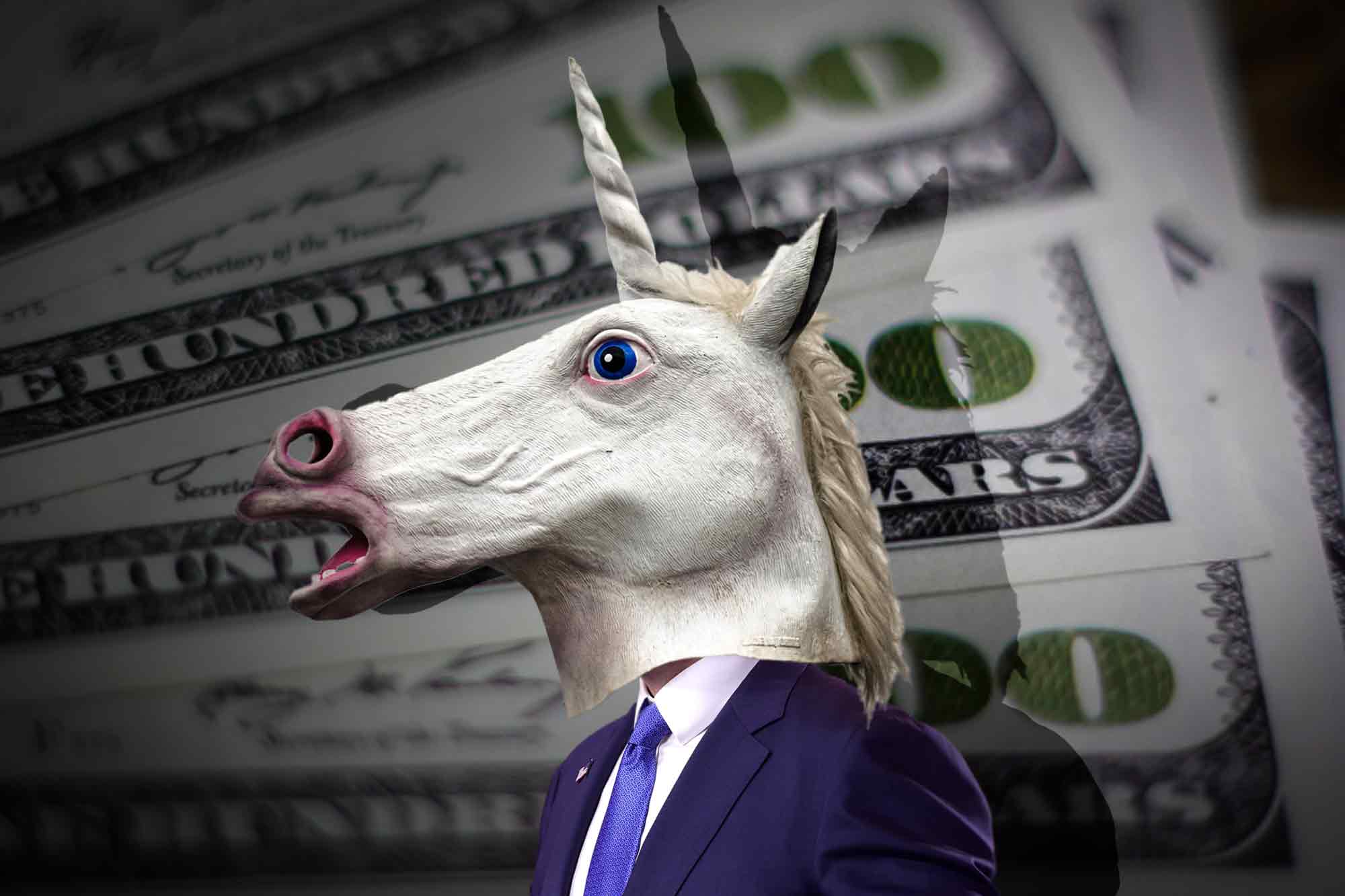
1,500 Companies, $4 Trillion, and No One’s Allowed to Look Under the Hood
The biggest companies shaping how we ride, rent, borrow, and think are private — and private means they owe you nothing. A former SEC director on the economy you’re not allowed to see.
Every morning the business news arrives like a weather report on the powerful: a record IPO, a fresh round of financing, a valuation that would have been unimaginable a decade ago. It reads like a story about winners. It’s actually a story about the dark.
Because underneath the headlines is a quieter fact: The biggest companies now shaping how we ride, rent, borrow, and think are often not public, but private, and private means they owe you almost nothing. No filings, no audited numbers, no reporters allowed inside.
There are more than 1,500 of these “unicorns” carrying over $4 trillion between them, and what most of us actually know about them isn’t a balance sheet. It’s a face, a founding myth, and a promise none of us can check.
And that’s the shift worth staying up at night over: The story has swallowed the numbers. Finance has become a branch of celebrity culture, where a founder’s imagination sells better than any ledger, and the feed you follow shapes belief more reliably than the front page of the Wall Street Journal.
We watched it happen just last week with the collapse of hedge fund Situational Awareness, which Leopold Aschenbrenner founded on the basis of a single essay written in 2024, moving real money on the strength of a vision alone.
We’ve been trained to trust the person the way we trust the personality online, and for 15 years we’ve invested that way too, buying the myth instead of the math.
In this WhoWhatWhy podcast, we’re joined by Renée Jones, who has seen this from the inside. A distinguished legal scholar at Boston College and, from 2021 to 2023, the Securities and Exchange Commission’s director of corporation finance under President Joe Biden — running the division that decides what American companies must tell the public — she’s the author of Untamed Unicorns: Why Startup Finance Is Broken and How to Fix It. WeWork, FTX, Uber in its first generation: We file them as isolated failures of character. Jones says they were the predictable output of 40 years of quiet deregulation.
She explains how Congress dismantled the rules that once forced companies into daylight, why your 401(k) is already tangled up in these private bets without your knowing, and why the last time Wall Street engineered risk into places no one could see turned into the financial crisis of 2008.
The question isn’t whether the next bubble is inflating. It’s who’s left holding it when a company nobody was allowed to watch finally comes apart.
 Apple Podcasts
 Google Podcasts
 RSS
RSS
Full Text Transcript:
Jeff Schechtman: Welcome to the WhoWhatWhy podcast. I’m your host, Jeff Schechtman.
There was a bargain at the heart of American capitalism, and for most of the last century, almost everyone understood the terms. A company that wanted to grow beyond what its founders could finance had to go out and ask strangers for money. And the moment it did that, it owed those strangers the truth. It filed its numbers, it opened its books, it submitted itself to auditors and analysts and reporters, and to a federal agency built in the rubble of 1929 for exactly that purpose. The price of getting big was being seen. Take the numbers away, and something has to fill the vacuum, because money still has to be raised and people still have to be persuaded. What fills it is a story, and a story requires a storyteller.
There has also never been so much money hunting for a story to believe. The venture capitalist who once demanded a board seat and a look at the ledger now stands in line behind hedge funds and sovereign wealth funds, and the private equity industry, which grew up in the shadow of the regulated banks and now lends in the trillions, with almost nobody watching.
We ought to recognize the shape of this. Last time Wall Street built a set of ingenious new instruments that pushed risk into corners where nobody could see it, the year was 2008.
None of this should be a surprise. After all, we live inside a celebrity culture that long ago stopped separating the work from the person who made it, and for a great many people, the feed they follow on Instagram now shapes what they believe far more reliably than anything on the front page of The Wall Street Journal. A country trained to trust faces instead of institutions was always going to put its money the same way. And for fifteen years, that is exactly what we’ve done: investing in personalities instead of in balance sheets.
We saw it up close and personal in these past few weeks with Leopold Aschenbrenner and Situational Awareness. Adam Neumann said he was elevating the world’s consciousness, and the money came, and then more of it came. Sam Altman presides over the most consequential enterprise in artificial intelligence and answers in any binding way to almost no one outside a boardroom. He has already survived once. And Elon Musk kept SpaceX private for the better part of [three] decades before taking it public this June in the largest stock offering in American history, at which point analysts on Wall Street said out loud that they could not make the arithmetic work.
All of this is part of the unicorn story. There are more than 1,500 of these companies now carrying better than $4 trillion between them, and what any of us actually knows about almost all of them is a face, a founding myth, a promise about a future none of us can check, a valuation arrived at by a handful of people in a room with the door closed. We know the names that ended badly, and we recite them like a liturgy: Theranos, WeWork, FTX, Uber in its first incarnation. We file them away the way we filed plane crashes—as isolated events. Many of these we see as isolated failures of character, an unlucky run of reckless people handed extraordinary sums of money.
But my guest today says this approach is a comfort we can no longer afford. She argues that these were not aberrations, but the predictable product of forty years of quiet legal engineering, in which Congress and the Securities and Exchange Commission dismantled, one rule at a time, the machinery that once forced a growing company into the daylight. Deregulation is what opened the door. The cult of the founder is what walked us through it, persuading us over and over to put the arithmetic away and buy the story instead.
My guest, Renée Jones, is professor and distinguished scholar at Boston College of Law, and from [2021] to 2023, she ran the SEC’s Division of Corporation Finance for the Biden administration, leading more than four hundred lawyers, accountants, and analysts charged with deciding what American companies must tell the public. Her new book is Untamed Unicorns: Why Startup Finance Is Broken and How to Fix It. It is my pleasure to welcome Renée Jones here to the WhoWhatWhy podcast.
Renée, thanks so much for joining us.
Renée Jones: Thank you so much for having me. I’m really happy to be here.
Jeff: Well, it is a delight to have you here. Thank you. Before we begin digging into this, explain for our listeners what a unicorn is. It’s one of those phrases that I’m sure they hear all the time, they see all the time. Explain exactly what it is and how that has evolved.
Renée: Sure. Well, a unicorn is a term that was coined to describe a startup company that was valued at a billion dollars or more. And when the term was first coined back in 2013, there were so few of these companies, they were so rare, that the thought was that spotting a multibillion-dollar private company was about as likely as spotting the mythical unicorn.
So while they used to be rare, now they’re actually ubiquitous. There were about forty unicorns back in 2013, when that term was first coined, and now there are more than 1,500—by some counts, 1,600. So they’ve proliferated. They’re everywhere. They’re having a significant impact on our economy, and we don’t know nearly as much as we need to know about these companies and how they’re operated. And I also have concerns about who’s overseeing them, because we used to rely on the venture capitalist investors to provide close oversight of the startups that they funded. But what I found in writing my book is that these investors aren’t really playing that role anymore.
Jeff: What changed in terms of the small number of unicorns that, in fact, gave it the name, as you explain, to so many of them now? What in the financial landscape, the legal landscape, the regulatory landscape changed that made these unicorns so prevalent?
Renée: So I think the main change is that there was much more money available in private markets to finance the growth of startups than there used to be in the past. So it used to be, as you said in your introduction, that if you needed to raise a large amount of money to make your company really grow, you really had to turn to public markets. But that began to change in about 2000, 2010, mainly because of significant changes in the law.
So in my book, I focus on two main changes in the law that led to this proliferation of unicorns. And the first was a 1996 statute that was adopted by Congress, and that’s known as the National Securities Markets Improvement Act, or NSMIA, and that basically lifted the cap that existed on the size of private investment funds, including the number of investors they could have. So after that change in the law, private investment funds, including venture capital funds, grew to enormous sizes, and the amount of money in private markets really took off, growing from about $200 billion right after NSMIA was adopted in 1996 to more than $9 trillion today. So there’s just so much more money in private markets than there used to be before.
And then the second big change that really, I think, allowed the number of unicorns to take off was a 2012 statute that was adopted by Congress, known as the JOBS Act. And what the JOBS Act did is it eliminated a longstanding rule that required a large company with five hundred shareholders or more to register with the SEC and then become a public reporting company. And that’s the rule, the legal provision, that had compelled companies like Google and Facebook to pursue their IPOs. So what the JOBS Act did is it changed that five-hundred-shareholder rule, or that threshold, to a two-thousand-shareholder rule. But very importantly, it excluded employee-held shares from that count. So after the JOBS Act, startups could basically stay private indefinitely. And the average age at IPO expanded from about eight years back in 1996 to about fourteen years in 2025. And SpaceX, I think you mentioned, which went public very recently, was more than twenty years old at the time of its public offering.
And that’s when we saw, after the JOBS Act, the number of unicorns really take off from, like I said, about 40 in 2013, right after the JOBS Act was adopted, to more than 1,500 today.
Jeff: Talk about Rule 144, which also made for employees who were holders of stock in these companies, it made it liquid—that they were able to trade in those stocks essentially without the company being public.
Renée: So securities laws, just to provide a little bit of background, require that every securities transaction be registered unless an exemption is available. So that registration requirement applies when companies are raising money, and if they don’t want to register with the SEC, they have to find an exemption. But it also applies to shareholders. So when they want to resell their shares, they have to find an exemption as well.
So shares that are acquired in private offerings that aren’t registered with the SEC, generally speaking, can’t be resold without registration. And there was a rule you mentioned, Rule 144, which basically provided bright-line guidance as to when you could sell those shares. And when that rule was first adopted, the rule was you had to hold those shares that you acquired in a private offering for three years before you could resell them.
Then the SEC incrementally changed that holding period from three years to two years and then to just one year. So now an employee of a startup that has held their shares for one year can turn around and resell them. And as those changes to Rule 144 occurred, we started to see the development of private trading markets for startup-company shares. And that was something that really didn’t exist in the past.
Jeff: Talk a little bit about why so many of these companies have not wanted to go public, that they have enjoyed being private companies, and what that affords them that really has created these unicorns.
Renée: Not being public, remaining private, provides a lot of benefits to a new company, a company that’s starting up and that’s trying to grow and gain traction in the market. That shroud of secrecy allows startups to engage in anticompetitive behavior.
So, for example, Uber, when it started, charged much-below-market rates for its rides, and that allowed it to grow and push out the traditional taxis in society. So they are offering below-market rates for their products, and then once they gain market share, they turn around and raise the prices. And that’s anticompetitive conduct, but you can engage in that conduct without having to disclose it because you don’t have to disclose your books. So that’s one example.
Another example I provide in my book is that a lot of these startups that are operating innovative or disruptive products and services in established industries are benefiting from being able to challenge or skirt or violate the law. And again, they can do that without detection and without reporting on what they’re doing because they don’t have the disclosure obligations that apply to public companies.
So those are just some of the ways that that provides a benefit. And then also, with respect to financial reporting, there are no standard rules regarding disclosure, audits, public oversight by analysts. And so the valuations in these private markets tend to get very inflated because there’s really nobody to throw cold water on those valuations.
Jeff: One of the other things we’ve seen is that more and more private individuals are able to partake in some of these private companies. And there’s this whole issue of what represents an accredited investor who can do that. Explain that.
Renée: So as I mentioned, every securities transaction has to be registered unless an exemption is available. And the exemption that startups are relying on when they sell shares without registration and without disclosure is the private offering exemption and, more specifically, an SEC safe harbor known as Regulation D.
So under the specific rule of Regulation D, you can sell securities without registration in a transaction where all purchasers are accredited. An accredited investor is an investor that has access to information as an insider of the company, an institutional investor, or an individual with a net worth of $1 million or more, excluding their home, or income of $200,000 or more.
So those income and wealth thresholds were established back in 1982, when Regulation D was first adopted, and they haven’t been adjusted for inflation since. So it used to be a very small segment of American society that qualified as an accredited investor—basically 2 percent of American households. But just because of the erosion of income and wealth standards because of inflation, the number is closer to 30 percent now. So there’s a bigger swath of Americans who are able to purchase securities in these private transactions. And for a Rule 506 transaction that’s sold only to accredited investors, there’s no disclosure required at all to those investors or to the public.
Jeff: The argument is made on the other side that, by keeping that simple, by keeping it the way it is now, that it democratizes the ability of individuals to partake in these companies.
Renée: Right, that’s an argument that we hear because the accredited investor standard is a wealth and income standard. It’s not really based on your sophistication or your ability to understand the risks. And so some people argue that that sort of arbitrary rule is keeping ordinary investors who are prepared to take those risks, who may be financially sophisticated, from participating in private markets.
That’s a bit of a red herring. Generally speaking, the startups that are raising tens of billions or billions of dollars in private markets are generally only interested in dealing with large institutional investors: venture capitalists, hedge funds, and sovereign wealth funds, et cetera, and they’re not really interested in selling securities to individuals, so to a person who earns $200,000 or more.
To the extent that private markets are going to be opened up to what we call retail investors, ordinary investors, there’s a concern that there’s going to be what we call an adverse-selection problem, or a lemons problem, and that the retail investors are going to be offered the opportunities that the more sophisticated investors have already passed on. So they’re just going to be getting the crumbs and not sitting at the table eating steak.
Jeff: And this goes hand in hand with what you were talking about before with respect to the JOBS Act, because you have more and more individual investors that are able to participate in this. The cap tables keep growing and growing and growing.
Renée: Right. So the five-hundred-shareholder rule that existed up until 2012 was sort of a brake. It basically was a disciplining mechanism in many ways. It really required that a startup, as it grew, as it had more employees, as it was offering stock options or stock to its employees, understood that when it reached that five-hundred threshold, it was going to have to go public. And so it really had to professionalize as it reached that threshold.
But when we got to a two-thousand-shareholder threshold and we don’t count employee shares, there’s really not that incentive to grow and to mature and to bureaucratize and professionalize as a startup grows.
What we see now is that these startups, the well-known startups, are staying private for so long that interest in acquiring their shares is growing among ordinary retail investors because they’ve heard about these companies, they sound really valuable. They want to get in on the ground floor and not have to wait for the public offering. They think that they want the opportunity, for example, to invest in the next Facebook before the public offering. And so what we’ve seen develop are these private trading markets where a regular retail investor can go online at a company like EquityZen or Forge Global, and they can bid, or they have the opportunity to buy those shares, as long as they meet certain wealth and income standards.
But the problem with those markets is there’s not sufficient information about the company, its prospective valuation, the management, to allow those investors to make intelligent investment decisions. So whether you’re selling shares in those private markets or buying shares in those private markets, there’s a huge risk that you’re not going to be well informed. And there’s also a risk that the person that you’re trading with does have access to better information than you do.
Jeff: And because those markets exist, in many cases, it’s employees of companies that are doing some of the trading and some of the bidding in those markets, often with more information than the investor has.
Renée: Those private trading markets have provided sort of an off-ramp for employees, early investors, and even founders to liquidate or to convert their holdings into cash. So whereas the IPO used to be the moment in time where all of those investors were able to cash in, now we’re seeing these early investors cashing in early by selling some of their shares or a portion of the shares on these private trading markets.
Another important point about these private trading markets is that they function in a way to evade that two-thousand-shareholder rule. So instead of one shareholder or an employee selling his or her shares on the market to another individual investor, which would increase the number of shareholders, typically the private trading markets create what we call special-purpose vehicles or partnerships, where all the shares are put into one entity that counts as one shareholder, and then interests in that entity, that partnership, are sold to individual investors. So instead of counting a hundred investors who are investing in that partnership, it only counts as one investor, keeping the startup shareholder count under two thousand shareholders.
Jeff: Lest anybody think that the average investor is not part of this, in many ways, they are, because 401(k)s and mutual funds are often very much a part of this whole financing scheme that goes on for these companies before they go public.
Renée: That’s one thing I think that a lot of ordinary investors, again, don’t understand. So people who are investing in mutual funds, who are saving for college or to purchase a home or saving for their retirement in a mutual fund run by Fidelity or Vanguard, might unwittingly also be investors in startup companies because, again, there are fewer companies going public. So there are fewer public companies to invest in, and mutual funds decided that they wanted to get in on the ground floor, or at least get in early, on some of these very hot, very successful, and what they expected to be very sought-after startups. So mutual funds started investing in startups, usually at a later stage in the startup life. So companies like Fidelity and Vanguard and T. Rowe Price purchased shares in Uber and WeWork. And in many of those instances, those investments didn’t really work out very well.
Jeff: Are we seeing a trend now of more companies going public? We’ve seen it with SpaceX, and we hear about the AI companies that may or may not go public within the next twelve to eighteen months. Is the trend now toward some of these companies going public, or do you see this trend that we’ve been talking about continuing?
Renée: So what I would say is, generally speaking, the number of public companies is much lower than it was back in 1996. There were about eight thousand public companies in 1986, and there are about four thousand today. And the number of IPOs per year is also significantly lower than it was back in 1996.
Now, in 2020 and 2021, we saw a bit of a spike in IPOs, but that has tapered off. One thing that has changed is that it used to be the case that tech companies really didn’t need a lot of cash. They were sort of capital-light institutions, so they could operate and grow without a huge amount of capital investment. But with the AI boom, we’re seeing that change. We’re seeing that these companies need to raise a lot of money. They’re raising a lot of money in private markets. They’re borrowing a lot of money to build data centers and purchase chips, et cetera. And so that’s why we’re seeing some of these AI-based companies sort of inching toward the public markets. They really do need that capital, which is a change.
Jeff: Is that taking money out of public markets, and is it having an effect on the overall markets and corporate America outside of these highly capital-intensive companies?
Renée: Well, what I would say is what we’re really seeing is that much more capital is being raised each year in private markets than in public markets. There are fewer public companies than there were in the past, so there are fewer investment options. And a lot of the growth is taking place in the private markets. And when a company goes public, it’s at a late stage, and a lot of the growth opportunities have already been lost.
So that’s, again, some of the rationale behind arguments to let retail investors into private markets. But the best solution, a better solution, would be to encourage or force or require these large private companies that have the capacity to provide that disclosure, where the cost is not going to be that significant, to go public, or at least to make public disclosure so that when retail investors do invest, they’re well informed.
Jeff: When we look at this from a thirty-thousand-foot view, should we be concerned that this is about transparency and accountability and the fact that some of these private companies, some of these unicorns, are having a profound effect in shaping technology and various other aspects of society? Or should we look at it strictly as a financial situation, in which case we’re concerned about the next Theranos or the next WeWork? Should we look at it as a business proposition or something larger than that?
Renée: I think it’s both. I think from a business perspective, it’s generally unwise for investors to be flying blind, and for investors to have their hands tied behind their back, not have the power to provide oversight or accountability for firms, whether they’re public or private firms. And if investors are flying blind and they don’t have sufficient power to provide oversight, what we’re going to see is a lot of misallocations of capital, where billions of dollars or tens of billions of dollars are invested in companies that don’t have sound business plans, and they just keep growing. And then at some point, for example, with WeWork, everything sort of blows up. So that’s one concern: just the concern about investors, the concern about allocation of capital.
But a bigger concern, a much broader concern, is the question of transparency and the question of corporate accountability more broadly. So one of the problems that we’ve seen with some of these unicorns, and I’ve already referred to this, is many of them are engaging in disruptive conduct. They are moving into industries that are not complying with the law. They’re not necessarily paying taxes. They may be misclassifying their workers as gig workers or contractors instead of as employees. So that actually has profound effects on the public as well.
So I think if we had better transparency, regulators would have a better opportunity to keep tabs on what’s going on and to step in and provide enforcement or discipline before the unicorns got so large that they were able to outmaneuver and sort of—
Jeff: I guess the question is, what becomes the better story to impact change? Is it the story about transparency and corporate governance, which has a limited appeal in the public imagination? Or is it the story about potential financial disasters in 2008 that has the stronger impact to generate change?
Renée: I think the strongest story takes us back to 1929 and why the securities laws were adopted in the first place. The whole system of securities law is based upon disclosure. And it’s the disclosure system, plus corporate governance rules imposed by Congress and the SEC, that provides a measure of corporate accountability. To the extent that we start to dismantle that system and eliminate that transparency and those corporate accountability rules, that creates dangers for the economy and then, of course, for broader society.
So a big concern is that, for example, we’re experiencing a bubble in AI. And then when that bubble explodes, a lot of us ordinary investors, people saving for retirement, are going to suffer.
Jeff: Talk a little bit about whether or not we should be looking at this as something where we also have to change the corporate accountability rules—that maybe those rules have become such an impediment to companies going public that we need to look at those. Somebody had suggested—I mean, maybe it came from the White House; I don’t remember—that maybe instead of quarterly reporting, companies could do semiannual reporting. The idea of changing the rules to make going public less onerous but provide the appropriate transparency.
Renée: So I think there you’re talking about some SEC reforms that have recently been proposed that are open for public comment. Those reforms are premised on the idea that we have to make IPOs great again. It’s premised on the argument that’s promoted by the SEC chair that overregulation is what’s deterring companies from going public. But I argue instead that it’s deregulation that’s responsible for those changes. So if we want more companies to go public, we should look at some of those deregulatory reforms and reconsider them.
And then, as far as accountability, a big problem that I’m seeing is that some of the governance structures that have become standard for unicorns—mainly the founder-friendly financing model, where founders get shares with supervoting power, meaning they have the ability to control the board of directors—essentially has disabled their venture capitalists and other investors from providing appropriate discipline over the founder. Because if a founder controls the board, they can essentially choose their bosses. And it’s much harder to discipline or dismiss an underperforming or unethical founder.
Jeff: Talk about board reform and what you think needs to be done there, because in a way, that’s where it all starts.
Renée: Yeah. So with this trend of more money in private markets and larger investment funds and more private funds, more types of private funds interested in investing in startups, these investors are competing for the opportunity to get in on the most attractive deals. And so they’ve shifted from a system of investor control to a system of founder control. And that really disables those investors from providing the oversight and discipline which is really necessary to ensure that these companies are being run effectively and efficiently and that they have viable business plans.
What we’re seeing is that this dual-class capital structure, which became popular in private companies, we’re now seeing in the public markets. And that’s really distorting the basic principles of corporate law, where founders are retaining their control after the public offering and state laws are changing to accommodate those founders’ desire for continued control.
Jeff: We also have companies that—and we’ve seen the beginnings of this or the stirrings of this—are beginning to shop around for what state they want to be based in.
Renée: So we’ve seen, where a state, Delaware—which is the dominant state for corporate law—started to crack down on these founder-control arrangements, other states that wanted to compete and attract corporations to their state—mostly Nevada and Texas—adopt more accommodating rules to accommodate this founder control versus investor control.
Jeff: The founder-control aspect of it goes back to this whole notion that I talked about in the introduction of corporate mythology and personality and stories. I mean, SpaceX is perhaps the penultimate example, where it’s selling the future, it’s selling Elon Musk’s imagination, essentially, certainly not the balance sheet.
Renée: Exactly. There’s a lot of mythology built around the founders of these companies. These founders tend to have outsized personalities. They tend to be good motivators or strong motivators, and they tend to be strong salespeople that are strong fundraisers. And again, because there’s so much competition for the opportunity to invest in these companies, they are able to acquire outsized power compared to their financial investments or their management experience. And that’s where we’ve seen the implosion of companies like Theranos, like WeWork, and like FTX, because the founders have been given unfettered control and the investors tend to be asleep at the switch, or at least looking the other way at potential problems and misconduct.
Jeff: What about the fact that so many of these companies are global companies nowadays and are subject not only to regulation in the US, but EU regulation, regulation in other parts of the world? What impact does that have?
Renée: That’s a very interesting question, and I think two examples can show how some of the strategies that startups use to evade regulation or enforcement in the US tend to catch up with them when they start to operate around the globe.
Uber, for example, as I mentioned, didn’t want to comply with taxi regulations in the US and, generally speaking, was very successful in outmaneuvering local and state regulators. But they did run into trouble abroad in Denmark, for example, in France, and in England, where the governments there weren’t so willing to bend to the will of Uber.
And then Airbnb, I think, is maybe a better example, because Airbnb was not necessarily complying with local regulations about short-term rentals or local regulations about taxes, hospitality taxes, and things like that. And again, they were able to run a little bit roughshod over US state and local regulators. But then abroad, we’ve seen countries like Spain, and Barcelona and other countries, really cracking down on Airbnb. So it seems like when you go onto the global stage and try to employ those same tactics, they’re not necessarily as successful abroad as they have been here in the US.
Jeff: And will that ricochet back to having better regulation here in the US? Because if these companies have to comply within one jurisdiction, isn’t it easier to comply consistently across all jurisdictions?
Renée: I mean, we have seen in the US, for example—well, attempts to regulate Uber have been a little bit less successful. California and Massachusetts and New York all tried to crack down and ended up, in most instances, finding compromises. But with respect to Airbnb, we’ve seen New York crack down. We’ve seen other states and local areas, especially tourist areas, crack down on Airbnb.
But these companies are huge, and they have a lot of power, and they’re very popular with their customers and with their platform users, their drivers or their hosts. And so regulating them has been, I think, more of a challenge in the US than it has been abroad, where, for whatever reason, foreign regulators are much more willing to crack down.
Jeff: Again, it comes back to this idea of popularity, whether it’s the company being popular and the service it provides, or whether it’s the founder being popular.
Renée: It’s a little bit of both, and it’s money in politics. I think there’s a lot at play.
Jeff: What is it going to take, in your view, to change any of this, getting back to the regulatory regime here and this whole issue of private companies versus public companies? Is there any reason to assume anything is going to change within this framework? What is the incentive? I mean, it seems like it’s only disaster: we talked about 1929 before, 2008, which gave us Dodd-Frank and some other things—that short of a disaster, nothing really seems to change fundamentally.
Renée: I’m a little bit more optimistic than you about this because the changes that I’ve recommended in my book have mostly been floating around for a while. Some have been proposed by the SEC but not adopted. Some have been developed within the SEC but not formally proposed. So I think we have some solid ideas that are well developed, most of which can be implemented by the SEC, a few of which would have to be implemented by Congress.
Now, the current SEC, as you mentioned, has taken the position that the way to encourage more public companies is to make public markets more like private markets by slashing dramatically the disclosure requirements. You mentioned moving from quarterly reporting to semiannual reporting. That’s just going to leave investors in the dark. So those changes, if they’re adopted, are probably not really going to help the economy or the securities markets because they’re just providing a greater shroud over corporate operations.
But if we had a change in administration and a change in leadership at the SEC, adopting these reforms is certainly a realistic prospect. So hopefully that type of change in leadership won’t require a crisis to bring it about. I’m really hoping that our economy and our markets continue to thrive, as they have since the securities laws were adopted back in the 1930s. But it may be—and my experience as a law professor has been that it’s been a major crisis, a major drop in stock markets, a major drop in investor confidence, that tends to lead to serious changes, serious reforms in the securities laws.
Jeff: And finally, talk a little bit about the shock to the system, if there was one for you, going from being a law professor to working inside government and seeing how the sausage truly gets made.
Renée: So, as you mentioned, for the first two years of the Biden administration, I served as the director of the Division of Corporation Finance at the SEC, and in that role was responsible for overseeing our disclosure review program, which is where our attorneys and accountants review corporate disclosure documents to ensure that they were complying with the securities laws. And again, it’s just to ensure that investors are getting the information that they need and that the information, to the extent that the SEC has the ability to determine, is reliable.
And I also was responsible for overseeing policy initiatives, recommending changes to rules or new rules to improve investor protection. And overseeing that policy process, or rulemaking process, was really eye-opening—to get to see exactly, as you said, how the sausage is made: how an idea gets developed into a set of policy points, then that gets developed into a proposed rule that goes out for public comment, and then how the SEC staff and commissioners respond to those comments to fashion a final rule that then has to go, again, back to the commission for approval.
It’s a really interesting process. It’s a really involved process. There are lots of points of view. There are lots of participants. But it was, like I said, an eye-opening and really educational experience for me—I really loved it. It was like a once-in-a-lifetime opportunity from a career perspective.
Jeff: Renée Jones. Her book is Untamed Unicorns: Why Startup Finance Is Broken and How to Fix It. Renée, I thank you so much for spending time with us.
Renée: Thank you so much for having me.
Jeff: Thank you. And thank you for listening and joining us here on the WhoWhatWhy podcast. I hope you join us next week for another WhoWhatWhy podcast. I’m Jeff Schechtman. If you like this podcast, please feel free to share and help others find it by rating and reviewing it on iTunes. You can also support this podcast and all the work we do by going to WhoWhatWhy.org/donate.