After 250 Years: The American Origins of Fascism
What if the roots of fascism weren’t European at all, but embedded in America’s founding struggles over democracy and race?
For more than a decade, we’ve been flooded with books warning about fascism — how to recognize it, how it spreads, how democracies lose their way. Almost all begin with the same assumption: Fascism was a European creation that eventually washed up on American shores.
Joseph Kelly says we’ve got it backwards.
Kelly, a professor at the College of Charleston and author of The Biggest Lie: The Prehistory of American Fascism 1818-1915, began writing a history of the 1920s and 30s. But every thread he pulled led somewhere earlier — past the World Wars, past the Ku Klux Klan, deep into the 19th-century South — until he found himself asking a far more unsettling question: What if America wasn’t simply influenced by fascism? What if it helped invent the political playbook that Europe later embraced?
In this week’s WhoWhatWhy podcast, Kelly traces that story from the compromises over slavery at the 1787 Constitutional Convention to the post-Civil War politics of Jim Crow and beyond. He explains why fascism is less an ideology than a corruption of democracy itself, why “the Big Lie” has such enduring political power, and why Hitler looked to the American South not simply as an observer, but as an admirer.
Kelly insists this isn’t a book about today’s politics. It’s about how democracies convince themselves that dangerous ideas will simply fade away — and what happens when they don’t. It’s an argument about American history that may change the way you think about American democracy itself.
 Apple Podcasts
 Google Podcasts
 RSS
RSS
Full Text Transcript:
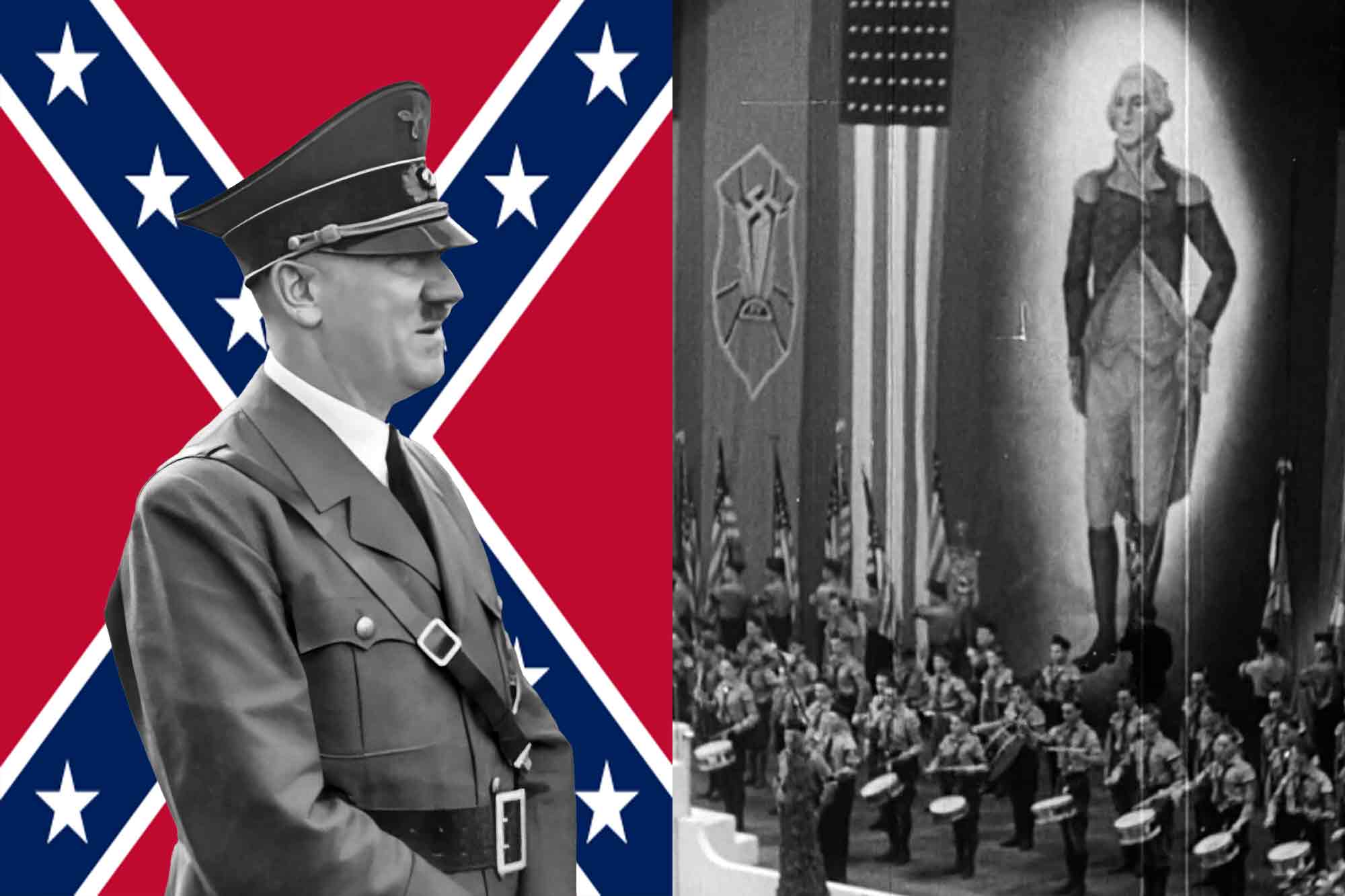
Jeff Schechtman: Welcome to the WhoWhatWhy podcast. I’m your host, Jeff Schechtman. There is an old American faith, and it is not liberty and it is not equality. It is the belief that time is on our side, that the arc bends towards justice on its own, that the ugly thing in the corner of the room is a holdover, a remnant, something the next generation will find embarrassing and the one after that won’t remember at all. In 1787, they said it about slavery. Don’t write it into the document. Don’t fight about it. In Philadelphia, the soil is exhausted and the economics are failing. It will die out on its own. In 1939, they said it about 20,000 people who filled Madison Square Garden under a portrait of George Washington hung between two swastikas. Foreign fringe. Un-American. It will die out on its own. It did not die out on its own. Nothing does.
That’s my guest’s argument, and it’s the harder one, because it means that the thing we keep waiting to expire has been alive here the whole time, and it was never an import. Joseph Kelly takes us back to the Missouri Crisis, to the moment the men who owned the plantation stopped apologizing and started preaching. Slavery is not a regrettable inheritance, they said. It is the natural order. Some men are born to govern and others to be governed. And this country belongs by right to one race alone. They built the machinery to protect that sentence: the mobs, the burned mail, the beatings handed to their own neighbors who said otherwise out loud. They lost the war, but they did not lose the argument. And by 1915, it had gone north, gone respectable, and settled into the immigration statutes and the science journals and the movie houses of the entire country.
And here is the part that my guest’s book stopped short of, because history books have to stop somewhere. The Garden is still there. The rallies still fill it. The language of blood and soil, which we last heard chanted by torchlight in Charlottesville, has migrated from the torches to the podium, and the men who use it are not fringe and not foreign and not embarrassed. The fight over who counts as real Americans is being conducted now the way it was conducted then, which is to say, not with an argument but with a rule book. Who may register? Who may vote? Which ballots are counted and which are set aside? The framers understood something that took the rest of us two centuries to catch up to. You don’t have to win the country’s mind if you write the rules about who gets to speak. Which leaves the question the founders handed us and never answered: If it doesn’t die out on its own, who kills it?
My guest, Joseph Kelly, is a professor at the College of Charleston who has spent twenty-five years writing about American democracy and the people who have tried to end it. His previous books are Marooned and America’s Longest Siege. His latest work is The Biggest Lie: The Prehistory of American Fascism, 1818–1915. Joseph Kelly, thanks so much for joining us here on the WhoWhatWhy podcast.
Joseph Kelly: Well, thanks for having me. I really appreciate the opportunity.
Jeff: Well, it is a delight to have you. Thank you. Let me start with this core idea that fascism wasn’t something that just came from Europe in the 1930s, but that it has a very American genealogy to it. Talk about that in a general sense first.
Joseph: Yeah. The original idea for this book came from the discussions about fascism that arose during Donald Trump’s first term and that whole giant slew of really interesting books that came out—what I call a mini genre of history now, the warnings about fascism: The Anatomy of Fascism, How Fascism Works, Fascism: A Warning by Madeleine Albright. It goes on and on. There’s been tons of them. And one of the things that struck me about those books was that they treated fascism more or less as an import to American politics in the second decade of the twentieth century and into the third decade. To some very large extent, I think I’m indebted to those writers. But as I started looking at it, I wanted to write a book about the 1920s and ’30s and about the struggle between those who were promoting a new, modern liberal democracy and those who were promoting an authoritarian, ethnocentric nationalism, an Anglo-Saxon nationalism. The first chapter was going to set the stage, and it was going to be about The Birth of a Nation—comes out in 1915—sort of the epic tale of America’s origin, the birth of America as this Anglo-Saxon nation. So I was going to try to set the stage for the seriousness of the threat of authoritarianism and ethnonationalism in the United States right after World War I. I started writing that chapter, and what happened is I started moving further away from the 1920s and ’30s and started going backwards. I started tugging on the roots of the fascism that we see very evident in the 1920s and 1930s, and it went back and back and back, and pretty soon we were back into what I consider sort of my natural historical wheelhouse, which is nineteenth-century Southern American history.
I started seeing everything that we associate with fascism in the twentieth century and as a European import to American politics—what Robert Paxton calls “the passions” or, in a really beautiful metaphor, he calls it the emotional lava that is percolating underneath a fascist society and is necessary for fascism to take hold. These are things like an intense tribal feeling, the feeling that your people are getting replaced by somebody else, that fear of decline and replacement, a disbelief that politics as usual can meet this crisis, so that leads to a conviction that extrajudicial violence is not only justified but manly. There’s a very strong sense of masculinity that goes along with this. And it goes on and on. Each of these things that we associate with Mussolini, with Hitler, and with twentieth- and twenty-first-century fascism, I was finding in American Southern history. And it’s not like nobody knows these things were there. But looking at it through the lens of the early twentieth century and looking back, it became very evident to me that fascism is a disease of democracy. It really needs a democracy to take hold because it’s a deformation of democracy. And it got invented, I think the seed was planted and then it was incubated in the American South. It was not Hitler’s Germany. It was not Mussolini’s Italy. We did it right here at home. And in many ways, we can look at the American South as a nation within a nation where we were experimenting with this type of government. And the rest of the country at first gave a wink to it and then gave more than a wink to it. It gave it its blessing in certain periods in American history. After the Dred Scott decision, after the Plessy v. Ferguson decision of the Supreme Court, we see the floodgates opening to let this type of nationalism spread out of the South and into the rest of the country.
Jeff: And to what extent do you think that fascism, as it happened in Europe in the late 1920s and 1930s, was in any way connected to what was happening in the US, or did it simply evolve there simultaneously?
Joseph: Well, I think it probably would have evolved there with or without the US I don’t think they needed the Confederacy or the Jim Crow South in order to do what they did. But we certainly know, especially in the case of Hitler, that he was very aware of the racial laws in the Jim Crow South. He was very much in favor of that. One of his favorite films was Gone with the Wind. And it occasioned… There’s this kind of apocryphal anecdote associated with Hitler that was attributed to Hitler in 1940, I think it was, that he thought the wrong side had won the Civil War, and if only the South had won, then the United States would have been set on the correct track. So he looked at the American South as a predecessor to what he was doing. Now, I don’t think that means we can blame Nazism on the Jim Crow South or something like that. But he certainly felt there was an intellectual, ideological connection—an affinity between the two.
Jeff: Part of the underlying framework, as you talk about it, goes all the way back to the founders and the framers of the Constitution and the decisions that they made about slavery. Talk about that.
Joseph: Yeah. In many ways, this is kind of a book about ideas, a history of ideas, where two different narratives of American history are competing with each other. And the original narrative is the narrative that is set in motion in the years just before the Revolution and then certainly gets ramped up by the rhetoric of the Revolution. And that story says that slavery was an evil that was visited upon this country by a foreign power in the colonial stage. So when the republic gets established on July 4, 1776, it inherits this incredibly difficult and entrenched problem to deal with. Everybody recognizes that slavery is inherently inimical to the ideals of republicanism, most especially that maxim from which everything else descends in the Declaration of Independence: that all men are created equal. And if you want to get into it, we could talk about what they meant by equal in the 1770s and the 1780s. But that’s the narrative.
Actually, Jefferson wrote it into the Declaration of Independence, and it gets written out because of the work of delegates from South Carolina and Georgia. So the rest of the colonies wanted to leave in the final grievance against King George. The proof that he was a tyrant is that he established the slave trade and visited it upon America. And the language—I don’t have it in front of me, so this is a paraphrase—but the language of that grievance against King George is that men have been kidnapped from Africa and dragged against their will to be enslaved here. They have been dragged out of Africa and brought to America. And that grievance uses the word “men” in it—the very same word that is operative: “All men are created equal.” So we see “men” in the beginning, and we see “men” again at the end of the Declaration. So it’s very clear that Thomas Jefferson and John Adams and Benjamin Franklin all meant to include enslaved Black people in the United States within that category of men: that all men are created equal.
So this is the narrative that dominates public discourse in the United States for a couple generations: that this is a really difficult problem. We can’t just declare all the enslaved Black people in the country free overnight because that’s going to cause so much social disruption. We can do it in those states that have a relatively small population of Black people, but if you do it in South Carolina, for instance, where there’s a majority of Black people, that’s going to be incredibly disruptive. And people like Thomas Jefferson, for instance, think it’s going to be impossible to actually have a biracial republic work because white people have visited so many sins against Black people that once we made Black people partners in this republic, they are going to have so many axes to grind, so many wounds that have not healed that they want to seek vengeance on, that a biracial republic would not work. So his reason, of course, that the biracial republic would not work is because white people had been so horrible to Black people. It was not because Black people did not have the capacity for self-government, or they didn’t have the moral standing, or they didn’t have the intellectual capacity to enter into the social contract. It was because of the crimes that white people had committed that they would seek justice for.
Jeff: How did this line up with the idea, the argument that slavery would just go away—that if we just don’t deal with it, it’ll just die out? That the economics of it were changing, that technology at the time was changing, that it would just go away. The problem would not exist.
Joseph: Yeah. I mean, we look at that now as kind of a naive and maybe evasive expectation. W. E. B. Du Bois, in his dissertation that he wrote for Harvard, actually talks about this and says this is a great moral failing. They should have dealt with it right then because, by not dealing with it, they let it get entrenched, especially economically. And it got more and more entrenched. It got more and more difficult to solve that problem. So, in some ways, it’s certainly naive to think, “Okay, we’ll just neglect this and the problem will solve itself.” On the other hand, in many ways it was. I mean, a lot of slave owners were naturally radicalized by the Revolution and became real republicans who believed very fervently in the notion that all men are created equal. So they knew that they were stealing the right of sovereignty from Black Africans. And we see all sorts of individual, private manumissions and what Thomas Jefferson called the mollifying of slavery. On the fringes, it started unraveling. And this was very concerning to those planters who wanted to perpetuate slavery for economic reasons. They saw what we might call the liberalizing of the institution, if you can talk about the liberalizing of the institution of slavery. Certainly conditions were better for enslaved people twenty years after the Revolution than they were twenty years before the Revolution.
What happens in 1818, as the country begins debating, “What are we going to do about Missouri?”—this seems to bring things to a head. We’ve got to decide what we are going to do. We’re either going to really get serious about emancipation or we’re going to live with slavery for the rest of the nation’s history. So, I mean, that’s what sort of brings the question into the forefront of public consciousness in a very acute fashion. And this is where we begin to see the planters actually recognize, “Oh my God, there’s a real serious chance that this institution is going to go away,” because so much public sentiment is against it that now people are trying to figure out a way to actually get rid of it. And that’s where we begin to see a new narrative of American history take shape. At first, it’s just a few people who are espousing it, and they’re throwing up almost like what we would call trial balloons today. And then it begins to take hold, and it takes hold very quickly, so that by the mid-1830s—let’s say from 1818 to 1835, this new narrative of American history is getting tried out, and it’s succeeding in individual places in the American South. And then 1835 is a very critical year because the abolition movement really mobilizes then. And because of the mobilization of the abolition movement where they actually start campaigning in the South to win over the hearts and minds, especially of the 75 percent of white people who don’t own slaves in the South. That makes a great crisis in the South. That’s one of those moments in American history. It’s a critical moment that after 1835, compared to before 1835, it’s almost night and day. It becomes, by the time you get to 1840, impossible in the American South to espouse the philosophy that all men are created equal. If you are making that argument loudly and in public, you’re imperiling your life.
Jeff: Talk about that—the fact that, really as a first phase of this, it was really the pushback from white Southerners that began the chain of events that ultimately became so awful.
Joseph: Yeah. This is why I say the story begins in 1818, even though the first chapter of my book is about the Declaration and what was meant by equality in the first generation of the republic. But really, there was a particular trial in Maryland, in a rural county in Maryland, where a Methodist preacher, at what we would call a revival, preached that you cannot hold the Declaration of Independence in one hand and, in the other hand, hold the bloody whip. So, in other words, this country cannot be a republic and be a slaveocracy at the same time. We have to get rid of one or the other. And this is a very conventional argument. It’s the very argument that Thomas Jefferson made in his Notes on the State of Virginia. Everybody made this argument. There was nothing radical about that. But these particular planters got pissed off at him. And this is, of course, because of the context of the Missouri debate. So they trump up charges that he was trying to incite an insurrection among the Black Americans who happened to be in attendance at this revival. So this Reverend Gruber gets accused of inciting an insurrection. And this becomes a really important case; it’s an early First Amendment case demonstrating whether or not people can talk about things, talk about important public policy issues that are controversial in the public. I mean, it’s not the trial of the century or anything like that, but it’s a pretty important trial. There’s a guy named Roger Taney who’s hired for the defense, and he does a brilliant job. The defense quotes Thomas Jefferson, and they say Thomas Jefferson himself said he trembles for his country when he thinks God is just and his justice will not sleep forever. I forget the exact phrase, but the idea is we have been—this republic has been—visiting an injustice against Black Americans for generations. And we know it’s an injustice. So for Reverend Gruber to preach this, there’s nothing new about that. What’s new is that he gets prosecuted.
In a way, it’s almost—not even almost, I think it’s analogous to what’s going on today, where we look at protesters who are facing trumped-up charges of terrorism or trying to kill ICE agents or something, or attack ICE agents, merely because they’re protesting. So they’re exercising their First Amendment rights, and this is now getting trumped up into a crime.
So this is what happens in 1818. Now, Gruber wins. The First Amendment wins in 1818. But in a way, that’s sort of the last great victory in the American South for the vindication of the right of free speech, because two years later, there’s a senator from South Carolina who makes a speech: it’s almost unrecognized—it doesn’t make a splash. A guy named William Smith makes the speech in the Senate that declares that all men are not created equal. This is a very early instance of the undoing of the Declaration of Independence and the start of a new narrative. So, in essence, he’s answering Reverend Gruber’s conundrum: We can’t hold the Declaration in one hand and the whip in the other. And he’s saying, “You’re right. We have to put down the Declaration of Independence so we can hold the whip.” And that new narrative, of course—what that says is that Black people are incapable of sovereignty. They are incapable of governing themselves, and they are certainly incapable of participating in the governance of white people.
So it’s at that moment that the notion of racial differences becomes so dramatic in mainstream white Southern culture. That’s where it really starts. That’s where it becomes okay to be saying these things in public for the first time. Then we see this new notion about Black primitiveness, about Black inferiority, taking hold and kind of exploding into this elaborate—really, what we call the science of anthropology—that is set up to prove that Black people are born to be enslaved by white people.
Jeff: As we look at this today, talk about the impact of essentially what amounts to two founding narratives running in permanent conflict with each other.
Joseph: Yeah. And this is an idea that’s at the center of a couple of really important books that influenced me. One is How the South Won the Civil War by Heather Cox Richardson. The other, by Steven Hahn, is Illiberal America. Both of those books are arguing that these two forces have been at it for 400 years of American history. As Heather Cox Richardson said, I think near the end of How the South Won the Civil War, this has been a battle between those people who believe that all men are created equal and those people who do not believe that all men are created equal. And I think that’s a good way to put it.
So, in some sense, yes, it has been going on, I think, for 400 years. I think it becomes particularly acute in the century of history that I’m looking at. And what’s really troubling about that century is that’s where we invent this modern, twentieth-century ideology that we call fascism. We plant the seed, we incubate it, then we nurture it, we really perfect it. So by the time we get to the turn of the twentieth century and the Spanish-American War, the Spanish-American War becomes possible. And this Anglo empire that is established and is behind all the rhetoric of the overseas expansion of the United States, that’s possible because of, you called it a rule book in your introduction, which I think is a good way to think about it; I think about it as a playbook—the antebellum South and then especially the Jim Crow South, where the playbook was written for this kind of politics.
And so when we get to the early twentieth century, the plays that are going to succeed are really laid down, and the plays that are not going to succeed are figured out, and the methodology of fascism, if you will, has become honed to an art in the United States.
The most important play in that playbook is this fear of replacement: that we have to control Black people, because if we don’t—if we let them do what they want—their animal instincts are going to be unchecked. And what that’s going to lead to—it’s amazing how often, when you get into the rhetoric through the nineteenth century, it always comes down to sexual terms—what’s going to happen is the Black man is going to sneak into your bedroom, and he’s going to slit your throat, and he’s going to throw your wife over his shoulder and carry her out as a sex slave, put her on a boat, and sail to Haiti or something, that was the story in one supposed slave rebellion. But some version of that story—that’s the core story that justifies lynching in the Jim Crow era: the protection of white women. We have to use this kind of extrajudicial violence because the courts can’t actually control the behavior of Black people. The only way to do it is through the threat of this horrific thing that we call lynching. That’s a lie that is exposed by folks like Ida B. Wells in the 1880s and the 1890s.
But that’s the main play in the playbook, and it’s incredible how successful that play is. It’s the same play that we saw a version of when there were stories told about Haitians kidnapping people’s pets and eating them before the last election, which, even as they were telling it, they were more or less, with a wink, admitting that these were lies, but they’re going to go on telling it anyway. And they’ve never, never really been called to account for that kind of thing. I mean, that one’s almost comical, but you get away with that, and then you can go on to the next one, and you can go on to the next one. And, of course, I mean, what is the narrative about immigration today? It’s that we’re going to let rapists come into the country. That’s the visceral fear that is going to excite people to do things that are really criminal.
Jeff: As you look at this history and you look at it from the lens of where we are today in 2026, talk about how it changes your perception—or shapes your perception, I should say—of where we are today.
Joseph: Yeah. I kind of address this question in the very beginning of the book, and I address it by avoiding it. I talk about January 6th in the introduction to the book, but then I say, “This is not a book about MAGA. It’s not a book about today’s Republican Party. It’s not a book about Donald Trump.” Nevertheless, I think there are lessons to be learned, and I think that’s true of any historian. No matter what you’re writing—you could be writing the history of ancient Greece—you’re really talking about your own contemporary times. That’s why you’re writing it. And I say I’ll leave it to the reader to figure those things out, but I feel like maybe I have more license on a program like this to kind of divulge what I think those lessons are.
There are two things that I take out of this. One is, we know the playbook because we’ve seen it. And essentially, my book is about how this has been going on now for 200 years in American history. I bring this up to the early 1920s, and 100 years later, we’re still seeing this. It’s shocking to people of our generation. It was mind-boggling to me watching what we call the Big Lie first get repudiated by leaders in the Republican Party and then get embraced by leaders of the Republican Party. So we know that they know that they’re lying that they think that the 2020 election was stolen, and yet they do it anyway. This was absolutely mind-boggling to me. But if we put it into this history, then it makes perfect sense.
So the lie that was told in the Senate in 1820 was that the Founding Fathers, when they said, “All men are created equal,” really meant, “All men are not created equal.” That’s what that phrase meant. Now, that was patently a lie in 1820. But it gets told, and versions of that get told and told, and it becomes a whole sort of mythology that grows up around it. So that by the time we get to the late 1830s, that is the orthodoxy—the political orthodoxy—of the American South. And we have an entire generation, really almost two generations, of Southerners who grow up knowing nothing else, because the South is essentially a police state. So this is the story they are told. That’s what the founders meant when they said, “All men are created equal.” They really meant white people are superior to Black people. So it was obviously a lie. Then it became this thing that people didn’t recognize any longer as a lie.
So one of the lessons to be learned for today is we have to absolutely keep attacking and fighting back against all of the untruths, whether it is about the reflecting pool, which is obviously trivial in itself. But it’s important that we don’t let lies get told. We don’t let somebody who touches the water get prosecuted for having damaged the reflecting pool. We fight back. So we’ve seen this playbook. We know the playbook. So we know what the defense is against the playbook also.
The other thing is that this has happened before, and the odds were a lot more stacked against liberal democracy in the past than they are today. We have so many tools at our discretion. We have so many people who are working on this right now. I mean, this program right here, as we’re talking about this, as we talk about how to discern truth from falsity in public discourse, we are nowhere near the kind of world that people were living in, say, in the American South on the eve of the Civil War or in the American South in the 1870s, with the rising of the first Klan and what were called the Red Shirts in the Carolinas, the prefiguring of the Blackshirts of Mussolini and the Brownshirts of Hitler. That sort of thug army backing up one political party in a democracy was invented in the American South, which leads, of course, to one-party politics, the one-party politics that we found in the Jim Crow South. The odds were so much more difficult. I mean, so many more people were getting killed for fighting this than they are now. This is in no way to trivialize those people that I consider martyrs to the cause of democracy that are going on today, but they are still relatively infrequent. And so the cards were stacked against liberal democracy in the past much more. It was a much more difficult fight, and yet they prevailed. So that gives us great hope for what we’re doing right now. I think we are so much more powerful than anybody was in dissent in the American South from about 1835 through 1965, and even beyond 1965, because, of course, Jim Crow doesn’t end with the Civil Rights Acts of ’64 and ’65. The entrenched, tooth-and-nail recalcitrance of white supremacy holds on and holds on. But we are so much more powerful right now.
So that’s the other lesson. It’s a very optimistic thing. Even though we’ve seen this before and we know how dangerous it is, we know what can happen. What can happen is that we end up in the United States with a new Jim Crow. I think that’s where we’re going. And that’s really—the American name for fascism is Jim Crow. Probably, I think, it’s more effective for us to think about it in those terms, not to call it fascism, because you say fascism and that conjures in people’s minds pictures of Adolf Hitler and the Holocaust. And if they’re not seeing that, they think you’re exaggerating the problem. But American fascism is Jim Crow. And if we say what we’re doing is heading back to Jim Crow, I think that’s going to be a more effective tool in winning elections and turning the tide against the undermining of democracy that we see going on today.
Jeff: Joseph Kelly. His book is The Biggest Lie: The Prehistory of American Fascism, 1818–1915. Joseph, I thank you so much for spending time with us.
Joseph: Well, thank you. I appreciate it.
Jeff: Thank you. And thank you for listening and joining us here on the WhoWhatWhy podcast. I hope you join us next week for another WhoWhatWhy podcast. I’m Jeff Schechtman. If you like this podcast, please feel free to share and help others find it by rating and reviewing it on iTunes. You can also support this podcast and all the work we do by going to WhoWhatWhy.org/donate.