Guns and Bucks: Why Republicans Always Cave to Trump
“Nice post-political semi-retirement you’ve got there… You wouldn’t want anything to happen to it.”
|
Listen To This Story
 |
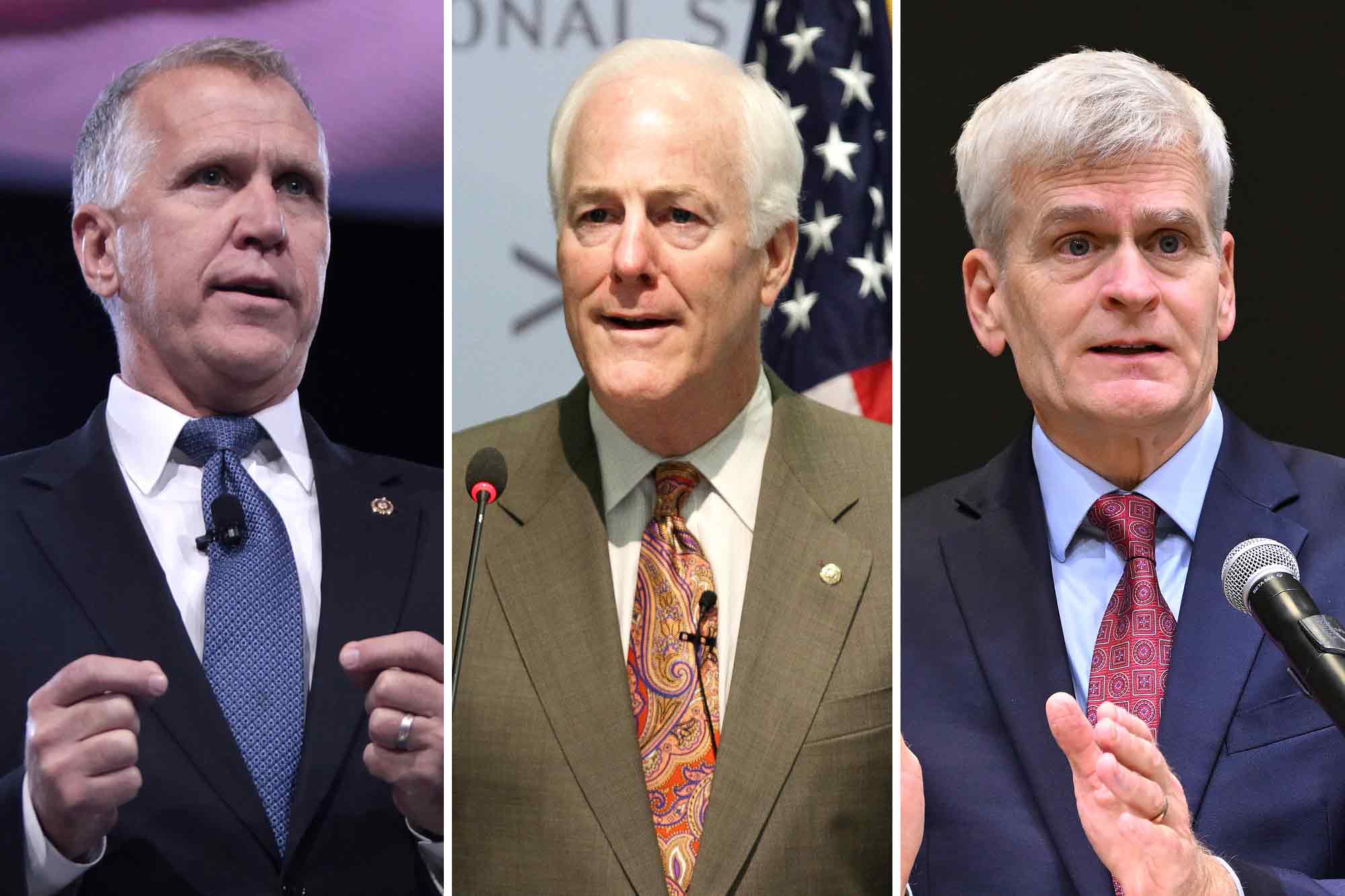
Thom Tillis, John Cornyn, and Bill Cassidy had every reason in the world to vote against the confirmation of Todd Blanche as US Attorney General.
The three GOP senators had all been politically abused by President Donald Trump, Blanche’s enthusiastic sponsor.
Trump had made no secret of wanting Tillis, an occasional burr under his saddle, out of the Senate; and Tillis, facing certain defeat in a Republican primary in North Carolina, surrendered without even contesting the primary.
Cornyn was being primaried in Texas by one of the worst candidates in political history — Ken Paxton, a man who had been impeached for financial corruption by his own party, no less — but Trump endorsed Paxton, which was the end for Cornyn.
And Cassidy met the same fate in Louisiana — an incumbent losing to a Trump-backed rival.
Each, then, had a good reason for retribution. Each professed to have reservations about Blanche: Cornyn about the slush fund and tax immunity Blanche had arranged for Trump; Tillis about the machinations Blanche had masterminded to protect Trump from revelations in the Epstein files; and Cassidy for all the malfeasance he correctly attributed to Blanche in a tearful speech announcing his decision.
All three played out the suspense. If either Tillis or Cornyn were to vote against Blanche’s confirmation in the Judiciary Committee, it would end the nomination. If any one of the trio were to vote against Blanche on the floor, it would defeat him.
So what did they do?
What everyone and his mother knew they would do: They voted to confirm.
You could say that they were victims of the Trump version of Stockholm Syndrome. Held hostage by Trump all these years, they just couldn’t bring themselves to break with him.
You could also say that they feared the vengeance that Trump’s MAGA troops might have meted out — the threats, the doxxing, the swatting, even the physical violence. They would have had targets on their backs. And lest you think this a bit far-fetched, Sen. Lisa Murkowski (R-AK) once admitted, in what can only be described as one of the most amazing comments from a sitting senator about a sitting president, that she was afraid of what Trump and his minions might do if she opposed them, and she didn’t seem to mean just politically afraid.
Judges and other officials who have crossed Trump have received credible death threats to themselves and their families; some have hired security details. When the consequence is that severe, even a slight risk can be enough to alter a public figure’s decisional calculus.
But there may be another reason why they caved and why Republicans always cave, even when we hear that there are senators and representatives who loathe or diss the Orange Man behind his back.
I think the answer is both social and financial — or, actually, a combination of the social and the financial.
Fiirst, the social reason. Conservatives have always formed a kind of social enclave. They stick to themselves. They help one another. They are a band of brothers in a world, or at least an intellectual world, where conservatism is a kind of pox. To part with Trump is to break from the club, to lose your friends, to condemn yourself to being ostracized.
There is no place for a former Trumpist: not among MAGA certainly; not among Never Trumpers, who often remain skeptical and distrusting, wondering what took so long. Any embrace by liberals is likely to be fleeting; there’s no long-term lodgings to be had on the left. Trump deserters wind up facing the heat of Trump’s enraged supporters more or less alone.
But there is another, even more plausible reason: the financial piece. When legislators leave the Senate or the House, they don’t settle down back home and retire comfortably. They have a sinecure waiting for them. They become lobbyists or “senior advisors” to companies that need political pull.
According to OpenSecrets, which tracks these things, between 400 and 460 former members of Congress are presently lobbying. As a percentage, between 30 percent and 50 percent of former members wind up lobbying or working in the so-called “influence industry.”
This isn’t just a Republican thing. It is a political thing. But folks like Cornyn and Tillis and Cassidy have a potential problem that a long line of predecessors didn’t have. The problem is that there is a retributive monster in the White House, and these sinecures for former Republican politicians are now reserved exclusively for his admirers.
No Republican lobbying firm dare hire an outcast from Trumpworld. It would almost certainly be punished by Trump for doing so. Similarly, with Republican law firms. And so, too, with corporate boards, where many former legislators land with significant remuneration. None of those companies want to take the chance of angering Trump.
Even when legislators are seemingly no longer under Trump’s sway, they are under his sway.
So the Tillises, Cornyns, and Cassidys can only hope to pacify Trump by returning to the reservation, humiliated.
The Blanche vote was almost certainly pacification. Trump gets his Carte Blanche. They get a cushy job. And we get the worst attorney general in our nation’s history (and there have been some very bad ones) and a Senate full of cowards who will do anything to make a buck.
That is Republicanism under the thumb of Trump.