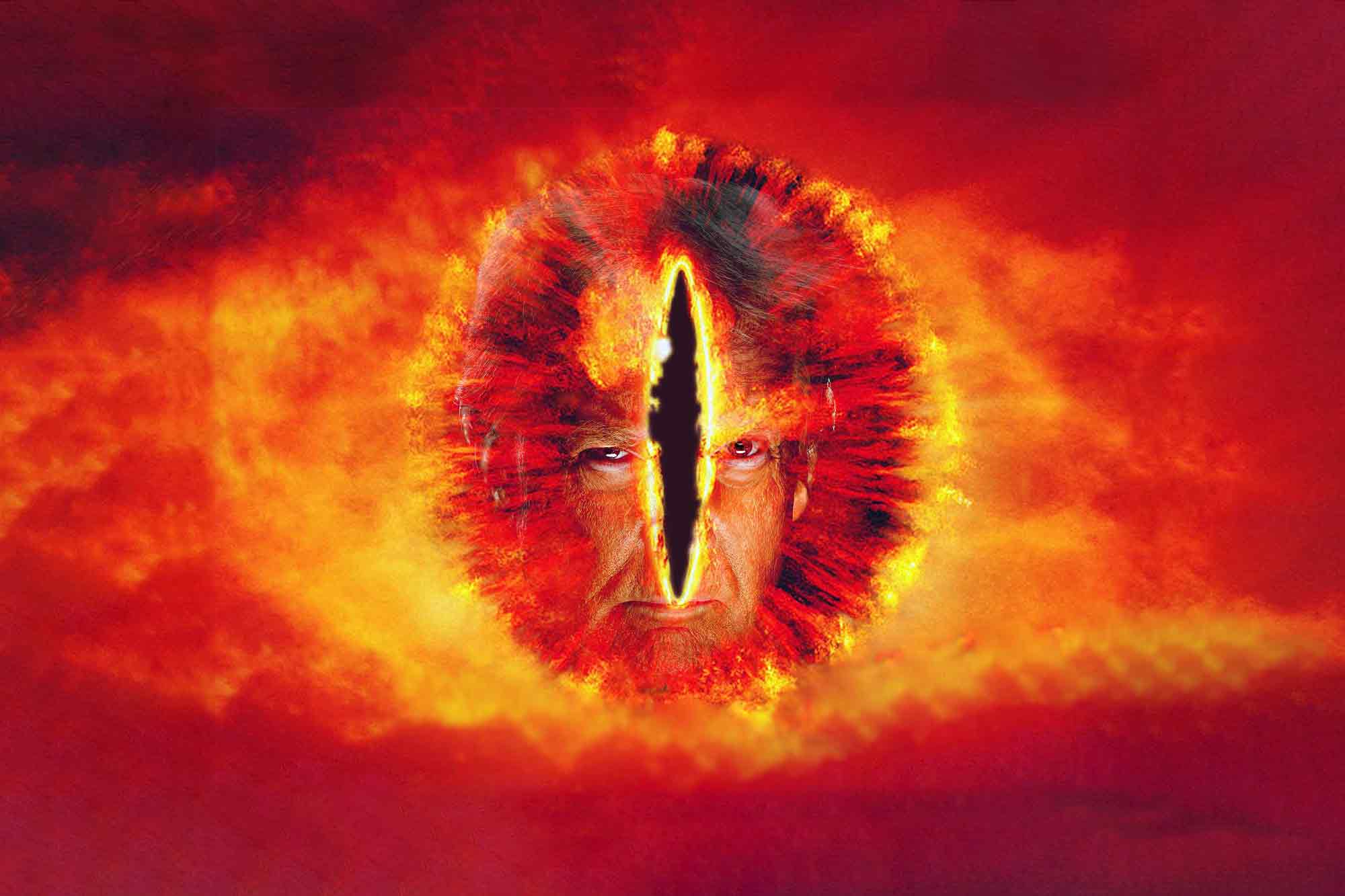
Evil in Middle-Earth and Middle America
Whom do you think Donald Trump resembles more, Saruman or Sauron? Hint: It’s a trick question.
|
Listen To This Story
 |
Like any good, long adventure story with a basically moral point of view, J.R.R. Tolkien’s The Lord of the Rings trilogy has its share of villains.
Most of them are defined by their relation to power, embodied in the “One Ring to Rule Them All” — Sauron’s Ring — forged in the fires of Mount Doom in the depths of time.
There’s Gollum, an ancient hobbit-like creature who in his youth murders his friend for the shiny gold band, and lives on for centuries as the Ring’s slave, both sustained and ruined by it.
There’s Boromir, the valiant and hardy son of the steward of Gondor, who — desirous of glory and his own renown in the salvation of his people — falls prey to the Ring’s lure and tries to seize it by force.
There’s Gríma, aka Wormtongue, driven, like Shakespeare’s Iago, mainly by envy and lust for a woman who is, as they say, out of his league.
There’s the Balrog — an ancient subterranean terror of fire and shadow.
There are, of course, the orcs — Sauron’s cruel, slavish, grotesque foot soldiers, reverse engineered in mockery of the virtues of Elves and Men, and notably better at internecine mayhem and killing each other than fighting the good guys.
And the Nazgûl, Sauron’s nine Ring-corrupted wraiths who, despite Tolkien’s protestations to the contrary, could hardly fail to be identified with the Nazi ghouls in thrall to Britain’s mortal enemy Adolf Hitler.
And there are assorted ruffians — like Bill Ferny and Ted Sandyman — the MAGA faithful of the piece, bullies and toadies sucking up to whomever has the upper hand.
(There are, for what it’s worth, no evil women — unless you count the steroidal spider Shelob, daughter of primordial Ungoliant, with her webs of darkness and death.)
I could draft a white paper charting the affinity of Donald Trump with each of these embodiments of evil.
He is, like Gollum, an inveterate liar consumed by his own lust and bent on vengeance. He is, like Boromir, vainglorious and fond of posing as all manner of NFT-worthy superhero, from conquering caped avenger to Jesus Christ himself.
He has been, like Wormtongue, driven by carnal desire and is a mixer of verbal poisons. Like the Balrog, a destroyer in flame and shadow, a terror to foes and allies alike. You get the idea.
But it is the two principal villains of LOTR — Sauron himself and Saruman the Wizard — that I think shed the most light on Trump and how he has impacted our world.
Two Archetypes of Evil
Both Sauron and Saruman are embodiments of evil but, from a moral standpoint, their failings could not look more different.
Sauron is presented by Tolkien less as an individual than as a phenomenon. A servant of the satanic Morgoth, long ago vanquished, Sauron initially maintained a capacity to appear, as Tolkien puts it, “not yet evil to behold.”
He could “pass” — mingle with Elves and Men, and learn their secrets. But that was in the Second Age, literally an eon ago, thousands of years past.
Sauron enters the Third Age, in which the action takes place, wholly consumed by his evil, terrible to look upon but only semicorporeal. A spirit of evil that, having transmitted the greater part of his powers to the Ring he forged, cannot be destroyed while the Ring lasts.
Sauron takes a new and darker shape after any defeat; ultimately, he has become just an eye — the Eye of Sauron. He is often referred to simply as the Shadow in the East, terrifying but almost abstract.
Sauron’s evil is tied inextricably to the lust for power embodied in the rings of power and the One Ring he made to “rule them all.” It is clear that he has no choice but to be evil, to lust after power and tie his very existence to that symbol and repository of power.
Not so with Saruman, who, from beginning to bitter end, has a choice. He is, in fact, repeatedly offered the choice of what ends to pursue, whom to help and whom to harm.
He, like his genuinely wise and good counterpart Gandalf, is one of five “wizards” sent to Middle-Earth in its Third Age to aid its inhabitants in their struggles with darkness. He has great and magical powers — most notably, his irresistibly persuasive voice — and begins as a force for good.
But lust for dominance and ever greater power works to corrupt him. He possesses a “palantír” — a “seeing stone” modeled, one suspects, on the newfangled (in Tolkien’s time) medium of television, but a two-way device closer in function to a mash-up of Zoom and Palantir, Peter Thiel’s spooky eponymous surveillance shop. There were seven palantíri all told, created, like certain miracles of modern technology, to do good but subject to perversion to evil purpose. Sauron has one of them.
Eventually, Saruman trains his magic stone on Sauron’s abode — Barad-Dûr, or the Dark Tower — and is snared: He believes he is spying on Sauron, but the Dark Lord is instead poisoning his mind, in their addictive “Zoom” sessions, with ever darker evil.
Thus, Saruman’s evil is, in a sense, derivative. And, internally, it wrestles with his residue of good. He knows his own corruption; he knows better. At certain moments, he entertains doubts.
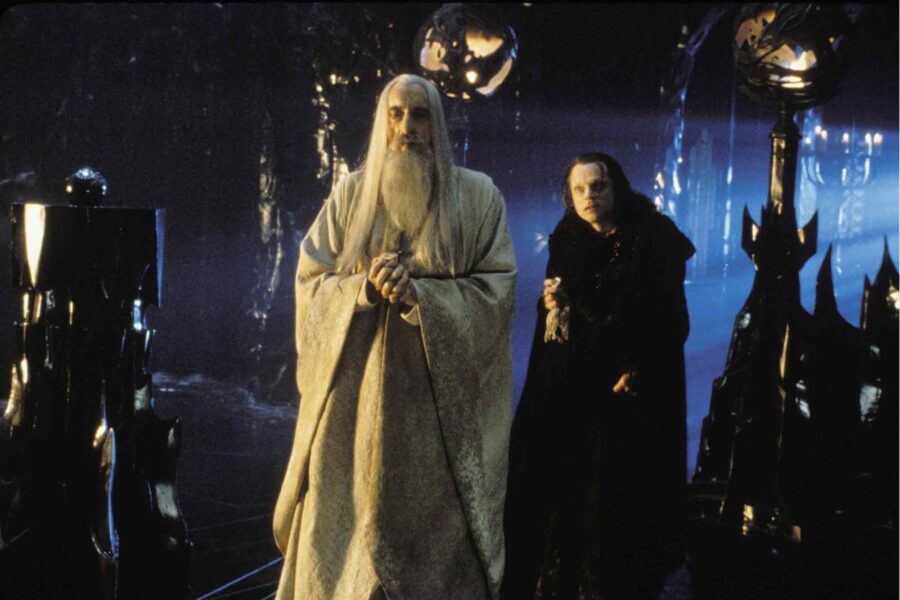
After his defeat in battle, Saruman is presented by Gandalf with an option: to stop serving Sauron, let go of his schemes of getting the Ring for himself, and start repairing the terrible damage he has done. It is a crucial moment:
A shadow passed over Saruman’s face; then it went deathly white. Before he could conceal it, they saw through the mask the anguish of a mind in doubt, loathing to stay and dreading to leave its refuge. For a second he hesitated, and no one breathed. Then he spoke, and his voice was shrill and cold. Pride and hate were conquering him.
Pride and hate.
When the Great War of the Ring against Sauron is won — when the hobbits Frodo and Sam succeed, with Gollum’s unintended help, in casting the Ring into the fires of Mount Doom, where it is finally destroyed — Saruman is left to roam in the wilderness, a beggar with the enslaved Wormtongue as his only companion.
Once again a choice is given him, and once again he rejects repentance and redemption.
He makes his way to the Shire — the placid homeland of the hobbits — and there proceeds to do, as Gandalf has predicted, “some mischief still in a small mean way.”
In fact, he goes to The Shire bent on pure destruction — tit for tat, in his ruined mind, for his own losses — and, in the short time allotted before Frodo and his companions return and “raise the Shire” to set things to rights, works wonders (he is, after all, a wizard) of pure gratuitous ruination.
He brings a troop of ruffians — thugs and goons — with him and terrifies the poor hobbits into submission. Some of the hobbits get with the program and see it as progress; the rest just keep their heads down and try to avoid being hauled off to the Lockholes.
Inns are shut down, torn down, replaced with smoke-belching “factories.”
Trees are felled and left to rot, including Hobbiton’s oldest and most beautiful tree.
Waters are fouled, along with the air.
Lists of “Rules” and punishments are drawn up, with new “offenses” added continuously.
Hobbits are evicted, starved, impoverished, while Saruman’s goons take everything and live off the fat of the land, swaggering and lording it over the bewildered.
Sound Familiar?
It’s hard to read that chapter, “The Scouring of the Shire,” without seeing DOGE, Elon Musk with his chainsaw, the fouled Reflecting Pool, and the piles of rubble that were the East Wing, the social safety net, civil and voting rights, the rule of law, the Constitution, our global alliances, civility, and truth itself.
Trump, like Saruman, beguiled listeners with the dark magic of his voice: Tens of millions heard their own redemption in his simpering and mocking cadences. He still holds them in thrall, enough to keep him politically afloat when every indicator says he should be drowning. He remains as terribly dangerous as he is terribly unpopular.
When the hobbits reach the Shire and see what’s afoot, their first impulse is to take cover and plan. But one of them realizes that if they don’t act immediately, the thugs and goons will “stamp us out” — so they “raise the Shire” in armed revolt. And they win!
After dispatching the thugs and goons, they reach Bag End — the home Frodo Baggins had left the year before on the quest to destroy the Ring — only to find Saruman lounging there quite contentedly, having wreaked what he believes is irreparable damage.
Once more defeated, at bay, Saruman is again given a choice. Frodo, respecting the wizard’s high lineage, allows him to go free. The villain, passing by Frodo, pulls a hidden knife and stabs him — the knife turned only by the hobbit’s hidden mail cloak. Even then, Frodo shows mercy — to both Saruman and his miserable sidekick, Wormtongue, whom Saruman kicks in the face as he grovels.
It’s Saruman’s last cruel, evil act, as Wormtongue snaps and jumps on his master’s back, slitting his throat with a knife of his own. Only in death is Saruman revealed as utterly corrupted and shriveled.
A dirty sack full of nothing.
It is a very fitting end, and a very personal one. Entirely different from the demise of Sauron, which was manifest as a kind of massive, Middle-Earth-quaking implosion of battlements, towers, and mountains, crowned with lightning and thunder, a “darkness inescapable” that blows away on the wind.
Which is Donald — Sauron or Saruman?
Who is the better fit for the villain of our piece? I think the question comes down to whether we believe Donald Trump has a choice.
Certainly Trump’s behavior tracks closely to that of the fallen wizard — lying, conniving, deluding, corrupting, ruining everything good that lies in his path. Not in some kind of remote and majestic superhuman manner, like Sauron, but rather cruel and destructive in an all-too-human way.
And yet… While no reader of Tolkien’s Trilogy could ever imagine Sauron changing course, seeing the light, becoming anything but the Dark Lord, we see Saruman repeatedly contemplate the possibility of a new path, free of the burden of his schemes and his malice.
Can any of us, as extras in the Trumpocene Trilogy, imagine Donald Trump changing course?
I don’t mean TACOing on this or that bluster or blunder; I mean becoming something other than evil. Something other than selfish like no one’s ever seen before; something other than mendacity’s GOAT; something other than power-obsessed, corrupt, cruel, greedy, vicious, vengeful, racist, misogynist, malignantly narcissistic, destructive in all things small and vast.
Has he shown any sign suggesting any such capability?
Sane or psychotic, the evil in him is so baked in and so bonded to some dreadful core weakness that it becomes child’s play to predict what position he will take, what role he will play, what he will do in literally every matter — today, tomorrow, for as long as he lives.
In that sense, Trump resembles Sauron — a force of evil, less interesting than Saruman because his ethos and his role are fixed, immutable.
But Trump also channels Saruman: He’s not remote but rather very hands-on, personally corrupting his goons and overseeing the ruin he has wrought.
The Shire Was Saved. What About America?
The Shire rises up and is saved (though not for Frodo, whose encounters with evil have left him exhausted, wounded, and old before his time). It takes one battle, with a few hundred participants. It’s all over in one page.
The MAGA hobbits, who had bought into Saruman’s authoritarian regime, come around. The Shire is “scoured”: With the help of some Elf-magic, gardens quickly flourish and a new, magnificent sapling is planted. Evil is banished — though only for a while, as Middle-Earth is a prequel to our own human history.
And here we are, facing a villain of our own time who melds the worst of Tolkien’s two archvillains.
Sauron was evil, Saruman chose evil, and neither one surrendered or negotiated.
I don’t expect Donald Trump and his Ringwraiths and orcs and goons and thugs — and dare I say his basket of deluded deplorables? — will go gentle. That is not the way of evil, the way of the power-enthralled, the way of the dictator.
Can the little battle to save the Shire scale?
Will we rise up before they “come down on us in force”? What form might that rising up take and who will lead it?
If our elections are subverted and our votes prove insufficient, what kind of fiercer battles are we — you and I — prepared to fight?