It is no longer possible to pretend that the United States is one of the “good guys.” And the damage Trump is doing to America’s reputation, which has been on the decline for some time, is incalculable.
|
Listen To This Story
 |
America’s legacy of being “the good guy” on the international stage is complicated, even setting aside its sordid domestic history of slavery, discrimination, and the genocide of its indigenous population, and that its ambition always exceeded its lived reality.
On the one hand, the United States has answered the call time and again over the past century when the ideals it aspired to were under attack across the globe. Whether that was to oppose the imperial expansion of the Central Powers in World War I, fascism in World War II, communism in the Cold War, or Islamic extremism.
In some of these cases, the US was reluctant to get involved, but we feel the fights you don’t want to be in are often the ones most worth fighting.
On the other hand, there is America’s own history of imperialism, its constant meddling in the affairs of other countries, which includes toppling duly elected governments for those that would be more pliant, and some of the methods that were used to achieve its objectives.
Despite these complications and contradictions, however, for a brief moment in time, Americans weren’t just the good guys; they led them.
As Europe picked up the pieces from two world wars whose tides the US turned, it was American foresight (and money) that resulted in the only truly successful examples of nation building — the reconstruction and reintegration of Germany and Japan in the global community.
Together, the victors of World War II (minus the Soviet Union) came to the conclusion that maybe they ought to give peaceful coexistence a chance instead of bashing in each other’s heads every few years for centuries on end.
The result has been a largely peaceful Old Continent and a military alliance that was so strong that it never had to fight.
Combined with an economic boom that brought prosperity to the American middle class as well as the burgeoning Civil Rights Movement that addressed inequality at home, the two decades that followed the war were the zenith of the United States.
Whether it was militarily, economically, (pop) culturally, or even morally, America was on top of the free world and a vital counterweight to the repressive Soviet regime.
It’s been downhill ever since.
The US staged coups from Iran to Chile, committed war crimes in Vietnam, violated the Geneva Conventions, engaged in “extraordinary rendition” and torture, spied on its allies, and became an obstacle to international efforts to address global problems like climate change and war crimes.
Still, even though it has slowly but constantly been ceding the moral high ground for more than 50 years and blurred the line between hero and villain, the US has generally been viewed as a force for good.
And that’s because everybody understands that being the good guy is more challenging than being the bad guy.
The former has to play by the rules to accomplish their goals while the latter can do whatever they want.
For regular Americans, those rules are commonly agreed upon laws and norms. For example, if you need $20, you don’t hold up a lemonade stand even though that little kid isn’t going to stop you. For one thing, it is illegal and you face some uncomfortable consequences if you get caught.
Still, even then, the US was considered one of the good guys.
That is no longer the case.
However, we hope (and believe) that most people wouldn’t do it even if they knew they could get away with taking that money because it is just wrong and would violate their individual moral compass.
For countries, the rules are more complex.
American presidents, for example, have to abide by the Constitution, domestic and international laws, various treaties like the Geneva Conventions, and a collective moral compass.
And, generally, they have done that.
Yes, plenty of them have stumbled and broken some of these rules, but they also paid the price. For example, Richard Nixon got caught and, ultimately, he just left.
Actually, it’s remarkable that there hasn’t been more corruption. Every president could walk out of the White House a billionaire, perhaps even without technically breaking any laws.
Someone like Vladimir Putin, on the other hand, makes his own rules. Sure, there are consequences to what he does; he just doesn’t care about them, or they are not severe enough to discourage him from invading another country, killing journalists, waging a hybrid war against the West, seizing the property of fellow Russians who don’t toe the line, etc.
And because the bad guys don’t have to follow the same rules, a lot of people are willing to cut the good guys some slack for sometimes doing some bad things in pursuit of a “noble” cause.
This is certainly true in literature or entertainment, where many protagonists break the law in pursuit of bad guys and justice. Robin Hood comes to mind, or the Count of Monte Cristo, the three musketeers, Zorro, Jack Bauer, or James Bond.
In reality, this was most pronounced in the “war on terror,” perhaps because Americans personally felt at risk, so they were more forgiving when the US used loopholes to torture and indefinitely lock up “enemy combatants” without any kind of due process, killed a whole bunch of civilians as “collateral damage,” and did a lot of other shady things.
Still, even then, the US was considered one of the good guys.
That is no longer the case.
Americans have to come to terms with the fact that, until they do something about it, their country is now the villain and not the hero.
Under Donald Trump, the US isn’t James Bond; it’s Goldfinger.
The president and his administration clearly don’t feel as though they are bound by the Constitution or any laws and treaties. Norms are shattered and moral compasses don’t seem to exist.
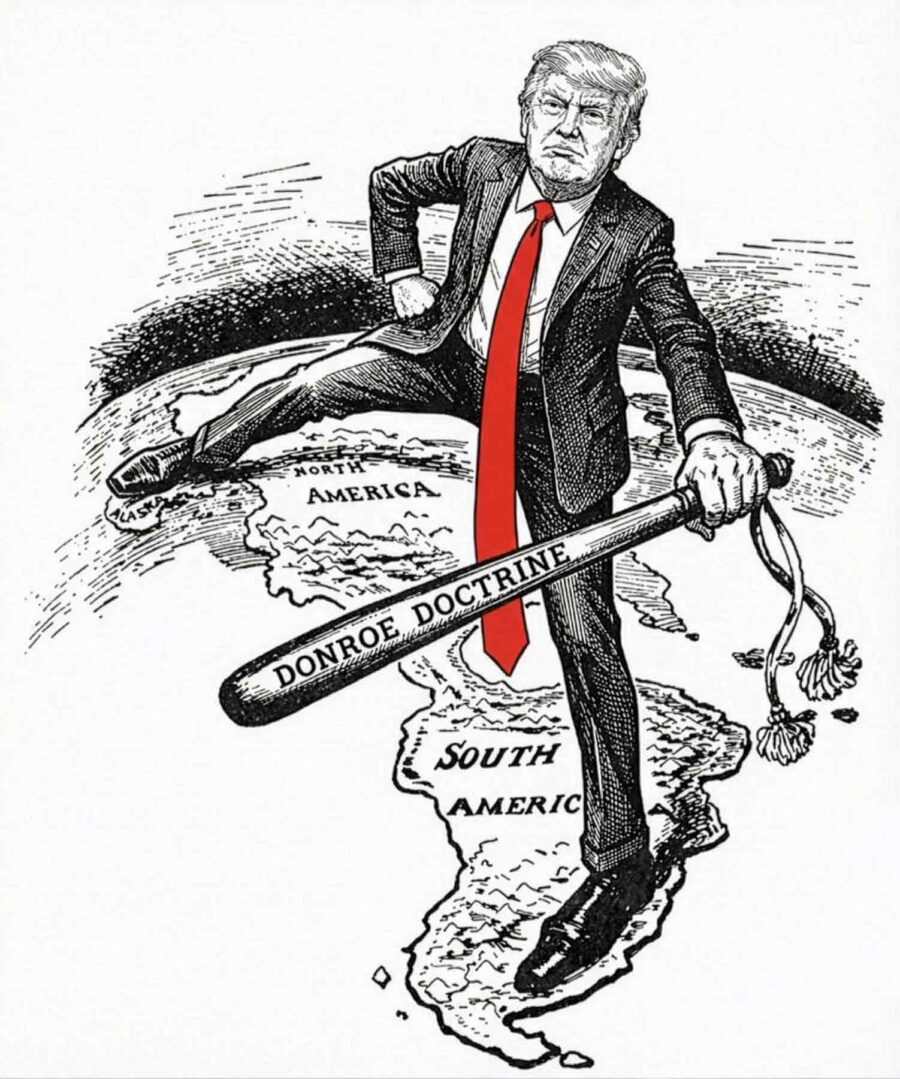
That was never more obvious than this week, when Trump unveiled his “Donroe Doctrine,” which boils down to him using the US military to run a Mafia-style protection racket in the Western Hemisphere. The message after the attack on Venezuela is clear: Do Trump’s bidding or else.
And just in case any Western Hemisphere country didn’t get that message, Trump and his henchmen spelled it out for them by naming names. Maybe Cuba is next, or Panama, or Colombia, or Greenland.
In any case, nobody and nothing is allowed to stand in the president’s way, and if he wants oil, other natural resources, or maybe a canal or a lemonade stand, then those countries better hand them over.
Why?
Because the US is bigger and stronger, that’s why.
And it is true that nobody in the hemisphere can stop Trump. Even an occupation of Greenland, which would trigger Article 5 of the NATO charter, wouldn’t result in a war between the US on one side and Europe and Canada on the other.
It would “just” end NATO.
But it would also make it clear that the US under Trump and every Republican who supports him is no different than Russia, China, Saudi Arabia, Iran, North Korea, etc.
And while ruling the Western Hemisphere with an iron fist may satisfy the president’s imperial ambitions for a while, the long-term consequences would be incalculable. For one, the other villains would be emboldened to seize more territories of their own. Perhaps Russia will try to take back the Baltic states and get the Soviet Union back together, and China will grab Taiwan and exert dominance over the South China Sea.
That’s the path down which we are headed.
And maybe the next president will try to reverse course, but the damage will be done.
It already is. Nobody, apart maybe from MAGA supporters, views the United States as a shining city upon a hill anymore, and America’s staunchest allies are coming to terms with the fact that Trump is not on their side.
And that’s putting it mildly.
In fact, according to a recent poll, fewer than 10 percent of people in Belgium, France, Spain, Italy, Germany, and Portugal feel that the US president is a friend of Europe. In each country, at least 5 times as many people think he is an enemy.
We’re talking about relationships that were forged and strengthened over generations.
What Trump is destroying will take years and decades to rebuild. And some of it will be irretrievably lost.
Ultimately, that is what the “Donroe Doctrine” will be known for.