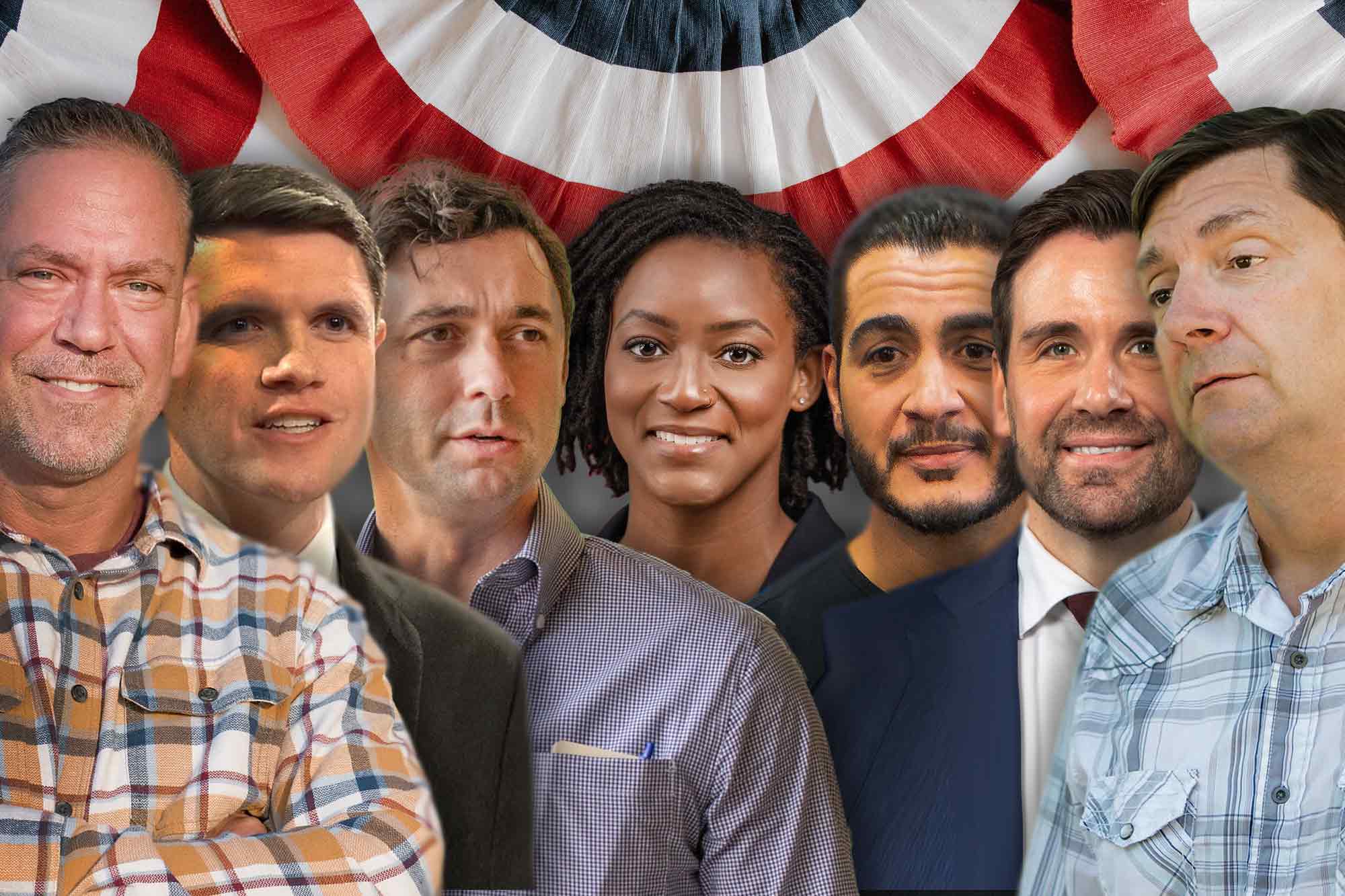
One Win Is Not a Lasting Majority
Democrats may win big in November. Whether they can turn a midterm won on backlash into lasting power depends on a distinction most candidates get wrong.
If the polls hold, Democrats are headed for a very good night in November. The maps favor them, Trump and his party are unpopular, and the resentment that historically punishes whoever holds Washington is running their way. The easy thing will be to call that a victory and move on.
Longtime Senate staffer and historian Adam Jentleson thinks a win like that is the least interesting thing that could happen to his party.
His question is what comes after: whether a midterm won on backlash lasts, or evaporates the way every narrow majority of the past decade has.
The answer turns on a distinction candidates blur at their peril.
According to Jentleson, every candidate faces two electorates before they can win. The primary that nominates them rewards purity and punishes any deviation from the approved list of positions.
The general electorate is heterodox and contradictory, loyal to no ideology and happy to take from both columns. The candidate who wins the first by proving orthodoxy often loses the second by the same act.
Jentleson spent two decades inside Democratic politics, as chief of staff to former Sen. Harry Reid (NV) and, for a brief time, chief of staff to Sen. John Fetterman (PA). His new book is Supermajority: How Democrats Can Build Lasting Power.
The pressure to stay pure, he explains, is largely about money — the donors and advocacy groups that fund campaigns and set their price in positions. He takes apart the fantasy of demographic destiny that was supposed to hand Democrats a permanent majority and never did.
He also makes the uncomfortable case that the era’s most effective heterodox candidate has been Donald Trump, who won by breaking with his own side as readily as the other.
However much Democrats may hate what Trump has done with power, Jentleson’s harder point is that they cannot afford to look away from how he took it— twice.
The midterms will likely hand Democrats a win. The harder question is whether they can tell a won election from won power, and whether a party can make itself want the second when the first feels so much like winning.
 Apple Podcasts
 Google Podcasts
 RSS
RSS
Full Text Transcript:
Jeff Schechtman: Welcome to the WhoWhatWhy podcast. I’m your host, Jeff Schechtman. We have made our peace with the coin flip. A decade of election nights has trained us to expect the same one every time: the map glowing red and blue in nearly equal measure, the country balanced on a knife’s edge and a few stray counties. A winner who wakes the next morning already too weak to do much of anything before the tide runs back out and carries it off. We have decided this is simply the weather of a divided nation, fifty-fifty, now and forever, and to survive the night is the only prize still on the table.
We keep a second article of faith close beside that first. The way to win the flip, we have told ourselves, is to be pure. Hold every right position, please every constituency, pass every test the coalition sets and the voters will follow. My guest, former Senate insider and staffer Adam Jentleson, says both of these are stories our party tells itself on the way down. He says that the real American voter was never that moderate, waiting patiently at the midpoint of a straight line. It is somewhat stranger and more alive than that: a voter who would jail every CEO and every immigrant in the same breath and still call it moderation, who loves Bernie Sanders and voted for Donald Trump and would be glad to wake to a President Michelle Obama.
The electorate is not a spectrum in his view: It is a contradiction, and it always has been. And the leaders who made their peace with that contradiction instead of the coin flip — Roosevelt and Johnson and Obama — did not win the kind of narrow victory you spend the next two years guarding. They won the kind you spend. They turned a single November into Social Security, into the Civil Rights Act, into things that still shelter people who have never heard their names. He calls this way out a supermajority, and he means something exact by it. And he has spent twenty years inside his own party watching it forget how such a thing gets built.
Adam Jentleson was deputy chief of staff to the late Senator Harry Reid, chief of staff to John Fetterman, where he did the best he could, and the author of the previous book, Kill Switch. His newest work is Supermajority: How Democrats Can Build Lasting Power. Adam Jentleson, welcome to the WhoWhatWhy podcast.
Adam Jentleson: Thank you for having me, Jeff. It’s great to be here.
Jeff: Well, it is a delight to have you here. There is this assumption that the country is deeply divided, that there is this fifty-fifty split that exists and that so much of it is a function of communications today. Influencers, if you will, the internet, just so many things have changed since the time in which it was possible to create that kind of supermajority that you’re talking about. Talk about the world we live in today and why you think that a supermajority still might be possible.
Adam: That’s right. I’ve spent the last twenty years of my life in this business, I guess we could call it, of politics. And I’m hyperattuned to all the ways in which politics has changed, all of the new trends that we’ve seen emerge that sort of dominate the discourse these days. But part of the reason I wanted to write this book was to also go back and say, okay, well, there are also things that are the same. Human nature hasn’t changed, the nature of our electoral system hasn’t changed, and some fundamental rules about how to succeed in politics still prevail. So this book is an attempt to say, what is truly unique about this era that we live in, and what are some lessons we can draw from the past? And how can we combine those two things today to craft a winning strategy?
The way we communicate is incredibly different now. The way that we consume information, the way we analyze elections, the data that’s available to candidates and their campaigns is stuff that would be hard to even imagine when I first started working in this business on my first campaign in 2004. But at the same time, the American people have some habits that remain true and are as true today as they were in FDR’s time. One of those is the habit that you alluded to in your intro of being hard to pigeonhole and sort of stubbornly resistant to neat categorization along ideological lines. We can hyperanalyze a person’s ideology, we can hyperanalyze their voting history, but people have this dogged independence and this independence of mind, and it’s something that they value in themselves, one of the ways in which they identify themselves as independent thinkers. And it’s also something they value in candidates.
I think one of the things that we’ve lost in terms of the ability to succeed is conveying that independence of mind to voters, because candidates, both Democrats and Republicans these days, have gotten in the habit of being incredibly rigid when it comes to ideology and trying to adopt every correct position dictated by interest groups, corporations, donors, what have you, all the different forces that are acting on them. And when you do that, not only do you often end up taking positions that are out of step with the American people when it comes to the individual positions themselves, you also convey the larger image of a candidate who is controlled by outside interests, who is having his opinions or her opinions dictated to them by other people and other interests. You certainly convey that you don’t have that independence of mind that voters value.
And it’s not all voters, but it does tend to be the voters who decide elections. If you’re going to win in a red state… That heterodoxy that I’m describing is something that’s a characteristic of the kind of working-class voters that Democrats have lost over the last few decades and are desperate to get back. If they do get [them] back, it is once again possible to win elections on a scale we haven’t seen in generations. So that’s sort of a long answer, but I think that if I were to sum it all up, I would say getting back to that heterodox way of thinking, that sort of independence of mind, is sort of a one weird trick we can use right now to win elections on a scale that we haven’t seen in generations.
Jeff: But how much of that purity is the result — beyond the communications aspect that we’ve talked about and that you’ve addressed — how much is a result of money, that those special interests, that those advocacy groups are really the one that provide the money for politics today? And it’s a more expensive business.
Adam: Yeah, a lot of it is. If you ask yourself, well, why do politicians do this? Why don’t they just ignore the groups or the donors who are trying to get them to take positions? The answer often comes down to money, because these other entities control the resources that you need to run a campaign. The average Senate campaign budget these days is upwards of thirty million dollars, and hundreds of millions of dollars are spent on Senate races when you combine all the outside groups that are working on these races. So it’s understandable why politicians might take points of view that they know are out of step with the people they’re trying to win, or that they don’t believe in themselves, because they need the backing of those groups that can spend money on political ads and pay for volunteers and do all the things that a campaign needs to survive and succeed.
But here’s the thing, is that one of the interesting functions of a more heterodox approach is that it can break through a lot of that money, that sort of force field of money that surrounds and suffocates campaigns. Because when you take a position that is unexpected for a Democrat, or that breaks with your party, it generates a ton of what we in the business call earned media, which is just a fancy way of saying press attention, attention from the media.
The two classic cases of this that I highlight in the book are Donald Trump and Bernie Sanders. Both of them defied their party’s orthodoxy on a bunch of issues during the 2016 campaign, and neither of these guys had well-funded campaigns to begin with. And those divergences, those issues where they stepped away from the party’s orthodoxy, created an enormous amount of media attention. For Donald Trump, it was opposing the war in Iraq, which he did vociferously at a time when it was still the standard position for Republican candidates to support the war. For Bernie Sanders, it was on issues like guns, immigration — he is a senator representing Vermont, an incredibly rural state; he was farther to the right on guns than most Democrats at the time, he was farther to Hillary’s right on immigration and criminal justice reform. So those areas — even as Bernie was to her left on economics — those areas of divergence, without ever spending a dollar on political ads for either of these guys, created an enormous amount of media attention and allowed them to completely dominate the narrative, so there are ways to break through if you’re willing to show that independence of mind.
Jeff: I guess a classic example of that goes back also to Bill Clinton and his Sister Souljah moment.
Adam: That’s right. You think back to that moment… For your listeners who may or may not be familiar with this episode, this was a rapper at the time named Sister Souljah, who, after the Rodney King — the riots that were sparked by the brutal police beating of Rodney King — this rapper, Sister Souljah, said to the media, well, if the police are going to be allowed to just beat up black people, maybe we should have a day where it’s okay to beat up white people. I’m loosely paraphrasing, but that’s almost an exact quote. I don’t have it in front of me, but that’s basically what she said. Yeah, it’s pretty close. So Clinton said, “Hey, maybe we shouldn’t say that.” And it created a huge firestorm and completely dominated the media. That wasn’t him taking an unreasonable position, it was entirely reasonable to criticize those remarks. But it demonstrated to voters that he wasn’t going to be captive to a lot of the interest groups that were insisting that Democrats toe the line there.
So it can be a very effective tactic. It should be in line with your principles. But I think that’s part of the thing here, is that we talk a lot about authenticity and the need for authenticity. Well, most people don’t authentically agree with every issue on their side. Most people authentically have issues where they differ from the orthodoxy, whether it’s on the left or the right. So a lot of this is authentically saying where you disagree with your party, because it’s almost certain that there are at least a few issues where you do. The problem is that we have gotten into a habit of trying to sweep those under the rug and pretend that you agree with your party on everything. And that is what ultimately comes across as inauthentic.
Jeff: How much of the responsibility rests with the voters too, because they’re the ones oftentimes that look at heterodoxy as inconsistency, that they’ve been trained over time to expect that purity?
Adam: It’s tricky because in any election, there are two different universes of voters, and they have very different habits. The first universe is the primary electorate. The first thing you have to do as a candidate is win your party’s nomination. Then the second group of voters is the general election electorate, the folks who vote in November once each party has decided who their nominee in a given race is. Then in November you go to the polls and you choose between Democrat and Republican in most cases.
So this is an issue because when you talk about that expectation of purity that you mentioned, that is extremely prevalent among primary voters who, on both the left and the right, tend to be people who are sort of the purest of the pure. These are party activists. I expect many of your listeners vote in primaries. I obviously vote in primaries. But we should know that this makes us weird, to be frank. We are unusual. Most people don’t… Depending on the election, often a majority of eligible voters don’t vote. So close to half of the people in America don’t vote at all. And then most people definitely do not vote in primaries. It’s somewhere around fifteen percent of each party’s electorate who vote, so a very self-selecting population. They tend to be activists, very engaged people, and they really press candidates on both sides to be pure. But then when you get to the general election electorate, the people who vote in November are much less engaged. Many of them don’t start paying attention to politics until well after Labor Day. They maybe consume a minute or two of political news per week. They’re not on Twitter, they’re not on Bluesky, they’re not listening to this podcast. So they tend to be the more heterodox people, and they’re less interested in purity, and they tend to be the ones looking for that independence of mind. So this is the trick, this is what’s hard as a candidate, is to win your nomination by being pure enough to satisfy the voters who decide the nomination, but then preserving some independence of mind so that you can actually win the general election.
There are reasons it’s become this way. This is actually a function of post-Watergate party reforms, and I write about this in the book, pretty interesting because it didn’t used to be this way. But that’s the system we have now, and there’s no real prospect of that changing anytime soon. So finding ways to excite the activists while preserving your appeal in a general election is a tricky thing to do, but it is possible to do. And I talk about some of those ways in the book.
Jeff: We’ve talked about several things now that are fighting this heterodoxy. We’ve talked about primaries, we’ve talked about money, we’ve talked about the change in communication, we’ve talked about expectation as far as the electorate is concerned. Those are pretty strong headwinds when you put them all together to try and change the system.
Adam: That’s right. But I would say that I’m pretty encouraged. I had no idea what the lay of the land was going to be politically when this book came out. You know how books work: You turn in the manuscript last winter and then none of these races were shaping up back then, and we were coming off a bad election cycle for Democrats. So no expectation that we were going to be doing well. But as we sit here, I have to say I’m pretty encouraged. You do see candidates defying those headwinds and succeeding in winning some of these red states that we thought — we as Democrats had written off.
I look at Texas, and James Talarico running for the Senate seat there has enthusiastically embraced the fossil fuel industry in Texas, which is not going to be the sort of predominant position in the Democratic Party. But if you want to win statewide in Texas, a state where the fossil fuel industry employs hundreds of thousands of people, and particularly employs a lot of working-class people, the exact voters that we need to win back, it makes sense as a candidate to adopt that heterodoxy and say, “Look, I obviously care about climate change. I want to reduce carbon emissions, but there is no path to reducing carbon emissions that doesn’t involve fossil fuels as a bridge.”
The tendency among Democrats in recent years has been sort of towards extremism on climate, to say, “Keep it in the ground. No new fossil fuels, no pipelines, no drilling.” And for a lot of Democrats, that’s still going to be their position. But you can’t win a statewide election in Texas with that position. So it makes sense for Talarico to do that. On most other issues, he’s still very, very passionately liberal and represents Democrats’ core values. But there are areas where he is adopting heterodoxy, and that is why most polls show him beating his Republican opponent right now.
You can look at other states like Iowa, Georgia, even a state like Nebraska where there’s an independent running who is competitive, and Alaska, where Mary Peltola is the Democrat leading her Republican opponent, also embracing fossil fuels, which are important to Alaska. And there are people who are defying these headwinds, and they’re the ones who are succeeding in winning these red states that we need to get back.
Jeff: One of the other factors in all of this is the changing face of the electorate, that we see different coalitions with each different election cycle. I mean, there was the belief for a long time that what was the Obama coalition would survive longer than it did. Talk about that.
Adam: That’s right. I write quite a bit about this in the book. There this prevailing belief, after Obama’s election, so late aughts and the teens, that became shorthanded among Democrats as “demographics is destiny.” And this was the idea that the rapidly diversifying American electorate was essentially going to lift Democrats to a permanent supermajority. There was a book at the time called The Emerging Democratic Majority that actually came out in 2003 and initially seemed wrong after Bush won twice. Well, didn’t win in 2000, the Supreme Court handed that to him. But nevertheless… But then sort of became popular and seemed to be prescient when Obama won.
Here’s the problem. You look at census data, it’s definitely true that America is becoming more diverse. The number of Americans with a college degree is growing by leaps and bounds, which is generally good for Democrats, but it’s not growing as fast as we thought, and that’s something we learned the hard way over the last ten years. We’re a big country, and so demographic change on that scale takes a long time. And the share of white voters remains the overwhelmingly dominant faction when it comes to how the electorate shapes up. It tends to be somewhere around seventy percent of the electorate even today. So the remaining thirty percent is broken up by all other nonwhite voters. So mathematically, I’m not a big math guy, but I know that if there’s a group that represents seventy percent of the electorate, you’re going to have to win a bunch of them if you’re going to try to get to fifty percent.
So what that “demographics is destiny” mindset did to Democrats was that it said, “Oh, we can really ignore the concerns of white voters and white working-class voters, because all we need to do is run up the numbers with these rapidly diversifying populations.” And that just didn’t work out by the numbers. So that’s not to say that we should not continue to bank on diversity and valuing diversity and shaping policies that take that reality into account. But at the same time, we can’t dismiss or certainly not come across as dismissive or condescending to the needs of white working-class voters. That’s one of the reasons that Hillary Clinton lost in 2016. She very famously had that comment where she called a lot of Trump voters “deplorables,” and it was pretty clear she was referring to white working-class people. That attitude has sort of infected the party because we thought we didn’t have to care as much about white working-class voters anymore. And that was a big mistake, and we’re kind of still paying the price for it.
Jeff: Talk about that in the context of the present landscape where a lot of Democrats are taking primary results as a reflection of what’s going to happen come November.
Adam: That’s right. We’ve seen a lot of instances recently where left-wing candidates have won primaries, generally in seats in districts that were pretty blue. So not a huge deal either way. Like there’s this part of Brooklyn that is known as the “commie corridor,” not a name I made up, but a name that they embrace because it’s quite left-wing, one of the most left-wing places in America. So you had DSA candidates, Democratic Socialists of America candidates, winning the primary there. And that’s fine. The primary is the general election in those places because the Republican is not competitive. So whichever Democrat wins the primary is basically going to waltz to the general election because eighty percent of the voters in that district are Democrat, so that’s fine. That doesn’t worry me. Socialists are well organized, they’re passionate. Just as a practitioner, I have a lot of respect for the way that they’ve approached politics and started to acquire some power.
But it’s really important to draw a distinction between what works in New York City’s commie corridor and what’s going to work in a state like Iowa. So that’s where we need to be a little analytical here and say, okay, look, Zohran Mamdani is an incredible talent, is a great fit for the deep blue area of New York City. But let’s not try to apply that model to a state like Iowa that is ninety-five percent white, first of all, and a state that was won by Trump by, I think, thirteen points in 2024. So I think part of what I advocate for is a big-tent approach where we say, “Let’s be smart and strategic about what works in what places.” Because if the Democrat Josh Turek, who is running for that Senate seat in Iowa, is farther to the right on a handful of issues than Zohran Mamdani, that’s the only way we’re going to get that seat back from Republicans. And that, in my mind, is an easy call when it comes to a cost-benefit analysis: Is it better to allow Josh Turek to be a little bit more right-leaning on a small number of issues in order to win that seat, or would we rather have it handed over to a MAGA Republican who’s going to back the president on every single issue? So to me, that’s an easy call. I think for most of your listeners, I would expect it’s an easy call, but we just need to be strategic about that and sort of think to ourselves, where are we trying to win? Who are the voters that this Democrat needs to win over?
Again, not a math guy, but if Trump won that state by ten points two years ago, then in order to win, you’re going to have to win over a lot of people who pulled the lever for Trump. So let’s be realistic about that and not do a slippery-slope mentality where you say, “Run to the right on everything.” But what are some areas where you can better reflect the electorate in a state like Iowa and actually have a better chance of succeeding?
Jeff: Talk a little bit about Trump as kind of the king of heterodoxy in so many respects.
Adam: Yeah. This is an underappreciated part of his appeal. But it was fascinating to watch as the 2016 election took shape. People may not remember, but he was running a shoestring campaign when he first launched in the summer of 2015. He had basically a handful of staff. He didn’t have much money, he was not self-funding, he wasn’t raising much money, and people didn’t take him very seriously. On top of that, you had the Republican primary field on the presidential side in 2016 was star-studded. It was a roster of candidates who pundits thought were the future of the party, from Jeb Bush, the former governor of Florida, to Marco Rubio to Scott Walker, the Republican governor, who was a hero of conservatives at the time. So among this sort of field of giants, you had Trump, who people didn’t take seriously. The way he broke through, and a big reason why he succeeded, was that he stuck his thumb in the eye of the orthodoxy of the Republican Party. And it wasn’t on small issues, it was on issues that were core to their ideology. I mentioned a little bit before the war in Iraq, and I just want to highlight that because there was a debate in August of 2015 where Trump was standing on stage with Jeb Bush, the brother of George W. Bush, and he turned to Jeb Bush and he said, “The Iraq war” — and this is a direct quote — “was a big, fat mistake.” And the crowd booed. Everybody thought that was a suicidal position, politically suicidal position for Republican to take. But it attracted a lot of voters who said, “Hey, listen, in retrospect, maybe that war wasn’t such a great idea. And this guy speaks for himself, he thinks for himself, he has that independence of mind.”
He did it on a bunch of issues. He used really aggressively populist rhetoric on economic issues. He slammed the Wall Street tycoons, and he promised to deliver universal health care. And he even said the government would pay for it, basically kind of walking right up to Medicare for All. No other Republicans talked like this. He pledged to protect Medicare and Social Security at a time when Republicans were sort of competing with each other to say who could cut entitlements deeper and more profoundly. This was the days of Paul Ryan and Mitt Romney when fiscal austerity was sort of the law of the land. Trump threw all that out the window, and it was a huge factor in his appeal.
As we talked about before, it generated a tremendous amount of media coverage. So he didn’t have to run any ads saying, “I’m an independent thinker.” He just was shown to be an independent thinker by the news coverage. And it attracted people to say, “Hey, this guy thinks for himself.” So in the days when he had no money and no support in the establishment, that was a huge factor in how he was able to break through and dominate news cycle after news cycle.
As liberals, we didn’t like a lot of the things he was saying. A lot of things he was saying were insane right-wing positions that were horrible and unconscionable. But to us on the left, I think that all the awful things he says obscures — if we’re trying to be analytical about it — that this heterodoxy was actually a core part of his appeal. I think it’s important to recognize that as we try to craft a path forward for ourselves.
Jeff: One of the things you talk about in the book is what you call the diploma divide and the impact that that has.
Adam: That’s right. So that’s a phrase for the divide between voters who have a college degree and don’t. Again, if you have a college degree — and I say this as someone who does — you’re unusual. Most Americans do not have a college degree. The number of people who do have college degrees has gone up, but it’s still a minority of the electorate. And what’s happened, and political scientists have been tracking this for years now, is that it used to be the case that folks with college degrees tended to vote Republican. Think of this as sort of the Nelson Rockefeller kind of country club. You were a white-collar worker, you were in management at your corporation, kind of “man in gray flannel suit”-type voters in the fifties, sixties and seventies. And not having a college degree was usually a strong indicator that you were a Democrat. So when JFK won in 1960, he won about two-thirds of voters who do not have a college degree. And Nixon — it was a very close election, so it’s kind of a good proxy, basically a fifty-fifty split — Nixon, who lost in 1960, overwhelmingly won voters with college degrees.
That has flipped. So in 2024, Kamala Harris overwhelmingly won voters with college degrees, while Trump overwhelmingly won voters without college degrees. The reason this is a problem for Democrats is it’s not an even trade. There are way more voters without college degrees, especially in swing states like Pennsylvania, Wisconsin, Michigan, the Midwest. So trading away voters without college degrees and gaining voters with college degrees is not a good trade for Democrats. So one of the things we have to be really careful about here is, even as we try to hold on to some of these voters we’ve gained, we need to improve our appeal to that much larger pool of voters who don’t have college degrees. Again, that’s where heterodoxy comes in when you look at the polls. Ideological rigidity tends to be a characteristic of people who have more education. This is actually true for conservatives and liberals. On both sides of the spectrum, if you have a college degree, you’re more likely to have all of your positions kind of fit into a given ideology. Whereas voters without college degrees tend to be much more heterodox: They mix ideologies together to arrive at their worldview. That’s the sort of voter, if you listen to… I’ve listened to hundreds of focus groups in my career. So you mentioned this in your intro. It’s not unusual to hear a voter say, “Hey, listen, I think everybody who caused the financial crisis, all those CEOs should be thrown in jail,” and then the very next breath, they say, “Oh, also, I think all illegal immigrants should be deported.” So you put those two views together, one’s economically populist, one is culturally conservative. Those are not consistent ideologically, but that’s a very common characteristic of voters without college degrees. And that’s why being more heterodox in our approach as Democrats is going to allow us to win some of those voters back.
Jeff: A lot of what you’re talking about, a lot of what we’ve been discussing really addresses voters that are proactive, whether they’re proactive in a purity sense or whether they’re proactive from a heterodox point of view. Talk about resentment and elections that rest upon being fed up with whoever’s in power at that moment. It’s a lot of what we’re looking at as we’re going into the midterms right now. It’s a lot of what drove the Obama victory and the frustration with eight years of Bush. Talk about reactive voters as opposed to proactive voters.
Adam: Resentment is — up there with hope — is one of the most powerful forces in politics. And Democrats can’t let themselves be governed by it, obviously, but there’s a lot of things they can do to prevent from sparking a backlash. That’s not just to sort of satisfy ourselves, it’s because when resentment-driven backlash occurs, it tends to be incredibly destructive to all of the causes that we care about as liberals and have very negative impacts on the people that we care about. I mean, this is how conservatives sweep to power and then wipe away programs that help people who need help and wipe away civil rights protections.
What I write about in the book is that we need to be very aware that there are two basic categories of resentment. I’m generalizing here a little bit, but it’s a useful frame of analysis. On the one hand there’s just straight-up racism, where people are just driven by racial animus and that determines their vote. There’s a lot of those in the Republican Party, and we’re never going to win those people and we shouldn’t try. But then there are people who have sort of what are called just-world concerns. This is sort of a sociological term where they say, “I want to know how my taxpayer dollars are being spent. I want to know if the people who are getting government benefits earned them and whether they deserve them.”
I talk a lot about Social Security in the book because I’m pretty obsessed with it as a public-policy-oriented person. Social Security is popular for a reason and tends to generate less racial resentment than other programs, specifically because people know that they paid into the program themselves, and that’s why they’re getting a benefit. And they know that everybody else who is getting a benefit also paid in. So that’s the kind of just-world concern where it doesn’t generate the same levels of resentment as other forms of welfare because people say, “That seems fair to me. I know why people are getting it.”
In the 1960s, we created a bunch of welfare programs that I think are admirable in their intent, but took a different approach where you are asking people to trust the government to be the arbiter of who gets what and why people get benefits. That’s trickier when it comes to these just-world concerns, because people might say… Even something as basic as deciding where is the poverty level, what level of income constitutes being in poverty? People might say, “I disagree with that. I don’t think that that’s right.”
So I fully support those welfare programs, but I think what we as Democrats need to do is not dismiss those just-world concerns. We should address them frontally and say, “Here is why these benefits are deserved. We are making sure that people who are getting government benefits are earning them in some way. We can be transparent about how we’re spending your taxpayer dollars. We should look to be as efficient as possible when it comes to government spending.” We as the party of government should be very rigorous about demanding excellence in government and cutting waste, fraud and abuse where we can. This is actually something Zohran Mamdani talks about a lot. If we want people to trust us to deliver, we have to show them that we are taking those just-world concerns seriously, that we are being responsible stewards of their taxpayer dollars.
So my case is that if you do that, you can basically divide these two populations of people who harbor resentment, where it’s like two halves of a nuclear bomb, right? When a nuclear bomb goes off, it’s because the two halves of the core meet together and cause that reaction. Our job as liberals is to keep those two halves apart and say, “You racists, you guys go your separate ways. We’re not going to worry about you. We are going to worry about folks who have these just-world concerns.” And we’re going to try to prevent those two things from fusing because where conservatives really succeed and where reactionary backlash starts to happen is when liberals dismiss those just-world resentments and create a wide-open lane for conservatives to fuse those things together directly to racism. That’s how you have these situations where both those people, those different categories of concerns end up in the same place politically, because liberals have not done a good job of addressing the fair concerns frontally and aggressively.
Jeff: A number of years ago, Karl Rove talked about, on the Republican side, wanting to put together a permanent Republican majority, from a Republican point of view similar to what we’re discussing from a Democratic perspective today. That didn’t work out entirely the way he envisioned it, because at the end of the day, candidates and events actually matter, and the times matter. Talk about that when you think about it in terms of a Democratic supermajority, as you do in the book.
Adam: That’s right. Basically Rove’s strategy was the mirror image of what I’m describing here, where he said… Some of your listeners may remember the whole theory of compassionate conservatism, which was what Bush ran on, which was the idea that he was not like other Republicans, that he was softer, he was kinder, he was more compassionate towards poor people and would take a softer view, wasn’t going to do a Ronald Reagan and gut programs that help poor people. So it was heterodoxy, but from the right. And it sort of succeeded initially. I mean, Bush was not the favorite to win in 2000. Gore was the strong favorite coming off a successful Democratic presidency of peace and prosperity. The Lewinsky scandal notwithstanding, that actually ended up making Clinton more popular because Republicans overplayed their hand. But it helped boost George Bush to an unexpected victory in the 2000 election. And then what happened, I mean, obviously, there’s 9/11 and the Iraq war, so some big global events intervene, and Bush’s bungled response to Hurricane Katrina.
But what those events did with regard to this framework we’re discussing here is that it washed away any semblance of heterodoxy and made Bush come across as the traditional conservative that he swore he was not. Obviously, the individual unpopularity of those events were a major factor. But the net effect was to say, nope, this guy’s just a hardcore conservative. He’s starting wars of choice in order to advance the neoconservative ideology, he doesn’t believe in government, and so FEMA bungled the response to Hurricane Katrina. He had already slashed tax cuts for the rich. So basically, he completely lost any claim to this sort of independent-mindedness. And then Obama was able to come and take advantage of that. The reason he beat John McCain in 2008 was in large part because… It’s kind of ironic because McCain had spent most of his career carving out this image as a political maverick. But back to this dynamic we were talking about before: In order to win the Republican primary in 2008, McCain tacked to the right on a wide range of issues. He defined himself as independent from George Bush. He physically hugged the president, George W. Bush. One of the images that the Obama campaign ran ad nauseam was a picture of McCain and Bush hugging. So he, the classic maverick, did away with his own maverick status. And that was part of why Obama was able to beat him. And then Obama did a lot to define himself as an independent thinker and heterodox in a number of ways.
So in my mind, it really is a question of which side is able to convey that heterodox image, that independence of mind to voters, that’s usually going to be the person who’s going to win the election.
Jeff: Proving that in spite of all of the things we’ve talked about, candidates still matter.
Adam: That’s right. I don’t want to sort of be a purveyor of Great Man theory of history here. But it is striking the degree to which these come down to individual choices that are not predetermined by structural forces and really could have gone either way. I mean, I spent two chapters on FDR, and it was not foreordained that he was going to succeed on the scale that he did. And a tremendous amount of that was his own innovative approach to policymaking, his willingness to experiment with different models, being sort of fiscally conservative here, but aggressively liberal there, and these were all individual choices and not structurally predetermined.
So in a way, this book is a strong pushback against this idea that we are victims of exogenous forces and that this era of polarization is always going to remain. Because I do think if people make different choices and candidates have the courage to do that, we can break this era of polarization and build something stronger and more durable.
Jeff: Adam Jentleson, his book is Supermajority: How Democrats Can Build Lasting Power. Adam, I thank you so much for spending time with us.
Adam: It was great to be here. I really enjoyed this conversation, Jeff.
Jeff: Thank you. And thank you for listening and joining us here on the WhoWhatWhy podcast. I hope you join us next week for another WhoWhatWhy podcast. I’m Jeff Schechtman. If you like this podcast, please feel free to share and help others find it by rating and reviewing it on iTunes. You can also support this podcast and all the work we do by going to whowhatwhy.org/donate.