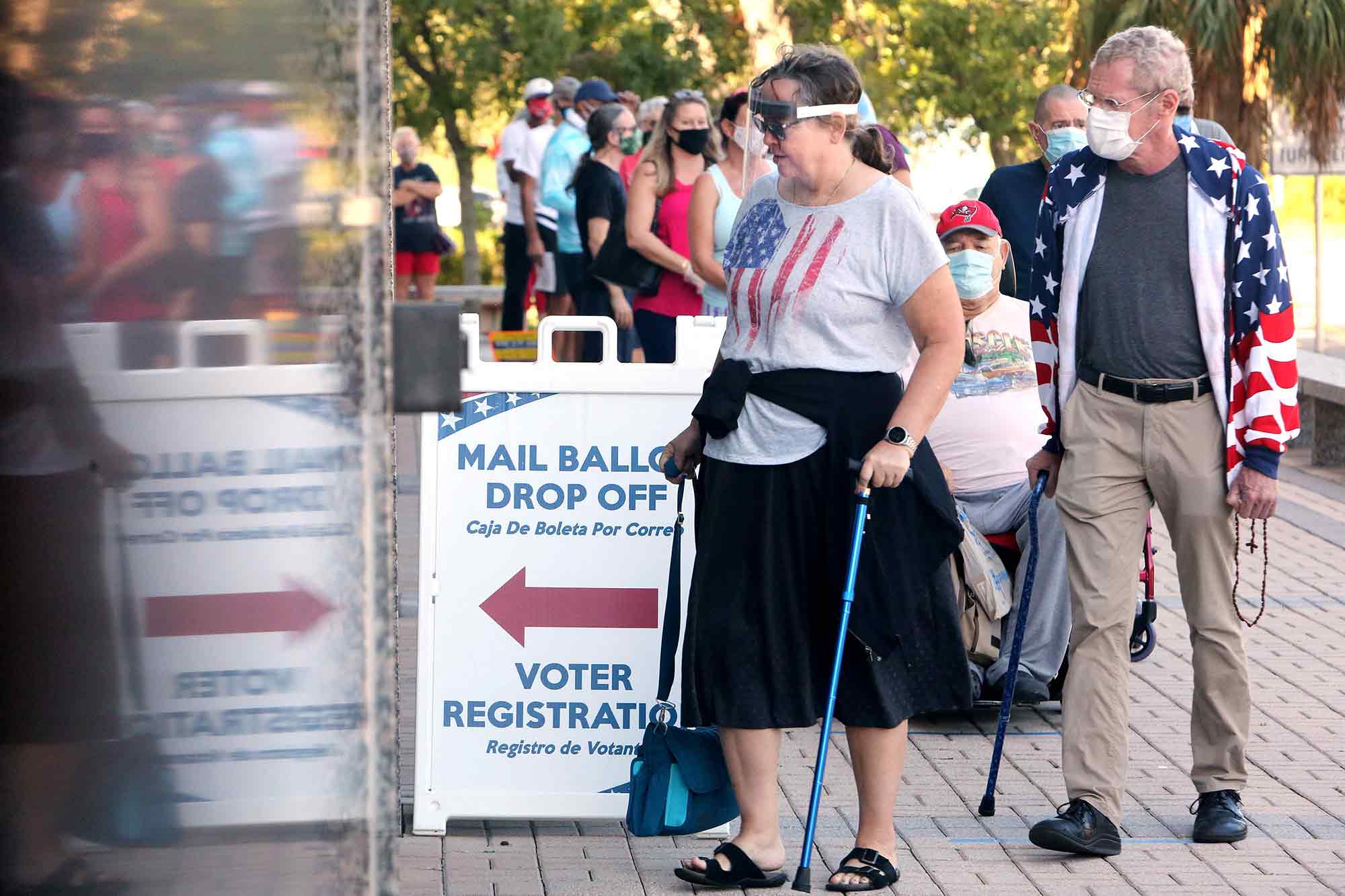
As America Becomes a Gerontocracy, Its Future Keeps Getting Delayed
What if the real crisis isn’t aging leaders, but an aging democracy where power never seems to change hands?
We’re living through the greatest transfer of wealth in history. Trillions of dollars are slowly passing from one generation to the next. Yet for all the money that’s changing hands, something far more important isn’t: Power.
The cohort of people making the biggest political decisions, controlling the most valuable assets, dominating elections, and shaping the country’s future are getting older, not younger.
We’ve spent years arguing over whether this politician or that president is too old. But what if those debates have distracted us from a much larger story?
Our guest on this WhoWhatWhy podcast, Yale historian Samuel Moyn, believes America has quietly become something few of us have recognized: an aging society where the balance between generations has fundamentally shifted.
This isn’t simply a conversation about Baby Boomers or presidential age. It’s about how longer life expectancy, delayed succession, and changing demographics are reshaping everything from housing and wealth to politics, innovation, and opportunity.
Moyn challenges some of our deepest assumptions about who holds influence, when power should change hands, and whether a democracy can truly renew itself when its institutions increasingly reflect the interests of those with the longest past — rather than those with the longest future.
It’s a discussion that asks us to look beyond the headlines and consider a question that may define the next generation of American politics: not simply who leads us, but when it’s time for the torch to be passed.
 Apple Podcasts
 Google Podcasts
 RSS
RSS
Full Text Transcript:
Jeff Schechtman: Welcome to the WhoWhatWhy podcast. I’m your host, Jeff Schechtman. Economists call it the greatest transfer of wealth in human history, trillions moving from the boomers to whoever comes next. But look closely and something doesn’t add up. The money is moving. The power isn’t. The assets change hands while the grip on institutions, decisions, and direction stays exactly where it’s been for over 40 years. Maybe that’s the quiet reason for a frustration a lot of people share, the sense that we’ve lost the ability to do big things. The people in charge have been in charge a long time, and people who’ve held power that long tend to manage what exists rather than imagine what doesn’t.
There’s one exception, and it’s a revealing one: technology. The land of the young is the one corner of American life where things still genuinely change, but it changes unsupervised, untempered by anything age is supposed to bring. Not generation sharpening each other, the old and the young in the same room, today we see generations in separate rooms, one holding the power, the other holding the future. We try to make sense of all this one leader at a time. Is this president too old? Is that senator still sharp? Should that justice have retired? But the question is misdirection. Change the names and nothing moves. A gerontocracy isn’t a person, it’s a structure, and a structure survives every funeral. It’s there in who votes, and in who decides our elections, and increasingly they are the ones with the longest memories rather than the longest futures. And underneath the structure sits something no law can reach. Strip away the tax code and the tenured chairs, the lifetime appointments, and what’s left is the oldest human impulse there is: the refusal to let go. Cicero wrote the manual for it; Jonathan Swift wrote the warning. We’ve simply turned it into public policy. My guest, Samuel Moyn, argues that this is the central, least examined fact of American life, and that it didn’t take a conspiracy to get here — it took consensus. Moyn, a professor at Yale University, has spent a career telling people the things they were proudest of were smaller than they believed, that human rights were a retreat from bigger dreams, that the campaign to make war humane is what makes it endless. In his latest work, Gerontocracy in America, he turns that same cold eye on age itself. And what a society owes the young when the old won’t leave the stage. Samuel Moyn, thanks so much for joining us here on the WhoWhatWhy podcast.
Samuel Moyn: Thanks for having me.
Jeff: It is a delight to have you here. Thank you so much for joining us. When we think about the gerontocracy today, to what extent do you think that our view of the broader picture is clouded by the fact that we’ve had two national leaders that were exceptionally old, that we have a lot of people in Washington that we know are old. But is that really representative of a larger problem? We can go back to the ’90s, to Clinton and Gore. We can go back to Obama. There were times when we thought we had young leaders. To what extent is our judgment about this being clouded by the reality of who’s in charge or who’s out front right now?
Samuel: First off, I feel you should keep talking because you gave a brilliant intro which captures so many of the views that we’ll discuss. On this question, you’re right that there’s a lot of contingency. Let’s call it just happenstance in the fact that we’ve had these two old men in succession leading the United States. Now, on the other hand, it’s not that big an accident. Neither, probably, would have been alive at their age in another era in history, and ours is one in which more than half of humanity has a political leader over the age of 70. So it’s not just random. However, I totally agree with you that there’s something that could lead us astray. I am trying to take advantage of this newfound consciousness that age matters for politics to say: it doesn’t matter for the reasons you think. I’m against having politicians who are too old, not just because of cognitive decline or death in office, but because it’s unrepresentative. But it’s not the biggest problem. So I’m proposing that we use Biden and Trump as stepping stones to confronting what it’s like to live in an aging society and thinking about all the different political ramifications of the fact that we’re just, on average, much older than ever.
Jeff: Do these things, though, come in waves? Because we think back to the ’90s and we look around the globe, or we look around certainly parts of it, and we see Clinton and Gore, we see Tony Blair, we see Justin Trudeau, we see a lot of younger leaders, all that coexisted around a similar period.
Samuel: I’d say there’s often variation across time, but there are also trends notwithstanding the variation. That sounded fancy. But it’s just to say something very obvious: there are big changes going on, and on average, our politicians, especially if you look beyond the presidency or prime ministership, have been aging and it’s been in one direction. There haven’t been big shifts. There haven’t been periods in which it’s moved back and forth. The aging of politicians is a big general phenomenon. And then, of course, there could be things that happen at the same time when a couple of young men get elected. If Kamala Harris had won, she would have been 60, and she was being touted as the youthful alternative. So that means everyone’s aging and it means that there’s something big going on that this very important story — that there are blips and waves — doesn’t really change.
Jeff: There is an argument to be made that politics, essentially, that we focus so much on politics, but that to such a large extent, politics is really downstream of culture. Do you think that’s true? And if so, to what extent does that enter into this larger discussion about gerontocracy and age?
Samuel: There’s some truth to it. At the same time, I’m thinking about politics in the broadest sense, and you got at it in your intro, like, what kind of society do we have when we look at culture? We’re watching movies about Tom Cruise saving the world again, at an advanced age, about Meryl Streep repeating herself in her role as the magazine editor. And it’s not that we can neatly separate politics and culture. I do agree that we need to take culture seriously because, in the broadest sense, what we all think, our mentality about what’s right and wrong is going to be far more important in any place in time than who’s in office and what they’re doing. They’re hostages of culture in the broadest sense. On this topic, the kinds of people there are will have a big effect on culture. And we’re in a unique, unprecedented demographic situation in human history where there are more older people, absolutely and relatively, and fewer younger people. Never happened. I talk in the book about the so-called demographic pyramid, which once decreed, in every society we know about, that there are more people the younger you go, including into the womb. Now that’s different. We have fewer younger people — in some societies, many fewer — and more older. And we have to think culturally about how that changes society, as well as the collateral effects on the political situation.
Jeff: Is this self-perpetuating? Is the fact of that inverted pyramid and the way it’s reflected in the culture in some way driving things like the declining birth rate?
Samuel: The decline in birth rate is a puzzler, and I don’t have a view about the exact causes, maybe you do. But I think there are going to be a lot of hypotheses about why it’s happening. And I’d prefer to look at what it means among the folks I’ve studied, who are the older people like you and me, in our society. And I do think that the sheer number of older people — absolutely, but also relative to the number of younger people — can’t but have big effects. In the first instance, it means that older people should justifiably have more power, but they also might be able to consolidate a gargantuan amount of power. Now, of course, it’s true, you could respond, we should really figure out why young people aren’t more numerous and aren’t, in a sense, having more children to outweigh the power of an aging population. That’s just one solution, though. And we could also think about whether older people shouldn’t enjoy the amount of power they have and have gotten to consolidate it in the way they have.
Jeff: To what extent is it reflective of, one, the sheer size of the boomer generation, the fact that it was so large and that inevitably so many people are sticking around, and also the fact that people are living longer, as you mentioned before, that part of it, plus the attitudes that grew up around that generation, and those attitudes being such that the desire to hang on, to control, is just so much more intensive, I would argue, than millennials’ or Gen Z’s in particular.
Samuel: There’s something to that, and yet I wanted to avoid scapegoating boomers. There are some hate-boomer books.
Jeff: Right.
Samuel: And I think one of them is called A Generation of Sociopaths. That’s the title. I think there’s a different story to tell, which is in part because of life extension. We should think of boomers as happening to be in the right place at the right time, and they have had a lot of power set up for them. I don’t see it as based on their sheer numbers, and that suggests to me that a lot of what they created are enduring structures. And so I think future old people, though they may be less numerous in certain cohorts than the boomers, will enjoy some of the perquisites that older people can now claim. And that means that gerontocracy is really not about a generation, or even about generations in conflict, it’s about how we have an aging population and older people have too much power relative to everyone else.
Jeff: But do we know yet whether millennials, let’s say, are going to want to hang on and want to maintain power as they age in the same way that boomers did?
Samuel: Do you think it was something generationally specific about boomers? I agree that there was something generationally specific in that, for a variety of reasons, they came into prominence early in their lives. But as far as I can see it, especially in a post-religious society, every one of us is going to want to live as long as possible, and every one of us is going to hang on to their significance and relevance and power as long as we can keep hold of them. And that’s not generationally specific: it’s human. And therefore, what really matters is what are the rules that allow that to happen? And do we let the powerful, in a sense, deny their decline in mortality to the point of perverting the rules in their favor?
Jeff: Let me make an argument or give you an example, because I’m anxious to get your response in terms of this generational difference. We saw, for example, during the pandemic, post-pandemic, a lot of millennials, Gen Zers that like the idea of working from home, like the idea of working remotely and not have to commute, not have to go into the office, etc. And yet you look back at boomers, the generation that you and I are part of. Certainly I, I can’t speak for you exactly.
Samuel: I’m a Gen Xer.
Jeff: Okay.
Samuel: Technically born in 72.
Jeff: But you look at the older generation and the world that I came from would never have thought about the idea in a business sense of not wanting to go into the office. And I spent a lot of years in Hollywood, and at one time the rule at Disney was, if you don’t come in on Saturday, don’t even bother to come in on Sunday. At places like Goldman Sachs in those days, and I know from people that work there, people came in on Saturdays, on Sundays, on holidays because they didn’t want to get left behind. They were so ambitious and it seemed so different from what we have seen of this younger generation.
Samuel: I think there’s got to be something to that. And especially in my cohort, Gen Xers are famously passive and withdrawn and unambitious. But I’d say the bulk of the phenomenon has to be about what people live through. In the pandemic, the older you were, the more you wanted to stay home, in part because of the incidence of the disease. And we’ve seen very little desire to return from off-site work, including among boomers, in the period since. You might be right that the work ethic has been especially intense in the boomer generation. But I doubt that the variation is as enormous as urban legend would have it. As I see it, younger people often don’t want to work as hard because, first of all, they don’t have jobs as good. And they don’t see pathways up in the same way that prior generations did. And that’s, again, more structural about pipeline and succession in various domains and less about some inborn generational view of whether work is fun or not.
Jeff: Talk about it in terms of the economics and this huge transfer of wealth that we are seeing and really will continue to see for many years to come right now.
Samuel: That’s right. I talk about that in the book. It’s been widely covered. And my main take on it is that it’s late — and of course it’s happening because even for boomers, death is inevitable. And therefore the hoarded assets that they have accumulated will go someplace else. But as I see it, they’re being transferred very late because of the extension of life. And if we just sit back and ask, when should people come into their inheritance? And not just within families, but on a social scale. When should they be entitled to resources? It’s when they’re being equipped for their adulthood and then when they’re trying to make something of themselves. And we’re decreasingly doing that. Rather, those who are inheriting from boomers are themselves pretty old. So I give the example of King Charles finally having his mother pass away in her 90s, practically 100, and he becomes king at 70. And the great wealth transfer you spoke about in the intro and just now is parallel because, who are the heirs of boomers? Well, they’re themselves not young. And I was inspired to do this book by a show you might have watched on HBO called Succession, which I interpreted as a parable about our society rather than just about one rich tycoon and his grasping middle-aged children, but what had happened to those children is that they were infantilized waiting. And in the end, the sad fact is, I think we’ve failed to organize succession on a social basis and direct the great wealth transfer earlier to those younger people who actually need the money, rather than have been dependents of their parents really for decades and decades.
Jeff: Talk about the way you see that as a societal issue, not necessarily within families, as you say, but in a broader societal framework, as you talk about in the book.
Samuel: Let’s just take the example of housing. I present the data, which is stunning, about the extent to which older Americans monopolize the housing stock. And I explore how they also control supply by showing up to the local zoning meetings where we make land-use decisions in this country and blocking new builds. And then by dint of life extension, they stay in their often big homes, some of the most desirable in the country, even though they’ve blocked the creation of senior housing that could allow them to downsize. And meanwhile, their children might have already passed their own child-rearing ages. And in rich families of the kind in Succession, their parents might have bought them a house, but it’s not the one they grew up in, which the parents don’t vacate. And more broadly, we know that especially folks with young families without means are just unable to purchase a house. I present data that the age cohorts most likely to own a house in this country are, in first place, those 70 to 74 and, in second place, those 75 and above. Meanwhile, the average age of purchasing a home has gone up by decades in the past few decades. So you have a lot of folks who are renting, often very far from the center of cities or from their workplaces. And that’s a sense in which even outside, or especially outside, rich families, you have a crisis of succession on a national scale, where in all these domains, whether it’s wealth in general, whether it’s housing or jobs, you have people reduced to waiting until they’re quite old themselves to get the kind of social resources, if they get them at all.
Jeff: And what do you see as the primary reason that they have had to wait so much longer than, say, boomers waited?
Samuel: It would only be fair to say that children in Succession were Gen Xers. And so my generation is one of the first biding its time, maybe willing to do so more than some other generations. But the main reason is that the boomers’ parents were still dying relatively young. We really had the mass increase in life expectancy due to the cessation of smoking, the attempts to grapple with heart disease, high blood cholesterol, high blood pressure. Those are all mass interventions that have completely changed the mass experience of life because it’s meant that especially men, who were those who were for a long time doing the hoarding, do not drop dead as readily as was once the case very recently. And that, of course, includes politicians, which provided a kind of age limit for political office through mortality that has evaporated. Now, of course, there are always people who are old, and I chronicle the facts about this in the book. What’s changed is that almost everyone can expect to live a long life. And so that’s a new thing. And it could help explain the novelty of the boomers’ experience in particular.
Jeff: And how does, and I know you talk about a lot of things in the book, but just as an overview, talk about the way in which society from a policy perspective, in your view, needs to begin to look at some of that.
Samuel: Well, I want to be careful here because it would be wrong to say that boomers are Republicans, or the old are reactionaries. Some are, some aren’t. We’ve seen views all over the map. The Iran war was the first war in really 100 years to be only supported by old people, to the extent it was supported at all. But at the same time, we’ve seen the No Kings protest trend old, especially as they’ve gone on. And so we have to be very careful and rigorous in making generalizations, in part, starting with just that, the fact that generalizations about age and political preference are going to have a lot of exceptions, but they’re real. And I’d start with basic examples of views about, say, climate change or immigration. We have very clear, hard data that the older you are, the less you care about global warming and the more immigration restrictionist you are. And I would say that I’m sold on a theory that thinks of age as a factor in conservatism, not in the sense of the Republican Party, but with a small C: you like normalcy and keeping things the way they are. And that’s part of the No Kings protest vibe, I think. If there are problems, you hope that they’ll outlive you. And so you’re tending to let things fester, like climate change, the worst effects of which you’re not going to see. And so you may do less about that kind of thing. You want a country that’s more or less like the one you remember. If you’re white, you’re enormously likely to be old. And if you’re not white, you’re enormously likely to be young. And that also has a big effect on immigration views, even though immigration would be great to pay for Social Security. And it would also be great to provide the physical caregivers that boomers and their successors will require. And yet it’s those very people who block the welcoming of new Americans to the country.
Jeff: Wasn’t there a similar feeling? You look back to the ’60s and you see what is the boomer generation coming of age and protesting the war in Vietnam and protesting in favor of civil rights and the attitudes of their elders and Nixon being the personification of the opposition to that. And you see similar kinds of patterns. I mean, the issues are different, the people are different, for sure. And again, not to generalize, as you say, but in a way, these things tend to play out in a way that they’re not the same. But as Mark Twain said, they rhyme.
Samuel: Yes. I appreciate that point, but it goes back to my resistance to generational framings, and my insistence that gerontocracy is, in a sense, about a related issue, which is the old of whatever generation versus everyone else — and you were there. But my sense is that the beef of folks in the ’60s was with their parents, not with the old at that time. And there’s definitely something in modern history that answers to the description of generational strife, in the sense of having cohorts against one another. But I wouldn’t have said that people in the 1960s were upset about things like Social Security, and the expense of it, or about just how much senior citizens control elections. They were concerned about other things that were chosen by middle-aged policymakers, like the Vietnam War. And so I feel I’m talking about something that at best arrives very imperfectly with your example and with generational conflict in general, because it’s really about something slightly different, which is what happens when we age and there are so many more older people that everyone else, not just the young, but people in their prime, see their interests set back by elder power.
Jeff: Talk about that in the context of a democracy, though, because as you say, there are going to be, and there continues to be, more older people, exactly as you’ve delineated, and therefore they are going to have more voting power, even if young people voted in equal percentages.
Samuel: Yeah.
Jeff: I mean, they don’t. But even if they did.
Samuel: For sure. The argument I’m making can’t be that older people don’t deserve more power than they had in the past. Of course they do. There are more of them, absolutely and relatively. My case is that when you look at the facts, they enjoy a gargantuan percentage of the power that’s not justified by their numbers. And so-called democracy is a great example because in the end, those over 65 are only 17 percent of the American population. We still have half the people in the United States 40 or under. But when you look at elections, you find that folks approaching 65 are already the median voter. And in some primaries, the median age of voters is 72. And so the exclusion, or non-participation, however you want to think about it, of much of the population in American elections is extreme. And it’s not justified by the numbers. If it were, I think we’d have to have a different conversation. Now, I’d still want to have that conversation because I’m also concerned about what kind of society we end up having when we’re an aging society. But we’re not just in that situation. We’re in a situation where the aging of society has meant this new structural thing where the advantage of older peoples goes way beyond what you would predict based just on the numbers of them.
Jeff: Given, and I don’t want, I truly don’t want to turn this into a political conversation in any kind of contemporary sense, except to say that is our situation right now, so unique and so highly charged, and having had two presidents or three presidential administrations with older leaders, that there is such a yearning on the part of young people for this to change, that we are approaching some kind of an inflection point. We look at who future leaders might be in both political parties, and you do see a younger core of people coming up. And with the very real possibility that no matter what your political views may be, that whoever future leaders are going to be in the very near future, are going to be significantly younger and will bring along younger people into those institutions.
Samuel: Absolutely. That’s a fair point. And I think it will happen with the presidency first, inevitably, because it strikes me as unlikely that either party will put up someone in his or her late 70s in the next round or two. Now, they’ve tried with other offices: Graham Platner and Maine beat a rival Democrat who was herself over 70 in order to have the opportunity to face Susan Collins, who is even older. And so as you look beneath the presidency, we’re still dealing with an extremely old group of politicians. And when you look beyond elected ones at the federal judiciary, it gets even worse. Actually, one of Donald Trump’s achievements, such as it was in his first term, was to rejuvenate the federal judiciary compared to the age of the federal legislature. So I’m not going to get as enthusiastic as you when we look at the whole sweep of federal political office, or for that matter, political office across the nation, governors and state houses and so on. I think we may be reaching a kind of upper limit. The average may not go up from here in those various domains. But as you say, it would be hard for the average to go up. We just can’t have older presidents than we’ve had the last couple times. So what counts as progress depends on how high you’re setting the bar, or low in the case of age. I’m not going to get too excited, but beyond that, my main point is that we shouldn’t really mainly look at the age of the politicians, where we may see change first. And my question is, does it even matter that much if the electorate remains as old, and if those who hold power in other forms like wealth, jobs, housing, remain so old?
Jeff: Can you make the case that perhaps at a certain point, even some of these older voters, and you hear rumblings of this, I’m curious how you see it, that some of these older voters are even coming to realize that the policies and the people that they have been putting in place need refresh, need revitalization, and that even they may tend to support younger people for various things.
Samuel: That’s my hope. And I reflected on this because, unlike your generation, the young people today aren’t that numerous. And I doubt they can make much change under their own power. And so when I crafted the book, I thought, how can we imagine intergenerational solidarity around the amount of power that different generations have? So it’s a very different politics than was happening in the ’60s where there were just divisions. And I hope that the kinds of glaring facts that I present can lead to some kind of politics where our divisions are reconfigured. And again, in part because I don’t want to scapegoat old people, let alone boomers, just for being boomers, I think that everyone has the capacity to respond to what turns out to be the truth about our choices. I think that there’s going to be a class of folks, like in any political situation, that are not going to respond to the public interest, but some will. And in the end, the majority of people can put a powerful minority in its place. It’s happened before. It should happen again. And I think that majority has to include some older people. And it could.
Jeff: Before we wrap this up, I want to talk a little bit about technology because it is an area that is changing and where there are younger leaders. I mean, for every Jamie Dimon, there’s a Sam Altman emerging in Silicon Valley. And with the recent, for example, SpaceX going public a week ago, and I think the number was around 1,200, 1,300 millionaires that were immediately created on that day. And there are going to be a lot more as some of these other big companies go public, etc. And as things continue to evolve in the Valley, that’s going to change things. And these are people, whether we like them or not — and the jury is out on a lot of this — but that group of tech leaders, of sort of young oligarchs that was at the inauguration and that we see so much of, they are younger.
Samuel: They are. So I think that’s of great significance. And we’re going to keep talking about that as a country for years to come, clearly. My main point in the book is to figure out what’s the exception and what’s the rule. And when one looks beyond Silicon Valley, it turns out that business people are aging too. And especially the leadership of business. And for all its importance, Silicon Valley is a minority of American capitalism. It does define it in many of the most visible ways for sure. And yet there’s a lot of other sectors where the kinds of cult of innovative youth that has made Silicon Valley famous and wealthy don’t prevail. And so I don’t want to deny or trivialize the importance of what’s happened there, and of AI wealth and all the rest of it. But in the end, we also wouldn’t want to mistake an exception for the rule.
Jeff: But what we are seeing as a reaction to so much of what we’ve talked about is that a lot of young people that don’t want to work for big corporations that are being led by 65- and 70-year-olds, and there are a lot, as you say, have decided they want to start, and not necessarily in tech, but just on Main Street, USA, want to find ways to start their own business. And small-business creation among young people is growing.
Samuel: Yeah, that’s undoubtedly true. And I’m for it. And I just would make the point that we don’t just witness what happens. We could envision government policy to spread resources to enable more of that kind of behavior. So one thing that we could discuss in this regard is the so-called abundance movement, which is precisely trying to figure out how to unleash creativity. And yet they think the problem is government hamstringing the creative class, including those in Silicon Valley. Whereas I think what’s at stake is as much as government regulation, which should be discussed, is also what is the government doing to spread the resources for people to launch themselves into creative new businesses and other creative activities. And we’re just not doing a good job there because of the gerontocratic effect and where the wealth in our society is located, who possesses it, who gets it, but so late in life that they’re much less likely to found businesses or do other creative things that they might otherwise have done.
Jeff: I think the abundance movement is not opposed to government policy. It really wants to eliminate one set of policies for exactly the kind of policies you’re talking about.
Samuel: Yes, I think we’d have to… There’s an excellent essay by Steven Teles called “Varieties of Abundance.” So it really depends who we’re talking about. But the Ezra Klein and Derek Thompson canonical version of it is much more about getting government out of the way. It does have a lot to say about government’s role in infrastructure in particular, but it doesn’t envision a big role for government in industrial policy or spreading innovation beyond where it’s already existing in a few cities. And if you’re concerned about… There could be a different abundance, which would be much more pro-government than the version that the canonical version that we’re talking about these days.
Jeff: The good news, I suppose, above all, is that people like yourself and your book, and even within the context of abundance, that these issues are getting talked about right now.
Samuel: Yeah. I agree. I’m not claiming there’s some totalitarian state run by old people for their own sake. It’s not that bad. And we still have a free media and so forth. So I wouldn’t write this book or the other books you mentioned to try to say counterintuitive things without the faint hope that there could be discussion and enlightenment and reform, and there’s definitely still a chance. I’m a very hopeful person. So it’s true that there are good signs of an impulse to a reformist era in American politics that I wouldn’t say has marked much of my lifetime as a Gen Xer.
Jeff: Professor Samuel Moyn, his book is Gerontocracy in America: How the Old Are Hoarding Power and Wealth and What to Do About It. I thank you so much for spending time with us today here on the WhoWhatWhy podcast.
Samuel: Thank you, Jeff. What a privilege.
Jeff: Thank you. And thank you for listening and joining us here on the WhoWhatWhy podcast. I hope you join us next week for another WhoWhatWhy podcast. I’m Jeff Schechtman. If you like this podcast, please feel free to share and help others find it by rating and reviewing it on iTunes. You can also support this podcast and all the work we do by going toWhoWhatWhy.org/donate.