Time to Cause Some Good Trouble Again in the South
The battle for civil and voting rights for African Americans has always been characterized by progress and setbacks. Now that the Supreme Court has dealt them another blow, it is time for a new generation to step up and fight back with new tools.
|
Listen To This Story
 |
The struggle for civil and voting rights for African Americans is an ongoing battle as old as the nation itself. At various points throughout US history, seminal moments have either brought about major gains or resulted in massive setbacks. In many cases, the victories were followed by a slow and steady erosion of hard-fought rights.
And while the Supreme Court delivered some of those wins, its terrible decisions also repeatedly paved the way for Southern lawmakers to put in place blatantly racist policies. The worst of them, Dred Scott v. Sandford (1857), directly contributed to the start of the Civil War, and Plessy v. Ferguson (1896) provided the legal justification for the Jim Crow era.
In each case, the devastating consequences of the rulings were ultimately undone… but at great cost. Dred Scott, which denied people of African descent the rights afforded to US citizens, was nullified by the adoption of the Fourteenth Amendment. However, it took the split of the Union and 700,000 Civil War (both North and South) deaths to get there.
As it happened, those gains were short-lived and incrementally rolled back through discriminatory laws that received the Supreme Court’s blessing in Plessy, which established the “separate but equal” doctrine.
While the Jim Crow era’s terrorism was less deadly than the Civil War itself, it fed the oppression of African Americans in the South for nearly a century before it was finally brought to an end by the Civil Rights Movement, which resulted in the passage of the Civil Rights Act (1964) and the Voting Rights Act (1965).
Once again, however, various states (primarily in the South) chipped away at these landmark laws. And, once again, the Supreme Court helped them.
First in Shelby County v. Holder (2013) and just last month in Louisiana v. Callais, it gutted the Voting Rights Act almost completely. And, wouldn’t you know it, Southern lawmakers were waiting in the wings to immediately nullify the power of Black voters to elect representative leaders.
So, what happens next?
Well, if history keeps repeating itself, and we have every reason to believe that it will, these disastrous rulings, and the resulting racist gerrymanders across the South, will spur somebody to do something.
After Dred Scott, it was Abraham Lincoln and his Republicans.
A hundred years later, it was a movement. While Dr. Martin Luther King, Jr. was its icon, there were countless others who played key roles — both in its leadership and in the trenches. While the history books teach us some of their names — like Rosa Parks, John Lewis, Thurgood Marshall, Medgar Evers, and Ralph Abernathy — there were countless others, both Black and white, who put their lives on the line for the causes of equality and justice.
Among them were the Freedom Riders, a group of (mostly) young civil rights activists who traveled to the South to challenge the segregation practiced there. They did so in the face of violence that was perpetrated by both the state and racist protesters.
So, who will step up this time to fight against the injustice practiced by the same states?
It could be you.
While some things have remained the same in the South, such as the apparent desire to disenfranchise as many African-American voters as possible, a lot has changed.
There are three factors to consider: access to power, the level of injustice committed, and the visibility of the oppression.
Ahead of the Civil War, Blacks had no power or leverage; the injustice committed against them was the gravest; and their oppression was not easily visible to those in the North. As a result, it took an outside force to end slavery.
A century later, African Americans had amassed some power, both political and economic. As a result, new tools to fight back were available, such as economic boycotts. And while segregation and open racism in the South were still despicable (and often resulted in murders), things had inarguably improved compared to when the “master” of a slave was able to beat him to death without having to worry much, if at all, about repercussions. Lastly, thanks to new technologies like broadcast TV, images of the brutality in Southern states were transmitted to living rooms across the country.
Fast forward to the present. While the economic and political power of an average Black American may not rival that of the average white American, it still has increased significantly. In addition, the injustices perpetrated against them — e.g., their disenfranchisement — are shameful, but they pale in comparison to state-sponsored violence and other forms of humiliating discrimination. Finally, the Internet and cell phones have offered new tools to fight back.
And fight back we must!
In response to Republicans rushing to disenfranchise Black voters, the NAACP, which has been in this battle for more than 100 years, introduced a plan that would hit their red states where it would hurt them the most: sports.
The organization called on African-American athletes to refuse to attend targeted universities in the South, where college sports are a religion.
“This generation of Black athletes understands something that those who came before them were never afforded the chance to say so plainly: Your talent is yours, and so is your community’s political power,” said Tylik McMillan, the national director of the NAACP’s Youth and College Division.
“These are not separate issues,” he added. “The state that is working to erase your grandmother’s congressional district is the same state whose governor will stand on the field and celebrate your touchdown or game-winning shot. We are asking young people — recruits, current athletes, fans — to see that connection clearly and to act on it.”
This would work — even better than professional athletes refusing to play for teams from Florida to Texas or entertainers canceling events there.
However, it would be unfair to put the burden of effecting change solely on the shoulders of young African Americans who have the opportunity to earn life-altering money.
Sure, it would be great if some of them heeded the NAACP’s call and chose other schools. Or if they used their voices, amplified through social media, to talk about the racist redistricting efforts aimed at silencing Black voters and lawmakers.
But this has to be a team effort.
And here is the great news: You don’t need to put your neck on the line like the Freedom Riders to get involved.
One thing you can do is to stay away from the states that want to use racist gerrymanders to rig the midterms for Donald Trump: Texas, Florida, North Carolinas, Louisiana, Alabama, Mississippi.
And don’t spend money on companies from there if you can help it. Maybe a clever programmer can create an app that shows where products are made and that automatically sends a message to a company when someone chooses not to buy from them because their states support bigotry.
Of course, the simplest thing anybody can do is to show up and vote. In a wave election, as this year’s midterms could be, some of the racist redistricting efforts could end up backfiring if the pro-democracy forces show up.
What you have to keep in mind, however, is that the Trump administration and Republicans will try to make this as difficult as possible for likely Democratic voters. In fact, they have repeatedly said the quiet part out loud.
In February, then-Secretary of Homeland Security Kristi Noem explained that one of her most important tasks is to ensure that “when it gets to Election Day, we’ve been proactive to make sure we have the right people voting, electing the right leaders to lead this country.”
And the president and his party are certainly trying to do that — through their unprecedented mid-decade redistricting campaign and such initiatives as the SAVE America Act, federal agencies pressuring states to submit voter lists, changing the rules governing how the United State Postal Service handles mail-in ballots, and many more.
In response, the pro-democracy advocacy of every American should begin with ensuring that he or she is (still) registered to vote and spreading the word to others to do the same. You can go here to verify your registration status.
Over the next five months, we will highlight the work of some pro-democracy groups and detail more ways for you to get involved.
Because, make no mistake, it will take all of us to fight the same kind of people who clung to the barbaric practice of slavery for nearly a century after the nation’s founding, who segregated and discriminated for another 100 years after that, and who now want to shut up Black voices throughout the South.
Just as in those cases, we have to trust that justice will ultimately prevail in spite of the Supreme Court once again coming down on the side of bigots.
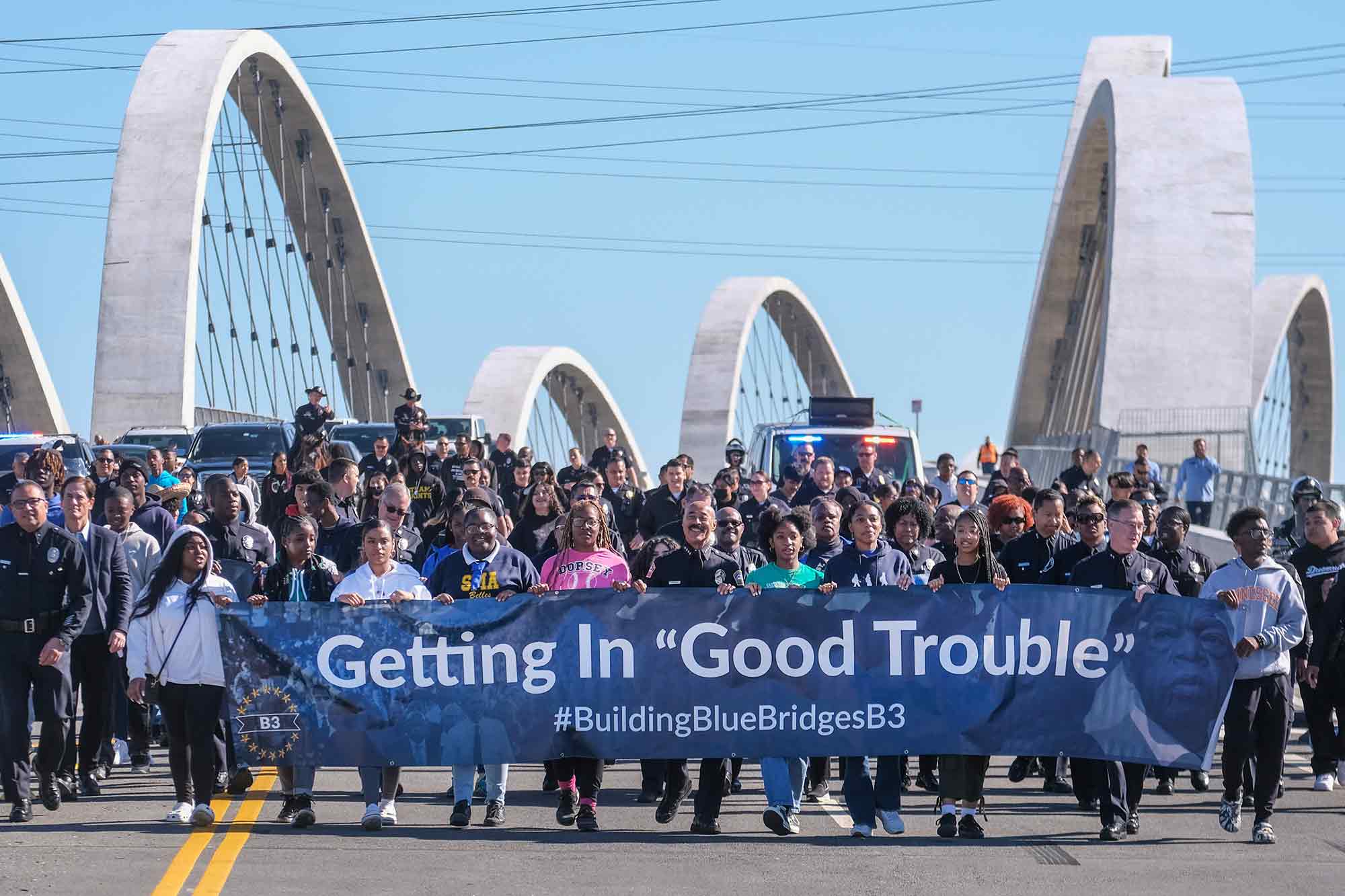
It will be hard work, but — in the words of Civil Rights leader John Lewis —– causing good trouble is always worth it.