The Company They Keep Shows Whom Republicans Really Work For
Donald Trump prefers authoritarians over democratically elected allies, and Republicans get their money from wealthy benefactors instead of regular Americans — so who do you think they are going to side with when push comes to shove?
|
Listen To This Story
 |
The idea that “you are the company you keep” tracks all the way back to the Greek playwright Euripides. It is a concept that has endured for the simple reason that it makes sense.
After all, birds of a feather do flock together.
So, why are we talking about this a month before an election in which both sides accuse each other of wanting to dismantle the Constitution?
Because we want you to keep in mind who keeps whose company.
Republicans are trying to make the midterms about a left-wing podcaster (whom most Democrats would love to shut up) and the specter of the rise of communism (for which nobody is actually advocating). Sure, there is also plenty of xenophobia and the existential threat of a few transgender high schoolers playing volleyball, but that’s pretty much the gist of it.
Conversely, Democrats claim that Donald Trump is turning the US into an authoritarian kleptocracy and that he wants to dismantle democracy while putting the interests of billionaires ahead of that of regular people.
Euripides would say that they have a point.
First, let’s look at the president’s associations.
Over the past few days, Trump wined and dined China’s President Xi Jinping and showered him with compliments.
His counterpart looks “strong, vibrant, and fit,” the president wrote on his social media site, while calling China’s first lady “BEAUTIFUL.”
In the conflict between Russia and Ukraine, Trump routinely urges Volodymyr Zelenskyy — not Vladimir Putin, the aggressor in the conflict — to make concessions, which is hardly surprising since he owes his job to the former KGB officer-turned-dictator.
And a couple of days ago, the US president touted his friendship with North Korea’s Kim Jong Un.
In addition, there are also the Middle Eastern monarchs who ply him with gifts and “business opportunities” for Trump and his family.
That’s the company he keeps.
At the same time, he does his best to antagonize the democratically elected leaders of America’s best friends and partners by threatening them, trying to hurt their economies, and jeopardizing alliances that have benefited the Western world for decades.
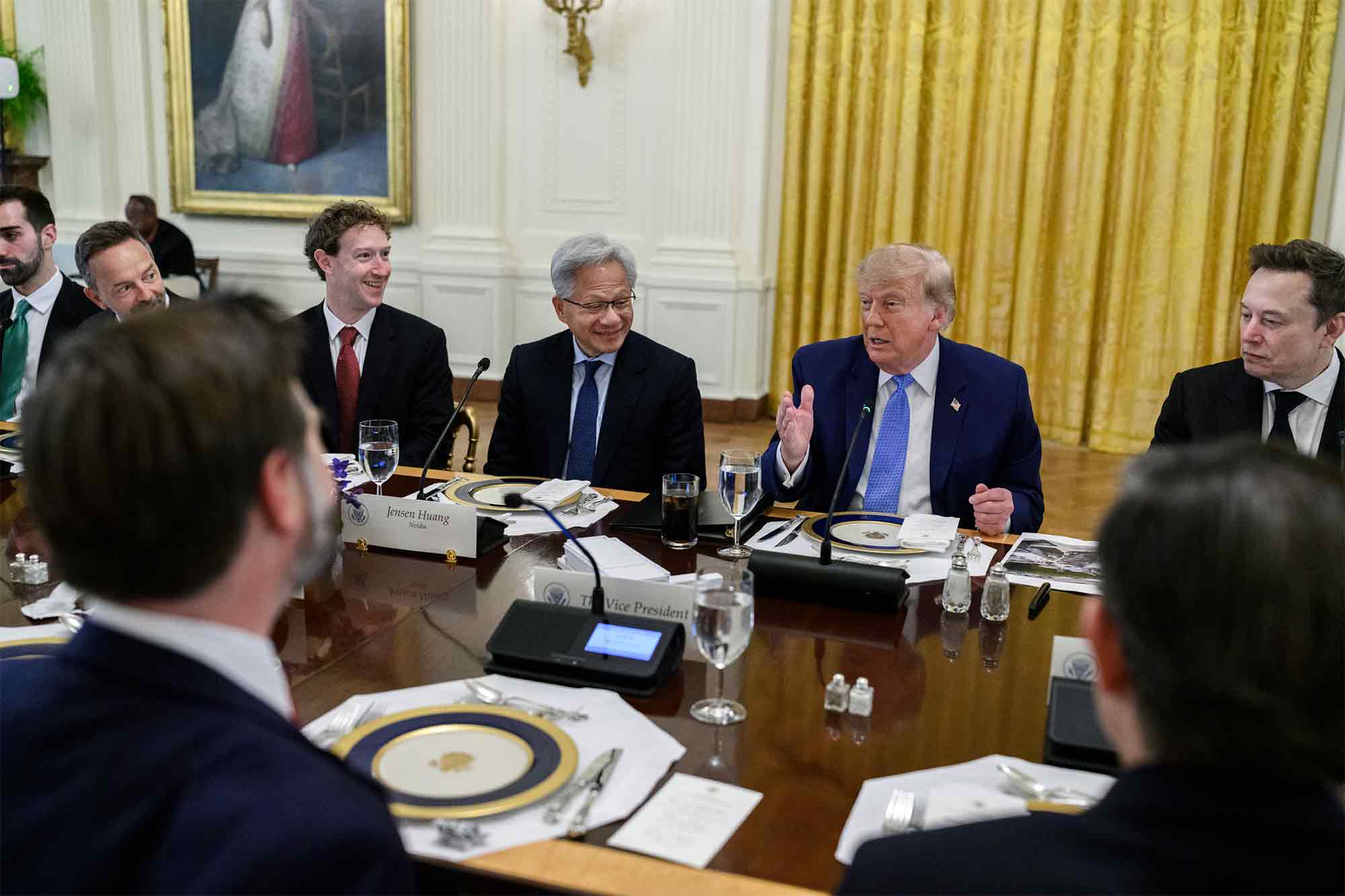
And that’s the company Republicans keep: the uber-wealthy people who are collectively spending hundreds of millions of dollars on ensuring that a compliant Congress will keep their taxes low, provide them with corporate welfare, let them do whatever the hell they want, and bail them out when they inevitably screw up.
But it’s not just that Trump is most comfortable around strongmen or — speaking of birds of a feather — that one of his best buds used to be Jeffrey Epstein, with whom he apparently “had certain things in common” and shared “wonderful secrets.”
There is also the GOP.
In politics, you can also tell a lot by the company that a party keeps. Or, to be more exact in this case, by the companies.
As we have covered extensively, Republican legislators, with the approval of the Supreme Court, have drawn themselves some favorable maps to assure that there will be as few Black representatives in Congress as possible next year, thus ensuring that the GOP is only likely to lose the House majority if the Democrats win by at least three points across the country.
Even with that ill-gotten edge, the sole reason that Republicans may avoid a massive blowout is that they are raising money hand over fist. Actually, that’s not quite accurate because it is not the candidates themselves who are raking in hundreds of millions in campaign cash. They can’t, because individual donations are capped at $7,000 across the primary and the general election.
Instead, the GOP’s fundraising edge comes from their national committees, which can get more money ($132,900 per person) from deep-pocketed donors. This alone gives them an advantage of more than $100 million.
But that’s not all, because there are also all those super PACs and shady dark-money groups that have become a way for the super-rich to buy themselves a Congress they like — and a look at the billionaires and industry groups who are plunking down at least $30 million each this cycle shows that nearly all of them support the GOP.
Republicans will need every penny of it.
Because, in the Senate races that will decide who controls the chamber next year, they are up against Democratic candidates who are generally outraising their opponents — and sometimes by staggering amounts.
In Texas, for example, James Talarico (D) has raised an eye-popping $68.5 million through the first half of the year, and the vast majority of donations his campaign received were $100 or less.
Yet while his opponent Ken Paxton (R) took in a mere $9.2 million during the same time, Talarico will still be outspent… by a lot.
That’s because the GOP is pouring unprecedented amounts of money into their effort to hold on to this seat. In September alone, outside groups supporting Paxton have spent $122 million in the Lone Star State, with another $66 million in ads already reserved.
The same dynamic would also play out in Georgia if Sen. Jon Ossoff (D) weren’t running away with the race, and it can be observed elsewhere across the country: Democratic candidates get more grassroots support that ends up being dwarfed by millions of dollars coming from outside groups fueled by the wealthiest Americans.
Unfortunately for the Democrats, there is a finite amount of small donor money while the billionaire spigot is essentially endless. This will almost certainly hurt the Democratic candidates in winnable governor’s races across the country — e.g., in places like Florida and Texas.
One reason is that anti-Trump sentiment is so strong that small donors want to spend their money on stopping him and his agenda above all, and that, voters understand, has to happen in Congress. Another is that the Democratic Senate candidates du jour often raise way more cash than they need, or that donors sink their money into losing campaigns. In other words, the limited amount of grassroots money is not being distributed effectively.
But we digress.
The point we are trying to make is that lawmakers tend to be beholden to the people who get them elected.
Therefore, if the issue before the Senate is either to put in place measures to protect communities from data centers or to incentivize their construction, which side do you think a lawmaker is going to come down on who got tens of millions of dollars from tech bros?
The same applies to environmental protection and oil moguls, curbing the crypto industry, safeguards on artificial intelligence, regulating banks, etc.
And that’s the company Republicans keep: the uber-wealthy people who are collectively spending hundreds of millions of dollars on ensuring that a compliant Congress will keep their taxes low, provide them with corporate welfare, let them do whatever the hell they want, and bail them out when they inevitably screw up.
So, our advice to voters is simple: If you are unsure whom to vote for, do a little research to find out which candidate is funded by people like you (and therefore likely to represent your interests).
Obviously, that should not be the only factor, but we think it’s a pretty good starting point.
By the way, if you go through this exercise and realize that you want someone to fight for the little guy, then we invite you to support WhoWhatWhy, a publication that does just that. You can do so by making a small donation or signing up for one of our newsletters.
And, if you are one of those uber-wealthy people, you are welcome to make a very large donation here… just don’t expect us to do your bidding.