25 Years After 9/11, the Saudis Still Owe Americans Answers and Accountability
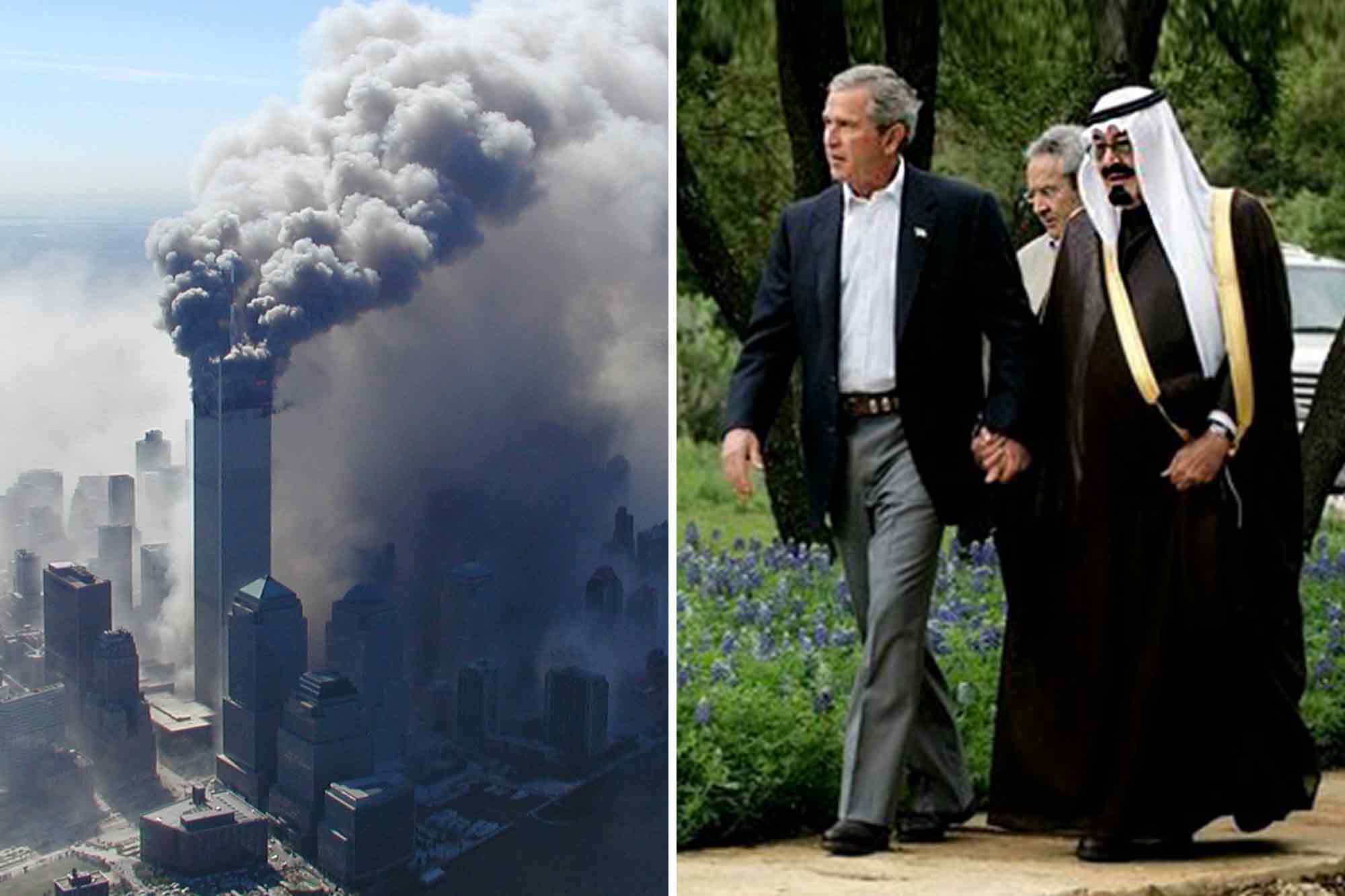
Ever since the 9/11 attacks, the US government appears to have protected the kingdom of Saudi Arabia from scrutiny. But inquiring minds in the media and among the families of victims have given us a much clearer picture of the involvement of some individuals who are still walking free.
|
Listen To This Story
 |
We do not subscribe to any theory suggesting that 9/11 was an inside job. It just doesn’t make sense. Therefore, we believe that it is pretty safe to assume that not a single American was aware of what was about to happen until the first plane hit the World Trade Center. That being said, we also believe, and the evidence strongly suggests that, apart from the hijackers themselves, there were individuals on US soil that morning who, at the very least, knew that some sort of terrorist strike was in the works.
Furthermore, we would bet dollars to donuts that not everybody in Saudi Arabia was surprised by the attack.
And it is truly scandalous that, 25 years later, we still don’t know who all of these people were, what they knew, or what their level of involvement was.
The report of the 9/11 Commission in 2004 largely cleared Saudi Arabia of any involvement.
For example, it stated that it found “no evidence that the Saudi government as an institution or senior Saudi officials individually funded [al-Qaeda].”
The commission also absolved individuals like Fahad al-Thumairy, an imam at King Fah ad Mosque in Los Angeles, and Omar al-Bayoumi of having aided any of the hijackers.
Of the latter, the report stated that “our investigators who have dealt directly with him and studied his background find him to be an unlikely candidate for clandestine involvement with Islamist extremists.”
The names of other Saudi nationals who were in contact with the attackers don’t appear at all.
In 2002, Robert Mueller, then the FBI director, told a Senate Committee in a secret session that “to this day, we have found no one in the United States except the actual hijackers who knew of the plot.”
However, since then, additional government disclosures, such as the infamous “28 pages,” cast a very different light on Bayoumi. For example, that previously classified document describes how the Saudi government pressured a company to send money his way.
And the amount of that funding jumped sharply during the time one of the hijackers, whom Bayoumi helped get an apartment, was in San Diego, where both of them resided in the second half of 2000.
All of this has made both Thumairy and Bayoumi, but especially the latter, central figures in a trillion-dollar lawsuit that survivors of 9/11 victims filed against Saudi Arabia.
Last year, a federal judge rejected the kingdom’s motion to dismiss the case, stating that “multiple pieces of circumstantial evidence creat[e] the reasonable inference that Bayoumi and Thumairy were coordinating with the Saudi government when providing assistance to the hijackers.”
This means that, as things stand, there will be a trial at which some of this evidence will be presented. However, the case is still in the discovery phase and is not expected to see a courtroom until next year at the earliest.
Still, the families of 9/11 victims deserve a lot of credit for pursuing accountability when the US government has not.
We should also point out that some (although not enough) news outlets, including WhoWhatWhy, have also shed more light on various Saudi nationals and their potential involvement in the lead-up to the attacks, some of whom were mentioned in the 9/11 Commission report and some of whom were not.
Among our work is an investigation into Anoud Ghazzawi and her husband, Abdulaziz al-Hijji, two Saudi nationals who abruptly abandoned their home in Florida days ahead of the attacks, and an interview conducted by WhoWhatWhy Founder and Editor-in-Chief Russ Baker with former Florida Gov. and Sen. Bob Graham (D), who was told by a top FBI official in no uncertain terms to stop looking into the matter.
He did not comply.
Until his death two years ago, Graham fought to hold Saudi Arabia to account and to seek answers to questions about the kingdom’s involvement in 9/11.
Graham is gone, the questions remain.
Which members of the Saudi government were involved in funding the attack or supporting it in another way?
Were any members of the royal family involved?
Why has the US government tried so hard to shield Saudi Arabia from scrutiny?
Will there ever be justice for those who lost loved ones during the attack?
While Saudi Arabia has skirted transparency and evaded accountability for the most part, it doesn’t mean that the kingdom hasn’t paid a price.
In fact, it has had to spend billions of dollars on trying to rehabilitate its image.
One of these efforts — the LIV Golf tour — just failed and demonstrated the limits of Saudi “sportswashing” — i.e., the practice of funding sporting events or teams as political and reputational PR.
And the families of 9/11 victims played a big part in that collapse.
The group 9/11 Families United protested LIV events at golf courses and with advertising in Times Square in New York City.
And it derived no small amount of glee when the tour declared bankruptcy last week. “This was never about golf. It was an attempt to outrun accountability. That effort has now collapsed,” said Terry Strada, the group’s national chair, who lost her husband on 9/11.
“There is no alternative path forward. The Kingdom must answer for its support of al Qaeda and for the US-based support network that assisted the hijackers in the lead-up to September 11,” she added. “The details of that network are already in the record in the 9/11 litigation against the Kingdom. They are established.”
And then she issued a warning to Saudi Arabia.
“This ends in one place: liability for the murder of nearly 3,000 Americans on US soil.”