Memorial Day vs. Donald Trump
Will Americans still be prepared to die in order to protect the corrupted control of government by wealthy oligarchs that Trump seeks to impose on us?
|
Listen To This Story
 |
If aliens from another planet were to land on the Mall in Washington, DC, they might be puzzled about what “Memorial Day” signifies in today’s America.
TV and social media offer a flood of ads promoting mattress sales and quick deals on household appliances. Travel companies claim that they are honoring veterans with cut-rate deals.
For most Americans, this Memorial Day is just another long weekend’s relief from an economy under strain from rising gasoline prices. The fact that despite the sales and commercial deals, the cost of just about everything has been rising since the Trump administration engaged us in a war that didn’t have to happen seems almost incidental. This is a day for honoring the dead; let’s not make it too political.
To be fair, most Americans pay at least lip service to Memorial Day. For a few moments, they make an effort to remember what the celebration is supposed to be about. Then they use the extra free time to picnic, watch a game on TV, or simply relax. More than a few confuse the holiday with Veterans Day, which falls on November 11.
Times change, and people forget. For anyone still puzzled about the difference between the two holidays, Memorial Day, originally called Decoration Day, is intended to honor those Americans who died while defending their country. Its origins go back to the Civil War, which killed more Americans than all of our other major wars combined.
Veterans Day, formerly known as Armistice Day, originally celebrated the end of World War I, which officially terminated in 1918 at the 11th hour of the 11th day of the 11th month. After World War II quadrupled the number of US casualties, it was decided to use the occasion to celebrate everyone who ever served in the military, whether killed in action or not.
Memorial Day is different. It was chosen to fall on the last Monday in May, specifically because no major battle was fought on that day. As a result, it commemorates all the battles that Americans have ever fought and died in.
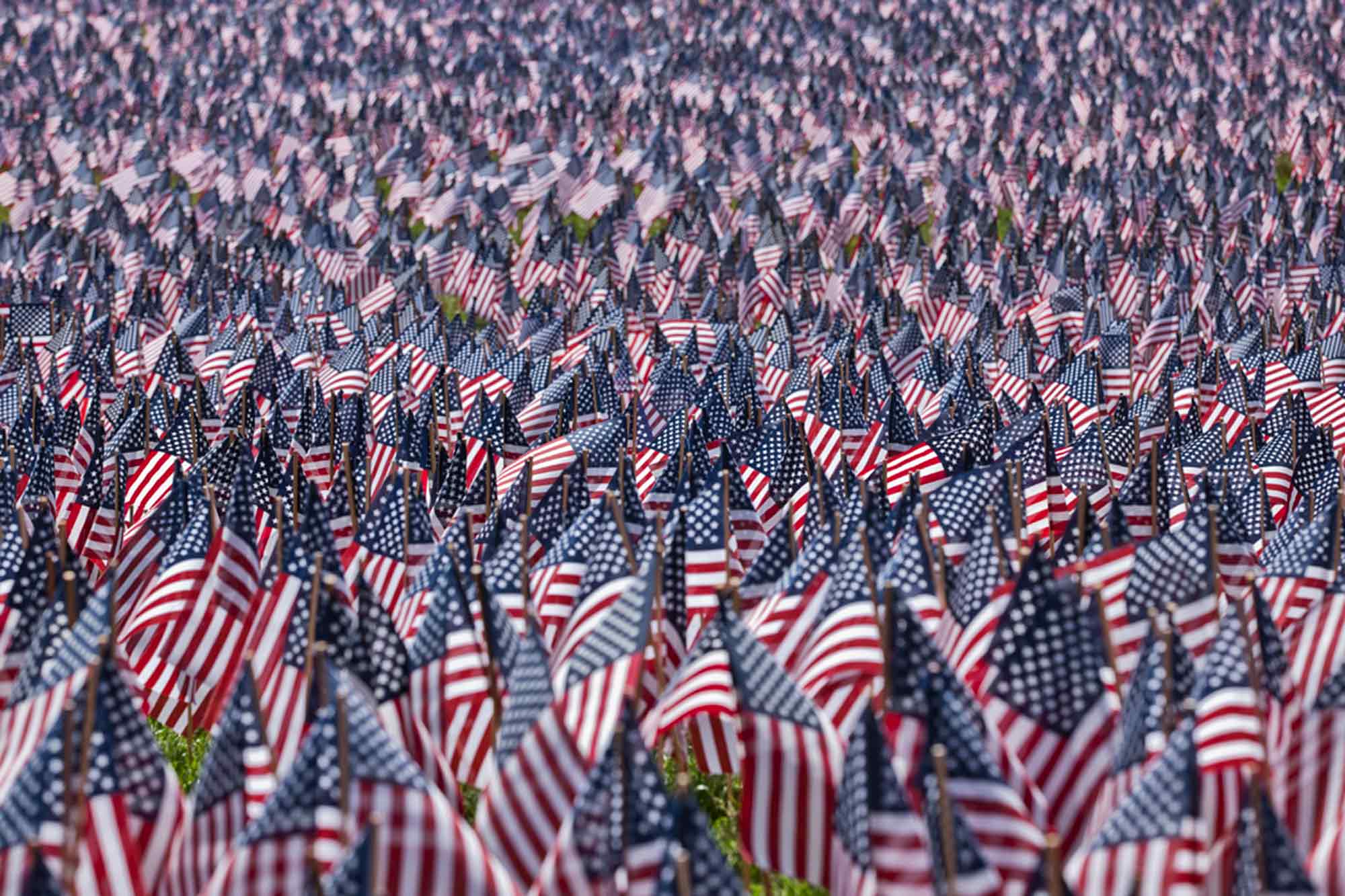
Official protocol calls for the flag to be raised to half-mast at sunrise in honor of those who died. At noon, the flag is to be raised to full mast in honor of all those who fought and survived.
The custom of choosing a specific day in the year to honor fallen heroes goes back to ancient Greece. In 431 BC, Pericles, arguably the greatest of Athens’s statesmen and generals, delivered a funeral oration that is recorded in the second volume of Thucydides’s History of the Peloponnesian War.
While Pericles praised the heroism of ancient Greece’s fallen warriors, the main thrust of his speech was that Athens’s heroes had prevailed not just because of their physical strength and courage, but because Athens — with its emphasis on democracy, justice, and openness — was worth dying for.
In many ways, Pericles’s description of Athenian democracy resembles how the Founding Fathers saw America.
“Our constitution does not copy the laws of neighboring states,” Pericles told the Athenians. “We are rather a pattern to others than imitators. Our administration favors the many instead of the few; this is why it is called a democracy.”
Pericles goes on to declare:
If we turn to our military policy, there also we differ from our antagonists. We throw open our city to the world, and never by alien acts exclude foreigners from any opportunity of learning or observing, although the eyes of an enemy may occasionally profit by our liberality; trusting less in system and policy than to the native spirit of our citizens; while in education, where our rivals from their very cradles by a painful discipline seek after manliness, in Athens we live exactly as we please, and yet are just as ready to encounter every legitimate danger.
In America, funeral orations grew almost spontaneously in response to the anguish felt at the end of the Civil War. That war, caused by divisiveness, obstinacy, belligerence, and a refusal to compromise, was the most destructive in the nation’s history. It led to the death of nearly 700,000 Americans — compared to roughly 100,000 Americans who died in World War I and more than 400,000 in World War II. The Vietnam War cost more than 50,000 American lives, along with several million Vietnamese.
The reasons for engaging in World War II were clear; the reasons for America’s involvement in Vietnam, and the wars that followed in the Middle East, were less clear. When a war is fought for the wrong reasons, the military bears the brunt of criticism, but it is really their political leaders in Washington who are responsible. The military simply executes the orders given by the nation’s leadership, and if those orders are given for the wrong reason or based on a faulty understanding of reality, the results can be catastrophic.
When I was still in college, I considered myself a pacifist. I admired the nonviolent philosophy of Gandhi and Thoreau, and I still do; but even back then, I had read enough history to realize that there are certain moments when the use of military force may be the only option.
In the lead-up to the Vietnam War, the draft was a constant threat. Just out of college, I had struggled to find a job and had finally landed a good one at UPI Television’s New York Bureau. I was due to be promoted to office manager when I received a notice to report for induction into the US Army.
It was relatively easy to obtain a deferment, but I decided against that. After analyzing the situation, I felt that America did indeed need an army and that it would be wrong to demand that others do what you would not be willing to do yourself.
The first thing I learned in basic training was that the Purple Heart, the medal awarded to soldiers wounded in action, was to be avoided. Certainly, it was a proof of valor, but it really signified either that one had made a serious mistake, was in the wrong place at the wrong time, or simply had bad luck. Hardened soldiers look at war realistically. They know better than the jingoism that is frequently dumped on the public. The other dictum that was drummed into us was the advice, courtesy of Shakespeare’s Julius Caesar, that cowards die a thousand deaths, the brave only once.
I spent a year and a half in Vietnam attached to a provincial advisory team on the Cambodian border. When my tour was finally up, I left the army and went back to Vietnam to spend another 4 1/2 years as a journalist reporting on the war.
Regardless of how one feels about Vietnam, there is no question that individual American soldiers exhibited enormous heroism under harrowing circumstances. The soldiers who fight a war are not responsible for the carnage that ensues. The politicians and policymakers who decide that war is necessary carry the responsibility for that.
The secret that many soldiers who have actually been in combat know is that the sudden confrontation with lethal violence is inevitably followed by a period of self-doubt. Some become addicted to the adrenaline rush of surviving imminent death. Others constantly relive their brush with death, asking themselves if they could have handled it differently. Most feel that, given a second chance, they could have done better.
That, of course, is an illusion. No one should have to face that kind of kill-or-be-killed situation, and hardly anyone is ever prepared for it. The truth is that it is not possible to change what happened in the past. War teaches you things that no civilized person should ever know.
The army teaches you to act without thinking. When your life is at stake, speed counts. If you take time to think about the next move, you will probably not survive the encounter. Many of the most impressive acts of heroism are the result of reflex reactions instilled by countless hours of training and repetition. It’s only later, after everything is over, that one has a chance to think about what actually happened. That is often followed by “survivor’s guilt.” Where is the justice in the fact that you survived an impossible situation while others, your buddies alongside you, didn’t? The real truth is that war is an endlessly lethal game of roulette. It is not skill or strength that saves you. It is luck. None of it is just or rational.
In a Hollywood movie, these situations are usually presented as high drama; in real life, they frequently seem absurd.
Nevertheless, for those who have seen the carnage that war produces, Memorial Day will always be felt as something deeper than just another opportunity for mattress sales and commercial giveaways.
To a public that has experienced war only in Hollywood movies, Memorial Day comes across as a more or less abstract concept, easy to forget.
After several years in Vietnam during the war, I tried to explain to a wealthy neighbor back in the US the senselessness that I had experienced there. “Who in their right mind would join the army?” he said. Right, I thought. The neighbor worked on Wall Street, drove a BMW, and had a house worth more than a million dollars. It certainly would not be him.
He could buy his way out of any situation, and yet the GIs that I had known in Vietnam, mostly 18 to 20 years old, had not tried to shirk their duty; they had put their lives on the line, if not for the country, at least for their friends. They had faced the ultimate test of patriotism, and most had shown exceptional courage and maturity that surpassed anything demanded in civilian life.
In the end, it had all been for nothing. Vietnam was fought based on the “domino theory”: the argument that if Vietnam fell to the Communists, all Asia would fall in succession like a string of dominoes.
In fact, once the US had pulled out, America forgot about Vietnam. It had never really made any strategic difference. Within a couple of decades we were wearing cheap T-shirts that bore “Made in Vietnam” labels.
The mistakes that led to the war in Vietnam had been made not by GIs, but by policy advocates in Washington who knew next to nothing about Asia and got it wrong from the beginning. The wars in Iraq and the fight in Afghanistan were similarly doomed, and for much the same reason. The heroes were still heroes, but the wars they fought had been based on false assumptions.
Not all of the heroism involves active warfare. In 1979, an angry mob of Pakistani protesters, incited by Iran’s Ayatollah Ali Khomeini, attacked and set fire to the US Embassy in Islamabad, the capital of Pakistan.
A crowd of terrified Americans and Pakistanis huddling inside the Embassy was in immediate danger of being murdered by the enraged mob. The government of Pakistani President Muhammad Zia-ul-Haq refused to intervene until Jimmy Carter, who was then president, threatened retaliation against Pakistan. Zia continued to hesitate. The Embassy was on its own.
Marcia Gauger, who was Time magazine’s bureau chief, stationed in New Delhi at the time, happened to be in the Islamabad Embassy while it was under siege. She later wrote that although Carter ultimately received credit for ending the crisis, everyone who had actually been there knew that it was really the US Marines who had saved their lives. Many of the Marines were only 17 or 18 years old. A Marine guard and a warrant officer were killed holding off the mob while politicians hesitated, trying to decide what to do. Those two Marines paid the ultimate price, but their names were quickly forgotten.
Mattress sales aside, will Americans still be prepared to die in order to protect the corrupted control of government by wealthy oligarchs that Trump seeks to impose on us? Even more to the point, will future Americans be prepared to die to defend a country that voted for a man like Donald Trump?
It is that kind of often anonymous courage under fire that has characterized the best aspects of the US military since George Washington and the ragtag Continental Army camped at Valley Forge. It is that kind of quiet bravery that those who have actually served tend to remember on Memorial Day.
It might be difficult for our current commander in chief to understand the mentality that leads to ultimate sacrifice, even though he more than willingly demands it of others.
Donald Trump famously avoided the draft through no less than five deferments. His last deferment, based on an alleged medical condition resulting from “bone spurs,” occurred after the draft had already turned into a lottery. The chance of Trump actually being called on to serve was practically zero. Nevertheless, he refused to take any chances. There is no question about which side of the thin red line he chose for himself.
It is an axiom in the military that any true leader should be ready to face the risk that he demands of his men. Many presidents have occupied the White House without having served in the military, but Trump’s obvious relish in sending America’s military into combat based on a personal whim, now that he is personally out of danger, is truly unsettling.
Trump’s use of special operation troops to kidnap the president of Venezuela, his extrajudicial assassination of Iran’s leaders, his involving the US in an unnecessary war that has spun out of control and now threatens the global economy, his destruction of our relations with former NATO allies who previously strengthened America’s defense, his vague threats to use American military power to overthrow the government of Cuba, his irrational firing of America’s top-ranking military officers, and his placement of Pete Hegseth, a Fox News weekend anchor, as a bellicose, self-styled “secretary of war” — all that gives the impression that Trump thinks of the US military as a personal plaything.
And that puts a new twist on this year’s Memorial Day celebrations.
The ultimate issue is the one put to the ancient Athenians when Pericles noted that Athens was worth risking one’s life and possibly dying for. Mattress sales aside, will Americans still be prepared to die in order to protect the corrupted control of government by wealthy oligarchs that Trump seeks to impose on us? Even more to the point, will future Americans be prepared to die to defend a country that voted for a man like Donald Trump?
My guess is that Trump and his MAGA followers will soon fade from history’s purview, but the memory of those heroes who paid the ultimate price to keep America strong will remain, and so too will the emotions of gratitude and respect prompted by our Memorial Day celebrations. But that is just a hunch.
William Dowell is WhoWhatWhy’s editor for international coverage. He previously worked for NBC and ABC News in Paris before signing on as a staff correspondent for Time magazine based in Cairo. He has reported from five continents — most notably during the Vietnam War, the revolution in Iran, the civil war in Beirut, Operation Desert Storm, and in Afghanistan.