The Sound of Silence: Foreign Students Are Self-Censoring in Trump’s America
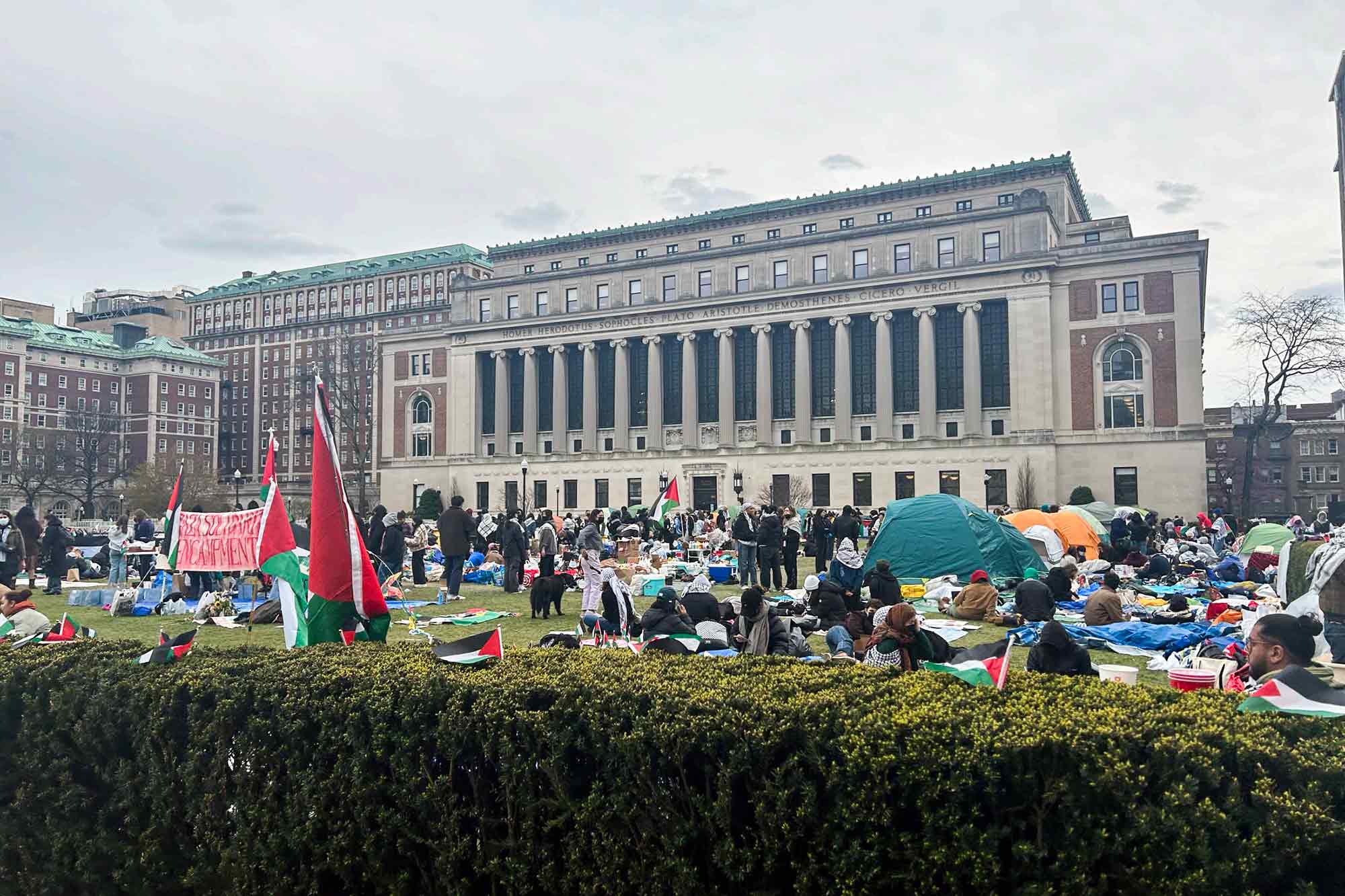
Two years ago, Columbia University was one of the US colleges that led a wave of protests against the war in Gaza. Today, the campus is largely silent — not because the views of its students have changed but because they are scared to exercise their First Amendment rights.
|
Listen To This Story
 |
Two years after Columbia University and its affiliated all-women’s institution, Barnard College, emerged as epicenters of the college protests against Israel’s war in Gaza, both campuses feel strikingly different. Many students who once spoke out publicly have grown quiet — not because their beliefs have changed, but because they fear the consequences of speaking freely.
This fear is also reflected in the interviews WhoWhatWhy conducted for this article. Most of the international students we talked with described a campus environment in which political expression feels increasingly risky, and none of them, including their professors, wanted to go on the record with their names, which is why we used pseudonyms for all of them.
Like “Jessa,” a Barnard College senior from Australia, who described how she withdrew from political engagement altogether.
“Even signing [electronic] petitions, I feel bad about,” she said. “I don’t want my signature to be on anything. I don’t want it to be traceable.”
This hesitancy to voice her opinion also extends to interactions with her peers.
“In every conversation, even with friends, I have kept it away from politics completely,” said Jessa. “It’s not worth it.”
In the spring of 2024, a total of 217 Columbia University-affiliated individuals were arrested on the lawn in front of Butler Library. The arrests followed weeks of student demonstrations calling on the university to divest from companies linked to Israel. For many international students, this marked a turning point, transforming a period of intense student activism into one defined by fear and self-censorship.
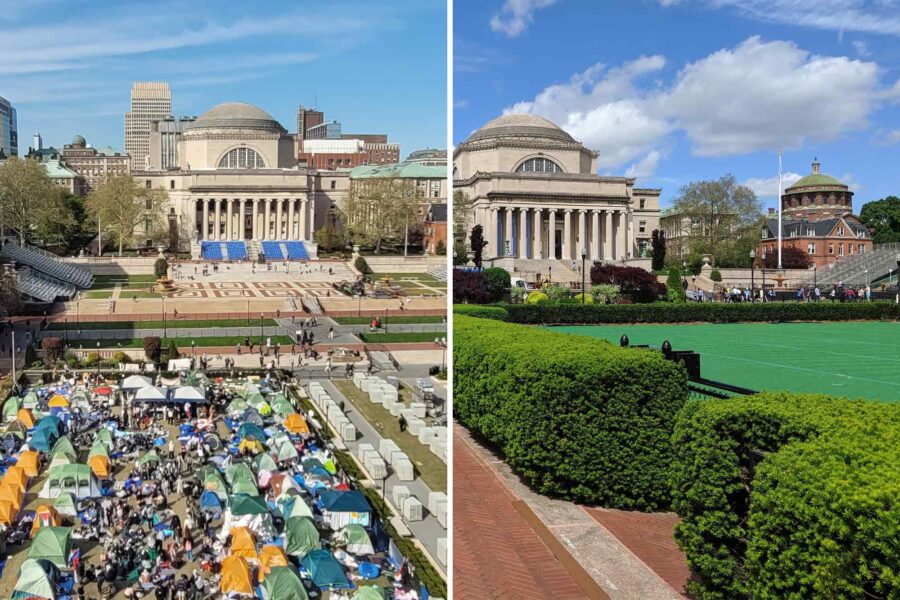
Photo credit: عباد ديرانية / Wikimedia (CC0 1.0) and MMDA-Photos / Wikimedia (CC BY-SA 4.0)
“Rachel,” a Columbia College senior from South America, noticed that many international students began to distance themselves from online political content after the arrests.
“I’ve unfollowed EyeOnPalestine and Palestinian journalists,” she said, adding that she had also become afraid of interacting with Instagram and TikTok posts critical of President Donald Trump.
Students, however, also emphasized that these fears extend far beyond social media, shaping how they participate in campus clubs and organizations.
Jessa explained that she abandoned plans to publish a critical opinion article in a Barnard student newspaper after hearing that online activity could potentially be traced back to her.
“Apparently, they can trace the IP addresses,” she said. “They can see who posts.” An American student ended up posting the article under their name instead.
Another student, “Allison,” a Columbia College senior from South America, described a similar experience related to her work for the Columbia Daily Spectator. She explained how she had begun requesting less controversial assignments out of concern that public association with politically sensitive topics could impact her future in the United States.
Jessa strongly argued that this growing self-censorship among international students is not necessarily a reflection of the environment at Columbia and Barnard, but rather a response to the broader political climate in the United States today. Like the other students interviewed for this article, she described deep fears that openly expressing political opinions could jeopardize her visa, future employment opportunities, and her long-term ability to remain in the country.
Looking back at her earlier activism, Jessa expressed a sense of loss: “I miss caring about things; it was nice to care and voice my opinions.”
The concerns that these students have in voicing their opinions are not unfounded.
Since the beginning of Trump’s second term, the federal government has significantly escalated its immigration enforcement efforts against international students and campus activists.
According to Inside Higher Ed, those efforts included the revocation of approximately 8,000 student visas in 2025. These nationwide crackdowns have been particularly visible at Columbia and Barnard, where several high-profile arrests tied to the 2024 protests drew widespread attention. For many international students, the arrests and subsequent visa revocations of Ranjani Srinivasan, Leqaa Kordia, and Mahmoud Khalil have reinforced fears that political activism, particularly surrounding Palestine, can carry potentially life-altering consequences.
For the students interviewed, fears surrounding political expression have also shattered long-term assumptions about life in the United States. Jessa, Rachel, and Allison all repeatedly returned to the same sentiment: They never imagined that openly expressing political opinions in America could feel dangerous.
Their professors described a similar sense of alarm about the growing crackdowns on free speech. One of them, whom we will call “Professor K,” noted that she could not recall another moment in recent campus history that felt comparable.
“I can’t think of a time since I’ve been teaching that the campus environment has been like this,” she said, adding that the subdued atmosphere has been heavily shaped by “the climate in the United States right now.”
Professor K further compared the current political climate to the era of McCarthyism, arguing that there are clear parallels between Cold War–era political surveillance and the modern monitoring of international students and visa holders by the Department of Homeland Security.
One of her colleagues, “Professor G,” said that fears surrounding surveillance and political expression have prompted many international students to reconsider studying in the United States altogether.
“The question first of all is whether you should come here,” Professor G explained. “After you come here, there is the question of whether you will be able to maintain your status and your student visa … and how you need to act or speak to maintain your status.”
According to Professor G, many international students are now understandably choosing universities in Canada or Europe over the United States, raising concerns that the US is losing talented students from around the world.
Based on her assessment, the Trump administration’s suppression of student political expression is not only harming the students directly affected. It is also damaging the United States itself by discouraging talented international students from studying, working, and building their futures here.
This concern is echoed in numerous studies, including one from the Brookings Institution which found that recent Trump administration policies have “squeezed multiple segments of the pipeline, making it more difficult for talented foreigners to contribute to the US economy.”
For decades, universities in the United States have attracted students from around the world not only because of their academic prestige, but because the US was widely seen as a place where freedom of expression was protected. However, as the students interviewed for this article described — and recent actions by the Trump administration have reinforced — the image of the US as the “land of the free” is beginning to fade. For Jessa, Rachel, and Allison, fears about speaking openly have shaped what they say to friends and in class, what they post online, the roles they take on in student organizations, and even whether they feel safe building a future in the United States.
Rachel said that although the work visa that she applied for will allow her to remain in the country for up to three years after graduation, she expects to continue self-censoring “at least until Trump is out of office.”
As the nation nears its 250th anniversary, the stories of students like Jessa, Rachel, and Allison highlight the far-reaching effects of the Trump administration’s suppression of free speech, and the complicit roles that American universities have played.
These institutions are supposed to be spaces where students can speak openly, debate concepts, and (respectfully) challenge authority, especially when constraints on free speech are increasingly felt in other areas of public life. Instead, international students at Columbia and Barnard say they feel pressure to do the exact opposite: stay quiet, avoid confrontations, and follow the prescribed rules.
As international students continue to feel that speaking openly could jeopardize their ability to remain in the United States, the consequences extend far beyond any single college campus. Their experiences raise broader questions about whether the United States can still credibly present itself as a country that protects freedom of expression — when so many students legitimately fear the consequences of speaking out.
This story was written by a member of our Mentor Apprentice Program (MAP). It gives aspiring journalists an opportunity to hone their craft while covering national and international news under the tutelage of seasoned reporters and editors. You can learn more about the MAP and how you can support our efforts to safeguard the future of journalism here.