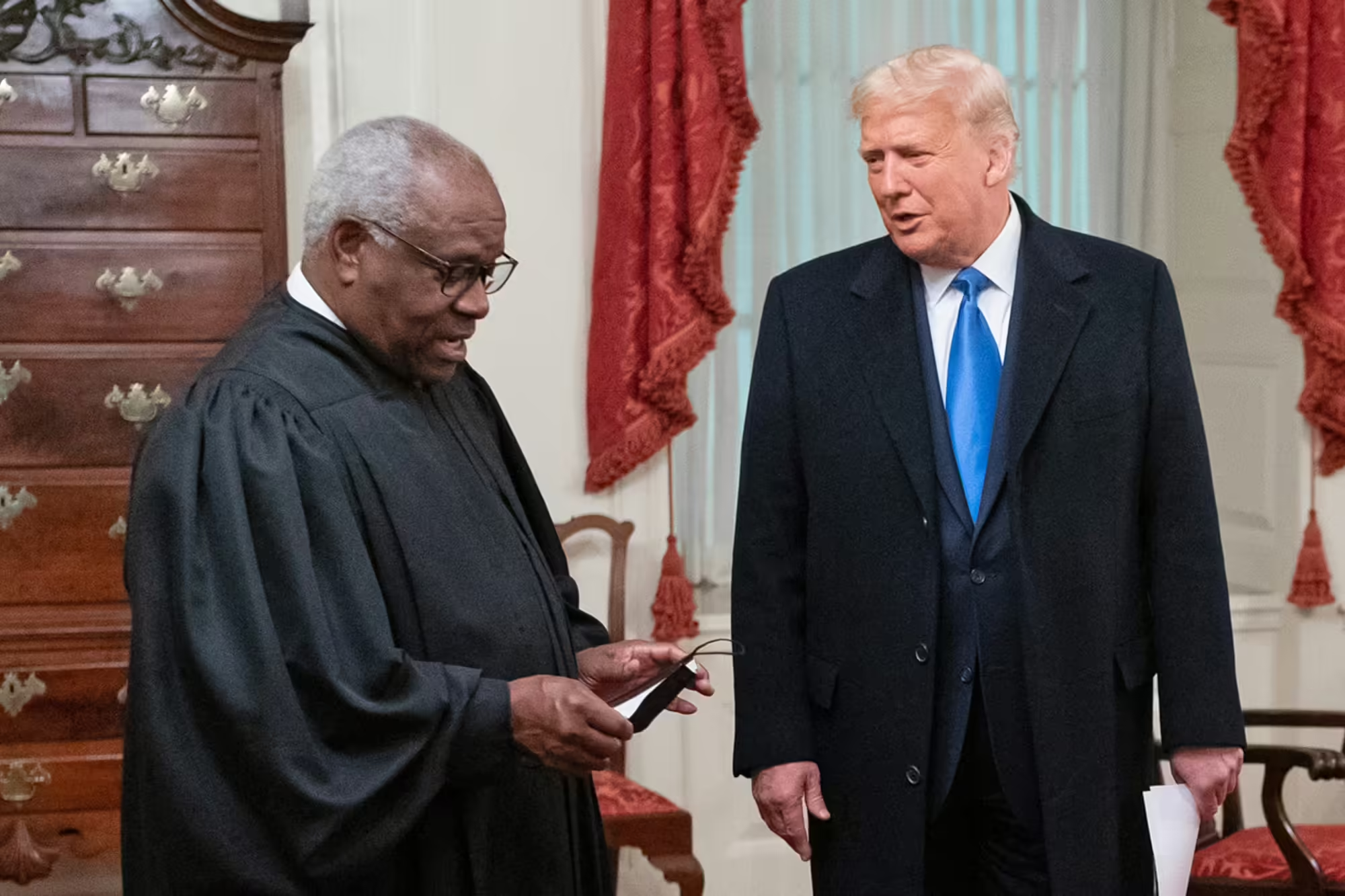
It Would Be Nice If All Supreme Court Justices Could Read
The fact that the Supreme Court's decision invalidating Donald Trump's attempt to take away the constitutionally guaranteed right of birthright citizenship wasn't unanimous is more than troubling.
|
Listen To This Story
 |
We have to be completely frank: If somebody tried to physically* enslave Clarence Thomas, especially a representative of a former confederate state or, perhaps, a major Republican donor, and that case made it to the Supreme Court, we honestly don’t know which side of the argument he — or Samuel Alito and Neil Gorsuch, for that matter — would come down on.
Before Tuesday, we would have been reasonably certain that they would have been in the anti-slavery camp, even if they were ideologically conflicted, because the Constitution is pretty clear on the subject: “Neither slavery nor involuntary servitude, except as a punishment for crime whereof the party shall have been duly convicted, shall exist within the United States, or any place subject to their jurisdiction,” the Thirteenth Amendment says, which is fairly straightforward.
Now, however, we aren’t so sure.
That’s because that trio somehow concluded that the language of the Fourteenth Amendment, which states that “all persons born or naturalized in the United States, and subject to the jurisdiction thereof, are citizens of the United States and of the State wherein they reside,” leaves some room for interpretation.
We know that because all of them dissented when their colleagues ruled against Donald Trump, who wanted to end this so-called birthright citizenship because he thinks there are too many brown people in the country.
Here is the thing: There are some Supreme Court decisions that should be unanimous, and if, as a justice, you can’t support them, then you shouldn’t be on the bench.
For example, if a state enacted a law making it illegal for women to vote, that would be a blatant violation of the Nineteenth Amendment.
Or, hypothetically, even if a deranged president suffering from various mental disorders began talking about wanting to serve a third full term in office, it’s pretty clear that the Twenty-second Amendment prohibits that.
This isn’t any different, and yet, blinded by their ideology instead of being guided by the law, Thomas, Alito, and Gorsuch wanted to uphold a clearly unconstitutional presidential action.
They should have set their personal views and distaste for (non-white) immigrants aside and concurred with Chief Justice John Roberts, who summed it up perfectly.
“Citizenship, then and now, was the right to have rights — to freely participate in our political community,” he wrote. “The Framers of the Fourteenth Amendment extended that promise to ‘every free-born person in this land.’ We keep that promise today.”
Instead, they all wrote (or joined) in lengthy dissents explaining why the Fourteenth Amendment doesn’t mean what it says.
Thomas, in particular, voiced his objection. In a 91-page screed in which he argues that the majority decision “devalues” American citizenship, he repeatedly makes the case that the concept of “domicile” should be a factor in whether someone born in the country is a US citizen. In fact, he mentions that word more than 60 times (and variations of it another 200 times).
However, an astute reader and/or constitutional scholar will note that the relevant part of the Fourteenth Amendment (or any part, for that matter) does not.
In the majority opinion, Roberts helpfully points out that domicile and citizenship may be related but that the former is not relevant in this case.
“The principal dissent (but not the Government) at times seems to directly equate domicile and national citizenship,” he wrote before adding, “Of course, domicile was relevant to naturalization and expatriation. But that by no means suggests it was a prerequisite to national citizenship at birth.”
Which is presumably why the authors of the Fourteenth Amendment didn’t include it in the text.
Of course, we aren’t on the Supreme Court and are therefore just spitballing here. But you know who is? Thomas, Alito, and Gorsuch — three justices who are such extremists that they apparently won’t even bother reading the Constitution before trying to take away the rights (albeit of little babies) that it confers.
* This is an important distinction to make in this case because, ideologically, Thomas, Alito, and Gorsuch have been slaves to the far-right philosophy that dictates most of their rulings.