The Lessons for America in India’s Cockroach Protests
While Democrats agonize over divisions between centrists and progressives, the leaders of India's Cockroach Janta Party find humor may be the best approach.
|
Listen To This Story
 |
Democrats, torn between the progressive and centrist wings of their party, might take a second look at recent developments in India. Besides being the world’s largest democracy by population, India also has a complex caste system, which, although officially outlawed by India’s constitution in 1950, continues to perpetuate inequality between India’s social classes.
The issue raised by recent demonstrations is whether any society is justified in letting a privileged minority use its wealth to grab the major share of a society’s resources while the less privileged go hungry and can barely afford basic essentials, such as education and health care.
In India, resentment against chronic inequality exploded when the public learned that government officials had leaked questions for a nationwide university entrance exam. The leaks gave families who could afford to pay under the table for advance access to the questions a much better chance of gaining admission to the top schools — a leg up likely to define their children’s future. When the scheme was revealed, some 2 million students were forced to retake the exam.
A substantial number of Americans might be willing to look the other way when members of the president’s family enrich themselves at public expense, while the government cuts food allowances to underprivileged children and the cost of basic health care keeps rising.
As important as a good education is to the economic future of students in the US, the stakes in India are even higher. Put simply, to many parents in India, education is essential to survival. Parents are willing to sacrifice everything for their children. Rajesh Kumar, a farmer in Rajasthan, is a prime example. Kumar, who was determined to help his son become a doctor, sold his farm for the equivalent of $29,000 and borrowed another $11,000 to pay for the extra tutoring he felt his son, Pradeep, needed. Pradeep had dreamed of becoming a doctor since childhood, and he had moved to Sikar, a city known for its educational coaching centers. Thousands of young Indians spend years in Sikar preparing for the National Eligibility-cum-Entrance Test, known as the NEET.
The money Kumar spent was not only for Pradeep. For families like Kumar’s, becoming a doctor is not simply about a profession. It is a bet that education can transform an entire family’s economic condition. Kumar’s family had focused all of its hopes on Pradeep. Then the examination system collapsed around him — and millions of other students.
Pradeep faced the long and daunting prospect of preparing for the difficult test all over again. Instead, he committed suicide — leaving his father, Kumar, bereft of his son and of the investment he had gambled on his son’s education. “We are farmers and we are hardly educated,” Kumar told WhoWhatWhy. “But my son always wanted to become a doctor.” Blaming his son’s death on the “failure of the system,” Kumar swore that he would not immerse his son’s ashes in the Ganges River — a traditional Hindu funeral rite — until India’s minister of education, Dharmendra Pradhan, had resigned. “I want accountability,” he said.
Like-minded people throughout India took up the same cause, joining street demonstrations to demand Pradhan’s resignation. But what fueled their anger went beyond the alleged duplicity of a single minister. It was about a promise that had shaped the lives of millions of India’s youth, who now felt betrayed.
The promise was that if they studied hard and showed their worth in fairly administered exams, they would be rewarded with an education that gave them a chance to move ahead. Instead, the scandal revealed that all too often money and connections determined who gets ahead. “The rich are paying for their children to pass. The poor are being left behind,” said Rishab, a 23-year-old student who traveled 50 miles by rickshaw, train, and metro to New Delhi with his brother Mohit to join in the protests.
The anger soon coalesced into one of India’s strangest political movements. It began as an online joke after India’s chief justice, Surya Kant, dismissed the student protesters as nothing more than “cockroaches.” Kant’s comment, which he later denied making, immediately spread across India’s social media outlets. Abhijeet Dipke, a 30-year-old political strategist, seized on the remark and asked, “What if all the cockroaches came together?”
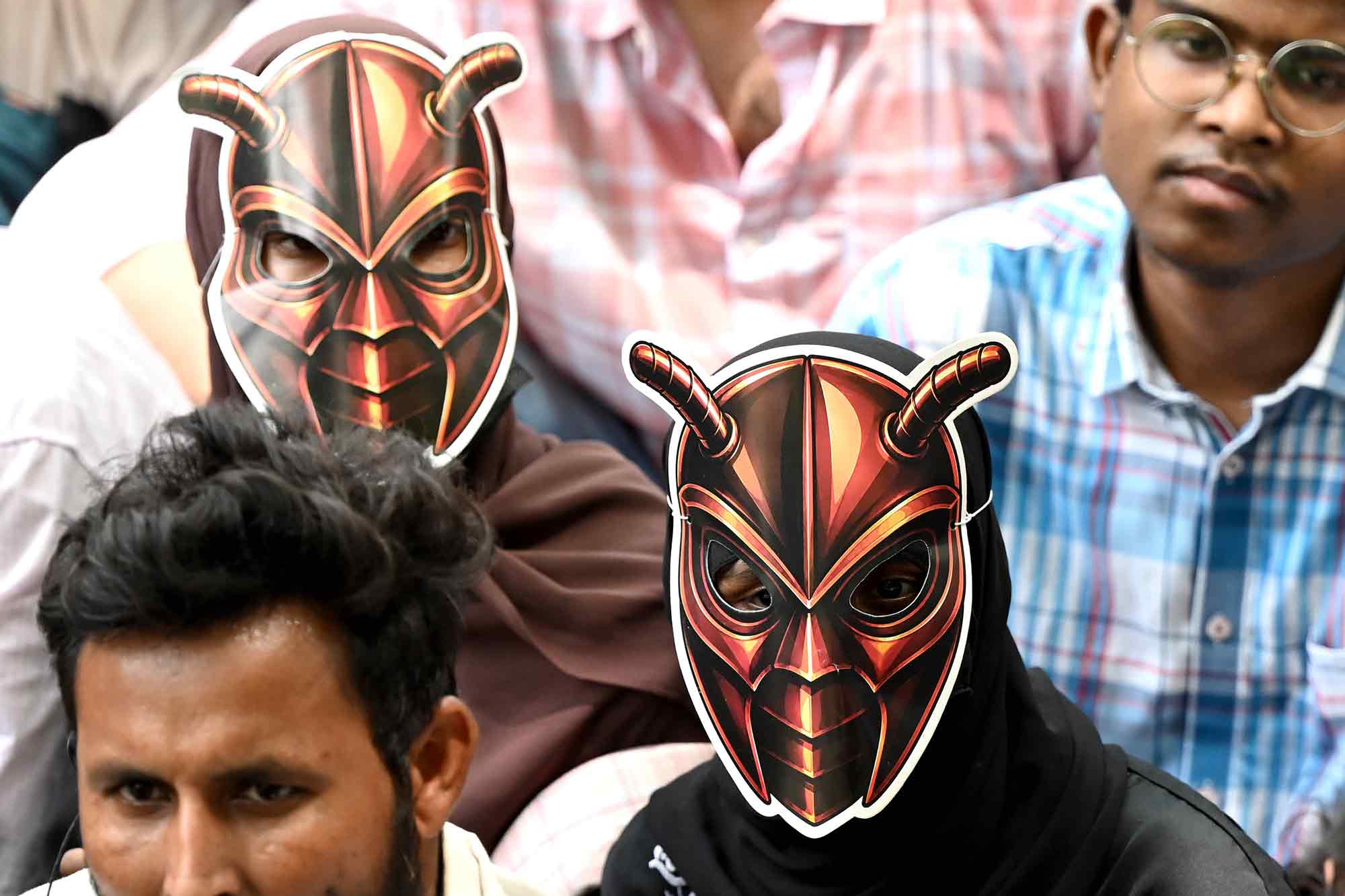
What started as a joke in response to the chief justice’s callous remark struck a nerve among India’s youth. Memes multiplied and Dipke gained a huge following online. He soon found himself at the head of a protest movement, under the banner of the Cockroach Janta Party, that spread from sarcastic posts on social media to massive demonstrations in more than a dozen Indian cities. Protesters wore cockroach masks, used memes, and succeeded in mobilizing various disaffected segments of Indian society into a powerful political force. “This is a movement to change the political discourse in India,” said Dipke. “India’s youth has largely been excluded from mainstream political discourse.”
Not any more. Despite their disparate points of view, India’s youth could rally behind a single complaint: We followed the rules. Why aren’t the rules being applied fairly? The common grievance that crossed lines of caste, class, religion, and language was blatant corruption in the educational institutions that controlled their lives. e. As sociologist Raheel Dhattiwala put it, “Education can act as a leveler, bringing everybody together.”
“It has become very difficult for the state to demonize them [the protesters],” said Sushant Singh, who teaches at Yale University. “That is what is unique about the protests. India’s youth might have different ideas about religion, caste, or politics, but they all agree on one thing: that an examination should not be sold to the highest bidder.”
The protests gained added credibility when Sonam Wangchuk, a prominent climate activist and proponent of education reform from Ladakh, joined the demonstrators and staged a hunger strike that lasted 26 days. As Wangchuk’s health deteriorated, students gathered around him. Police finally hospitalized him, and he ended his hunger strike on July 24. Education Minister Pradhan resigned the following day.
When thousands of protesters marched towards India’s parliament in New Delhi, police blocked the route and used tear gas to drive them back. Images of the confrontation flooded the internet. Supporters ordered meals for the demonstrators from online delivery services. Suddenly, it wasn’t necessary to be in New Delhi to participate. Anyone could send a meal, share a video, and post messages of support.
In the end, India’s prime minister, Narendra Modi, was forced to respond. He announced that the people responsible for leaking the exam questions had been arrested and that changes would be made.
For the self-designated members of the Cockroach Janta Party and their allies across India, the greater lesson was that by engaging in mass protests that ignited passions with humor rather than violence, India’s youth had become impossible to ignore.