India Gets Ready to Compete in Space
As India prepares to send its own astronauts into orbit, its scientists are forced to choose between working for the government or joining private industry.
|
Listen To This Story
 |
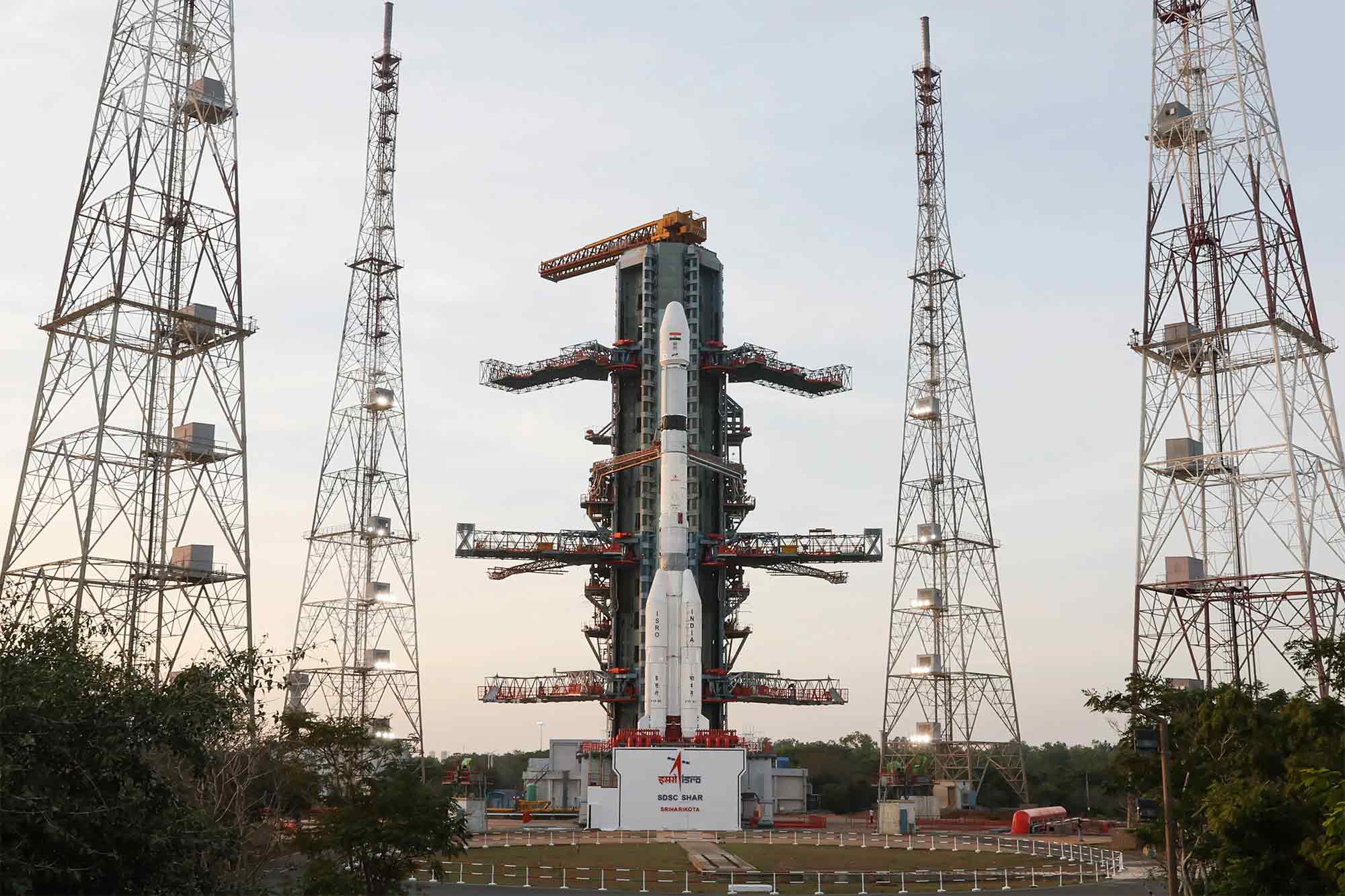
India has already landed a spacecraft near the south pole of the Moon, placed a solar observatory in space, and demonstrated orbital docking technology. Now it’s preparing astronauts for its first manned spaceflight, while getting ready to launch its own space station and planning a deeper exploration of the planets in the solar system.
India’s ambitions are impressive, but they have run up against an unexpected hurdle. In recent months, more than 100 top scientists and technical personnel have either resigned from the Indian Space Research Organization (ISRO) or asked for voluntary retirement.
The departures are beginning to affect some of the agency’s major centers and are likely to have a serious impact on several important programs, including India’s efforts at launching its own human spaceflight. And the departures raise the question of how India can build the next generation of spacecraft if the people who built the last ones are leaving because they are finding better opportunities elsewhere.
Last July, the government issued a memorandum requiring that all requests for voluntary retirement or resignation involving Group A scientific and technical personnel associated with India’s upcoming Gaganyaan mission and other critical programs be referred to the Department of Space for a final decision. The Gaganyaan mission aims to put three Indian astronauts into low Earth orbit at an altitude of 250 miles for three days, then bring them safely back to Earth. The objective is to prove India’s capacity for putting human beings, and not just satellites, into space.
“The real issue is not the number of people leaving,” says V.R. Lalithambika, former director of ISRO’s Human Space Programme. “It is the loss of accumulated experience. In complex space programs, expertise is built over years, and that institutional memory is one of an organization’s most valuable assets.”
A major concern is that as India moves toward human spaceflight, technical mistakes are likely to have consequences far more serious than the failure of a satellite.
For much of its history, ISRO was the only game in town if a scientist wanted to work on the country’s most ambitious space missions. That has changed.
India’s decision to privatize part of its space operations and open the field to private participation has resulted in a new generation of companies producing rockets, satellites, launch services, and space-based applications.
Startups such as Skyroot Aerospace, Agnikul Cosmos, Pixxel, Bellatrix Aerospace, and Dhruva Space have helped the private sector become a serious part of India’s space ecosystem.
For engineers, that means a broader, more competitive market for their skills.
But the attraction involves more than money. Private companies offer faster decision-making, shorter development cycles, and greater responsibility for younger scientists. Stock options help sweeten the career choice.
Ambitious future scientists often find themselves held back in government organizations by established hierarchies and lengthy administrative procedures. In contrast, a youthful engineer at a startup is likely to find himself responsible for an entire subsystem, working directly with senior management and seeing a design move from the drawing board to a prototype in a matter of months.
Space programs involve thousands of decisions. Some are documented; others are simply remembered as acquired experience: why a particular component was redesigned, how a subsystem behaved during testing, which failure modes engineers discovered during previous missions, and why a particular engineering decision was made.
When experienced personnel leave, the documents remain, but the institutional memory that resides in the minds of the people who actually experienced the organization’s history is no longer there. The challenge is especially acute when it comes to the Gaganyaan mission. You can lose a satellite, but losing a crew of live astronauts is a catastrophe at a different level.
The demands for human spaceflight go beyond ordinary project management. Engineers need to understand not only how a system is supposed to work, but what the options are when something suddenly goes wrong.
The government’s dilemma is how to keep scientists from leaving the program while still maintaining the enthusiasm and commitment needed to make the program a success.
To do that, they need to address why people want to leave in the first place.
“You cannot retain scientists simply by making resignation difficult,” says Anirudh Mehta, a hypothetical space-policy expert and former aerospace researcher. “[Government] institutions must offer them a reason to stay — meaningful responsibility, faster career progression, professional autonomy, and recognition for the expertise they bring.”
Another way to look at the exodus of ISRO personnel is that when an experienced scientist leaves ISRO and joins an Indian space startup, like Skyroot Aerospace, for example, the country does not necessarily lose that expertise; the knowledge remains within India.
A former ISRO engineer working for an Indian launch company can help develop a new rocket. Another may join a satellite startup. Someone else may establish a company of their own and employ dozens of younger engineers.
In that sense, the movement of talent can actually strengthen India’s wider space ecosystem.
Rather than making it legally difficult for its engineers to leave ISRO, the government might be better off putting its efforts into seeing what other measures it can take to ensure that competition from the private sector does not hollow out the institution at the center of India’s national space program.
Gaganyaan, future lunar missions, a proposed space station, and new launch vehicles will require thousands of engineers and scientists. Making these programs succeed will be the ultimate test of India’s institutional capacity. That will depend on ISRO giving its most valuable scientists compelling reasons to stay — while still allowing the broader ecosystem to grow around them.