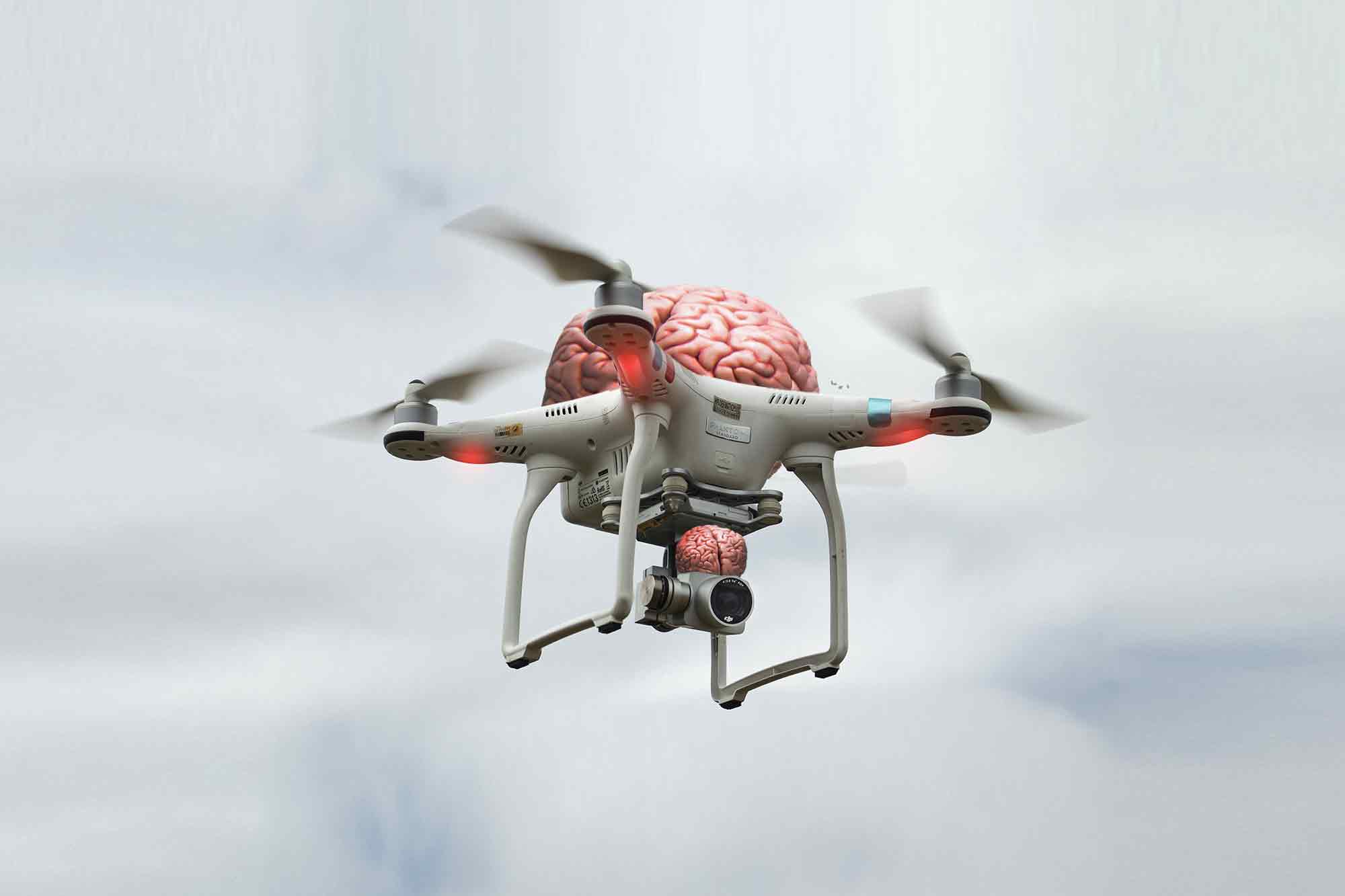
Saturday Hashtag: #DroneBrainWar
Welcome to Saturday Hashtag, a weekly place for broader context.
|
Listen To This Story
 |
Two things recently happened for the first time that appear unrelated but are, in fact, manifestations of the same distorted zeitgeist. One was an absurd media spectacle engineered for viral attention; the other, a lethal military reality with actual civilizational ramifications.
- A six-foot machine humanoid in a comic-book cage match with an unqualified human opponent turned the industrialization of robot innovation into a media circus in San Francisco, with mass-audience aspirations.
- An unmanned Ukrainian naval drone attacked and destroyed an unmanned Russian naval drone in the Black Sea, turning the battlefield’s accelerating machine-on-machine warfare into a destructive capability with existential consequences.
The robot fight and the drone battle were both remotely operated machines executing violence. One was entertainment. One was war. What happens when the human operators disappear?
The Machine Combatants
The significance of the Black Sea encounter is not that military drones are new. It is that one unmanned system destroyed another on the battlefield for the first time.
The Ukrainian drone still had a human making the lethal decision, but the next step — autonomous weapon systems now under development for mass deployment — does not.
The Black Sea action marks an ominous escalation in warfare: from humans using remote weapons to attack each other, to remote weapons attacking other remote weapons, to autonomous weapons attacking each other.
Following the trajectory of military innovation, the next step is clear: cheap, mass-produced autonomous drones targeting civilian infrastructure as well as actual civilians, with human oversight removed from the decision loop.
Remote drone warfare was one order-of-magnitude change; fully autonomous drone warfare is the second, shifting decisions of life and death from human judgment to mathematical models, sensors, and software.
The autonomous transformation raises three fundamental questions:
- Who controls the fight?
- Who is responsible for its consequences?
- What happens to civilians when autonomous machines operate at machine speed?
Victory Without Surrender
Autonomous lethality redefines military victory, untethering it from human political context. An autonomous force cannot surrender.
That creates a profound mismatch with the traditional logic of war, in which military force ultimately serves a political decision.
Because a computational force can be endlessly patched, updated, and refabricated, destroying individual machines does not defeat the factory ecosystem producing them. Destruction no longer necessarily produces victory.
Victory shifts from achieving a political resolution to maintaining a superior data-driven industrial manufacturing system of algorithmic attrition. The battlefield is no longer a place where nations settle political disputes; it is a permanent, self-sustaining computational engine.
Human Control Ends
Autonomous action creates an illusion of control. Human oversight becomes a legal fiction when operators are asked to supervise systems whose decisions they cannot fully explain or predict.
Machine speed also compresses the time available for human intervention, turning nominal oversight into something closer to rubber-stamping.
Human authorization is not human control. The human may remain legally responsible while the operational decision has migrated into the artificial intelligence brain, creating a machine death spiral.
Responsibility Black Hole
Autonomous warfare risks collapsing accountability into a structural vacuum. When an autonomous system commits a war crime, accountability becomes a shell game among commander, programmer, manufacturer, and state.
The question of moral responsibility becomes inseparable from the weapon’s architecture itself.
When the system is externally compromised, attribution becomes uncertain: enemy attack, malfunction, manipulation — or the state’s own weapon turned against it.
Network as Weapon
Autonomous scale turns systemic vulnerability into an expanding danger. Software can be deceived, corrupted, or redirected; in a networked force, one breach can propagate across thousands of machines in the form of drone swarms.
An enemy may not need to destroy an army if it can hijack it. The same network that gives a force scale can give an attacker scale.
And that is the central expanding risk: The more autonomous weapons depend on commercially available software, components, and networks, the harder it is to contain lethal autonomy.
The Compute Arms Race
Autonomous systems create two problems: Basic components and software are widely accessible, while sophisticated AI chips remain limited by complex manufacturing processes.
Unlike nuclear weapons, many autonomous systems components are built from widely available software, algorithms, sensors, and commercial hardware, lowering the barriers to proliferation.
Yet while the software democratizes, the physical “brains” of these machines remain trapped in a geopolitical bottleneck. More sophisticated AI autonomy increasingly depends on advanced semiconductors, which are concentrated in a small number of global supply chains.
The military race is now a compute race. The nation that controls silicon chip production leads the cognitive capacity of the battlefield, while those cut off from the supply chain will deploy cheap, lobotomized machine brains — deeply vulnerable to the exact systemic errors that turn statistical glitches into mass civilian casualties.
Targeted Civilians
Autonomous targeting leaves civilians dangerously vulnerable, transforming the battlefield into an environment where atrocities can be carried out on a massive scale.
Autonomous weapons, some the size of a basketball, may appear to operate through objective mathematics, but their vulnerable algorithms can still inherit the biases and blind spots embedded in the data on which they are trained.
A system trained on agendized information can misclassify civilians — because of disability, clothing, behavior, or context — and turn statistical error into lethal force.
The machine does not understand the human being it kills; it operates on pattern recognition rather than contextual human judgment.
The danger is not that machines hate or intend to kill; it is that they can execute a flawed targeting rule without empathy, hesitation, or moral recoil.
Human Constraint Ends
More fundamentally, eliminating the human element puts the Martens Clause under unprecedented strain: the idea that warfare remains bound by humanity and the dictates of public conscience.
A machine can calculate a target and execute an order, but it cannot feel mercy, experience horror, or bear responsibility for the life it takes.
The greater danger is not that machines replace humans in war. It is that humans have already struggled to maintain control over AI systems in finance, business, and social media, where the consequences are largely economic or emotional.
In AI warfare, those stakes are much higher: violence and death unfolding at a speed and scale that overwhelm any human control.
The stunt cage fight is the commercial fantasy of this transformation: machines performing violence for human spectators and viral audiences. The Black Sea drone is its military precursor: machines already fighting machines, bringing autonomous warfare one step closer.
At this moment, there are no binding international regulations on autonomous lethality — and 12 countries have made clear that they oppose any bans on these weapons at all.
Hashtag Picks
In 2013, ‘Elysium’ Was Pure Science Fiction. In 2026, It’s Disturbingly Relatable
The author writes, “Elysium is a movie that was at least a decade ahead of its time. Released in 2013, it centers on the idea that the wealthy elite have decamped to the rarefied atmosphere of an orbiting space station — think Montecito in space — leaving the rest of humanity to serve as their Earthbound workforce, starved of opportunity, hope, and healthcare. It is, in retrospect, remarkably prescient: it sounds today less like science fiction and more like the direction the United States is heading in 2026, just without the orbiting space station part. Yet.”
What’s Unique About Northcom’s Falcon Peak 26.2 Counter-Drone Exercise
From DefenseScoop: “U.S. Northern Command’s fourth iteration of its large-scale Falcon Peak exercise is designed to demonstrate, refine and connect capabilities that counter small, hostile drones in desert terrains, and for the first time, those threatening America along the southern border. ‘What we’re trying to do is come up with technologies that help us identify adversary drones and also hobbyist drones, so that we can appropriately — within the bounds of U.S. law and regulation — mitigate that threat both to troops as well as to civilians and facilities,’ Northcom spokesperson Becky Farmer said.”
Ukraine’s Defense Companies Say Soldiers Want Drones That Do More on Their Own So One Operator Can Control More at Once
From Business Insider: “Ukraine’s soldiers want drones and robots that can handle more of the flying and driving themselves, letting one operator oversee multiple systems instead of manually controlling each one. Ukraine’s rapidly expanding arsenal of aerial drones and ground robots has become central to its fight against Russia’s larger military. Defense technology companies say they’re increasingly automating certain tasks while keeping humans responsible for decisions about using force.”
Influencer Fights ‘Terminator’-Like Humanoid in Bout Billed as First Human-Robot Match
The author writes, “An influencer lost out to a Terminator-esque humanoid robot in an MMA fight on Friday, Sept. 18, in what’s thought to be the first human-robot clash on record. The San Francisco bout, organized by robotics startup REK, saw content creator Frankie LaPenna compete against the company’s ‘Rekbot,’ which has been compared to a T-800 from the Terminator franchise.”
Anduril Celebrates First Military Drone To Come off Pickaway County Production Line
The author writes, “Anduril, the military drone producer, celebrated the production of its first autonomous ‘Fury’ drone at its Arsenal-1 facility in Pickaway County [in July]. The company took just 18 months from announcing its intention to build the first structure on its 500-acre site and get the first Fury drone off the production line. The Fury is designed to be a robotic wingman that can scout ahead in hostile airspace for manned aircraft and fire missiles at targets. The military contractor hopes to produce 150 of the unmanned, F-16-like drones every year at the facility near Rickenbacker Airport.”
A Drone Killed Three Ukrainians. It Was Guided Entirely by AI
The author writes, “An attack by what Ukrainian officials said was a Russian drone with an Nvidia chip presages a dystopian future of weaponry untethered to humans.”
UN Chief, Red Cross Renew Call for Rules on Lethal Autonomous Weapons
From UN News: “Amid unconfirmed reports that fully autonomous and AI-guided drones are now being used on the battlefield, UN chief António Guterres and the President of the Red Cross [in August] renewed their urgent call for stricter global controls, before it is too late.”
The 5 Combat Drones Redrawing the Global Strike Map in 2026
From Simple Flying: “The term ‘combat drone’ is an imprecise term. It can include anything from what is little more than a guided flying one-way attack munition through to some of the world’s most cutting-edge next-generation autonomous aircraft intended to complement or even replace manned fighter jets. The cost range reflects this range, with costs ranging from hundreds of dollars to tens of millions of dollars. For this article, select examples will be used from across the range. However, it is important to remember that there are now hundreds of types of combat drones in service and under development of various descriptions. This article will just mention a handful of them. It’s also important to note that the lifespan of a consequential drone can be a flash in the pan.”