As Discontents Flare Up, Fascists Feed on the Flames
Will violence, disorder, and chaos play into the hands of France’s far right?
|
Listen To This Story
 |
At the end of the film The Joker, for which Joaquin Phoenix won his Oscar, the title character — an abused, lonely, misbegotten, deranged young man — finagles his way onto a late-night talk show as a kind of oddity, a weirdo the audience can ridicule.
There, having come to the realization that he isn’t the Joker but rather the joke, he delivers a snarling monologue about the injustices of the world, then murders the show’s host, thus fomenting a rampage of young men in clown masks tearing through the streets of Gotham City, overturning cars, burning buildings, and committing general mayhem.
It is intended to be the eruption of the long-seething resentments that these young men, all variants on the Joker, have harbored. And it happens to look very much like the scene last weekend in France, where young people were also rampaging, some of them garbed in black — though it could also have been recent violence in India, Nepal, South Korea, or a number of other places where young people are venting their anger at their own unjust societies.
Destruction pretty much all looks the same.
In France, the apparent cause of the original fury was the decrepitude, both physical and institutional, of their country’s education system: schools in disrepair and rat-infested, teachers absent, vacancies going unfilled, a computer system meant to match students with higher education opportunities that was hopelessly laggard.
But then the protest morphed. Union members joined it. The old “yellow vest” movement joined it. Disaffected French citizens with a multitude of grievances joined it. The left endorsed it. It was almost as if the country, at least the urban sections of the country, had come together in one loud chorus.
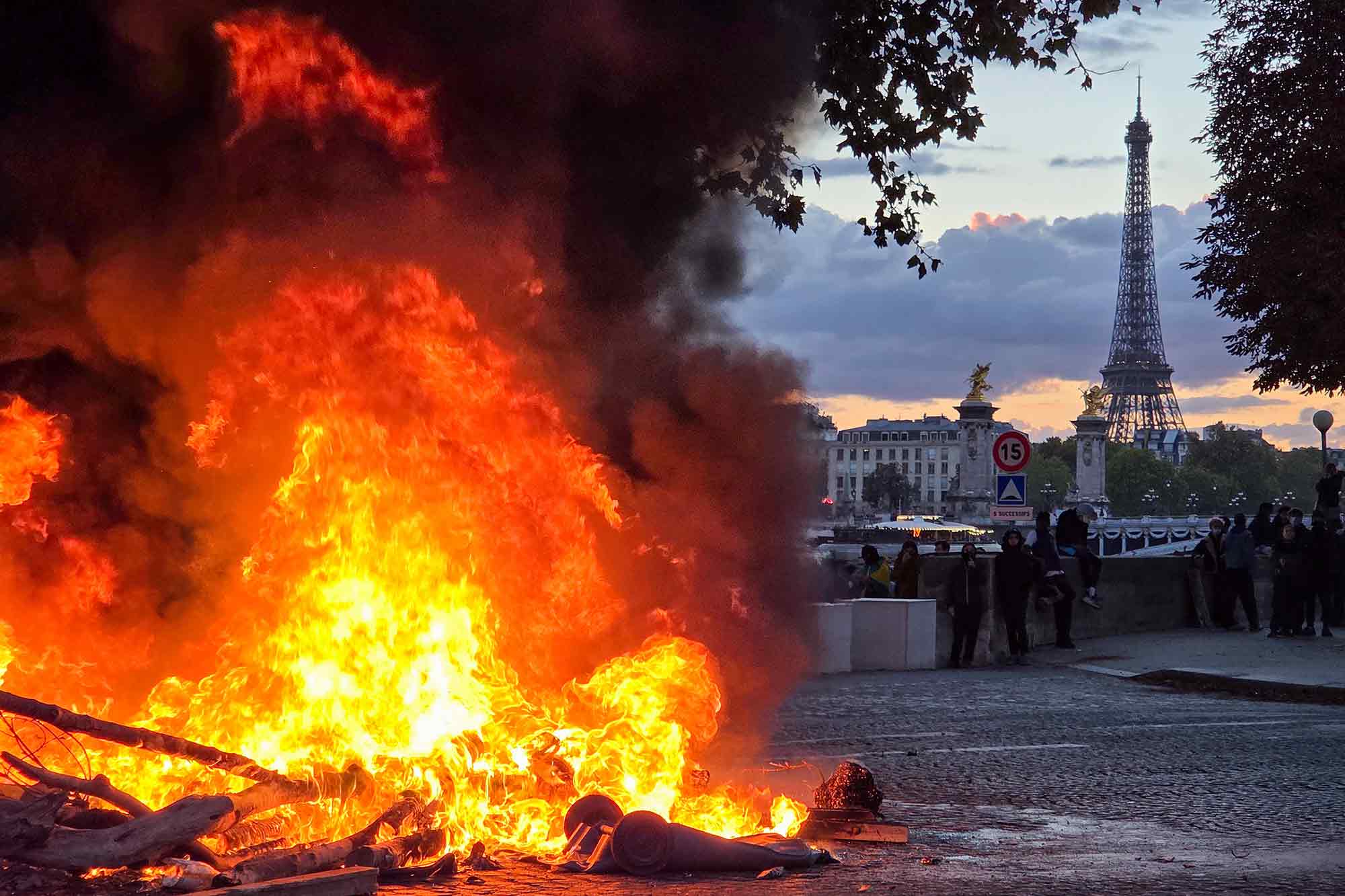
And then came something else: the Joker scene, as those black-clothed hooligans moved from protest to vandalism — smashing windows, looting stores, setting fire to civic buildings, creating chaos.
Protests focus on cause — on social agonies. Vandalism focuses on effect — on what comes after the agony.
The object of protest is to express dissatisfaction and engender change. Mass vandalism may have many objects, but one intent is surely to create disorder — to wreak not only retribution but also, and I suspect more important, to create the impression of a society out of control, and perhaps more than just the impression.
The French students may have wanted educational reform. The vandals wanted to just tear the whole society down and send it to hell where they think it belongs.
Rioting is always more useful to would-be fascists than protest. It gives them the excuse to crack down. It gives them the excuse to curb, or crush, democracy.
Both protest and mass vandalism are basically performative; an,d though they often exist side by side, they elicit very different responses from their “audiences,” which are the general public. And that is what really matters when you think of how this may affect France. It is not the politics, but the aesthetics of the politics that the audience is seeing and to which they will be reacting.
And when it comes to aesthetics, the drama boils down to disorder versus order, which generally comes down to the far right’s promises to impose order on the vandals and crush them.
This is how it goes. This is how it always goes — even, or especially, when the far right itself causes the disorder, which, since we have no idea who the black-clothed hooligans are, may be the case in France.
Hitler had his Reichstag fire. Stalin had the assassination of popular Soviet leader Sergei Kirov. Trump had his Black Lives Matter riots, which he successfully blew out of all proportion to their size and damage.
Rioting is always more useful to would-be fascists than protest. It gives them the excuse to crack down. It gives them the excuse to curb, or crush, democracy.
So it is that The New York Times titled one front-page story, “France’s Far Right Seizes the Moment as Rioting Stuns the Country.”
The presidential candidate of France’s antisemitic, nativist, neo-Nazi National Rally party, Marine Le Pen, wasted no time promising that she would provide the antagonist to the rioters’ protagonist, bringing down the full force of the police on them, though hers is a prospective promise since the election is six months away.
But Le Pen gets how this show goes. She knows the script, and she probably knows her audience. Most people these days want order at any price, including the price of democracy.
Now we shall see whether this time France, which has a proud record of rejecting the siren song of the far right, will go the way of other democracies where the aesthetics of the iron hand have prevailed.
And, depending on what chaos is ginned up in the fraught aftermath of our own election in two weeks, we may see whether American democracy also yields to an offer of order at any price.