My Florida Academic Freedom Blues
Can you really be said to enjoy academic freedom when you have to worry that writing about it might get you fired?
|
Listen To This Story
 |
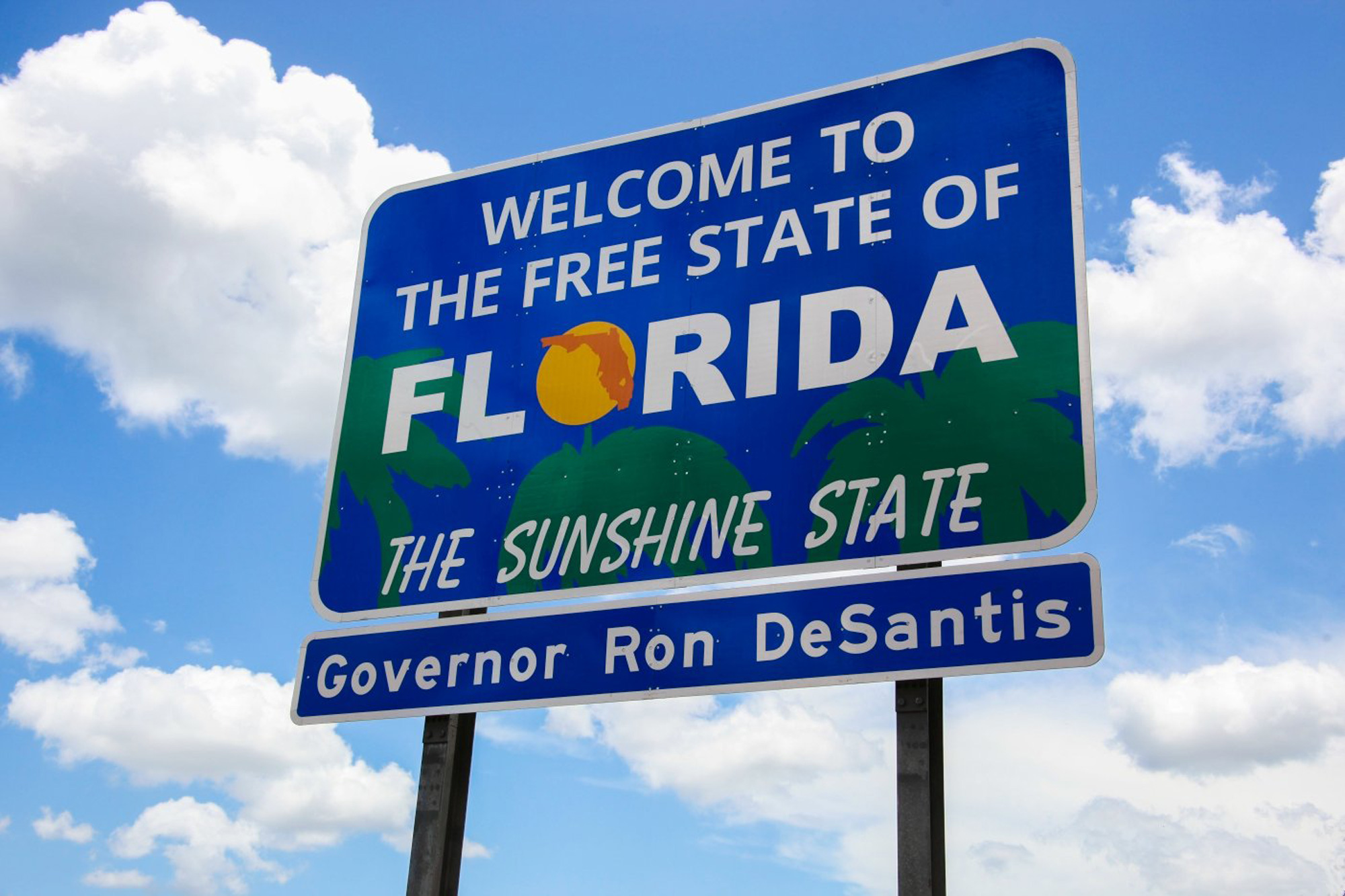
Ah, Florida. The Sunshine State. Or, as some people who are inordinately fond of messing with other people’s freedoms have taken to calling it, the Free State of Florida.
That is the nickname favored by a governor and a Republican supermajority in Tallahassee who are far more invested in trolling liberals, squabbling amongst themselves, and finding ways to make life harder for people who are already struggling than in helping their fellow Floridians prepare for a future radically different from the sunny one they have always been trained to expect.
In the hands of Florida’s GOP, what Thomas Jefferson called the “sacred fire of liberty” has become a cruel, meta-Orwellian internet joke.
“Free State of Florida” certainly feels cruel to those of us who work in the state system of higher education, to which my university belongs. (It feels even crueler to public school teachers and librarians, who have had to deal with book bans that somehow aren’t book bans and the infamous “Don’t Say Gay” law, as critics have called it.)
During my 22 years here, I have watched a rising tide of illiberalism gnaw at the solid ground of academic freedom, of trust and commitment to equality and diversity, upon which our universities were built. It was a foundation that made the idea of studying and working at these institutions appealing to talented scholars from all over the world. Almost as appealing as the prospect of Golf Cart Life in The Villages — the massive, overwhelmingly white retirement community not far from Orlando — has been to older Donald Trump fans from blue states.
Those kinds of transplants, hundreds of thousands of whom have moved to Florida over the past few years to escape such so-called abominations as COVID-19 mask mandates and state income taxes, have supplied much of the illiberal energy coursing through our state politics. With all the sex, drugs, and golf carts they have at their disposal (just watch Lance Oppenheim’s documentary Some Kind of Heaven if you doubt me), conservative retirees aren’t likely to see a need to enroll in our universities; few of them will ever witness for themselves how we educate our students.
That’s too bad. Our traditional students could learn a lot from them, and the retirees might develop some useful media literacy skills. Instead, they have been all too willing to believe right-wing propaganda.
Under its intoxicating influence, they have weakened our academic communities by helping reelect the obstreperously anti-“woke” Gov. Ron DeSantis and by voting for Republican state legislators who would rather waste the public’s time and money on sham debates over “woke indoctrination” in our classrooms than address real problems.
For instance, these legislators could have been promoting the renewable energy revolution that should have taken off decades ago, and in which Florida could have been a leader in the country and the world. (Maybe Communist China, as they like to call it, will give them all medals some day for helping China become a world leader in renewable energy technologies at the expense of the United States.)
Some of the state government’s efforts to kill “wokeness” in higher education have been impossible to ignore. They are detailed in a report published in 2023 by the American Association of University Professors:
- The hostile takeover of New College in Sarasota.
- The shuttering of LGBTQ and women’s centers, along with offices promoting campus diversity — even interfaith projects.
- The meddling in our curricula.
- The battle against tenure.
- The push to weaken or destroy our faculty union, United Faculty of Florida (while exempting unions representing law enforcement officers and other nonacademic state employees from having to meet the same forbiddingly high standards).
Sometimes the assaults on academic freedom are carried out swiftly, openly, and unapologetically. For example, last fall, after telling a joke that had something (I’m still not entirely sure what) to do with the killing of Charlie Kirk, one of the visiting instructors in my department, Jacob McElroy, was reported by a student. A few days later, he was escorted out of his classroom by campus police officers and summarily fired.
Not Repression’s First Rodeo
Some observers might be tempted to point out that the situation could be worse — as bad as things were, say, during the Cold War.
As outrageously discriminatory as the state government’s anti-educational projects have been (projects that have been made even more outrageous by being carried out in the name of fighting discrimination and enhancing education), an optimist might note that we don’t seem to be anywhere near having a 21st-century version of the Florida Legislative Investigation Committee (FLIC), better known as the Johns Committee (1956–1965).
The Florida Legislature’s answer to McCarthyism in Washington, the Johns Committee harassed the NAACP and whipped up anti-gay hysteria at the University of Florida, among many other activities driven by paranoia over communism and terror over how white supremacy was losing ground in a rapidly changing multicultural society.
“Anticipatory obedience,” as Timothy Snyder has dubbed it, is alive and well at many universities that depend heavily — some might say abjectly — on state funding for their ongoing existence.
At my university, I haven’t seen any evidence of Johns Committee–style tactics such as spying, infiltration of progressive organizations, or the spreading of right-wing propaganda. The political purges of faculty members that some of my colleagues and I were fretting about two or three years ago have not materialized. The Johns Committee’s ideological heirs in Tallahassee, unlike their predecessors, have not been cornering terrified, humiliated professors and students in smoky motel rooms to grill them about their “subversive” behavior.
Far from it. Republican legislators have shown zero interest in going to the state universities and getting their hands dirty — or in meeting with us at all.
That doesn’t mean we aren’t scared.
In the case of my colleague who got fired, I doubt that someone from the governor’s office or the Legislature called our provost on a burner phone at 3 a.m., telling her to “tie up the loose end… or else.” They didn’t have to. “Anticipatory obedience,” as Timothy Snyder has dubbed it, is alive and well at many universities that depend heavily — some might say abjectly — on state funding for their ongoing existence.
Indeed, this is where the resonances with the FLIC era become especially troubling. As historian Stacy Braukman shows in a book on the Johns Committee, the University of Florida administration engaged in plenty of what it called “legitimate self-policing.” Not only did they give the Johns Committee free rein to spy on campus community members in bathrooms and behind hedges, and to haul suspected gay men and lesbian women in for interrogations that would now be regarded as grossly unconstitutional, but they chose to fire, rather than defend, faculty members and other employees accused of being gay. Meanwhile, they kept students in the dark about the whole Inquisition-like process.
It’s possible that administrators at my university have sent dozens of scorching emails to Tallahassee in private, but I don’t recall them making the tiniest squeak of public protest as we shut down our DEI programs and started coming under pressure from state officials to remove words such as “diversity” and “culture” — yes, “culture” — from our syllabi.
Administrators have dressed their lack of gumption up in the beige language of compliance and legality — even when, as my colleague John W. White observes, they are complying with a “law” that doesn’t exist. They keep behaving as if the laws, regulations, and “secret rules” in question have been handed down from Olympus rather than crafted by people: people who can be browbeaten, shamed, denounced, “primaried,” lobbied, cajoled, and so on.
But perhaps I should be more grateful. Our administrators’ quiet efforts to deal with an indisputably tough situation seem to have kept the Eye of Sour-Ron, as it were, from fixing on our campus. Our administrators have to be scared, too. I wouldn’t be surprised if most of them — maybe all of them — are personally opposed to the deformations of academic freedom they feel obligated to comply with; they must have been dealing lately with some serious inner conflict. And, after all, the people who lost their positions at places like our woke virus-infested LGBTQ Center when it was shut down are still employed here. So am I.
For how long, though?
The trouble with accommodationism — from the perspective of the brilliant M. Gessen, who was raised in the Soviet Union and returned to Russia as a journalist in time to cover the ascent of Vladimir Putin — is that, while it can often seem rational and even charitable in the beginning (when you can tell yourself, for example, that you are keeping your co-workers and subordinates from losing their jobs), it only feeds authoritarianism’s insatiable appetite for power over the long run.
Republicans in Tallahassee seem to have grown bored for now with their experiments in de-“woke”-ification. Or maybe they’re tired of all the bad publicity, or frustrated with the lack of an unequivocal MAGA triumph at New College.
But they have learned what the rest of us will tolerate. It is an invaluable lesson they will easily recall the next time they feel the need to scare up a few votes.
“Find out just what any people will quietly submit to,” Frederick Douglass said, “and you have found out the exact measure of injustice and wrong which will be imposed upon them.” Or, to paraphrase Timothy Snyder, we “[taught] power what it can do” when we should have been teaching it to fear the wrath of a group of smart, highly trained people who could have collectively decided — especially if large numbers of students had started agitating — to draw a line and defend it.
Looks Can Deceive
What does quiet submission — life at Compliance State University — feel like?
Honestly, to me it doesn’t look too different from life in the Before Ron era (B.R.). Most faculty members still seem to be teaching what they have always taught. Too many of our students still spend too much of their time staring at their phones.
But this definitely doesn’t feel like freedom. Everyone who submits to injustice secretly knows the truth of Audre Lorde’s words, however badly they want not to believe them: “Your silence will not protect you.”
What this does feel like is uncertainty, a limbo of unknowing.
A while back, when a student complained about me to one of our trustees, the message about the complaint that filtered down to me from the trustee consisted of essentially one word: “politics.” Was the student a conservative who thought I was trying to infect them with the “woke mind virus”? Had I said something that a left-leaning student considered insufficiently progressive? Or did the complaint come from someone who, like many of our students, despised politics and felt that I had no business making whatever comment I had made in an English class? I never found out.
Two years ago, campus police arrested a small group of pro-Palestinian student protesters. The arrests took place at the same spot on campus, the Green, where anti-abortion activists and ultra-fundamentalist preachers have been given carte blanche, for as long as I can remember, to verbally harass our students and display large, gruesome photographs of dismembered fetuses.
Last year, when I invited one of my colleagues who grew up in an illiberal democracy to participate in a teach-in about anti-democratic developments in the federal government, she immediately declined, saying she felt the risk was too high. She is a US citizen. When I invited a fellow professor who comes from Sweden, of all places, I got the same answer. (To their credit, our university administration supported the teach-in; it was state and federal authorities that my colleagues feared.)
Would faculty members who participated in the Gaza protest have been fired? Would my colleagues have been sent to “Alligator Alcatraz” for taking part in the teach-in? Five or ten years from now, will the state replace all humanities professors with TruthDroids™ trained by conservative education icons Christopher Rufo, Hillsdale College, and the organization that misleadingly calls itself PragerU? In other words, will the state get down to the kind of hard-core ideological indoctrination work that they have accused people like me, without evidence, of doing?
Will I face some kind of retribution for publishing this essay?
The answer to all these questions is, “Probably not.” But there is a vast difference between life lived in the “Probably not” — this funhouse of vague risks and unforeseeable threats in which we dwell — and Emily Dickinson’s House of Possibility. That is a part-imaginary, part-literal place of boundless creativity and imaginative freedom that has much in common with the university model I fell madly in love with in the 1990s.
At the heart of the current situation in Florida smolders a question that people all over the nation have been asking in this, the 250th year since Jefferson played such a pivotal role in helping us declare our independence: Are we still free?
My first experience of true academic freedom was as an undergraduate at the University of California, Davis, which is world-renowned for its interdisciplinary research programs and its commitment to confronting modern environmental and social predicaments.
The next was when I became a doctoral candidate at the University of Virginia. That institution was founded to promote the “illimitable freedom of the human mind” by Thomas Jefferson, who wrote in 1820, “For here we are not afraid to follow the truth wherever it may lead, nor to tolerate any error as long as reason is left free to combat it.”
At the heart of the current situation in Florida smolders a question that people all over the nation have been asking in this, the 250th year since Jefferson played such a pivotal role in helping us declare our independence: Are we still free?
The answer to which seems to be hovering uncomfortably somewhere between yes and no.
Right now, the operative question for many of us in Florida’s system of higher education is, What can we still get away with?
Can we still teach foundational texts that make some of our students, and even ourselves, squirm?
Can we still profess the ugly, beautiful, necessary truths that we have spent years of our lives struggling to understand about race, gender, sexuality, religion, and other controversial topics?
For instance, can we still talk about squirm-inducing aspects of Jefferson’s own life, above all his relationship with Sally Hemings and their daughter and sons, whom he kept in slavery even as he was eagerly designing an academic utopia of “illimitable freedom” for the privileged young sons of other white men?
Can we still “follow the truth wherever it may lead” as we carry out the kinds of advanced research, and create and perform the kinds of provocative art, that the self-appointed champions of orthodoxy in all its varieties will undoubtedly find disturbing?
Yes, we can. Mostly. For now.
But are we free?
‘For here we are not afraid…’
I’ve been thinking a lot lately about heat lightning.
(Meteorologists would want me to inform you that what people call “heat lightning” is merely ordinary lightning seen from a suitable distance. But where’s the poetry in that?)
In case you aren’t familiar with it, let me explain. Florida, you see, is one of the lightning-est places on Earth. There are the massive, often terrifying — and all too often lethal — bolts of electricity that turn our summer storms into visions of the gods at war. And then there’s heat lightning.
Sometimes, on a sticky July or August night throbbing with the otherworldly chorus of toads mating and strange insects chattering, after the torrents of rain have ebbed, you’ll see a big cloud moving slowly off in the distance, its blasts of thunder muffled and its flashes of lightning shrouded in heavy tufts of water vapor.
Lightning breaks out of the cloud now and then, but mostly it stays tantalizingly half-hidden, half-revealed within the cloud, which may tint the light in outlandish shades of yellow, blue, pink, and purple.
The light pulses, it glows, it broods, it shimmers, it shivers, it leaps and twists in odd directions. It appears where you don’t expect it and doesn’t appear where you do. At times, it will show up at one end of the cloud and then almost instantly dazzle out at the other, as if different parts of the cloud were talking to each other.
As if celestial synapses were firing. If the sky had a brain, this would be it.
It is easy to imagine life itself beginning in this kind of cloud, with electric thoughts reaching out, doubling back, battling with themselves, testing, testing again, marrying chemical compounds with a propitious spark, dropping them, seeding the barren land with Possibility.
But what, you’re surely wondering, does heat lightning have to do with academic freedom?
When you spend a few minutes watching heat lightning, no matter how busy you may have been staring at screens all day and worrying about your job and complying, you can’t help feeling that life is far wilder, far weirder, than the sad, safe, gray thing some humans have done their best to make of it — wilder and weirder, even, than the howling apocalypse that oil and gas CEOs, authoritarians, and fundamentalists seem to be longing for.
Whether or not you believe in the supernatural, heat lightning seems to tell you that there are mysterious forces at work in this world — unquantifiable, uncommodifiable, ungovernable forces — that no developer will ever be able to pave over and no politician will ever be able to ban. Not in a million years, even on the frail assumption we’ll have that kind of time.
If physicists are right, we are made of the same basic stuff (i.e., water and energy) as clouds and heat lightning; if physiologists and neuroscientists and Walt Whitman are right, our hearts beat and our nervous systems hum with that same electricity.
At its best, a university is a place where we can go not only to explore and better understand the truths of existence but to live them. One of these truths, I would argue, is that we have always been free to one degree or another, living in a universe in which freedom is more than a privilege or even a right — it is part of the very fabric of being.
When real education is happening, all the participants are engaged in what bell hooks calls “the practice of freedom.” Thomas Jefferson’s description of the “freedom of the human mind” as “illimitable” may constitute nothing more than wishful thinking if we’re talking about individual humans, but we can attain something approaching illimitable freedom collectively. This happens as promising ideas arc from mind to mind in impossible-to-predict ways and as errors, Jefferson might say, fall away in the heated but nonviolent battles of academic debate.
In a cosmic sense, freedom is illimitable in that energy has a trickster’s capacity for changing forms, crossing boundaries, and enduring across vast stretches of time and space. A good class discussion or a lively academic conference feels a lot like heat lightning, as you see the light of intelligence — made, again, of actual electrical (and biochemical) impulses — flash here and glow there, producing emergent forms that no one could have anticipated at the outset.
Clearly, freedom — whatever the context — is never absolute. (Some thinkers would go much further than that — arguing, as they are perfectly free to do, that what I am calling “freedom” is nothing but an illusion.) Any meaningful endeavor requires discipline and boundaries as well as freedom.
Shared freedom demands constant vigilance and care if we want to keep a “mutant definition of freedom” (in Evan Osnos’s words) from taking root, spawning unfair license for some and cruel unfreedom for others. Thrusting clenched fists in the air and barking “Freedom!” as a battle cry for some self-serving political agenda or power play has become an all-too-common perversion of a precious but perilous concept.
This is true across the political spectrum. Public universities in blue states as well as red ones can never assume that academic freedom will preserve itself. And I am not arguing that our funders in Tallahassee should never have a say in what or how we teach. Any state has a duty to ensure that tax dollars are being spent in ways that benefit its citizens. If state officials in Florida had amassed a solid body of evidence that my colleagues and I really were abusing academic freedom by trying to turn all our students into social justice warriors, using our tax-funded positions and the power of the gradebook to force them to parrot left-wing viewpoints, these officials would be well justified in challenging us to a Jeffersonian battle of ideas. I think they would be within their rights to issue such a challenge under any conditions. As would we.
But please note that Jefferson’s vision of academic freedom does not call for totally eradicating “error” from the university, which appears to be the impossible goal animating DeSantis and his conservative allies.
Jefferson envisioned a university where students and professors would be free not just to “follow the truth” but to make mistakes as they did so, where people would be able to disagree fiercely with what they saw as others’ erroneous ways of thinking without ever ceasing to tolerate the others’ right to hold those views.
Jefferson’s vision of “illimitable freedom” seems to assume that, over time, combatting error would be worth the effort because those clinging to faulty ideas would be capable, at least sometimes, of letting go of them, particularly if their opponents built their arguments on a foundation of tolerance rather than one of contempt.
Unfortunately, rather like the members of the Johns Committee, conservative politicians in Tallahassee have been acting as if the academic targets of their ire are beyond redemption, fit only to be silenced — or, perhaps, excommunicated.
But at least the Johns Committee felt it had a duty to win the support of the public. This could be seen in their publication (however ill-conceived) of a pamphlet called Homosexuality and Citizenship in Florida and in other outreach efforts. The Johns Committee’s modern counterparts seem to feel no obligation to persuade anyone — only to keep their base well-fed on fictions of Marxist brainwashing.
This summer would be an excellent time for students and professors in Florida — those who aren’t planning on moving to Virginia (or, like a wise colleague in my department, to Australia) — to think about what it would take to spark an academic revolution in the state’s universities and colleges. Even better, it would be a perfect time for everyone to think about how to spark a political revolution in the country.
It is worth revisiting the opening words of Jefferson’s sentence: “For here we are not afraid…”
That statement may seem like little more than bravado, given that the first classes at the University of Virginia hadn’t even met — the bricks of its “academical village” were still being laid — when he wrote it.
Jefferson had many reasons to fear that his great experiment in academic freedom would turn into an expensive, humiliating fiasco. But he could also take comfort from the history of an institution — with outposts of higher education dating back deep into the Middle Ages — that had managed for close to a millennium, almost unbelievably, to survive wars, plagues, famines, religious turmoil, economic collapse, and more as it cultivated a vision of freedom that could often seem violently at odds with the realities of human existence.
Jefferson’s confidence — and the work of countless unsung women and men, enslaved and free — resulted in a university that, 200 years later, would be ready to carry the “sacred fire of liberty” into a stormy future that will sorely need defenders of freedom, all kinds of freedom, to combat the ever-growing seductions of illiberalism.
Where did Jefferson’s confidence come from? Maybe, in addition to thinking about the long history of the university, he had been watching some heat lightning.
Will Florida’s higher education system carry the fire for 200 years or more? It’s impossible to say. The signs are not good; the signs that Florida will even exist in any recognizable form a few decades from now are not good.
But Thomas Jefferson and his associates proved that true revolutions can sometimes happen.
This summer would be an excellent time for students and professors in Florida — those who aren’t planning on moving to Virginia (or, like a wise colleague in my department, to Australia) — to think about what it would take to spark an academic revolution in the state’s universities and colleges. Even better, it would be a perfect time for everyone to think about how to spark a political revolution in the country.
If anyone wants some advice this summer, I would say to stay off your screens as much as possible. Watch the heat lightning whenever you can. And think hard about freedom.
Bart H. Welling, Ph.D., is an associate professor of English at the University of North Florida in Jacksonville. He is currently writing a book titled Resisting Energy: The Long Struggle Against Irresponsible Power, which traces the origins of our current energy and climate predicaments back to the early days of European colonization of the lands that became the United States.