Saturday Hashtag: #AirDroneEnforcement
Welcome to Saturday Hashtag, a weekly place for broader context.
|
Listen To This Story
 |
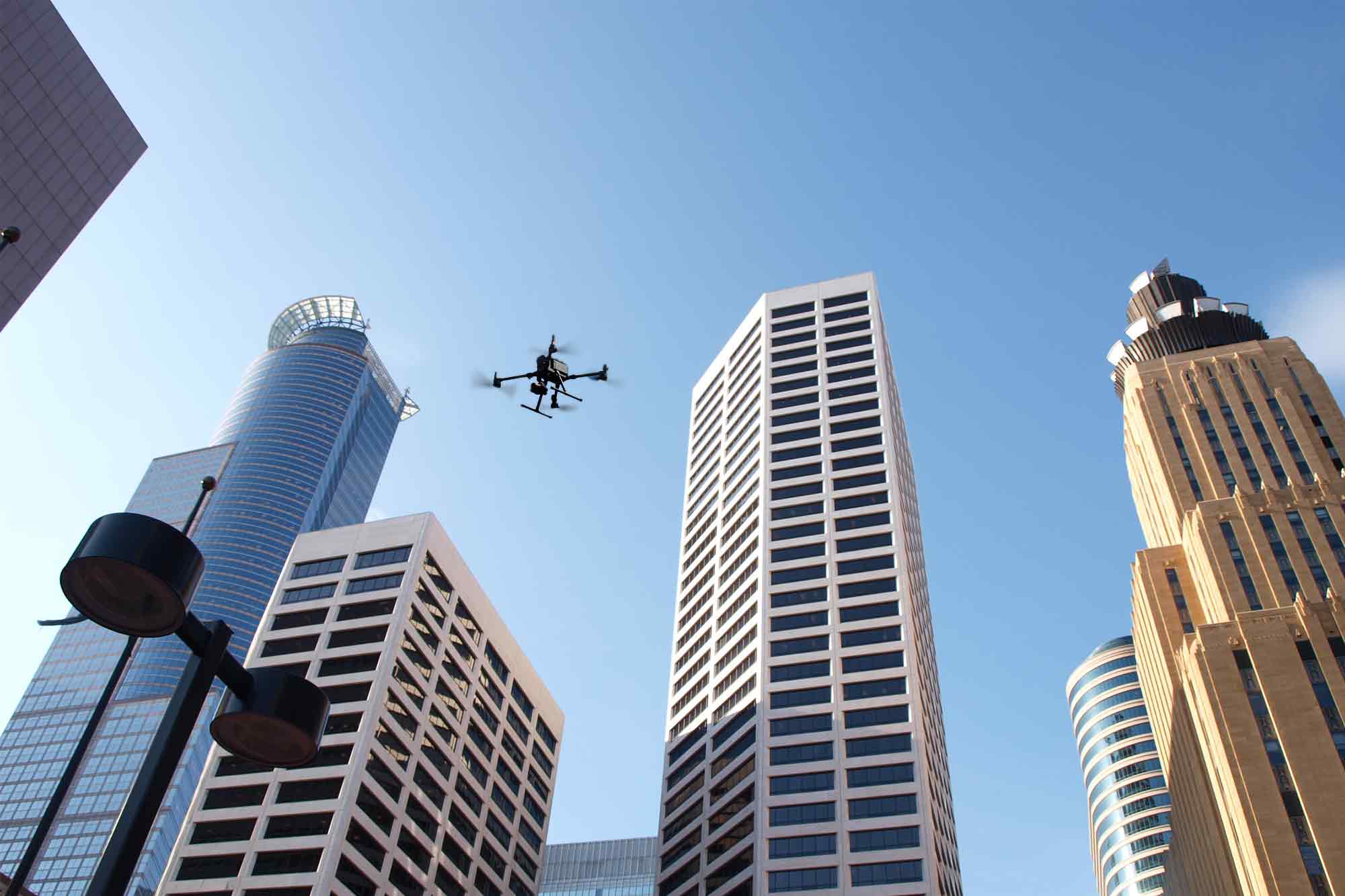
Flock already turns public spaces into searchable surveillance networks. Now it is putting those surveillance capabilities in the sky.
Its drone-as-first-responder system can automatically launch after a 911 call, a detected incident, or even a sound such as a possible scream. Its Alpha drone can reportedly fly 60 mph, use thermal and low-light imaging, and read plates from up to 2,000 feet.
A human responder sees and records selectively, limited by time, distance, and manpower. A drone can scan hundreds of vehicles and an entire neighborhood all at once.
That is what makes “flying response” so significant: It turns mass surveillance into an ordinary feature of emergency response. The drone is sent to respond to one incident, but in doing so collects information on hundreds of innocent people who have nothing to do with it.
This is not simply replacing an officer’s eyes. It removes the practical limits that once constrained surveillance and makes mass collection part of the response itself.
License Plate Becomes Identity
This is not simply Flock moving from stationary license-plate recognition to aerial predation masked as observation. It is building an interconnected surveillance system that can combine what it sees from the air with the zettabytes (1 billion terabytes) of data that systems have already collected.
Flock’s Nova accessory is designed to turn vehicle information into a detailed personal profile. It can connect a vehicle and license plate to an individual, then connect that person to a spouse, children, address, phone number, relatives, associates, and other records.
A license plate stops being merely a record of a vehicle. It becomes a gateway into a person’s identity, relationships, movements, and history.
Nova has code associated with “dark web data,” which can give access to sensitive information such as Social Security numbers, financial information, leaked email credentials, and passwords.
Flock disputes that Nova provides law enforcement with stolen dark-web information, saying it considered the capability during development but rejected it.
But a claimed rejection of one capability does not answer the larger question: What happens when increasingly powerful surveillance systems can connect pieces of information that were once separate?
Flock is not the first to attempt 360 surveillance. Since 2009, software company Digital Recognition Network has amassed billions of license-plate scans, using GPS and timestamps to map where vehicles have been and where they are.
Police buy access to this private surveillance network, built by repossession agents scanning plates as they drive.
Clearview AI is adding to the collection mix with InquiryIQ, which lets authorities gather your personal data from across the internet.
The danger is not any single piece of data. It is the ability to turn countless fragments into a detailed map of a person’s life.
The Danger Is Not Theoretical
The Johnson County Sheriff’s Office in Texas performed a nationwide Flock database search of more than 83,000 automatic license plate reader (ALPR) cameras while looking for a woman who they said had a self-administered abortion.
In Florida, police arrested Lindsey Isaacs after a Flock camera wrongly linked her Dodge Durango to a fatal crash; she spent 13 days in jail and faced life in prison before charges were dropped seven months later.
A cop confronted Colorado resident Chrisanna Elser at her home with a summons for theft because of a Flock camera mistake. Other cases involve wrongful detentions and police officers using Flock to stalk ex-partners.
These cases expose the fundamental danger of this flawed, automated surveillance: When the system is wrong or manipulated, its error does not stay in the database — the person targeted faces police at the door, handcuffs, prison, and even death.
Machine Errors, Human Costs
Imagine Flock cameras moving through your town, tracking vehicles, hovering over residences, and using thermal or infrared sensing to detect activity far beyond what human responders could observe.
The existing law still operates in a world where surveillance is limited by human time and labor. The technology removes those limits, expanding what government can observe, record, connect, infer, and remember.
The use of predictive predation is a growing threat in this system, but Flock is not the only culprit. Anthropic is building artificial intelligence to monitor activists, track protests, and anticipate potential threats. The Department of Homeland Security is using predictive policing to target Americans’ financial activity and trigger traffic stops.
These technologies are not limited to suspected criminals; they are used against people exercising their First Amendment rights by protesting.
Surveillance is no longer just watching what you do. It is beginning to predict what you might do next.
Algorithms Generate Suspicion
Consider what happens when an automated system detects something unusual, even just a deviation from the pattern of your already cataloged behavior.
The responder dynamic becomes:
- Sensor
- Algorithm
- Alert
- Drone
- Observation
- Police response
Each step can amplify the previous one. A sensor generates data. An algorithm interprets it. An alert triggers a drone. The drone generates more “evidence.” Armed police then respond as though it were all established fact.
This matters especially when Flock’s own Raven gunshot-detection system has already revealed a dismal 8 percent accuracy rate, when independently tested in Champaign, Illinois.
This is critical because systemic police violence already disproportionately targets sober, unarmed minorities. In fact, independent research shows that Black victims of police violence are 23 percent less likely to be armed and 60 percent less likely to exhibit mental health issues than white victims.
The point is not simply that automated surveillance can be wrong. The concern is that automated errors can trigger potentially deadly armed responses in an already biased system.
Everyone Is Searchable… Kinda
Mass surveillance collects first and investigates later. You do not have to be a suspect; you only have to be within range.
Flock cameras started on poles. Now they will launch from those poles, fly through neighborhoods, and use thermal and infrared sensors to extend surveillance into areas where the Constitution limits government intrusion.
The danger is no longer simply being watched in public. It is surveillance extending beyond the public spaces where it began. But the surveillance profiteers don’t want to become its subjects.
Flock CEO Garrett Langley has obscured his own private data on the web, exposing a profound contradiction: Flock profits from making ordinary people’s information accessible while protecting its executives from the same exposure.
When InvestigateTV reporter Brendan Keefe filmed a Flock camera installation from a public street, the Flock employee swatted him with a 911 call. The company’s surveillance logic was suddenly very different when the watcher became the watched.
The double standard extends to enforcement: Government agencies and private companies can surveil citizens with drones, yet citizens who use drones to expose real crime face investigation. The Intercept reported that the FAA investigated drone pilot Joseph Allman after he filmed animal abuse at California cattle operations.
Constitutionally, the question is whether warrantless, persistent surveillance violates the Fourth Amendment — particularly as technology allows law enforcement to conduct surveillance on a scale and with a level of access that was previously impossible.
Flock began by making your public movements searchable. Now it is building the capacity to come find you, charge you, and maybe even imprison you — even when you have done nothing wrong.
Hashtag Picks
Cops Are Using Flock To Spy on People for the Crime of Standing Around
From The Intercept: “Though Flock’s investors and executives insist its surveillance dragnet thwarts the most serious of crimes, it turns out police are also using the company’s technology to go after some of the pettiest possible offenses: curfew violations, loitering, and simply being homeless.”
Reps. Massie, Burlison Introduce the ‘Flock-Off Act’ To Defund Surveillance State Cameras
The author writes, “Rep. Thomas Massie (R-KY) announces the introduction of H.R. 10221, the Flock-Off Act. The legislation responds to Americans’ concerns about the growing surveillance state by prohibiting the use of federal funds to purchase, install, maintain, operate, or upgrade automated license plate readers (ALPRs) and biometric surveillance cameras. Rep. Eric Burlison (R-MO) is co-leading the legislation.”
Beware of Other License Plate Surveillance Companies Besides Flock
From the ACLU: “There’s a nationwide rebellion against license plate readers underway, and the company Flock is the focus. That’s natural, because the company has ‘essentially dominated license plate recognition across the United States,’ as industry analyst IPVM put it. But Flock is far from the only vendor, and with Flock rightly receiving most of the heat, it’s important to realize that its competitors aren’t so great either, and that simply replacing Flock surveillance with another company’s surveillance won’t necessarily solve any of the privacy and other civil liberties problems posed by this mass surveillance technology.”
DHS Program Analyzes Americans’ Finances To Flag Drivers for Traffic Stops: Report
The author writes, “The Department of Homeland Security (DHS) is allegedly analyzing Americans’ financial data to conduct traffic stops of drivers, some of whom were never flagged of committing any crimes. DHS is allegedly conducting operations through a U.S. Border Patrol program that feeds intelligence to local police who then pull drivers over, according to an investigation by 404 Media.”
Flock CEO’s Address Spread Online as Surveillance Backlash Explodes
The author writes, “Garrett Langley went on Fox News’ Saturday in America in mid-August 2026 and told America that obsessing over privacy alone “prioritizes the wrong thing.” His company, Flock Safety, sells automated license plate reader cameras to police departments nationwide. The clip hit X and went viral. Then the internet did what the internet does: users began posting what they claim is Langley’s private home address. X’s moderation team has been deleting posts. Users keep re-uploading them — altering wording and images to slip past filters. It’s a whack-a-mole problem, except the mole sells surveillance infrastructure.”
Dying in Detention
From Human Rights Watch: “In the 500 days between President Donald Trump’s inauguration on January 20, 2025 and June 4, 2026, 52 people died in Immigration and Customs Enforcement (ICE) custody in the United States. The mortality rate of deaths in ICE custody is at its highest level in over a decade and has more than doubled since Trump’s second term began. The rate is nearly four times that of the Biden administration, and more than two and a half times as high as that of the first Trump administration.”