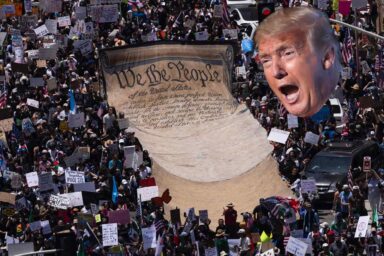
The Second American Civil War Is Already Here
Donald Trump’s aim to punish, terrorize, and subjugate any state that didn’t vote for him is the biggest threat to the country since the Confederacy split from the Union.
|
Listen To This Story
 |
By the time the Civil War officially began in April of 1861, seven states had already seceded from the Union, and tensions between the North and the South had been simmering for years.
What followed were four brutal years that claimed nearly as many American lives as all other wars the US has fought combined. Apart from pitting brother against brother, it was a traditional conflict — fought over land and ideology by armies in uniforms, i.e., it was always clear what was at stake, who was friend, and who was foe.
Unfortunately, the underlying issues and divisions were not fully resolved when the South surrendered in 1865 and have been festering ever since. Some of these have even contributed to gaping rifts in modern society, and it was inevitable that a conflict would flare up again eventually.
And now it has.
We refer to it as Civil War II, or perhaps The Shadow Civil War.
Granted, historians will probably not categorize the first year of Donald Trump’s second term as a “civil war.”
After all, there was no casus belli; there are no officially constituted armies, no us-or-them uniforms, no traditional casualty lists.
There is no Mason-Dixon Line this time around that shows who belongs to which side.
Or if there is, it is not a geographic demarcation but rather a political one (perhaps we should call it the Trump-Harris line), and it is quite possible for Americans living under one same roof to be on opposite sides of Team Fascism and Team Democracy.
Note that we are intentionally not saying that they are “fighting” on opposite sides. That’s because only one side is doing the fighting while most of those on the other side don’t even realize that they are engaged in an existential struggle.
And, still, we think Civil War II is an apt term to describe what has been going on over the past year.
From the moment he was sworn in, Donald Trump has waged war against the cities and states that did not vote for him, against the rule of law, against moral decency, and against democracy. By any means necessary, his goal is to turn the US into a fascist state, with him above any law and any norm, and to subjugate those who dare to defy his wishes.
In order to punish anybody who doesn’t support him, Trump is (ab)using his presidential powers in ways that are unprecedented, and he has demonstrated that he will use any tool, legal or illegal, to punish his opponents.
He wants to starve blue states into submission by withholding federal funds; his Department of Justice has become a purely political operation; and, of course, he is using an unaccountable paramilitary force to terrorize communities that voted against him (while also itching to use the actual army that he has at his disposal against Americans).
We believe all of that deserves to be called “waging war.”
Ironically, and this is the one way in which we concede that the term “war” doesn’t quite fit what is happening, the side that relies on violence in this conflict is ultimately going to lose.
If the protesters in Minnesota, for example, are goaded into fighting back, then that will only serve as a justification for an escalation of the government-sponsored violence.
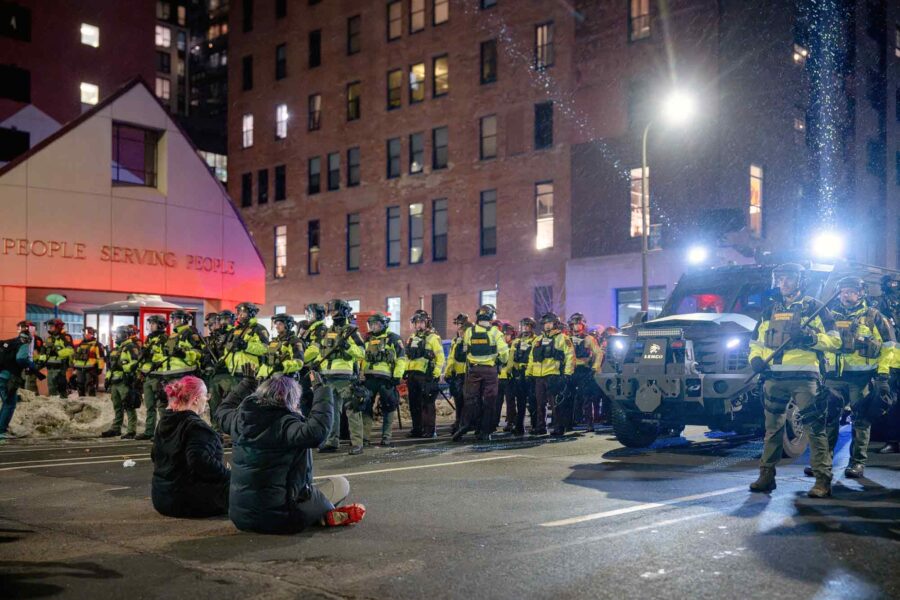
Photo credit: Chad Davis / Flickr (CC BY 4.0), CDP
However, if the thuggish behavior of federal agents results in more bloodshed, then public opinion, the most potent weapon in the arsenal of the good guys, will swing against the administration and anybody else who fails to rein in Trump.
For example, if the baby that ICE tear-gassed this week had died, the entire Minnesota operation would have fallen apart very quickly, especially since the Department of Homeland Security — in a since-deleted social media post — first suggested that the family, which had been caught in the crosshairs between protesters and law enforcement, was somehow to blame for what happened.
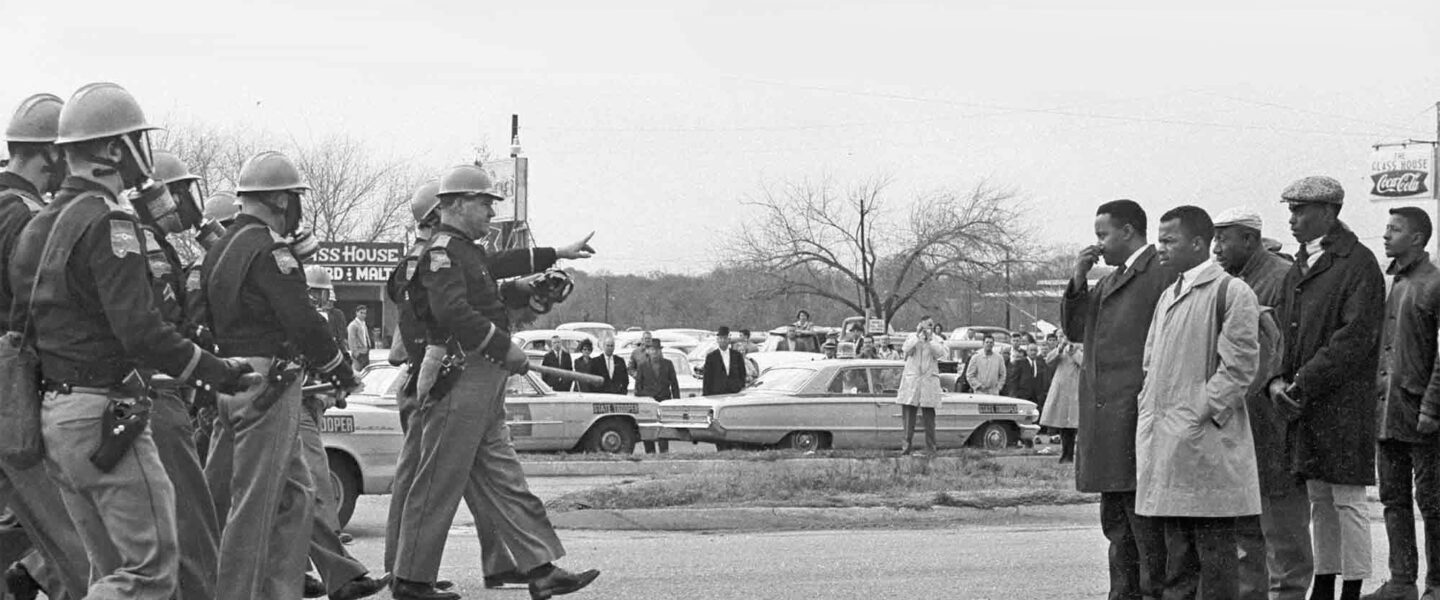
In other words, even though it may not sound like an appealing strategy, those opposing Trump have to provoke his thugs into a narrative-changing moment like “Bloody Sunday” – the violent attack on peaceful protesters in Selma, AL, on March 7, 1965, that became an inflection point in the fight for civil rights — and led to the passage of the Voting Rights Act a few months later.
In light of the poor training of ICE agents, the lack of accountability, and the brutality that they have been getting away with, we hope (and believe) that this will happen sooner rather than later. When it does, Team Democracy needs to be ready to seize the moment.
Unfortunately, a defeat in Minnesota, or wherever it comes, won’t mean that Trump will give up his determination to wage war against those who oppose him, just as South didn’t immediately surrender when the tide decisively turned against the Confederacy in 1863.
There is too much at stake for him, and we saw in 2020 what he is capable of in defeat.
Therefore, it would be foolhardy to expect any easy victories.
Just as it took almost exactly 100 years from the end of the Civil War to Bloody Sunday on the Edmund Pettus Bridge, vanquishing Trump and his authoritarian vision for America will be a lengthy fight.
Fortunately, just like the Union, the good guys have strength in numbers and a just cause on their side.
And we believe that, in the end, that will make the difference, even though it won’t be easy to defeat a determined Trump and his hateful ideology.