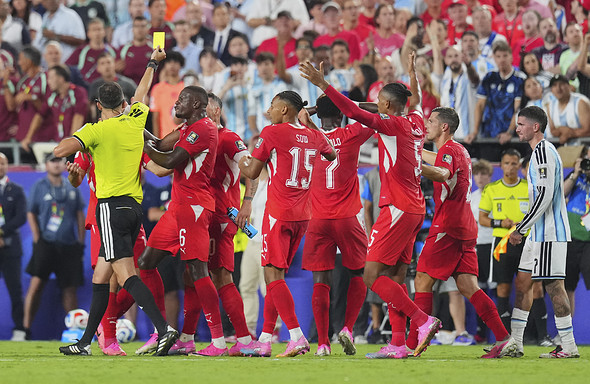
A Dive, a Red Card, VAR, and Voting
What hi-tech video review does for sports, lo-tech hand counting can do for our elections.
|
Listen To This Story
 |
Breel Embolo is, from all I could glean, a good egg. He is a devoted father and partner, tall and handsome with a wide and winning smile.
He is also a supremely talented striker, with a long career at the highest levels of soccer, well respected in that world and well loved by his coach and teammates on the Swiss Men’s National Team.
Last Saturday, in a World Cup quarterfinal match against Argentina, Embolo committed one of the few truly cardinal sins of the game: He faked being fouled and injured. In soccer lingo, it’s known as “simulation, intended to deceive the referee”; in common parlance, diving.
As a referee for over 30 years, I’ve seen my share of it — and I suspect missed my share of it as well. That is what makes diving a cardinal sin.
Soccer is a fast game, and a game of inches and angles; if done well, a dive can fool even the sharpest, best-positioned referee on his or her best day. As a consequence, the wrong player — an innocent player — and their team will be punished, sometimes most severely.
Players would work on the skill of tripping over an imaginary leg, or their own feet, and rolling over and over while clutching a knee or ankle whose ligaments were, judging from the expressions on the players’ faces, in shreds.
Around 10 to 20 years ago, diving in soccer was endemic. It started at the game’s top levels and soon permeated down through the ranks to the 8-year-olds.
Players would work on the skill of tripping over an imaginary leg, or their own feet, and rolling over and over while clutching a knee or ankle whose ligaments were, judging from the expressions on the players’ faces, in shreds.
It got embarrassing — soccer haters and soccer fans alike condemned the beautiful game as an ugly farce. Referees were made fools of on a regular basis.
The poobahs took steps to clean up the mess. Referee clinics made detecting dives a point of emphasis, and simulation was added to the list of yellow card offenses. That awareness and deterrence helped bring things somewhat under control.
Surveillance Soccer: The Advent and Impact of VAR
Now we’re in the VAR (Video Assistant Referee) era — video review spread gradually from American football to other sports, including soccer. Initially, the scope of VAR — the situations in which it could be applied — was very limited: goal/no goal, red card review. Then it expanded: penalty kick review, offside review, corner kick review, etc.
Soccer — this year’s much-decried hydration (advertising?) breaks notwithstanding — is a game of flow and continuity. It would not do to have interruptions for VAR of every borderline foul, boundary call, or even yellow card. Even assuming VAR infallibility, the cost in discontinuity would be ruinous. So the trade-off was essentially between getting every last call right and having a recognizable game.
All of which led to one of the most controversial administrative decisions about VAR’s use in this FIFA World Cup: the interpretation of “mistaken identity” and specifically what situations involving that problem were eligible for VAR review.
As previously interpreted, mistaken identity meant correcting a wrongly identified culprit responsible for a given foul or misconduct. For example, there was a deliberate handball (a yellow card offense) on the blue team, but it was committed by #5 rather than #11 of the same team; or it was #8, not his teammate #6, who grabbed the attacker’s shirt and denied an obvious goal-scoring opportunity (a red card offense).
Earlier, in this year’s group stage, VAR was used to change a caution for a foul into a caution for simulation, when the replay showed there was no contact, but rather a dive.
There was, naturally, an outcry — as Horace might have said of this World Cup, nulla dies sine furore — since VAR corrections for mistaken identity had not, to that point, been applied to different infractions by players of opposing teams; in this case, a reckless foul vs. simulation.
FIFA — which does have a way of making up interpretations, if not rules, on the fly — clarified that yes, that was a permissible use of VAR. Which should have served as fair warning: Diver, beware. Or, as Horace might have put it: Caveat simulator!
Perhaps Embolo and the Swiss team didn’t get the memo. Because he and his teammates looked genuinely shocked that he was rung up by VAR, after the referee missed the dive in real time. Embolo, in fact, burst into tears.
Risk and Reward
Perhaps the referee fluffed it because no sane player, having given it a moment’s thought, would have done what Embolo did in that circumstance. It had to be some kind of brain freeze.
As referees, we are trained to consider risk and reward in anticipating foul play. We expect players to take small risks for potentially big rewards, but not the other way around.
For example, on a corner kick, when a dozen or so bodies are clustered near the goal, shoving and grabbing, if an attacker pulls or pushes down a defender to get a kick or header directly on goal, the potential reward, if the infraction is not seen by the ref, is a GOAL; the risk, if it is seen, is a free kick toward the other team’s goal from more than a hundred yards away.
If a defender does the same thing to an attacker, the risk is a penalty kick (at 80 to 90 percent conversion rate, a very likely goal), while the potential reward is just one fewer attacker in position to score — a very unfavorable risk-reward ratio.
Referees are, or should be, highly aware of such a dynamic and alert to catch the far more likely high reward-low risk foul, call it, and chew the player out publicly to send a message that that’s not okay.
In the case of Embolo, Switzerland had tied the match and had momentum; the site of the incident was not in the penalty area or close to goal, but out by the touch line, so a foul called there would result in a not-very-promising free kick. And perhaps, if Embolo’s acting job was good enough, a caution might be delivered by the referee to the Argentinian player who “fouled” him.
But Embolo had already received a yellow card caution (uncontroversial) earlier in the match, so a second caution for him would mean a red card send-off, and Switzerland would have to play the rest of the match down a man (as the match went to 30 minutes of extra time, that wound up being nearly an hour of playing time, a major handicap that completely altered the dynamic of the match). In other words, really high risk for really low reward.
I can imagine that the referee, schooled in risk/reward perspective and thinking like a soccer player, found it very hard to imagine Embolo would dive under those circumstances — especially with VAR on the prowl. So when Embolo flew through the air, arms outstretched, and rolled over and over, clutching his leg, the referee bought it, called the foul, and carded Leandro Paredes, the supposed Argentinian culprit, who immediately protested the call.
Now, soccer players have been known on occasion to protest a call, but there was something about Paredes’s appeal to the referee that instantly made me think it sincere, that his “I am an innocent man” act might not be an act.
In real time, at full speed, from the TV camera angle, it sure looked like a nasty foul, but perhaps it wasn’t as bad as it looked? As a referee, taught to think in terms of risk/reward, I confess a dive seemed out of the question to me — Embolo, already on a yellow card, would have to be nuts to risk being caught in a dive!
https://www.youtube.com/watch?v=6ttdGtk8eGI
And then, along with the referee, we TV viewers got to see the VAR, slo-mo replay from several camera angles, and it was obvious: a classic dive, risk/reward be damned. You could use the replay at a referee clinic to illustrate diving.
In Embolo’s case, as I hope everyone can see, there was no contact, and nothing accidental: It was a pure, cynical attempt to deceive the referee, in circumstances that made it so ill-advised that the referee, in real time, missed it completely.
Simulation is not punished casually: The culprit is given every benefit of the doubt. If there is even slight contact between players associated with a suspected dive, it is not considered simulation and will not be carded. The player who has, in soccer terminology, “made a meal of it” will generally get some kind of warning from the referee along the lines of “I don’t need your help to call that foul, so knock it off, okay?” But such embellishment is not simulation — it is a far lesser offense.
In Embolo’s case, as I hope everyone can see, there was no contact, and nothing accidental: It was a pure, cynical attempt to deceive the referee, in circumstances that made it so ill-advised that the referee, in real time, missed it completely. VAR nailed it and Embolo, good guy or not, richly deserved the punishment (the second yellow, resulting in a send-off) he received.
The Coach Protesteth Too Much
So it was strange, bordering on ridiculous, to hear Swiss coach Murat Yakin — another good egg, by all accounts — yammering about the unfairness of it all, how it was a bad rule, misapplied, and ruined the match and his team’s chances (Switzerland pooped out and lost in Extra Time). With insinuations that Argentina, the defending champions, were beneficiaries of thumbs on the scale from a corrupt FIFA.
While FIFA corruption and coddling of Argentina are at least debatable, this particular incident was not. Yes, coaches routinely come vociferously to the defense of their players, but to shift the blame in this case from Embolo to the referee, to VAR, to FIFA — was almost Trumpian.
Embolo, in a court of law, might plead insanity, but there was no other person, entity, force on Earth responsible for the outcome.
Never Liked VAR
I was against VAR before I was for it.
No fan of change for change’s sake (consider, e.g., AI), I loved the fact that soccer was a simple game, demanding high levels of stamina in its very continuity. Its roots were essentially primitive — a ball of some sort, a couple of sticks with (maybe) another stick across them for a goal, and probably something like “game over when the sun hits those treetops over there” (this is reflected in the survival of “primitive” timekeeping, in which the match ends when time added at the referee’s sole discretion expires — how quaint!).
I’d always liked the element of human error in officiating: Players could never be perfect, so why not live with — and maybe even celebrate — the inevitably fallible human element in refereeing? Let the game proceed — imprecise, living, breathing, human in every facet!
I didn’t think VAR had much if any place in soccer (well, perhaps determining whether the whole ball had crossed the goal line for a goal, a notoriously difficult call for the human refereeing crew in certain circumstances).
I’d always liked the element of human error in officiating: Players could never be perfect, so why not live with — and maybe even celebrate — the inevitably fallible human element in refereeing? Let the game proceed — imprecise, living, breathing, human in every facet!
But I’ve come around. They’ll have to pry my flip phone out of my cold dead hand, but VAR has a vital place in soccer — high-level soccer, at least, where the game is too fast and sometimes too busy for the unaided human eye, even the best. (It is interesting to note that VAR was a virtual no-show in the subsequent semifinal match between France and Spain, I suspect because a chastened FIFA put a muzzle on it. And, naturally, there were then complaints to be heard about its underuse!)
VAR is annoying. It does interrupt a game whose ethos is continuity and flow. But fairness in high-level soccer requires the kind of verification that only VAR and its interruptions can provide.
Related: The Beautiful Game in an Ugly Era: My View as a Soccer Referee and Journalist
Now for Something Important
I could leave it all right there, a human-interest sports story and a paean to VAR from an erstwhile skeptic.
But, as riveting as I found the World Cup and as fascinated as I am by the challenges of refereeing, there are things on my mind every day now that matter more to me than soccer or sports by many orders of magnitude.
Those things are elections, the most essential component of a democracy — and vote counting, the bedrock protocol of free and fair elections.
With our elections — specifically, the critical midterm elections coming in November — under siege by a power-obsessed autocrat who is in the process of weaponizing so-called election “integrity” with diabolical intent, America desperately needs the equivalent of VAR to detect and deter the political equivalent of simulation. And every other attempt to deceive the public and subvert its will.
Right now, our electoral process resembles pre-VAR soccer whistled by a referee with 20-200 vision in one eye and a patch over the other.
We have reached a state where elections can be challenged (by Trump & Co.) without having been rigged, and rigged (by Trump & Co.) without triggering any challenge.
Our first task is to stop deluding ourselves about just how asymmetrical this political-electoral warfare is.
As I will be examining in a series of columns over the coming months, our counting processes are computerized, concealed, and largely entrusted to just a few equipment providers all of which have strong right-wing pedigrees and affiliations; our audit processes are anything but uniform and are generally piss-poor; and concern about the vulnerabilities of this whole system has been so utterly co-opted by Donald Trump’s “Stop the Steal” putsch that no Democrat or journalist at the adult table will now even clear their throat over bizarre election results that cry out for deeper investigation and forensic analysis.
We have reached a state where elections can be challenged (by Trump & Co.) without having been rigged, and rigged (by Trump & Co.) without triggering any challenge.
Our first task is to stop deluding ourselves about just how asymmetrical this political-electoral warfare is.
Trump’s Threats, Overt and Covert
We have now witnessed Trump, in his desperation to hold power and escape accountability, building higher and higher upon the baseless foundation of his Big Lie about the alleged theft of his “sacred landslide” in 2020, in order to justify everything from federally directed mass voter purges to draconian and discriminatory proof-of-citizenship registration and photo-ID voting requirements, to USPS control of mailed ballots, to seizure of ballots and equipment, to intimidation of election administrators, to threats to deploy ICE and the US military to the polls.
These are all tactics designed to warp the electorate in the GOP’s favor and keep Congress friendly to Trump, when every historical indicator points to an electoral drubbing resulting in a shift in control of at least one congressional chamber, most likely both.
And all based on a Huge Lie. The 2020 election was not rigged, at least not against Trump or the Republicans; mail-in voting leaves a paper trail of signed hand-marked paper ballots, more subject to verification than in-person votes cast on computerized ballot-marking devices; illegal voting, by US citizens and especially by undocumented immigrants, is vanishingly rare and no threat at all to the legitimacy of our elections.
The manipulation of vote counts is such a threat — a very serious one.
If we take all the other, more visible threats seriously and turn a blind eye to this one, we will be like the referee who was deceived in real time. We now need the equivalent of VAR to show what’s happening in the pitch dark of cyberspace, to show the one angle that exposes and can deter the most dangerous fraud of all.
Electoral VAR
We desperately need Electoral VAR — ironically, reliance not on hi-tech but lo, the manual counting and/or auditing of ballots in public view — to counter an inveterate liar and cheater, for whom all options, however foul, are very much on the table. For Trump, there is no ethical bright line that renders certain schemes out of bounds.
We have to understand where we are — grasp that we’ve left normal far behind. And be willing to slow things down enough to get them right.
We’re in a fight for our democracy’s life. Because Trump knows he can no longer prevail and save himself democratically. That ship has sailed. But he must have the illusion of approval and popularity, and that, along with his imperative grip on power, can come only through electoral triumph, however jiggered.
So I’ll say it again: We are in a fight for our democracy’s life.
The following passage appears in the introduction to the third edition (2016) of my book CODE RED: Computerized Elections and the War on American Democracy:
Why would a nation install, and why would its people acquiesce in, such a patently untrustworthy process [as computerized voting and vote counting] for making its most critical decisions and for transforming the public will into leadership, policy, and direction?
We will return to this question often in the course of this book; it has several disturbing answers. But for the moment we think it fair to observe that we live in a time and a place where convenience is king. Every improvement in speed, each yet slicker technological “advance,” has been embraced with reflexive zeal. Our cultural impatience (Faster connection time! Faster downloads! Tweet! Swipe Right!) seems to know no bounds.
Perhaps the only real exception to our pan-cultural haste is our embrace of video review in our various sports (now trickling down even to the high school level). We accept these delays because of the importance we have come to place on accurate athletic outcomes and sports justice — i.e., because “football matters.”
That was an unheeded warning from what is now known as the Before Times — pre-Trump.
In sports, we’ve proven willing to use every tool to get things right and keep games fair.
What about the game on which depends the fate of our beloved country?