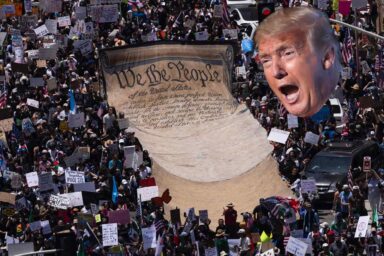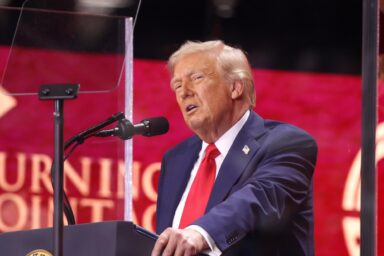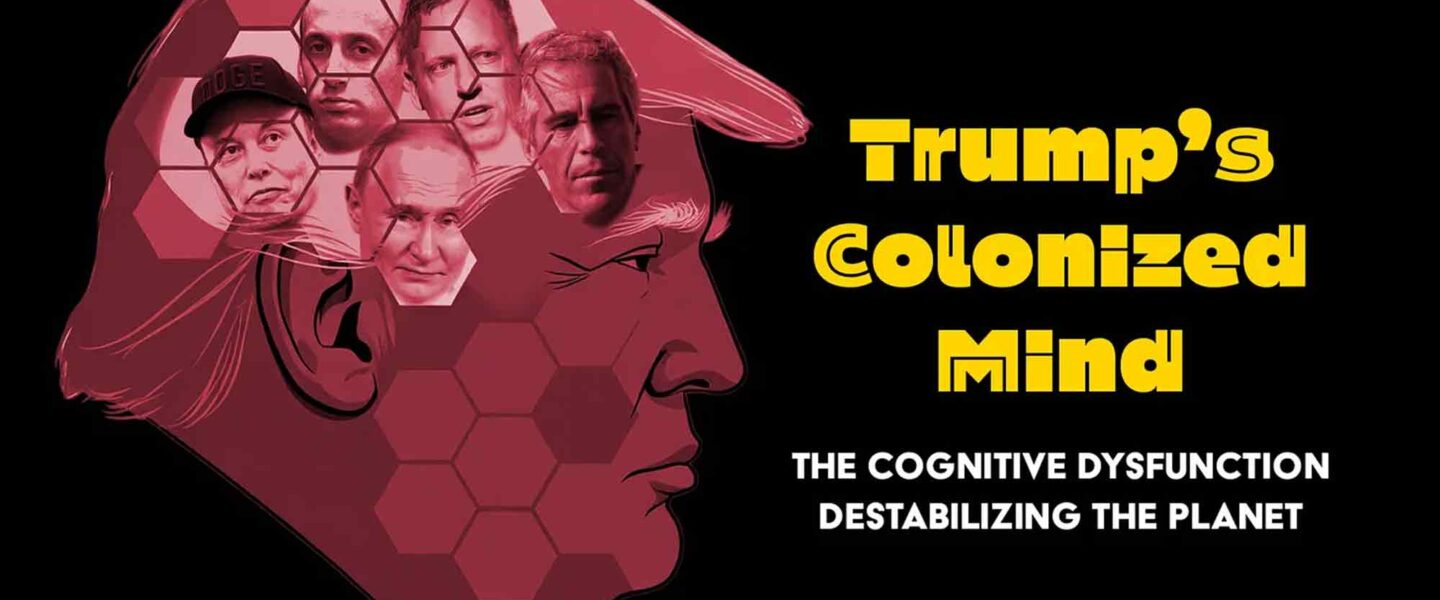
The neurological, psychological, and political breakdown of the American president — and the people taking full advantage of it.
|
Listen To This Story
 |
Donald Trump’s comments about Rob Reiner and his wife’s horrific murders left many in Trump’s party, including those who have been steadfastly loyal to him for a decade, unable to explain or endorse his behavior.
MAGA stalwarts like Laura Ingraham and James Woods, while careful not to criticize Trump directly, gave poignant comments about Reiner’s character and legacy that could not be seen as anything but a rebuke to this:
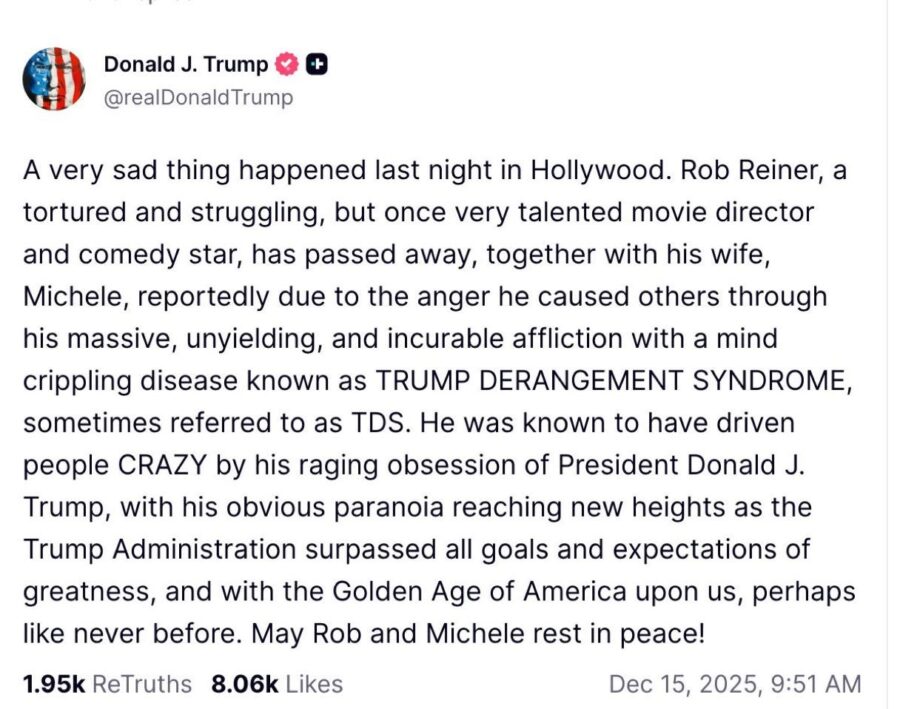
Before Trump posted his disgraceful thoughts, and subsequently doubled down, many other Trump supporters had boasted that their political side’s reaction to these murders was categorically different from the “left’s” to the murder of Charlie Kirk. According to them, there would be no celebrating or making light of Reiner by “the right.”

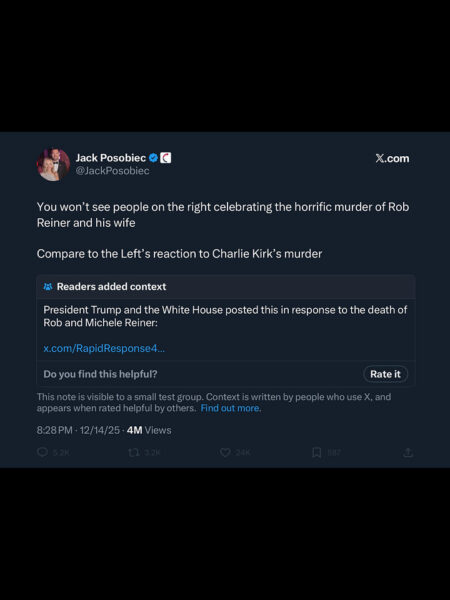
Trump, needless to say, put them in an uncomfortable position.
There is also a sense, across the media sphere, that something is very “different” about this Donald Trump from the first term’s Donald Trump. There is no “twinkle” in his rhetoric. He has “lost his sense of humor.” He’s “uninhibited.” And so on.
As a close observer, I can say that Trump is experiencing a rapid decline in cognitive function. But the decline is specific in nature. It’s not so much the memory loss, or even his inability to stay on topic that screams loudest — although those symptoms are apparent as well. It’s more that he is increasingly:
- apathetic
- disinhibited
- and exhibits a total lack of either affective empathy (feelings) or cognitive empathy.
That is, he can’t even pretend to care about anyone but himself anymore.
Donald Trump is alone and angry on a deserted mental island.
Understanding this decline, and the danger it poses to the world, requires looking at several layers of the mind’s ontology: neurophysiological, psychological, and sociopolitical.
The pressure on Trump’s psyche is astronomical, which makes it difficult to see how we collectively emerge from his collapse without a severe crisis of some kind.
Neurophysiological
While there are numerous psychological pressures on Trump, the neurological symptoms cannot be ignored — especially in conjunction with his obvious physical problems. Trump has had bruising — and now a full bandage — on his right hand for months, after he effectively disappeared from view for a week, with no explanation.
I believe there are two neurophysiological factors at play: serious vascular problems, and dementia, likely what’s called behavior-variant frontotemporal dementia (bvFTD) — the most common form of FTD, which can symptomatically run its course over many years.
Here are some of the most common behavioral changes in early FTD according to the Mayo Clinic:
- Increasingly inappropriate social behavior.
- Loss of empathy and other interpersonal skills — for example, not being sensitive to another person’s feelings.
- Lack of judgment.
- Loss of inhibition.
- Lack of interest, also known as apathy — which can be mistaken for depression.
- A decline in personal hygiene.
Each of these behaviors has gotten substantially worse for Trump in his second term. While it’s true that he has “always been this way,” his ability to filter himself — even for his own good — is effectively gone. His internal regulatory system no longer functions at all, even for self-preservation. He is completely disinhibited.
For example, over the weekend, at a holiday party at the White House, Trump gave a truly bizarre performance totally free of inhibition. With his wife standing next to him, he picked out a blonde woman from the front row and remarked breathily about how she looks like Ivanka, and asked her to turn for the cameras; he proclaimed his new “arch” in D.C. will be grander than the Arc de Triomphe; and he told a long, bizarre story about “Little James and Big James,” which is reminiscent of Little St. James and Great St. James — Epstein’s islands.
Trump’s recent racist tirade about Somalis was also of a very different character from the president who faced a multi-week controversy over his “very fine people” comments after Charlottesville in 2017. He now feels free to be as hateful as he feels inside — regardless of the consequences.
It’s impossible to watch him at this point and ignore his dysfunction.
Note that Trump’s family history is supportive of a dementia diagnosis. His father Fred suffered from dementia, which Trump said was “probably” Alzheimer’s — which is often a misdiagnosis for FTD. Several other members of his family have also suffered from dementia.
Gullible
Perhaps the most alarming symptom of dementia, whether FTD or Alzheimer’s, is that it makes the patient far more suggestible, and vulnerable to malign influence. Scientifically, according to a 2025 study, dementia makes people more gullible.
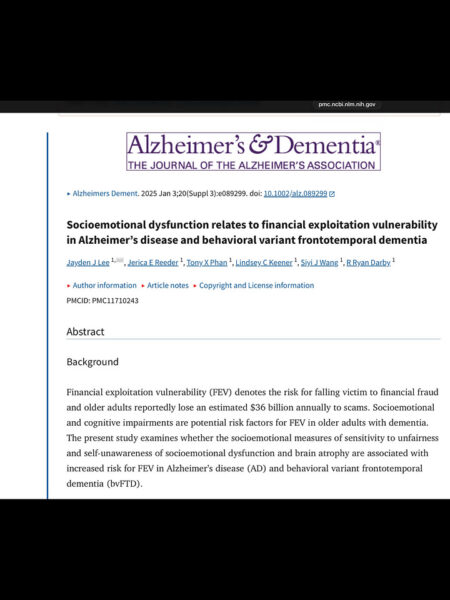
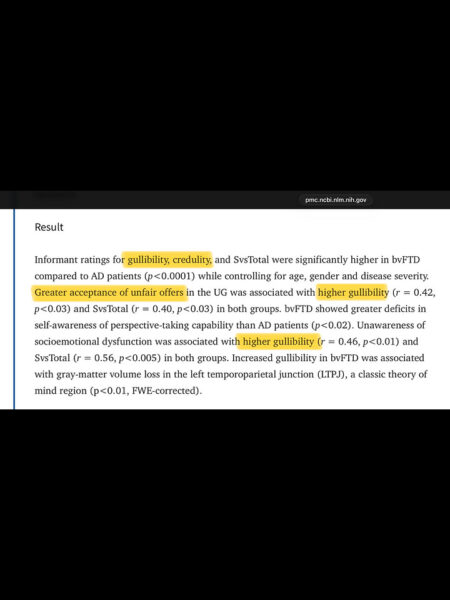
In a president, of course, this is a deeply concerning trait. In this light, it’s hard to see most of his policies as more than stenography for the people around him, including the massive AI-crypto boondoggle, his Duginist “National Security Strategy,” his pardon of nearly 2,000 criminals, and Stephen Miller’s anti-immigration fantasy being played out by ICE.
It’s as if his shrinking mind has been colonized by his advisors and donors.
Note that similar symptoms to FTD can also arise from mini-strokes — of the kind Trump may have suffered several months ago. Last week, Trump volunteered on Air Force One that he had a recent MRI but “didn’t know what part of the body” it was for. He said it couldn’t have been his brain because they gave him another cognitive test — the third one since he was inaugurated.
In fact, Trump just keeps confirming that his doctors are closely monitoring his cognitive function — and the reasons couldn’t be any more evident. He is getting worse, and they cannot make him better.
Psychological
Trump’s behavior is not created by his illness; it is who he has always been. He is just becoming uninhibited by either anyone around him, or by his own mental guardrails.
By all standards except a formal diagnosis, Trump has always been a Dark Tetrad personality type: narcissistic, psychopathic, Machiavellian, and sadistic. But over the last six months, he has lost the ability to play-act the emotions of a normal person, or even to acknowledge that others really exist at all, except as political targets.
That’s why, when given the chance to moderate his comments about Rob Reiner, Trump doubled down, called him “deranged,” and blamed Reiner for the “Russia hoax.” Trump cannot help telling on himself.
REPORTER: Mr. President, a number of Republicans have denounced your statement on Truth Social after the murder of Rob Reiner. Do you stand by that post?
TRUMP: Well, I wasn’t a fan of his at all. He was a deranged person as far as Trump is concerned. He said he like [sic], he knew it was false. In fact, it’s the exact opposite that I was a friend of Russia controlled by Russia. You know, it was the Russia hoax. He was one of the people behind it. I think he hurt himself career-wise. He became like a deranged person, Trump derangement syndrome. So I was not a fan of Rob Reiner at all in any way, shape or form. I thought he was very bad for our country.
Calling the man who brought us Stand By Me, A Few Good Men, When Harry Met Sally, This Is Spinal Tap and “Meathead” to Archie Bunker “very bad for our country” is the rhetoric of a man to whom the human race no longer matters.
The entire world has been reduced to its relationship to a single collapsing psyche.
Psychologically, Trump is decompensating as a result of his unresolved narcissistic injury being repetitively re-inflamed through the drip-drip of the Epstein files. As I’ve reported for months, he is in what is called narcissistic collapse because the prospect of being exposed is not just a political problem — for a narcissist, it is psychological annihilation.
With the deadline of the Epstein files release this week — regardless of how complete they will be, given the current state of the FBI and DOJ — the pressure on Trump’s self-image, his ego, cannot be overstated. He will go to any lengths to avoid being exposed — even if it means betraying his supporters and allies. Even if it means creating an international emergency.
Trump is in a psychological spiral heading towards oblivion — but how much he takes with him remains to be seen. The cracks in his coalition are real and expanding — and the sharks he’s brought around himself are positioning for a transition.
Sociopolitical
In pure political terms — if America were still in a place we could be confident that elections will happen on schedule, free of interference — the Republican Party and Donald Trump are in a historically bad position for 2026.
Trump is underwater on every issue. His popularity is at an all-time low and going lower. And there is nothing on the horizon to improve things. Seemingly, the only guarantee is that the country will be worse off at the end of 2026 than it is now.
As we all feel the pain from the Trump regime’s policies, only 50 percent of Republicans now identify more with “MAGA” than with the GOP itself.
Trump is losing support for MAGA at a fast clip among self-identified Republicans, according to latest polling. https://t.co/U59cvVOnjg pic.twitter.com/l2saOzW6fW
— Jesse Rodriguez (@JesseRodriguez) December 14, 2025
This is significant, because identity is exactly how Trump’s psychological hold works. His cult members identify more with him than with their own best interests. That is the nature of undue influence — otherwise known as brainwashing. It means prioritizing the leader’s emotions over one’s own. This leads to the kind of flocking behavior typical of Trump’s followers — a phenomenon I have called mimetic synchrony.
But like any complex behavior, it is liable to disturbances — think “Butterfly Effect.” As entrained as his followers are to follow him no matter what, when his behavior causes enough cognitive dissonance to create visible ripples in his support, there is a lot more brewing underneath.
Colonized Mind
The biggest danger represented by this extraordinary confluence of pressure on one fragile man is the extent to which Trump’s behavior is supported and enabled by people who see his mental illness not as a national security issue but as a precious commodity.
Donald Trump is less the leader of a nation and more of a glitchy, reprogrammable weapon of mass destruction — being wielded by a constellation of America’s enemies, foreign and domestic.
The recently published Vanity Fair interview of Susie Wiles is emblematic of both Trump’s decline and how the coterie of sycophants he’s brought around him take advantage of it. His own chief of staff recognizes, at nearly every turn, the recklessness of his policies — such as allowing Elon Musk to decimate USAID to fulfill his racist agenda — and nevertheless does nothing.
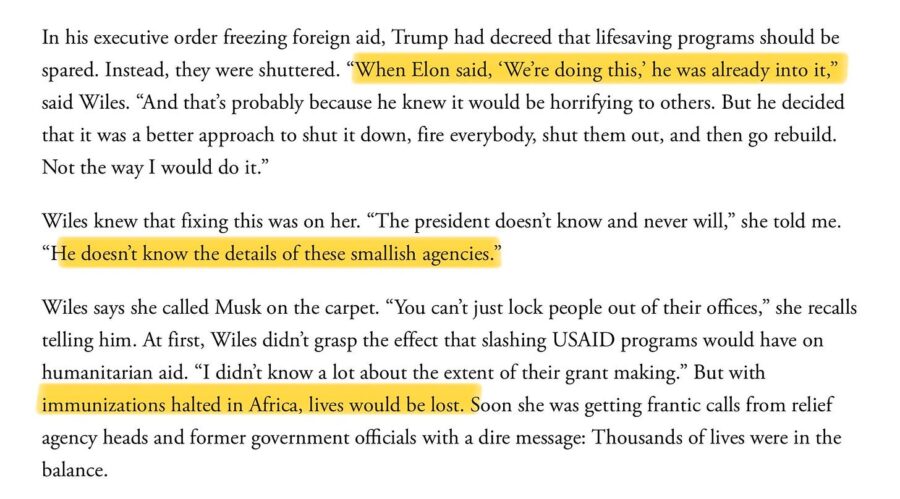
Wiles may have dug her own political grave by granting this access. She is scathing about a number of Trump’s policies — and about a number of the people around him. But her comments are an important window into just how amoral, and incompetent, the regime truly is.
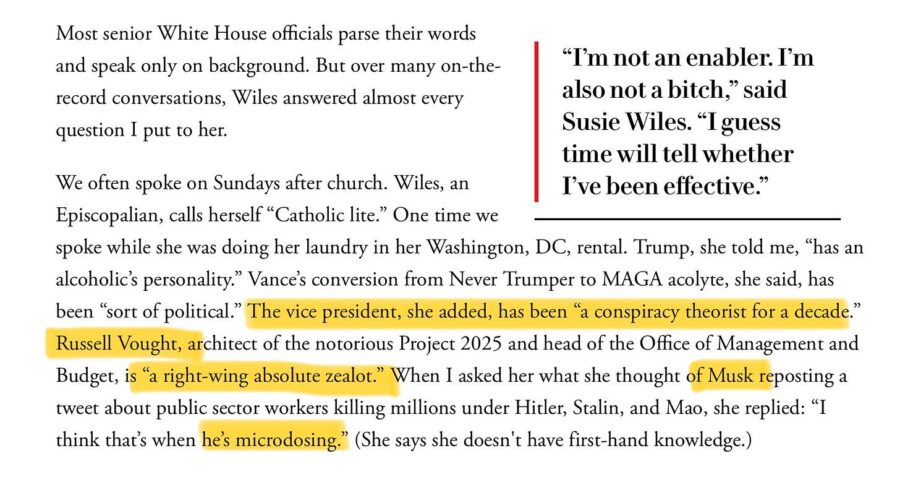
The people who might replace Wiles as chief of staff, as amoral as she is, are much worse. The leading candidate would be Stephen Miller, which would raise the stakes in the race to the bottom. America would truly be a nation whose chief strategic guidepost is great replacement theory.
Tonight, Trump is calling the nation together for a primetime address to detail, according to his press secretary, Karoline Leavitt, “the historic accomplishments that he has garnered our country over the past year” as well as “teasing some policy that will be coming in the new year.”
It’s safe to say that the vast majority of the country wishes he wouldn’t. While most people don’t know the cognitive, psychological, or even the political reasons for his decline, they do know they are sick and tired of Donald Trump.
Unfortunately, when you take responsibility for an elderly person with a progressive neurological disorder, you have to deal with the consequences of their behavior.
For Americans going about our daily lives, with our own families and loved ones to care for, it is wearing thin that we have been enlisted as involuntary stewards of a collapsing dementia patient — all because a slim plurality were conned into trusting him with the nuclear codes.
“The hate of men will pass, and dictators die…” — Charlie Chaplin
As a service to our readers, we curate noteworthy stories through partnerships with outside writers and thinkers. Jim Stewartson is an Emmy and Cannes Award-winning VR programmer and game designer. This column has been adapted with the author’s permission from his MindWar: The Psychological War on Democracy site.