Push Comes to Shove: The Unspeakable Threat to Election 2026
What happens when a vulnerable election system meets a desperate dictator?
|
Listen To This Story
 |
“With three bland, technocratic sentences, the Supreme Court saved the midterm elections.”
That’s the thrilling lede of Ruth Marcus’s New Yorker column “Mail-In Voting Survives” — referring to SCOTUS’s terse per curiam ruling in US Postal Service v. California, as a consequence of which Donald Trump’s campaign against mail-in voting is, for this election at least, mostly dead.
Other observers have, of course, weighed in, some echoing Marcus’s great “Whew!” while others sound a note of caution that Trump may not be entirely out of options for subverting the midterms. There’s lots of analysis to wade through if you’re so inclined.
Trump, for his part, wondered what had become of the three simpatico justices he had interviewed back in his first term for life tenure as his lickspittles. How dare his court commit a justice!?
In the midst of the general non-MAGAworld celebration, though, few have asked whether, in practice, Trump’s rogue USPS can actually be counted on to process and deliver mailed ballots expeditiously, in good faith, without prejudice.
Its new rules and protocols already delay the time-stamping of completed ballots until they reach regional processing centers. Which, pardon my skepticism, leaves a lot of room for foot-dragging — sufficient delay to disqualify and disenfranchise voters in targeted (i.e., Democratic) zip codes who mail their ballots on time.
Democratic voters will of course be advised by their party, and by pro-voting advocates, to avoid such a fate by mailing early or using drop boxes — where those have not been removed or strategically relocated.
Such is how the game is played.
‘Cheat Like Hell’
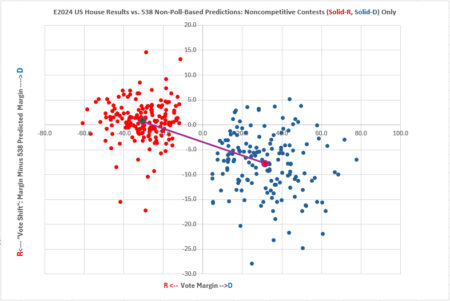
An analysis I performed in 2020 (see “The Real Steal? Electoral Forensics and the 2020 Election,” pp. 9–12) — and repeated in 2024 (when the telltale scatterplot, shown below, was even more egregious) — points to several million ballots apparently “gone missing” from strongly Democratic venues.
Incompetence? Malice? Just one of those things? Who knows — but it’s hard to get around the numbers.
Trump’s message to “his people” at the GOP Midterm Convention in Dallas earlier this month was “cheat like hell.” In fact, he had everyone raise their right hands and pledge to do it, “so help me God” — pledge this to him, “the greatest president in the history of the United States, that loves us so much he can’t even breathe.”
I’ll bet the poobahs at the Postal Service also got the message: Cheat like hell (because, as Trump never tires of telling us, they do, so whatever you do is completely justified). SCOTUS may have spoken, but they don’t deliver — or manage to not deliver — the mail.
So count me among the skeptics that the midterm elections are “saved.”
Suppose Suppression Is Not Enough
But my skepticism goes a lot deeper than the various stunts that may remain open to a Trump-compliant USPS for messing with mail-in ballots.
As I previewed in my last column, “Of all Trump’s many options for keeping Congress under his control, I am most wary of the most covert one: votecount manipulation.”
Trump has given every indication that maintaining GOP control of Congress is for him a stone-cold imperative — an end that justifies all means, fair and foul.
He’s manifestly terrified of losing power, both psychologically because of the extreme fragility of his ego and pragmatically because he believes his political enemies will expose his criminality and bring him crashing down — which is, after all, what he would do.
His desperation is betrayed by his words (e.g., “cheat like hell”) and his actions, such as going to the mat for his precious SAVE Act; his desperate attempt to bring elections under federal (i.e., his) control; his campaign against mail-in voting; his threats to patrol the polls with his ICE goons, etc.
Now, if winning is imperative and if various means to that end are thwarted, the chance that other means will be embraced increases accordingly.
In every contested attempt to gain access to state voter rolls (for the purpose of purging unwanted illegal voters), Trump has lost in court. Despite all his threats and twisted congressional arms, his SAVE Act failed — and with it, his scheme to disenfranchise millions of married and divorced women, along with elderly, young, and disabled voters.
And now mail ballots are being mailed out after all, and millions more voters he had hoped to disenfranchise will stand a reasonable chance of getting their votes counted — if they mail early or use drop boxes.
Last Stunt Standing?
That leaves a few stunts still viable: ICE, the FBI, or even the military at the polls; voluntary federalization and purging of red-state voter rolls; gobs of dark money from the likes of Elon Musk and the tech bros who have staked their trillions on a hands-off, AI-friendly federal government; threatened federal seizures of ballots and voting equipment, etc. And, of course, the already played card of Trump-initiated and SCOTUS-approved mid-decade redistricting.
But, given the number of dum-dum bullets that have been removed from Trump’s gun, given the law of extreme diminishing returns that seems to govern obscene campaign expenditures, and given all the indications portending that anything approaching a free and fair election will result in an epic drubbing for his party, it must be apparent to the Trump war room that pulling this rabbit out of the hat is going to take some sort of miracle.
In fact, assuming the Miracle Store is out of miracles, it’s going to take more cheating like hell than his remaining overt schemes can likely manage to pull off — short of nullifying results, invoking the Insurrection Act when that nullification sends tens of millions into the streets, and plunging the country into a hot civil war.
That leaves the unthinkable. The very same unthinkable that Trump and his projectionist posse of election deniers have for six years been screaming cost him his “sacred landslide” in 2020.
So how “unthinkable” is it — really — that computerized voting equipment can be programmed, or hacked, to miscount votes?
Well, for those keeping score at home, a few points are worth thinking about:
The Partisan Pitch-Dark of Electoral Cyberspace
Since the passage of the Help America Vote Act (HAVA) in 2002 greatly expanded the role of computers in voting and vote counting, experts in IT and election security have, again and again, concluded that numerous nodes in the digital pipeline, from the casting of individual votes to the reporting of both unofficial and official results, are vulnerable to attack by both outsiders (i.e., hackers) and insiders (i.e., operatives with privileged access to the equipment, its programming, and/or distribution).
It is critical to understand what has happened to the field of election “integrity” over the past decade since Trump descended onto the scene. While there have been some positive developments in security — such as more auditing and more reliance on paper ballots — the main cause for the shift among many experts, both individual and institutional, from deep concern about the vulnerabilities to defense of the integrity of our voting systems has been the need to circle the wagons in response to the fierce “Stop the Steal” attacks of Donald Trump and his battalion of MAGA election deniers.
Paradoxically, this reflexive defense of an election system that remains vulnerable — which is its own species of denial — helps clear the path for any scheme of electronic cheating Trump himself or his backers might be inclined to pursue.
And now Trump has effectively gutted both the Cybersecurity and Infrastructure Security Agency (CISA) and the Election Assistance Commission (EAC), the principal bodies responsible for, respectively, securing our elections against cyber-meddling and establishing testing standards and protocols for our election equipment and its use.
The three outfits that manufacture, program, and distribute all but a small fraction of that equipment — Election Systems and Software (ES&S), Liberty Vote, and Hart InterCivic — all have right-wing pedigrees and/or affiliations. Liberty — run by former Republican election official Scott Leiendecker, who also founded the electronic pollbook company KNOWiNK, no stranger to controversy — purchased and took over the entire operation of the much-maligned (by Trump and MAGA) Dominion Voting Systems, shortly after Dominion won a massive $787 million defamation settlement from Fox News.
Thus, virtually the entire voting equipment industry, including most of the satellite contractors that do much of the actual programming and distribution of the equipment, sports right-wing ties.
Although there has been a gradual turn away from wholly electronic vote casting (via touchscreen computers) to paper ballots, a quarter of votes are still cast on either a computerized ballot marking device (BMD) or a direct recording electronic (DRE) touchscreen. The vulnerabilities of such devices to electronic fraud have repeatedly been documented.
Optical Scanners Are Computers
Less well understood but of equal if not greater importance, virtually all of the roughly 70 percent of votes that are cast on hand-marked paper ballots are read and tallied by optical scanning devices, which are computers. In fact, an optical scanner routinely carries between 500,000 and 700,000 lines of code on its (portable) memory card.
In one very basic exploit, which requires the insertion of just three lines of code, a coder or hacker can simply offset the “zero counters” (the number assigned to the first ballot the scanner counts) to +X for the candidate desired to win and -X for their opponent. When the memory card is uploaded at close of voting, it shows the correct number of votes cast (because the +X and -X cancel out), matching the precinct poll tape and roster — and, voilà!, you’ve shifted a net of 2X votes per scanner so rigged.
In another approach, the area of the ballot that the scanner “sees” can be shrunk, enlarged, or shifted, such that a valid hand-marked vote is “missed” (i.e., not tallied) or invalidated by “stray marks” in the enlarged area. Lest this seem fanciful, just last week I noticed that AOL had shrunk the effective perimeter of each email’s “trash can,” such that a click that formerly deleted an email now opened it instead — a service, I suppose, to the spammers. This optical scanner stunt basically works the same way.
Over the years, numerous experts have proposed intrinsic verification innovations to address such vulnerabilities, virtually none of which have been adopted.
Audits Too Weak to Detect or Deter
For those with faith that audits will come to the rescue, it is worth noting that, with few exceptions, our audit processes are effectively a mirage.
To begin with, because the conduct of elections remains entrusted primarily to the states, our audit protocols are anything but uniform — a patchwork quilt with more holes than fabric. Although they are gradually improving, the design of audits is still such that, in many states, they can neither detect nor deter even moderately sophisticated exploits aimed at the manipulation of votecounts at the precinct, county, and/or state levels.
Even worse, the execution of audits tends to be compromised by the compelling interest of administrators in running “clean” elections, which leads many in charge of audits to respond to disparities between hand and machine counts by “fixing” the machine counts for the sample audited rather than regarding the disparities as possible red-flag indicators of more widespread disparities and expanding the audit accordingly.
The bottom line is that the majority of audits, as currently designed and executed, are inadequate to either detect or deter moderately sophisticated electronic fraud — the kind of fraud that routinely bedevils both public and private entities with much higher levels of security than present in most US election systems.
As for recounts, they are rarely pursued, even in close elections; are often prohibitively expensive (at least for candidates without the backing of an Elon Musk or major super PAC); and are problematic from a ballot chain-of-custody standpoint (as I witnessed as a participant in a 2011 recount rife with ballot custody breaches).
Statistical Forensics: A Long History of Red Shift
And last but not least — and most controversially — there is more than two decades’ worth of data and analysis that strongly suggests these system flaws and vulnerabilities have already been exploited.
This means that our grave concerns about the integrity of Election 2026 do not exist in a vacuum.
The statistical forensics record of US elections in the post-HAVA computerized voting era is long and complex — far too long and complex to do it justice here. I can, however, direct the interested reader to some of my own work in this field: in particular, a book, CODE RED: Computerized Elections and the War on American Democracy, covering that history up to the 2020 election; and a study, “The Real Steal? Electoral Forensics and the 2020 Election,” analyzing the surprising numbers of that controversial election.
More recently, the nonprofit Election Truth Alliance has investigated anomalous patterns in the 2024 presidential and subsequent elections. I myself am still digesting much of their work, probing it for flaws and organic factors that would account for the anomalies they found.
The overall takeaway from the large but mostly buried body of work dissecting the warp and weft of our 21st-century American elections is that the big picture is characterized by a profound directionality.
Which is to say that, for a quarter century, virtually all the disparities, shifts, and anomalies have aligned to the right, in favor of Republican candidates for office.
And further, that the presence and magnitude of such shifts has correlated strongly with both the competitiveness and the significance (i.e., impact on the political balance of power) of individual contests.
This pervasive pattern is not, I want to be clear, proof of fraud. But neither is it in any way compatible with the random, bi-directional pattern that would be produced by chance or “glitches” or accidental errors.
It is, rather, indicative of some sort of persistent systemic error or bias, either in the suspect vote tallies themselves or in all the baselines to which we are able to compare those tallies.
The strong impression is one of intentionality — a force applied to the process repeatedly in one direction.
Baselines and Disparities
Please take a moment to digest all this. Many questions will naturally arise: What are these “baselines” against which the election results are measured? How reliable are they? Why not take a more direct approach to validating (or questioning) the results?
I will tackle these and related questions in subsequent columns in this space, and they are addressed in even greater depth in CODE RED and “The Real Steal.”
For now, let me acknowledge that much, though not all, of our pattern analysis draws on the relation between polling — whether pre-election or exit polls — and votecounts. Specifically on the chronic disparity for which, in 2004, I coined the term “red shift.”
A red shift occurs when the election results under examination come out to the right of a baseline measure, which may or may not be a poll or aggregate of polls. It might also be a comparison between hand-counted and computer-counted venues, or between venues counted by different kinds of equipment or equipment manufactured by different vendors.
Or it might be a comparison of disparities — for example, the poll-votecount disparities in competitive versus noncompetitive contests, which would point toward a targeting pattern (i.e., intentionality).
Such “second-order comparatives” are in fact far more useful and probative than simple poll-votecount comparisons — think of it as a scientific experiment that employs controls. There are numerous lenses that, alone or in combination, provide an analytical handle on the turbulent sea of numbers with which a major election presents us.
The upshot of a quarter century of such analysis is that the red shift is pervasive — and strongest, it bears repeating, in competitive contests that matter. We very rarely observe a blue shift.
It is impossible to overstate just how one-sided — i.e., unidirectional — the whole thing is.
What to Make of Chronically ‘Bad’ Polls?
As for the use of polling — once highly respected, but increasingly maligned in the computerized voting era — it would not be our first choice.
We turn to polls because other evidence — what is known as hard evidence, from actual voted-on ballots to voting computers’ memory cards and coding — is off-limits to inspection in our profoundly non-transparent electoral system, as even Trump found out when his Stop the Steal campaign tried to pry open the locks.
We work with whatever we can access, and polls serve as prolific, if imperfect, parallel gauges of voter sentiment and intent.
Polls can, of course, be biased and inaccurate in numerous ways, ranging from possible biases of the pollsters themselves to genuine difficulty in obtaining random or fair samples. (I’ve examined the vagaries of polling at greater depth here and here.)
Related: The Electoral Devil’s Dictionary: A Glossary of Terms the Pundits Kick Around
That is why we seldom take polls at face value.
We consider their potential biases and any factors that might contribute to inaccuracy. In particular, we examine the demographic and political (i.e., partisan) characteristics of samples, and we look for intrinsic validators, characteristics that square with, or depart from, well-established measures of the electorate.
How to Know When a Poll or Polling Aggregate Is ‘Good’
To give an example of how this works, taken from “The Real Steal” (p. 6), both aggregate pre-election and exit polls in the 2020 presidential election showed Joe Biden winning the national popular vote, by margins of 12.6 million and 13.1 million votes respectively.
His official margin was slightly over 7 million, a poll-votecount disparity of more than 5 million votes.
This was, of course, written off as a massive polling failure — strange as it was that pre-election polls and exit polls were in such close agreement with each other. All those cockeyed pollsters must have “oversampled Democrats” (again)! Trump voters must have refused to participate. COVID must have somehow skewed the sample, or maybe it was cellphones? It must have been something!
Lost in the rush to discredit the polls, however, was the following measure buried not all that deep in the crosstabs (the breakdown of the overall samples into subgroups): Trump approval.
Specifically, his approval in the Election Day aggregate of polling posted on the FiveThirtyEight website was 44.6 percent; his approval in the exit poll national sample was 46.0 percent. Both those figures were at or above the running measures of Trump approval during the whole period stretching from the start of early voting through Election Day.
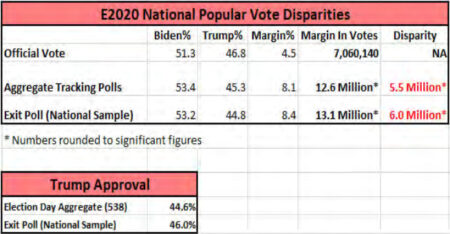
That tells us that the polls certainly did not undersample Trump supporters, nor oversample his detractors. If anything, the opposite. Such validators — measures intrinsic to the polls themselves — contradict the facile assumption that the poll samples must have been biased because they failed to agree with the votecounts.
Second-Order Comparative: A Disparity of Disparities
As noted briefly above, we go further in our efforts to make valid forensic use of polling by paying close attention to patterns in which poll-votecount disparities correlate with other factors — such as competitiveness and national significance or mode of voting or vote counting — where there is no colorable organic reason for such correlation.
We refer to such an analysis as a “second-order comparative” — which we can also call a disparity of disparities — and it is a powerful tool in statistical forensics.
Here’s an example from the 2016 presidential election:
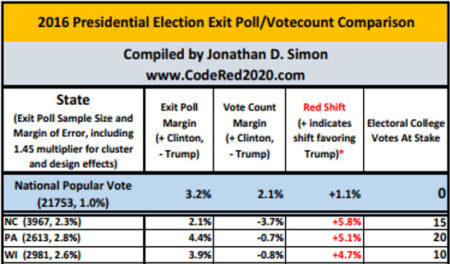
The table here shows that the performance of the nationwide exit poll (a 1.1 percent red shift) was just about at the poll’s margin of error (+/- 1.0 percent), while in the three key battleground states in Hillary Clinton’s supposed “blue wall” the red shifts (5.8 percent, 5.1 percent, and 4.7 percent) were far outside the respective states’ margins of error (2.3 percent, 2.8 percent, 2.6 percent).
This is a familiar pattern in the computerized voting era, and it begs the question: Why did the pollsters get it right in the safe states (the 1.1 percent national red shift is attributable to the higher shifts in competitive states combined with spot-on performance in the safe states) but wrong, all in the same direction, in the competitive battleground states where it mattered?
Same math, same methodologies — so what accounts for the glaringly different results? It’s harder to glibly conclude that “the polls were off” when in fact they were “on” nationwide — in venues where the presidential election was not on the line.
There are deeper nuances to consider (e.g., the forensic impact of the hour delay in the first public posting of exit poll numbers in states with two time zones, like Florida and Michigan), and such consideration can be found in CODE RED and “The Real Steal.” But I hope I’ve conveyed enough to establish for you that our work is serious, our forensic analyses conscientious and objective — utterly unlike the baseless rantings of Trump’s Stop the Steal campaign.
Just Short of Proof — But Well Past the Threshold for Alarm
We do not insist, as Trump and millions of his supporters continue to do, that hinky numbers — difficult as they are to explain as the product of benign or organic factors — prove that these elections were rigged and stolen.
What they should do is raise questions that need answers and illuminate the perils of not bothering to answer, or even ask, those questions. And they should be marshalled in support of demands for greater transparency, more public access to the hard evidence that alone can offer resolution.
We’re looking forward, not backward — but with an alarm rooted threefold in: 1) what we know about Trump’s ethics; 2) what we know about the vulnerability to interference of a poorly secured and inadequately verified computerized system; and 3) what chronic patterns of disparity and anomaly may tell us about the likelihood that such vulnerability has been exploited in the past and can be exploited in the future.
The Pollsters Hear Footsteps and Pull In Their Horns
There is one additional phenomenon to account for: the disjunction between pollsters’ forecasts for November and the consensus impression among observers all along the political spectrum regarding what’s in the cards.
Specifically, why was the nonpartisan and highly regarded Cook Political Report (CPR), as of earlier this week, forecasting a US House that will remain in GOP control if the 21 contests CPR rated as toss-ups split evenly (11–10 or 10–11) — even as Charlie Cook (CPR’s founder) himself predicts the outcome for the GOP will be “really bad” — as in a loss of 26 to 35 seats? Why are so many pollsters and handicappers, in the words of prominent analyst G. Elliott Morris, “lowballing the Democrats” in these midterms?
Put very bluntly, how does the Blue Wave (or Tsunami) that just about everyone now expects square with the Barely a Ripple results many pollsters’ and handicappers’ models are forecasting?
The historical pattern is solidly established: The president’s party, barring some spectacular wild card like 9/11, loses seats in the midterms. If the president is really unpopular, say with an approval rating below 40 percent, the losses mount — into the 30–40 House seat range. Trump’s approval is well below 40 percent; in fact, one recent poll came in at 29 percent approval (yes, it’s something of an outlier, but not by all that much). Even more salient, his Strong Disapproval number (the “haters”) has now crossed the 50 percent mark, while Strong Approval is in the teens, a huge intensity gap that correlates strongly with voter turnout.
The Democratic lead in the generic congressional ballot (“Do you plan to vote for the Democratic or Republican candidate in your district?”) is now double-digit among likely voters and definite voters, again reflecting both the intensity gap and the price GOP candidates are set to pay for Trump’s unpopularity.
Against this stands Trump’s successful mid-decade gerrymandering putsch, which was calibrated to net the Republicans about 10 House seats, though some of the expected pickups are falling into competitive status as Trump’s numbers continue to tank. And a lot of mogul money (remember Elon Musk?) available for GOP candidates in tight races. And whatever targeted voter suppression schemes the states and courts haven’t managed to put a damper on.
Still, the math is the math. And, as Charlie Cook himself concluded, just about the best-case scenario for the GOP is “really bad” — the worst case being “truly horrible.”
So why is the very outfit he founded still giving the Republicans effectively an even chance of holding the House?
To understand that, we have to go back to the 2020 election, in which CPR rated 27 House contests as toss-ups. Republicans won every single one of those “toss-ups” — 27 for 27! — as well as seven more seats rated Lean Democrat (while losing none of their Lean Republican seats).
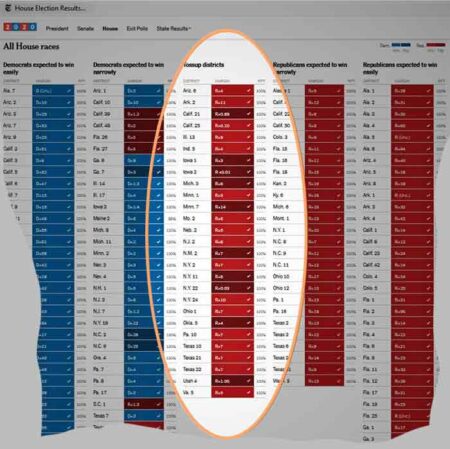
To call this an epic polling failure would be an epic understatement.
Not only were the mathematical odds astronomical, but this bizarre down-ballot GOP table-run transpired in the context of Biden’s convincing 7 million-vote (or 12–13 million if we credit the tracking and exit polls) victory. It made no sense (the most plausible “conspiracy” theory was that the intent of the unknown meddler(s) might have been to save the GOP, jettison the unpopular and problematic Trump, but spare the party the embarrassment of a 13 million-vote top-of-ballot defeat), and it sent CPR and the rest of the polling profession scurrying back to their models and sampling methodologies to figure out what they’d done so wrong.
And not for the first time. Throughout the computerized voting era, pollsters have overestimated Democratic strength, made “corrections,” and overestimated Democratic strength yet again. It’s been a consistent pattern, unidirectional and vexing for the polling profession.
Pollsters don’t stay in business by erring repeatedly and consistently in the same direction. So the response to the 2020 debacle — as it was to the 2016 polling debacle before it — was to tweak their sampling and weighting methodologies to stop “overestimating Democratic strength.” That is, to push their samples and polls to the right. That’s why Cook et al. are lowballing Democratic prospects in these midterms.
It’s understandable: They have touched the hot stove — over and over — and are very wary of doing it yet again.
It’s also deadly, as it would permit tainted election results to corrupt just about the only baseline measure remaining to challenge (or verify) more tainted election results going forward. Votecounts and polls form a closed feedback loop: If Republicans pull off a “miracle” and hold the House, CPR and all their colleagues who lowballed Democrats will come out smelling like a rose. They will have gotten a very likely stolen election “right.”
So just maybe all the red thumbs on the electoral scales have left the pollsters wondering what they keep doing wrong, when they’re not doing much of anything wrong at all.
This is worth our consideration as we move toward an election in which Donald Trump has called upon his side (voters, administrators, operatives, vendors…) to “cheat like hell.”
What We Can Do
As for what to do about all this — how to prevent it, how to guarantee that in this most pivotal of elections, this moment of crisis for country and democracy, at least the votes are counted honestly and accurately — I wish I had a good answer.
There is much that pro-voting, pro-democracy forces can defend against. The consensus recommendations are that you:
- Check your voter registration repeatedly, and update it if necessary, to ensure that you have not been purged and to correct any inaccuracies that might be used to challenge your right to vote — especially if you reside in a state or county where elections are under Republican control (there is no evidence that Democratic administrators target any voters for suppression). Especially now, in the wake of Friday’s 6–3 SCOTUS shadow docket decision allowing election officials to continue using the Department of Homeland Security’s deeply flawed SAVE (Systematic Alien Verification for Entitlements) database to purge their voting rolls — a development that some observers regarded as relatively low impact for the midterms, while others found alarming, Trump’s monstrous executive order coming in through the back door (you can probably guess where my assessment falls on that spectrum).
- The times being what they are, beware of scams like Musk’s VoteSafe.org, which, under the guise of offering assistance, hoovers up not only your voter information but just about everything else about you, for partisan exploitation.
- Secure any documents (state-issued photo ID, passport, etc.) that might be required for registration and/or voting.
- Vote early if possible, using a hand-marked paper ballot deposited in a drop box or hand-delivered to the elections office of your venue; this is preferable to both in-person voting on a BMD and relying on the Postal Service, especially if you cast your ballot within two weeks of Election Day.
- Where states or counties provide such opportunities, track your mailed or dropped ballot after casting to ensure it has been received and recorded.
- If you do vote on Election Day, be prepared for long lines (denial of service via equipment “breakdowns,” especially where BMDs are part of the vote-casting process, is its own species of voter suppression) and possible challenges or intimidation.
Some of these tasks or directives may seem onerous. Ideally, they wouldn’t be necessary. But we’re living in a reality that makes them so — if we care about what becomes of us.
There are further steps that many of us are taking that go beyond the casting of our own votes: serving as poll workers or observers, countering the forces, from ICE to MAGA vigilantes, that Trump has threatened to deploy to the polls in the best authoritarian tradition; communicating with and encouraging family, neighbors, colleagues, and friends — making voting in these midterms a communal project for all who value our democracy.
Waiting for the Shoe to Drop
Unfortunately, none of these efforts, and no ordinary vigilance, can do much of anything to protect against the mistabulation (addition, deletion, flipping) of votes in the partisan, proprietary, pitch-dark of cyberspace.
A collective decision was made long ago that public, observable vote counting — and even public, observable votecount auditing — were not worth the effort and delay they would necessitate. Yawn. Shrug.
And we’ve stuck to that decision in the face of a parade of red flags, trusting the computers to be secure against both outsiders and insiders who regard democracy as an impediment to their objectives.
In fact, with very few exceptions, the only ones who think elections can be or have been stolen electronically are MAGAs.
I think you can see how beautifully that works for Donald Trump, whose contempt for democracy and whose need to cheat are both off the charts, and who has exhorted his whole cult to do just that — “cheat like hell.”
Can he? We’ll soon find out. Some at or near the adult table have actually begun to float the possibility (at 4:07) and express concern, though it remains a high-voltage third rail.
Trump has, for this election at least, been thwarted in his attempts to rig via his SAVE Act and his frontal attacks on mail-in voting. The courts have effectively blocked his efforts to take control of the election by forcing unwilling states to surrender their voter lists and detailed information to his DOJ and DHS. ICE and/or troops at the polls, even if not just a feint, is likely to turn out to be pretty weak numerical tea as well as awful optics. States, including red states, have already begun to defend against federal forays into their domains to seize ballots and voting equipment.
Meanwhile, Trump’s imperative to stave off calamity keeps intensifying with every new development and every new poll. As his speech to the UN General Assembly this past week illustrates, he sees himself as a world-historical figure, an omnipotent dictator on the global stage, flexing the power to “annihilate … quickly.”
And yet politically, standing before the American people, he’s been on an epic losing streak, growing ever more desperate, feckless, unhinged, and unpopular. There are even some signs that the desertion among his MAGAs is edging toward a catastrophic non-linear dynamic, a cascade.
Facing this colossal convergence, with push coming inescapably to shove, he’s left with two viable alternatives to cling to the power and domination that have become essential to him, both pragmatically and psychologically: manipulate votecounts to “win” and keep his faithful supporters in control of Congress, or attempt to overtly subvert the election nullify it by attacking its disastrous (for him) results.
Far more observers fear the latter than the former, but the latter is so, well, messy, so January 6. The former is neat and tidy. A win is a win, and it beats an insurrection every day and twice on Sunday.
I doubt there’s anything we can do in advance to stop it. Warnings unheeded, we’ve managed to get to a place where election results can be challenged (by Trump) without having been rigged, and rigged (by Trump) without being challenged.
Unlike checking our registrations or voting early or using a drop box, once our vote is cast it’s committed to the tender mercies of the computers and their programmers — though overwhelming turnout would make it harder for a successful rig of the key contests to pass the stuffed-nose smell test, so for Pete’s sake VOTE!
It’s anyone’s guess whether, assuming he can — that is, assuming insider’s or hacker’s access to the computers — Donald Trump will “go there.” And whether the tech bros (who are, after all, computer guys!), with the trillions they’ve staked on an AI-friendly government, will “help” (as the account by Ashley St. Clair in Alex Gibney’s new documentary Musk suggests one may already have in 2024).
But, even with all the right-tweaked polls lowballing Democrats, the absence of a massive blue wave, if the election were held today, would be shocking.
And, barring the darkly miraculous — a “terrorist” attack, an asteroid — it’s very hard to see how it could be anything but shocking fewer than 40 days from now when November 3 rolls around.
The question is: If that is what we wake up to, will we be shocked and sad — or shocked and prepared?
Prepared to demand immediate investigation. Prepared to demand that the ballots in all close elections be hand-counted in public and that votecounts be verified all the way up the tabulation tree from precinct to certified results. Prepared to assemble and march for this. Prepared to fight.