Is SCOTUS Signalling? The Implications of Its Trump v. Illinois Realignment
The Supreme Court took its time with this “emergency” case. Was it taking stock of Trump’s descent into madness?
|
Listen To This Story
 |
I’m going to cut straight to what I think is the chase: There is reason to at least pose the question now whether the Supreme Court of the United States has finally turned a corner.
In the shadow docket case Trump v. Illinois, SCOTUS yesterday handed down a 6–3 ruling that said “No” to President Donald Trump’s federalization and deployment of the Illinois National Guard to patrol Chicago. The decision, which came to some court-watchers as a surprise, hung from a hook of statutory interpretation that easily could have gone either way.
And therein lies the point. Let me explain.
Trump, since regaining the White House, has been on a major roll when it comes to SCOTUS’s “emergency” docket (aka, shadow docket) rulings, prevailing over 80 percent of the time, very often overturning lower court decisions concerning various aspects of executive power and the president’s efforts to consolidate and expand it.
These shadow docket rulings — inherently problematic in many cases, because bare-boned when it comes to judicial reasoning and guidance — have seen SCOTUS consistently undermine deeply reasoned lower-court efforts to constrain Trump’s power grabs and thereby uphold the constitutional structure with its separation of powers and checks and balances.
While the lower courts, including those under Trump-appointed judges, have most often found the arguments put forward by the administration and its agencies to be flawed, if not outright specious, SCOTUS’s conservative majority — with the adherence of the three Trump appointees — has again and again come to the president’s rescue, staying or overturning judicial restraints.
That pattern suggested that Trump v. Illinois might follow suit, and the court would find, somewhere in Article II and the statutes pertaining, the authority Trump was claiming to federalize state National Guard units and sic them on cities that he didn’t like, such as Chicago, Los Angeles, New Orleans, or Charlotte, NC.
Decide First, Then Reason?
Without going too deep into the weeds of the case, Trump argued he had that authority to federalize and deploy the Guard because his front-line “forces” — Immigrations and Customs Enforcement (ICE) and Customs and Border Protection (CBP) — couldn’t effectively do the job of “executing the laws of the United States.”
The district court rejected that argument and the appeals court affirmed as to deployment but stayed the district court’s order regarding the broader issue of federalization. Trump appealed to SCOTUS two months ago for “emergency relief” and SCOTUS took its time in handing down yesterday’s response — a slow-walk that I think is in itself significant.
The important thing to recognize is not so much the validity of the court’s reasoning or of the arguments for either side, but the fact that the court, if it had so desired, could easily have twisted this legal braid in the opposite direction and come down on Trump’s side once again.
The case ultimately turned on the court’s interpretation of the statutory term “regular forces,” which Trump’s DOJ argued included its ICE and CBP units but briefs to the court on behalf of Illinois countered meant specifically the US military. Their argument was that Trump could federalize and deploy state National Guard units only in cases where the US military had tried and failed — a hard scenario to fathom
Now the catch: Trump had not deployed military units but had long argued that he could deploy such units because the purpose — to protect federal personnel and property — did not fall under “executing the laws” as defined by the Posse Comitatus Act, which does not permit the military to be used for that purpose without congressional authorization.
So — stay with me here, though I can barely stay with myself — Trump’s argument that he was federalizing and deploying the Guard because what he claimed were his “regular forces” (ICE and CBP) were unable to execute the laws ran afoul of his own concession that regular forces (the military, as interpreted by the court), could not be called upon for that purpose without congressional authorization, under the prohibitions of Posse Comitatus. That is, those “regular forces” could not possibly prove to be unable to execute the laws if they could not be deployed to do so in the first place.
Believe it or not, it gets even weedier. For a more thorough analysis, look here.
A Pivot, Perhaps?
But the important thing to recognize is not so much the validity of the court’s reasoning or of the arguments for either side, but the fact that the court, if it had so desired, could easily have twisted this legal braid in the opposite direction and come down on Trump’s side once again.
It didn’t. And it took two months to not do so. Two months in which, to put it in Trumpian terms, the nation has “gone through some things.”
It is, of course, possible, even likely, that Trump v. Illinois is a one-off, an outlier, signifying nothing much. And perhaps the decision will even have the, one would assume unintended, consequence of goading Trump into turning to an outright military deployment or invoking the Insurrection Act.
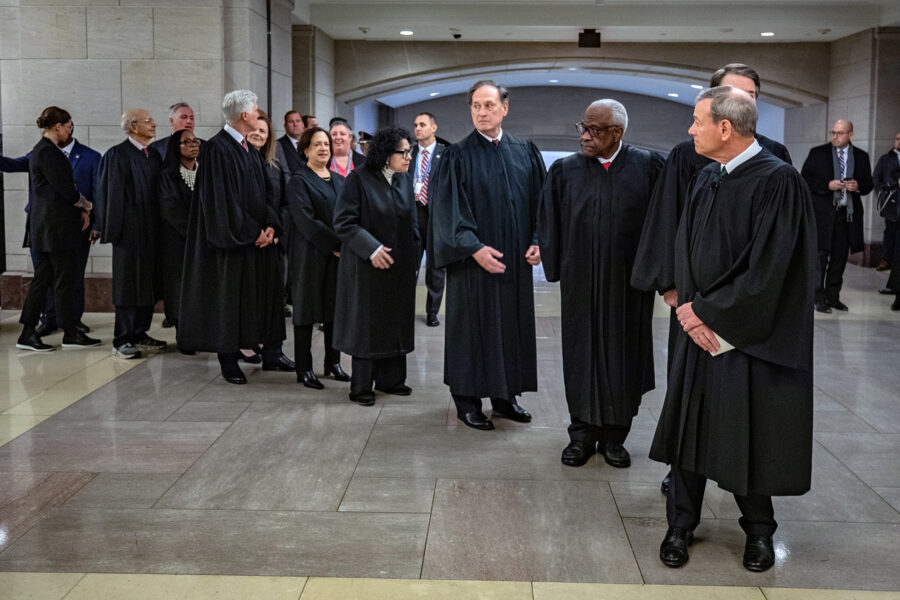
But as this horrible year limps to its ominous end, I’d like to think that SCOTUS — specifically Justices Barrett, Kavanaugh, and Roberts — is reconsidering its role as co-creator of a looming dictatorship.
The past two months, while the high court was sitting on this “emergency” case, have seen a president falling through the cracks of his own derangement — alternately falling asleep and yelling, breaking laws, slapping his name on things that don’t belong to him, rage-posting, blathering incoherently, threatening wars and annexations, calling for political executions, and dodging further exposure as a sexual predator and pedophile. None of which has proven popular. Nor have any of his “policies.”
Even SCOTUS, which famously lives in a bubble, has probably noticed. Perhaps that’s why it took its time with this case — the time needed to be sure they had gotten the picture.
Trump is the rabid dog to whom they’ve given an ever longer leash — right up to the edge of letting him run and rage entirely free. The justices have life tenure but there is historical liability to consider, while there’s still, perhaps, time to hit the “retract” button.
Could that be what Trump v. Illinois is signalling? Only time will tell.