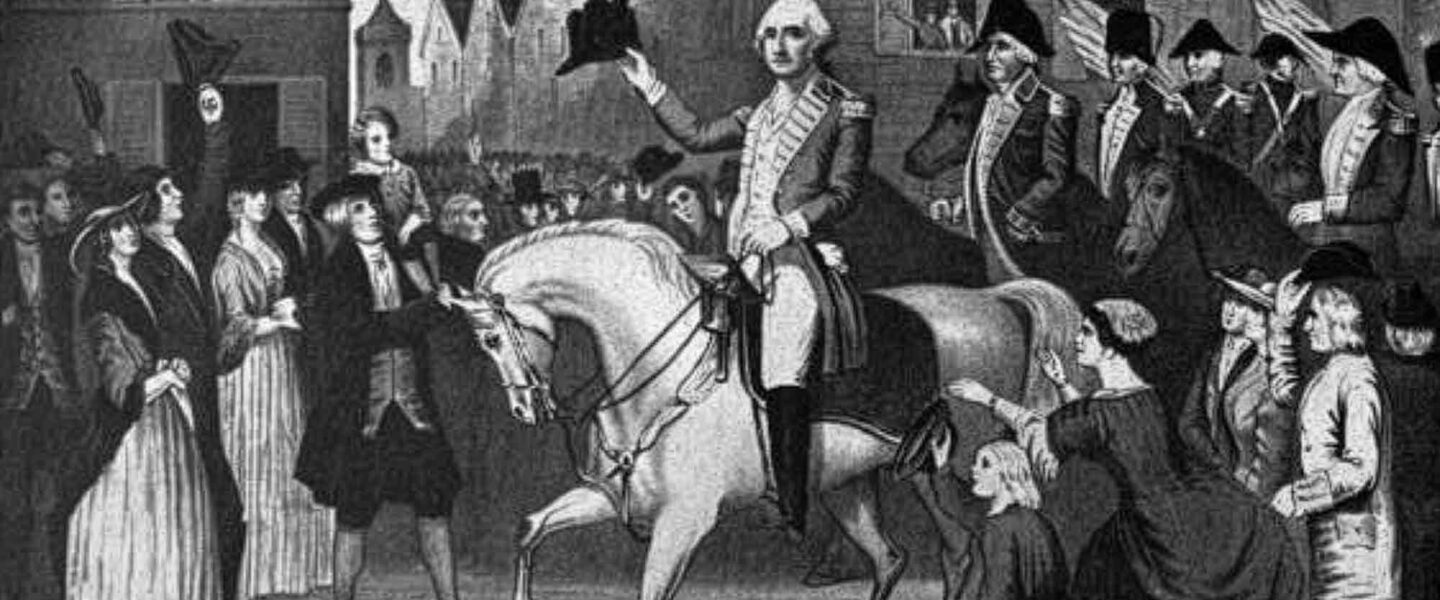
Something George Washington, faced with a comparable power dynamic, understood and acted upon.
|
Listen To This Story
 |
On this day 250 years ago, America was not winning its revolution.
After Lexington and Concord, the British Army withdrew into Boston, the most important city in British North America. What followed was a long, awkward standoff known to history as the Siege of Boston. Colonial militias ringed the city. The British held the port, the guns, the professional army, the navy, and the backing of an empire. The patriots had enthusiasm, local knowledge… and… well, enthusiasm.
When George Washington arrived to take command of the Continental Army in July 1775, after the pyrrhic British assault on Breed’s (Bunker) Hill, he understood something essential: He did not need to defeat the British Army to win American independence. He only needed to keep it from defeating him.
Washington was painfully aware of his army’s weaknesses: poor training, short enlistments, and inconsistent supplies. In letter after letter, he warned the Continental Congress against risking a catastrophic engagement.
As historian David McCullough put it, Washington’s central insight was that the revolution could not survive a decisive loss. Britain could replace an army; the colonies could not.
Washington wrote in 1776 that he wished to avoid “a general action,” not because he lacked courage, but because he understood the stakes. The British were fighting for control. The Americans were fighting for existence. Only through an understanding of this asymmetry was a winning strategy possible.
So he waited.
He dug in. He maneuvered. He bluffed. He held together an army that had no business existing.
And in March 1776, after months of stalemate, Washington quietly fortified Dorchester Heights, placing cannon marched by Henry Knox through the New England backwoods from Fort Ticonderoga above the city. The British — suddenly vulnerable, strategically stuck, and unwilling to gamble everything — folded. They evacuated Boston.
No decisive victory. No annihilation of the enemy.
Just not losing.
That lesson matters now.
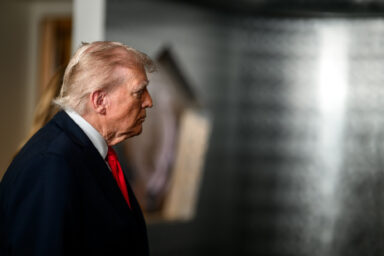
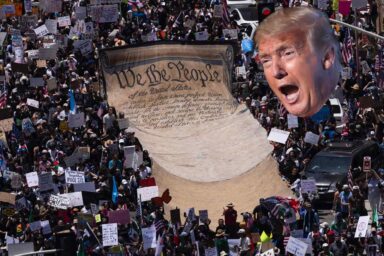
We live in a political moment where Donald Trump controls many of the levers of power: a political party, a loyal media ecosystem, a movement comfortable with institutional brinkmanship. Like the British in Boston, Trumpism holds entrenched positions. It is loud. It is armed with procedural advantages. It thrives on forcing opponents into reckless confrontations. It thrives on resentment.
But one year into Trump 2.0, we have not lost.
That fact is easy to miss because it does not feel like victory — because it isn’t. But it is a lattice.
Look carefully at the ground already held this year.
Trump’s first year has been defined less by what he has done than by what he has been stopped from doing. The worst impulses of his agenda have been dragged into the light, where they lose power. Immigration enforcement now plays out on camera: raids filmed, families interviewed, deportations traced all the way to overcrowded El Salvadoran prisons.
Trump’s garrulous cruelty against noncitizens, and his constant fantasy of its extension to citizens, have forced judges, governors, foreign governments, and even skittish allies to intervene, slow-walk, or block the worst excesses.
He rages about decisive action, but decisive action requires silence, compliance, and institutional obedience, none of which he fully has anymore.
The same pattern holds elsewhere. He has not invaded Venezuela, despite the threats and theatrics, because the military will not go along with it; bluster is not a substitute for lawful orders or strategic sense. Today’s generals were captains when the Twin Towers fell. They remember how we got beat. Getting blown up in Spanish doesn’t make you any less dead than getting blown up in Arabic.
He has stocked key posts with loud, unserious figures like Pete Hegseth, people more interested in culture-war cosplay than competence. And that incompetence has become a brake of its own.
And that’s just the tip of the iceberg. His tariff schemes, sold as strength, just caused Americans to spend more money on Christmas and walk away with fewer presents for their families. That family budget, when you throw in an increase in healthcare premiums set to hit on January 1, and heating bills in a colder than usual winter (in the era of global warming), is a time bomb set to explode in home-economics case studies, if that were a thing. When the time comes to pay off the credit card in January, well, Americans won’t be blaming “wokeness.”
In year one, the story is not that Trump has been restrained by good judgment or moral growth; it’s that institutions, exposure, and reality itself have repeatedly said no.
And for all the damage he’s tried to do, the most important fact remains: Some lines have held.
Indeed, many Republicans are beginning to imagine a future without him. You hear it in guarded statements, in donor behavior, in the sudden reappearance of words like normalcy and post-Trump. Just as British officers in Boston began to wonder whether holding the city was worth the cost, parts of the GOP are asking whether permanent Trumpism is survivable.
This is the siege phase.
Trumpism wants a decisive battle, a moment of total domination or total collapse. It wants opponents to overreach, to panic, to force a confrontation that can be framed as persecution or civilizational war. That’s all to its advantage. The oldest strongman play is to declare a big emergency and then react to it with big emergency tactics.
That will come in early July of this year when they try to force Americans into a false binary: Do you love America or not?
The counterstrategy — Washington’s strategy — is dull, unheroic, and effective: Do not lose.
Hold the line through November.
Defend institutions.
Protect elections.
Resist normalization.
Keep coalitions intact even when they are uncomfortable.
Accept that this phase is about endurance, not catharsis.
Don’t take the bait when the binary is “if you think it’s cringe to host cage fights where Lincoln slept, you’re not a real man!”
Washington did not win independence at Boston. He preserved the possibility of independence there. That was enough.
The siege taught the colonies something: Power is not always broken by force, but by patience; it can be outlasted. The British left Boston not because they were crushed, but because time, cost, and uncertainty made holding it untenable.
The same is true now.
If we keep not losing, if we refuse to hand Trumpism a decisive collapse, then time becomes our ally. Fatigue sets in. Coalitions fray. The question shifts. It’s not “How do we win everything?” It becomes “Why are we still doing this?”
Two hundred and fifty years ago, Washington understood the math. His very existence as the head of an army was the real war being fought. It was what the British Crown could not tolerate. It was his center of gravity. The existence of millions of quietly patriotic American citizens who take our democratic heritage seriously, and the interests of ourselves and our families even more so, is ours.
We just have to not lose.
As a service to our readers, we curate noteworthy stories through partnerships with outside writers and thinkers. Daniel Barkhuff, MD, is an emergency room physician and former Navy SEAL. This column has been adapted from Daniel’s Substack with the author’s permission.