The Greatest Threat to America May Be White Christian Men
Where Trump converges with the Cornell 7.
|
Listen To This Story
 |
When our secretary of “war,” Pete Hegseth, announced that he was going to subject all male servicemen over 30 to a testosterone test, apparently to identify if they were manly enough to be warriors, any right-minded person regarded it as a kind of joke.
There would be no wusses among our soldiers, or, as Hegseth later put it, “no fatties, no trannies, no beardos, no weirdos, no wimps, no radicals.” Nosiree. Not in our military.
At any other time and during any other administration, this would have been a Saturday Night Live sketch. But not at this time and not during this administration. This wasn’t a joke. This was our new America, and Hegseth’s ludicrous test, like so many of the Trump administration’s derangements, speaks not to hilarity but to something very dangerous in the national psyche.
This is what is dangerous. The Trumpsters want to make America even more masculine than it already is, but there is a very thin line, perhaps an invisible one, between masculinity and toxic masculinity.
Obviously, masculinity is already deep in the culture, a feature of American individualism or what some have called the “cowboy ethos.” Women serve. Men do. Our old iconic movie stars are strong and silent. Our heroes must possess physical prowess, to wit, our superheroes; Clark Kent morphs into Superman, Bruce Wayne into Batman, Peter Parker into Spider-Man, so that normalcy must always be balanced with aggression. We typically measure courage not in moral terms but in terms of strength. We like tough guys. We love muscles more than brains.
But not quite as much as we used to. The culture has changed over the past 50 years. Feminism vested new powers in women, not because men wanted to give power to them (as if), but because women demanded it. Many men, though hardly a majority, embraced a more feminine side of themselves. The civil rights movement engendered a growing tolerance for those outside white male hegemony. The gay rights movement helped redefine gender identities. America became softer — and I mean that in the very best sense. We grew morally better.
And therein lies a problem. The evolution of men from hunters to nurturers was a long time coming, but it was not necessarily a welcome evolution, certainly not among the men who regarded their power as a birthright. For them, this was a devolution. For them, a changing culture that empowered women and minorities had disempowered them. And we are only now fully discovering how serious this seething resentment has been and how terrible the repercussions of it are.
But Republicans knew. Republicans generally and Trump specifically understood that a large segment of men harbored not only a sense of anger but also of revenge over how the culture had changed, and Trump and his Republican enablers have played to a deep sense of emasculation among American men, especially white men, and even more especially among white Christian men, the latter apparently because they believed this greater tolerance was a violation of their interpretation of the Bible. I guess they think Jesus was a man’s man.
Though white men have always ruled the world and do so now, though they have always gotten the perks, though they have always subjugated women and minorities, though they gloat over their superiority to every other manner of being, Trump understood that they have been aggrieved lately, very aggrieved that this antediluvian vision of theirs has been under attack and that their inferiors no longer respect white Christian male dominance, which is why white Christian men reserve their greatest animosity for liberals, whom they hold responsible for turning their world upside down.
Trump promised many things when he rose to power, but this was a significant one: He would restore the old order. He would put women and minorities back where they belonged, and he would vanquish the liberals who had changed the order. He would bring back the patriarchy, as two supporters of his, the noxious Tate brothers, proudly announced.
All it would take is a fascist dictator to turn back the clock and destroy the progress the country had made.
One can only assume that it is their antipathy to America’s cultural trajectory, an antipathy that Trump has done everything in his power to enflame, that binds those white men to him and to the Republicans.
And nothing seemingly can unbind them.
How important the cultural dissatisfactions of white Christian men has been to our politics and to Trump’s popularity has largely been scanted by the legacy press. They much prefer to discuss economic disaffections because it is more digestible than saying that one of the two largest cohorts in the nation — men, much less white men — may be furious at the other cohort — women — and that they are eager to do something about it.
The legacy media don’t want to say that these white Christian men are nostalgic for the good old days, even though many of them and their would-be Republican saviors are now emboldened to say so. Various Republican officeholders have told us that women shouldn’t have the vote; that the days of slavery weren’t so bad; that every technological advance has been the product of white men.
And the media certainly don’t want to say — can’t say — that many white men are pathetic, self-pitying, self-serving, malicious, and, as I said, dangerous. They don’t want to say that there is a very large group of unregenerate men in the country that is smoldering with hostility, and that it has a president who shares their hostility.
They don’t want to say it, but it is indisputable. White men support Donald Trump. They support him overwhelmingly, giving him roughly 60 percent of their votes in all three of his presidential races. This would, of course, constitute a landslide if only white men voted, but if only white men voted, this would no longer be a democracy. It would be closer to Nazi Germany where the physical also outweighed the moral.
There would be no Trump presidency, no MAGA, were it not for white men. And though there is no breakout for white Christian men in the polling, Trump received anywhere from 75 percent to 80 percent of the white male evangelical vote and roughly 60 percent of Protestant, non-evangelical voters, which gives you some sense of how even more in thrall these allegedly godly men are to Trump and his vision. If you are looking for America’s moral cancer, you need look no further.
It bears repeating that this devotion to Trump isn’t about economics, no matter what the pundits would have you believe, because not all white men are affected by economics equally, and yet they vote, more or less, in unison.
Even now, with the economy tortured by rising inflation, stagnant wages, astronomical mortgage rates, and tariffs, of all things, when you might think white men might have abandoned him — and, to be honest, a chunk have — men in recent polling still approve of Trump more highly than women do by a significant margin — 10 points in one poll — though there is no break out of white men specifically, where the margin is likely to be significantly greater.
As we face the possibility of a blue tsunami in the midterm elections, 44 percent of white men in a new Pew poll said they would vote for the Republican candidate for congress, the economy be damned, and only 37 percent for the Democrat. By comparison, among white women the numbers were 47 percent for a Democrat, 31 percent for a Republican.
The only real explanation for this kind of fealty to a clearly failing presidency as well as for the division between men and women is that culture for a good many white men still matters more than economics, even when they are suffering from Trump’s incompetence, and while I do believe that there is a tipping point where economic pain begins to outweigh cultural dissatisfactions, white men — and presumably even more, white Christian men — have yet to reach that point.
One can only assume that it is their antipathy to America’s cultural trajectory, an antipathy that Trump has done everything in his power to enflame, that binds those white men to him and to the Republicans.
And nothing seemingly can unbind them.
*
But this is not the case for all white men, just a very large but self-selected portion of white men. That was New York Times guest columnist Thomas Edsall’s point in a recent essay entitled, “The Gender Gap Has Taken a Strange Turn.” As Edsall put it, the emphasis on the gender gap between women’s voting behavior and men’s has been misplaced. The real gap is intragender, which is to say within the male gender. In Edsall’s words, “Men — specifically white men — who see themselves as extremely masculine tend to support President Trump, while those who are weaker in their assessment of their masculinity — or in how they think about masculinity — are far less likely to support Trump. The gap between the two is just as significant if not more significant than the gender gap.”
Edsall goes on to cite a study that finds the intragender gap, that is, the gap between the hypermasculine men (overwhelmingly Republican) and the less hypermasculine ones (overwhelmingly Democratic), is four times as large as the gender gap.
While I would argue with how Edsall frames the issue — he makes it seem as if there are masculine men and effeminate ones — I wouldn’t argue with the conclusion. The framing, however, matters. There is nothing particularly novel in the idea that men, again especially white men, sort themselves by hypermasculinity and a softer form of masculinity. But, given our cultural proclivities, this makes it seem as if one group, the macho group, is to be celebrated, and the other group, the group of tender mercies, is to be chided, while I would argue just the opposite. In fact, I would argue the first group has masculinity issues while the latter is secure in its masculinity.
But Edsall’s is exactly how Republicans have been sorting men since at least the end of World War II. Republicans engaged in whispering campaigns against 1952 and 1956 Democratic presidential candidate Adlai Stevenson, a man of great intelligence and eloquence, as a homosexual, Joe McCarthy wielded the homosexual cudgel against assorted Democrats, his homosexual Roy Cohn notwithstanding, and there was an underground murmur in right-wing circles that Barack Obama was gay, since brilliance and heterosexuality apparently are mutually exclusive among conservatives.
Republicans are still trying the same trick against Texas Democratic senatorial candidate James Talarico. When they call him a vegan or mock him as “Tela-freako,” the subtext is scarcely hidden. Republicans are real men. Democrats are girlish (and gay).
The difference between the previous iterations of attempts to feminize Democrats and this current one is that what was once a whispering campaign is now a shouting campaign in which Republicans have no compunction about openly attacking Democratic sexuality. And the difference is that even as Republicans are trying to define Democrats as weak and sissified, they are amping up their own alleged masculinity — not only amping it up but turning it into policy, which has put not just the nation but the entire world at risk. We are at the mercy of a kind of masculine “roid” rage.
How much of Trump’s vaunted tariffs had nothing whatsoever to do with revenues, as Trump said, but with Trump’s desire to demonstrate his manhood to our allies and his much-beloved fellow dictators? How much is his savage treatment of undocumented immigrants, including the murders of Renee Good, Alex Pretti, and others, a way to flex his muscles and triumph over individuals who opposed him — liberal individuals?
How much are his attacks on fishing boats in the Caribbean yet another performance of his machismo? How much is the Iran War a gleeful attempt — now, not-so-gleeful — to show how this tough guy could bully another country and kill its leaders? We all know Trump is cruel. But how much of his cruelty is tied to his sexual insecurities?
This is what strong-man dictators do. This is what strong-man dictators have always done. They like to show off their strength because, one suspects, they are so insecure about their own masculinity, and no man may be more insecure than our doddering, balding, flabby, overweight president. And so, one might say, the entire American government has become basically compensation to soothe his self-doubts about his manhood.
*
But the dimensions of this toxic masculinity go well beyond politics. It wasn’t Trump’s policies that won him his white Christian male adherents. I seriously doubt they cared about what he did or didn’t do in the policy arena. It was his pose of manliness that won them, and his bragging about his manliness that gave them vicarious chills. (This is a man, after all, who began his debate performances in 2015 by talking about the size of his penis.)
When the now-famous Access Hollywood tape was first revealed near the end of the 2016 campaign, pundits leapt to the conclusion that it was disqualifying for Trump, that it was an electoral fatality, that no one would possibly stand for their potential president saying he could grab women’s genitals and his adding that they liked it because, after all, he was Donald Trump. Just imagine any other candidate, certainly any Democratic candidate, saying something like that.
But the pundits and political strategists were wrong — very wrong. The tape wasn’t disqualifying to white males, and even those hypocritical evangelicals who are oh-so-pious. It was certifying.
It certified that Trump was just as disrespectful of women as they were, just as misogynistic. It certified that he thought about women exactly as they did — as something to be grabbed and molested for male satisfaction. It turned out, I think, to be an advantage for him — maybe even his greatest political advantage at the time, more even than his racism, which also appealed to white men.
(The last Democratic presidential candidate to win the white male vote, Bill Clinton, was, I believe, similarly rewarded by men who admired his womanizing. He wasn’t some wimp. He was one of them.) Trump appealed to them not only as a white supremacist. But as the white male supremacist par excellence.
And this is where Donald Trump not only shapes the new masculine culture that he had promised and that Project 2025 had envisioned; this is where he converges with the seven fraternity louts at Cornell University who have been accused of throwing themselves upon a drunken young co-ed and raping her for seven hours. (You can read the details elsewhere.)
But in this case, at this time, there was something beyond the casual shrug — something uglier, something that seemed to endorse what happened, not just “boys will be boys,” but “boys have the obligation to be boys,” that “not raping the girl would have been an injury to manhood,” that raping the girl was a retribution against the indignities that men had suffered.
It may seem as if Trump and the frat boys have nothing whatsoever to do with one another, as if they inhabit different worlds. Donald Trump obviously didn’t cause their behavior. But I think he helped lay the groundwork for it. He provided and purveyed an attitude that encouraged it and even justified it — justified it every time he leered at an attractive woman at his rallies and then said he couldn’t say she was beautiful because he would get in trouble for treating a woman as if she were nothing but her looks, justified it every time he demeaned a woman.
I am not saying that what happened at Cornell should be particularly surprising. When I was in college many, many, many years ago, those of us who were politically engaged regarded frat boys as the campus idiots — the guys who drank and smoked weed and caroused and acted as if they were god’s gift to women. There was an attitude about them. When Trump dismissed the Access Hollywood tape, he summoned that locker-room, frat boy attitude, by calling his remarks “locker-room talk,” meaning he was just boasting, just doing what guys do, which was really no exculpation at all, but an indictment.
Anyone who has ever been in a male locker room has heard a lot of that kind of talk. Men love to brag about their sexual conquests, and I always had the feeling that the conquests were an excuse for the bragging. Acting as if women were useful accessories to male dominance was a way of racking up points with the bros. It made small men seem big. Fraternities are really locker rooms writ large. The entire frat culture is predicated on being a lout, on using women, scoring points, and boasting about it. They exist for that.
But if what happened at Cornell when those seven louts descended on that inebriated woman wasn’t anything new, the ambience around it was newish because while frat culture hadn’t changed much over the years, the culture surrounding it had.
We know that the alleged culprits — whether or not they are eventually adjudged as rapists — were treated rather gently by Cornell. The university’s president has even apologized for handling them so gently. We know that they were treated gently by law enforcement.
The local attorney determined that the evidence was too thin to prosecute and that Jane Doe, the unnamed victim, had consented to the “gang bang,” as it was called, even though she had told police she had been raped. The case disappeared, or it would have disappeared if Jane Doe hadn’t resurrected it and brought suit against the perpetrators, the university, the fraternity, her own sorority and the bar that served her before she went to the fraternity, even though she was underage.
In the old days, a case like this would have also disappeared on the pretext that boys will be boys, and women need to be cautious, and any woman who put herself in that kind of situation probably got what she deserved. (According to Helen Lewis in The Atlantic, one of the assailants, who had been a “friend” of the victim, later claimed that he was the one who was raped — and by Jane Doe.)
But in this case, at this time, there was something beyond the casual shrug — something uglier, something that seemed to endorse what happened, not just “boys will be boys,” but “boys have the obligation to be boys,” that “not raping the girl would have been an injury to manhood,” that raping the girl was a retribution against the indignities that men had suffered.
The toxic masculinity that had been permeating the country, the toxic masculinity that had not just excused this kind of behavior but elevated it and had turned it into privilege, as Trump said on the Access Hollywood tape, had floated from Washington, DC, and come to rest at a fraternity party on the Cornell campus.
“Shop still open?” one of the louts texted that night as Jane Doe was being raped. The Washington Post’s Monica Hesse called those the most chilling words in the case, and I think she is right. Others texted, “Free p—y in the house,” and “Like you can walk in and whip it out.”
As Hesse put it, “‘Shop’ brings to mind an assembly line, or the fast checkout lane, not a human interaction. It implies that your interest is less in having sex with a person than walking in and whipping it out. Taking turns with several of your buddies.”
That night the louts high-fived one another. Jane Doe herself put it simply: “I was a sex doll for all intents and purposes, which is sad.” Not incidentally, that was exactly how Trump talked about women in the Access Hollywood tape.
In her Atlantic essay on the Cornell case, Lewis cited forensic psychologist Mackenzie Lambine that “sexual elements within juvenile group offending are often ‘coincidental’ — secondary to the need for the group to exercise power over the victim, exert male dominance and develop relationship bonds.”
That is what I meant when I said sexual assault among these louts is an excuse to exult with their buddies. What Trump has done with his promotion of masculinity cum misogyny is stretch those bonds from the frat house to the entire white male cohort of the nation. He was their permission structure — their house father. He became the frat-boy-in-chief.
And if rape was now a permissible form of masculine dominance, there is this newish element too. The louts not only enjoyed their toxic masculinity; there were also many of those on the right who did too. The Global Project Against Hate and Extremism reported a surge of online misogyny after the rape report: “If Jane Doe [were] raped by an illegal immigrant, they wouldn’t care.”
Ben Shapiro, co-founder of The Daily Wire, posted on X, “Jane Doe engaged in promiscuous and disgusting sexual behaviour…and then changed her story to allege rape.”
Matt Walsh, who has a show on The Daily Wire, claimed without evidence that the alleged assault was “fully consensual” and Jane Doe only regretted the incident because it was “immoral and degrading.” Walsh also said that Jane Doe is feeling “guilt, not trauma,” and should “repent of her sins.”
Far-right livestreamer Zack Hoyt (“Asmongold”) said “I think she was obviously a slut” and “this is what women do.”
The reliably reprehensible Megyn Kelly told her podcast audience that Jane Doe was “not the most attractive gal,” that she was “extremely beefy in like, her arms and her legs,” and that she was “probably thrilled to be so admired because she clearly didn’t grow up the incredibly beautiful one.” (It is not even clear she had the right woman.)
And Donald Trump weighed in with sympathy — for the frat boys — by attacking New York Attorney General Letitia James, who was charged with investigating the case, and saying, “They” — meaning the louts — “won’t get a fair shake.”
Again, people on the right might have always felt this way toward any woman who accuses a man of rape, but they would have been less public about it, more guarded in a world in which morality still operated. Now they are liberated. Now they express their misogyny openly. Now morality on the right has vanished.
*
This is one time, then, where Donald Trump delivered on his promise. Comedian Shane Gillis appeared on Saturday Night Live and bemoaned that women at gyms dressed like “whores.” On SNL! Louisiana State University football coach Lane Kiffin recently had the visitors’ locker-room painted pink, presumably on the basis that it would sap the opponents’ testosterone.
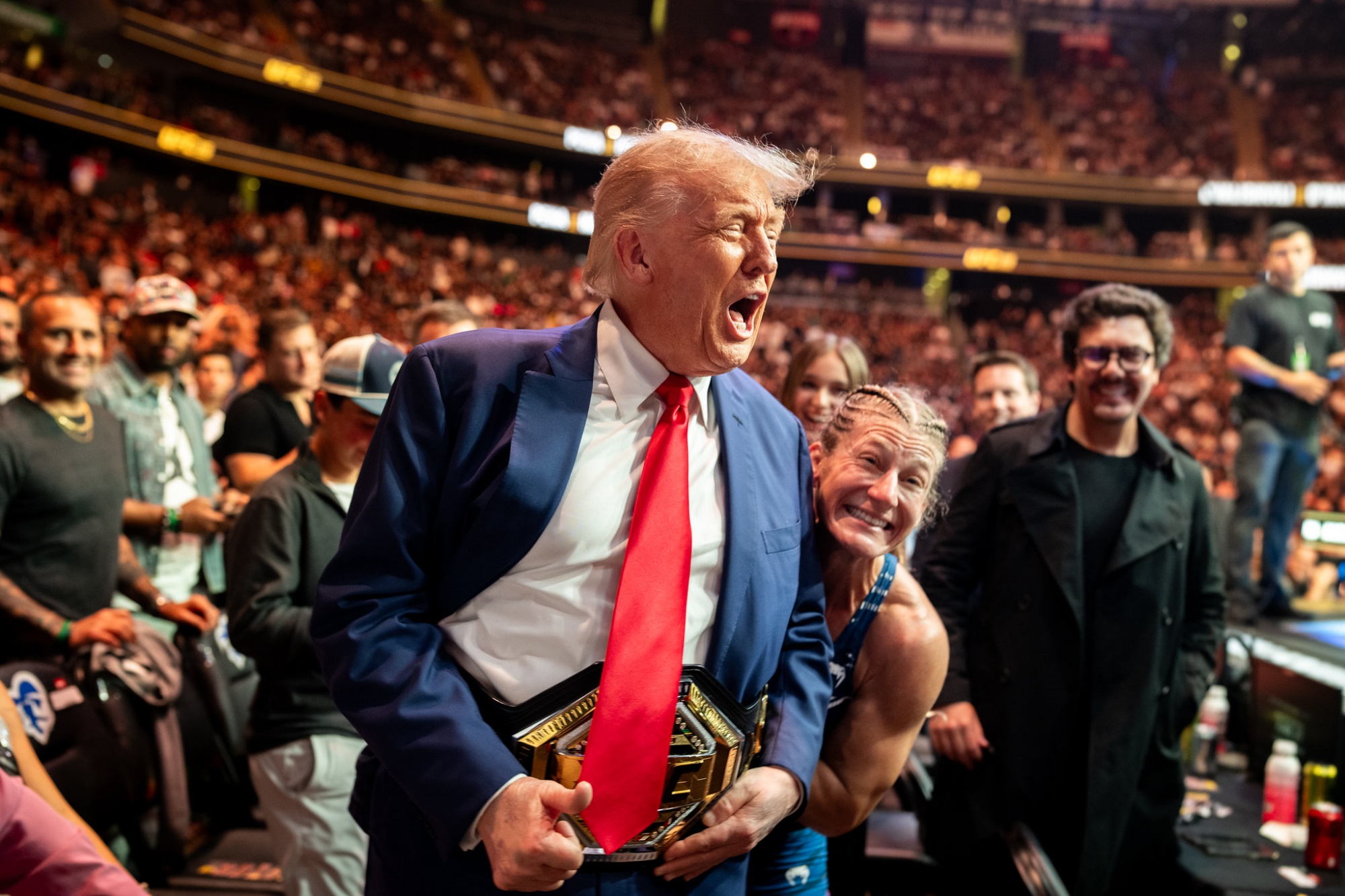
America celebrated its 250th anniversary with a UFC martial arts event where the object is for two men to beat the hell out of one another, a sport dripping with testosterone, and now the UFC has a contract with the FBI to train its agents.
Women are getting cashiered out of the armed services. The state and the society have gone to war against transgender individuals. The Tate brothers, about whom I wrote several weeks ago, are heroes on the manosphere, not despite of accusations of rape and mistreatment of women but, one presumes, because of them, and the manosphere itself, where Trump has been lauded as a savior, is a vast universe of women hate. And rapists are getting cheers.
Finally, there is this. In Edsall’s piece, he describes a study of gender that lists so-called feminine attributes: “being affectionate, compassionate, gentle, sympathetic, understanding, warm, sensitive to others, tender” — which are, the study says, not only attributes that one associates with the feminine but with Democrats, and values, I believe, that we Americans should do everything in our power to promote. And yet these are the very values that are disparaged by the masculinity assault — the values Trump and Hegseth and their white Christian male gang abhor, the values that they believe make America “soft.” So it is morality, once again, that is at stake — morality that is really under assault.
How do we restore those values, I ask here repeatedly? How do we quarantine toxic masculinity? How, when so many subscribe to it? How, when so many think this is the way America ought to be — a white supremacist nation dominated by men? How, when one of our two political parties thrives on this poison, encourages misogyny, longs for a bygone era that we thought had disappeared forever? How do we make America not more masculine but more compassionate, empathetic, and kind?
Please remember: Tomorrow, October 17, is “No Kings Day.” Be there!
Adapted, with permission, from Neal Gabler’s substack, Farewell, America.