How Close Is the US to a National Popular Vote?
Americans want their presidents to be elected by all of them and not just voters in a few swing states. Activists are feeling optimistic about making that happen.
|
Listen To This Story
 |
For its 240-years, the United States has relied on the Electoral College, rather than the popular vote, to elect its presidents. For just as long, there have been those who have disagreed with this approach because they think the candidate with the most votes nationally should win.
Today, activists believe they have found a way to circumvent how the Electoral College currently works. And they say the country is closer than ever to changing how it elects the president.
The workaround they put their faith in is called the National Popular Vote Interstate Compact.
According to the National Center for Interstate Compacts, interstate compacts are “formal, legally binding agreements” that a state can join by “enacting the same statutory language, ensuring consistency across all member states.”
For example, all 50 states are members of the Emergency Management Assistance Compact, which helps coordinate aid and resource allocation among states in times of crisis. Compacts are enforced through compact commissions, to which each member state usually appoints one or more delegates.
If enacted, the National Popular Vote Interstate Compact would do away with the “winner-takes-all” approach that most states currently use in determining for which candidate electors are pledged to vote. Instead, the electors of each participating state would be bound to vote for the candidate who wins the most votes nationally. Once enacted, member states could not back out of the compact if, say, they did not like the result of an election.
The activists behind the effort say this way of electing presidents is fully consistent with the language of the Constitution.
“What a state does with their electors is up to that state, and when enough states choose to have a national popular vote for president, through a sovereign vote of their legislature, we’re gonna have one,” said Patrick Rosenstiel, a senior consultant for the nonprofit group National Popular Vote.
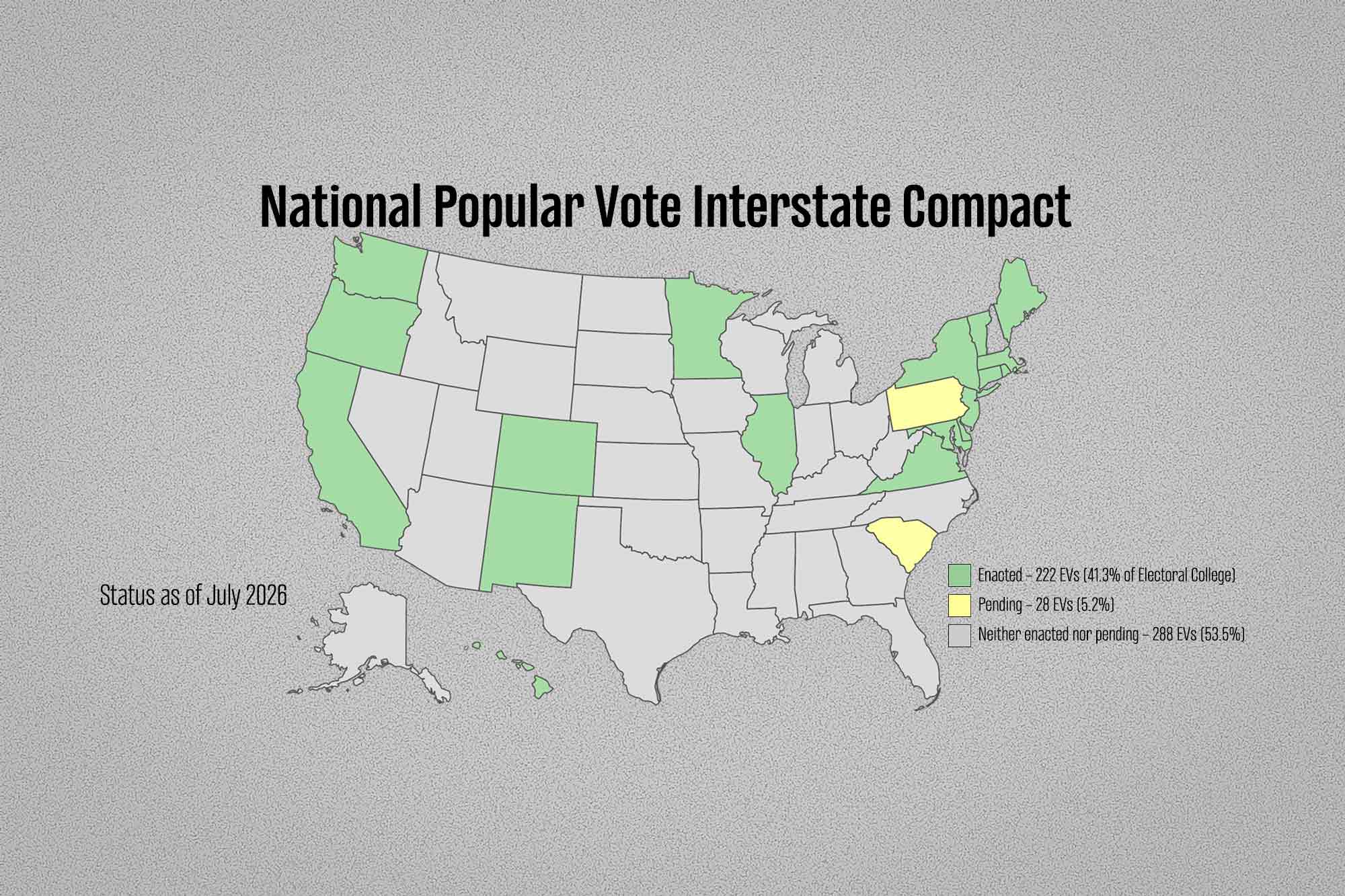
So far, 18 states and the District of Columbia, accounting for 222 Electoral College votes, have signed on, and the activists of National Popular Vote believe that they can get enough others to join to reach the threshold of 270 — perhaps even ahead of the 2028 election.
One of the reasons they believe momentum is on their side is that recent elections have exposed serious flaws in the Electoral College. Two of the past four presidents — George W. Bush and Donald Trump — were first elected even though they lost the popular vote.
But the problems go even deeper than that. Presidential campaigns now almost entirely focus on a handful of swing states since the outcome in all others is not in doubt. That essentially makes any votes cast in most of the country irrelevant.
The only exceptions are Nebraska and Maine, which apportion their Electoral College votes based on which presidential candidate gets a majority in each of their congressional districts. However, in each of these states, only one of those districts is competitive.
“The impetus for creating the National Popular Vote is that the current system leaves three out of four voters and three out of four states on the political sideline,” Rosenstiel said. “It basically delivers … hair-splitting lawsuits and battleground states where judges are more likely to pick a president than any American voters.”
The numbers back him up.
Ahead of the 2024 Election, nearly 90 percent of Trump’s and then-Vice President Kamala Harris’s campaign events between July 21 and November 4 were held in the seven swing states: Arizona, Georgia, Michigan, North Carolina, Nevada, Pennsylvania, and Wisconsin.
With few exceptions, candidates only venture outside those states for major fundraising events.
What this means is that only swing states benefit from the billions of dollars the campaigns spend — not to mention the even greater promises of future federal funding and investment — and only their residents decide who will become president.
The National Popular Vote Interstate Compact would immediately change that and give every American an equal say in who should lead the country.
“It won’t matter what precinct you live in, it won’t matter what state that precinct’s in; if you believe that you should have a voice in electing the president of the United States, your voice will be valued every bit as much as anybody else,” Rosenstiel said. “Right now, you’re totally ignored.”
Rosenstiel added that he believes that a national popular vote would increase voter participation.
“What voters will feel is empowered. What voters will feel is involved,” he said. “What you’ll see is a massive uptick in voter participation in presidential elections, because right now, turnout in battleground states — the states that matter — is 11 points higher on average in presidential elections than in flyover states.”
Once again, the majority of voters support this change.
Nearly two-thirds of Americans are on board with moving away from how the Electoral College has worked until now and towards supporting a national popular vote.
State Rep. Carrie Rheingans (D-MI) first ran for office in 2022 and campaigned on having Michigan join the National Popular Vote Interstate Compact. The Wolverine State is one of 32 states that is yet to join the compact.
“I remember my very first presidential campaign when I voted in the year 2000 … and I remember just being shocked that somebody could not win the most number of votes, but still be named president,” Rheingans said.
That year, Bush was elected president despite having 500,000 fewer votes nationally than then-Vice President Al Gore.
In 2016, Trump won the Electoral College by 304 to 227 even though Hillary Clinton received nearly 2.9 million more votes.
Perhaps that explains why it is primarily blue states that have joined the compact. However, with Democrats hoping to make big gains across the country in the midterms, activists like Rosenstiel believe more states could soon join and surpass the critical mass.
He pointed to the swing states of Arizona, Michigan, Nevada, Pennsylvania, and Wisconsin as potential candidates. While Democrats serve as governors in four of them, their party doesn’t have (full) control of the respective legislature. In Nevada, it is the other way around.
Even though all of them benefit from the current system, Rosenstiel said that battleground state status can be fleeting, and that they may one day also find themselves being ignored.
Furthermore, he is optimistic that swing state lawmakers will be motivated by altruistic factors.
“I think it’s [state] legislators who are the ones who have to decide whether or not they’re going to support the National Popular Vote Interstate Compact, because nobody cares what a congressperson thinks about this, right? It’s all up to the individual state legislatures to determine,” Rosenstiel said.
“They want to have meaningful campaigns at the local level where they can share their message with voters,” he added.
Meanwhile, Rheingans believes enacting the compact will also change the way PACs and super PACs finance election campaigns.
“I will say right now, the way that our electoral system works to elect the president, there are only a few states where billionaires can pour in their money,” Rheingans said. “If we have the National Popular Vote Interstate Compact enacted, then every presidential candidate will need to earn votes in every state … and we would make sure that those billionaires, they have to spread out their money that they’re spending.”
Given how the National Popular Vote Interstate Compact would drastically change the way the Electoral College has worked from the country’s inception, this reform may sound like a pipedream. However, Rosenstiel stressed that this is not the case.
“We’re not a political science project or a theory, we’re an active political movement,” he said. “If everybody who supports a national popular vote gets on board, I’m confident that we can get this done for the 2028 presidential election.”