Election 2026: How Little We Know
Hard to know what to make of an election where an honest result would be a shocking result.
|
Listen To This Story
 |
I’ve taken some heat of late for not just coming out and stating the “fact” that the midterms will be rigged, and specifically that the rig will include outcome-altering votecount manipulation.
The gist of the critique is that my own work, as well as that of trusted colleagues, has, over the past 25 years, established that US elections can be and have been rigged for the benefit of various Republican candidates, from Georgia’s Saxby Chambliss (in 2002, when the votecounts nationwide were so far to the right of the exit polls that the polls were never released to the public) to George W. Bush to Donald Trump.
One critic cited the sworn testimony in 2004 of then-software developer (more recently Shasta County, CA, election official) Clint Curtis before a US House committee, to the effect that he had been engaged by then-Speaker of the Florida House Tom Feeney to create a program to “control the vote” in South Florida. In the eyes of this particular commenter, that alone settled the matter.
I am more accustomed to responding to those who dismiss my work, and that of my election forensics colleagues, as not worth taking seriously. Who attribute the pervasive “red shift” to 25 years of (suddenly) bad polling. Who don’t want to invest the time and energy to review analyses designed to control for and rule out such benign or organic explanations for the steady stream of unidirectional anomalies and disparities.
It’s never been easy to know for sure just what the curious, and often enough bizarre, patterns were saying, what the spreadsheets filled with red (for red shift) numbers meant. Even for myself, let alone for public pronouncement.
Now I feel compelled, in the face of criticism and skepticism from both sides, to revisit the question and try my best to clarify and defend my agnosticism regarding our electoral and vote-counting processes, particularly as it pertains to the election now 10 days away.
Electoral High Anxiety
This is not the first election whose run-up has included some measure of concern, and even skepticism, about its processes. Lou Dobbs aired a segment, “Democracy at Risk,” a few days before the 2006 election, centered on the question “Will your vote be counted?” Donald Trump wouldn’t agree to accept the results of the 2016 election unless “I win.” And election integrity advocates have raised questions before just about every election in the computerized voting era.
But the level and pitch of concern has never before approached what we’re witnessing now.
Mainstream politicians and mainstream media have sounded alarms regarding the Trump regime’s plans to keep Congress in Republican control by subverting the election in a host of ways — ranging from voter roll purges, voter intimidation, and other means of targeted voter suppression, to manipulation of votecounts, to postelection schemes to nullify Democratic victories.
Democratic supporters are rather desperately urging their voters to vote in numbers vast enough to overcome Trump’s rig, as well as advising them on how to cast their votes so that they have the best chance of being counted.
None of this is normal preelection politics. The whole country is on edge — not just over the outcome of this highest-stakes election, but over how it will be conducted and what, if any, recourse there will be if and when it goes off the rails in one way or another.
It is understandable that some would leap to the conclusion that Election 2026 will be rigged, that votes will be counted inaccurately and dishonestly, and that we will wake up on November 4 to an absolutely shocking, gobsmacking result that the pundits will immediately start tying themselves in illogical knots to explain.
And indeed that scenario cannot and must not be dismissed.
Looking Ourselves in the Empirical and Epistemological Eye
But I believe it is of vital importance to distinguish between what we know and what we suspect or fear. Because our credibility as analysts, advocates, and journalists hangs on that distinction.
There are numbers, facts, assumptions, inferences, speculations, deductions, and conclusions. All play a role in our attempt to depict and predict reality. The lines between them aren’t always bright, but great care is called for in not letting them just glom together, even in the service of a noble cause.
So what do we know about votecount manipulation and what do we know about Trump’s attack on Election 2026?
- We know that there’s a long history of unexpected numerical disparities between polls and votecounts, dating back to 2002 when the Help America Vote Act rapidly accelerated the computerization of US elections.
- We know that these disparities are not the product of chance or “glitches” because those disparities would break roughly evenly in both directions and the ones we’ve documented break virtually exclusively in one direction. We’ve termed it the “red shift” because the disparities are consistently in favor of Republican candidates.
- We know that the disparities have strongly correlated with both the competitiveness and national significance of the contests, indicative of a targeting pattern with national balance of power as the goal.
- We know that most of our voting equipment — including touchscreen voting computers (Direct Recording Electronic, or DRE), ballot marking devices (BMD), optical scanners (OS), and county tabulators — have been demonstrated to be vulnerable to exploits by insiders and hackers alike.
- We know that AI now provides powerful new tools for hacking systems.
- We know that certain key individuals involved with the design, programming, or investigation of computerized voting in the US have met untimely and suspicious ends.
- We know that the “adult table” has been highly allergic to pursuing the serious investigations that these disquieting patterns warrant, and the “hard” evidence — voter-marked ballots, OS memory cards, computer code — has proven off-limits to inspection.
We actually know a lot more than that, but I can see eyes glazing out there. The bottom line is that there’s way more than enough evidence — things we know — to bring a prima facie case that the vote recording and counting processes in US elections are suspect and deserve both intense scrutiny and substantive reform.
But that is different from declaring that Election 2026 will be electronically rigged.
A Sampling of Spoors
Yes, Clint Curtis testified under oath that in 2000 he was commissioned to write local vote-flipping code (Curtis also passed a lie detector test shortly after providing that testimony). But there’s quite a distance between what Curtis swore he was asked to do by the then-speaker of the Florida House in 2000 and what we can authoritatively say will happen nationwide in 2026.
Then there was Mike Connell, known informally as Karl Rove’s “IT guru.” Connell, whose GovTech servers, in Chattanooga, TN, were set up to “process” much of Ohio’s vote — was subpoenaed in a case challenging the results of the 2004 presidential election in Ohio.
The decisive state in 2004, as you may recall, was Ohio — whose secretary of state and chief elections officer, Ken Blackwell, happened to be the honorary chairman of the Bush campaign.
Ohio was also the state that headquartered Diebold, whose equipment recorded and counted Ohio’s votes, and whose chairman, Wally O’Dell, was a Bush campaign-fundraising “Ranger” who had written to prospective donors that Diebold’s mission was “helping Ohio deliver its electoral votes” to Bush.
The case dragged on, as Connell, with the guidance of Rove’s legal team, refused to testify or produce the relevant documents. Eventually, in early December 2008, Connell was obliged to sit for a closed and sealed deposition in the case.
The court notified Connell that it would require him to return for additional questioning in January. I was tracking the case closely, including the claim from the lead attorney that Connell felt “threatened by” Rove and felt that his life might be in danger. I emailed a colleague, less than half in jest, “The poor guy [Connell] will never see Christmas.”
Connell’s plane went down on December 19.
Bad weather? Mechanical failure? Sabotage? The official investigation was unorthodox, as recounted by Cybergate author Simon Worrall. The circumstances were suggestive. But sometimes a cigar is just a cigar, right?
There have been an awful lot of “cigars” in the computerized voting era — numbers, patterns, statements, bodies. What does it all add up to? What does it signify? What is actually happening behind the electoral curtain? That remains, maddeningly, something of a mystery.
Stop the Steal, and MAGA Election Denial
Most of the people who now think they’ve solved that mystery turn out to be MAGAs, following Trump’s Stop the Steal battle cry. People like Mike Lindell and Tina Peters (and yes, Clint Curtis). People who don’t trust the vote-counting process but are secure in their belief that it is rigged — against Trump.
One can readily understand the distrust. It is all but impossible to monitor or guard against computerized votecount manipulation. It’s gotten harder since Trump oddly gutted the EAC and CISA, the two federal agencies tasked, respectively, with upholding standards for our voting equipment and protecting it from cyberfraud.
No “observers” can observe what’s happening on an OS memory card or any other vote-tallying computer. Thus, the only mode of detection/deterrence is the woefully inadequate audit process or — as Peters has called for — seizing ballots and equipment and comparing hand counts to machine counts.
In one sense, I’d welcome such an exploit. Except that I doubt that Peters and MAGA would show much interest in “verifying” contests narrowly won by the GOP. They took no issue, for example, with Trump’s win in 2024.
Some MAGA “election deniers” — or “election integrity advocates,” depending on who’s doing the naming — including Peters, have called for the elimination of the computerized equipment and a return to hand-marked, hand-counted paper ballots, which seems to be as big a nonstarter now as when my colleagues and I were advocating that reform 20 years ago.
That’s just the way it is: There’s an indelible track record. Trump and MAGA have shown themselves, without variation, to be about outcome, not process; power, not principle. To the best of my knowledge, none of them has ever questioned a single Republican victory.
They have shown zero interest in any analyses demonstrating a red shift, whether in 2020 or any other election. And they have produced no reliable evidence to support their own wild claims — whether of hordes of illegal voters stealing elections or of electronic rigging for the benefit of any Democratic candidates.
We share a profound distrust, but it is difficult, verging on impossible, to imagine working together on ferreting out the truth in a frenzied postelection firestorm.
Ten Days and Counting: The Storm Before the Storm
Turning back to what we know, it is manifest that Trump & Co. are approaching this election ready to do just about anything to get the results they want, the win that Trump sees as imperative.
They are purging in the states where they can purge.
They are moving on states, like California, that endeavor to protect the voting rights of all their eligible voters.
They were even knocking on doors of potential voters they loosely suspect are not eligible, until a federal judge said no.
They have had discussions about seizing ballots and equipment. Before gutting CISA, Team Trump tried to task the agency with secretly acquiring and hacking a voting machine, without notifying the manufacturer or state officials about any vulnerabilities found. If you’re thinking there’s no benign explanation for that play, you’re right. Career CISA staff, evidently smelling a particularly malodorous rat, are reported to have successfully resisted Trump’s demand.
They have attempted to throttle mail-in voting.
The US attorney general, Todd Blanche, has refused to rule out federal interference in state-controlled election and postelection processes, and in fact just yesterday, at Trump’s command, brought suit to override Alaska’s highest court and block certification of the state’s election for US Senate, if the Republican candidate loses.
Confident Kamikaze
Just as ominously, the political behavior of MAGA, from Trump on down, does not suggest a plan to face the voters in anything approaching a straight-up electoral evaluation.
The president, fully aware of his unpopularity, has insisted on making the election about him, a referendum on both his failing policies and his increasingly pathetic shtick. He has doubled and tripled down on crazy, on lawlessness and defiance, on cruelty, on corruption, and on just plain ugliness. A president on a mission to torpedo his party’s prospects would have a hard time outdoing Trump’s antics — and it just keeps getting worse.
Which brings us to the latest indication that Election 2026 is off-key: the Acton ad.
The ad, run by Amy Acton’s Republican opponent for the Ohio governorship, Vivek Ramaswamy, is so low, so despicable, so just plain wrong — it features Acton’s long-estranged mother calling her a liar with reference to Acton’s own well-documented ongoing abuse and rape, at age 12, by the mother’s second husband — that the only sane political reaction to it would be unequivocal condemnation.
Not Vice President and former Ohio Sen. JD Vance. And not President Donald Trump.
Vance expressed “disgust” — not with the ad or Ramaswamy, but with the Republicans who found the ad disgusting. They should be focused, in Vance’s view, on winning elections, not critiquing moral abominations.
As for Trump, of course he took to Truth Social (every time I say or type those two words, I lose a few billion brain cells) for a long post not just defending the repulsive ad as “very powerful” and “hitting paydirt,” but savaging as “weak” Ohio’s GOP governor, Mike DeWine, and the other Republicans who publicly criticized the ad or Ramaswamy. Trump has continued, in public appearances, to gush.
This is not subtle. This is not just the liberal or the Democrat in me clutching pearls. This is as close as I can get to an objective analysis of political irrationality bordering on insanity. The Cook Political Report (CPR) just moved the race into the Democrats’ column, “Lean D” — not far enough, in my opinion. If Ramaswamy wins in the wake of this, it will be for one of two reasons: Our elections are electronically rigged or this country, as represented by long-time “bellwether” state of Ohio, is terminally ill.
“How Little We Know”
So why are Donald Trump and some other Republicans behaving as if the fix is in — for their side? Can we infer from their behavior that we’re all in for a massive shock on November 3?
This is where I part ways from those who are sure, who say we have enough to know Election 2026 will be rigged. Anxious, yes. Suspicious, yes. Aware of the long parade of unidirectional “red shift” anomalies, absolutely. But certain? No.
At the same time I’d caution anyone who, still believing in the 2 + 2 = 4 of honest elections, has concluded it’s in the bag for the Democrats.
You might look at the nonpartisan CPR race ratings for the House — where Cook just shifted 19 more contests toward the Democrats — and see that, to maintain their House majority, the GOP would, if the election were held today, have to win all 17 races rated “Toss Up” and pick off three rated “Lean D” while losing none of their own “Lean R” seats.
You’d look at that scenario and say, “No way! I told you it’s in the bag!”
I’d then ask you to have a look at Election 2020, won by Joe Biden with a margin of 7 million votes (while both tracking and exit polls predicted a margin of over 12 million). Cook rated 27 House contests Toss Up.
The GOP won all 27. In that Democratic year. They also picked off seven Lean D while not losing a single Lean R.
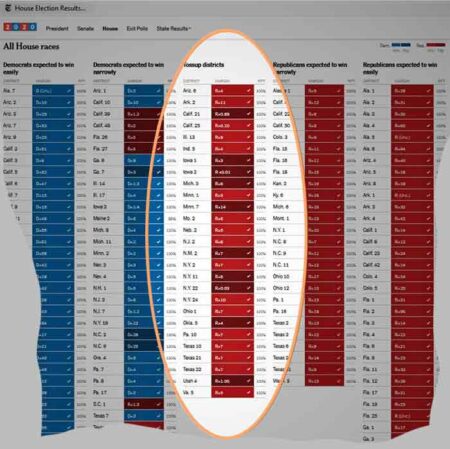
(center column shows predicted toss-ups; red fill = Republican) / NYTimes.com.
Well, the polls sure were “off” that year, weren’t they? Could they be “off” again? Could all of the serial rightward methodological tweaking the pollsters have engaged in throughout the computerized voting era be for naught? Are we in for yet another November surprise?
I wish I could tell you.
I have asserted that computerized election theft is worse than martial law or any of the other out-in-the-open postelection gambits that some defenders of democracy are gaming out. It’s not easy to detect, especially in the tight postelection, precertification time frame. And, if detected, then what?
The pressure to accept results and “move forward” is immense — as even Trump discovered in 2020. With Trump in office and all his apparatus — legal, media, military — geared up to crush any potential Stop the Steal from the left, even overwhelming evidence of fraud, difficult as that is to obtain, would likely not be enough to, well, stop the steal.
The fundamental problem is not that we know computerized rigging will occur — much less where or by whom — but rather that the current process is incapable of satisfactorily validating its results and legitimacy.
For you, for me, for Tina Peters, for Clint Curtis — for anyone who demands to know.
Yes, it’s frustrating that our best and most conscientious work is generally greeted with a yawn, shrug, and eyeroll from the adult table. It feels like you have to scream FRAUD from the rooftops to simply get anyone’s attention.
But I have learned how self-defeating it is to claim proof or certainty without evidence sufficient to the claim. We focus on statistical anomalies and patterns precisely because the hard evidence is withheld. Trump and his “Stop the Steal” skip the serious analysis and make baseless claims: millions of illegal voters, a long-dead Hugo Chavez vicariously manipulating votecounts.
In effect, Trump took our work and our genuine concern for the integrity and legitimacy of our elections and weaponized the concept while completely ignoring the numbers. Their logic, their mantra: Elections are honest when we win. Do we really want to join them? And what do we get out of insisting it will over it might be? Or even it was over it might have been?
Saying we need to be prepared for rigging — and drawing attention to all the arrows that point in that direction — is not the same as claiming we know what we don’t know but only suspect or fear.
We really don’t know, we cannot know, what’s going to go down.
The best we can do, I think, is turn out in droves, vote smartly (i.e., vote early if mailing, use drop boxes where feasible, track our ballots), and be prepared to mobilize massively and immediately if there is a shocking result and a statistical stench.