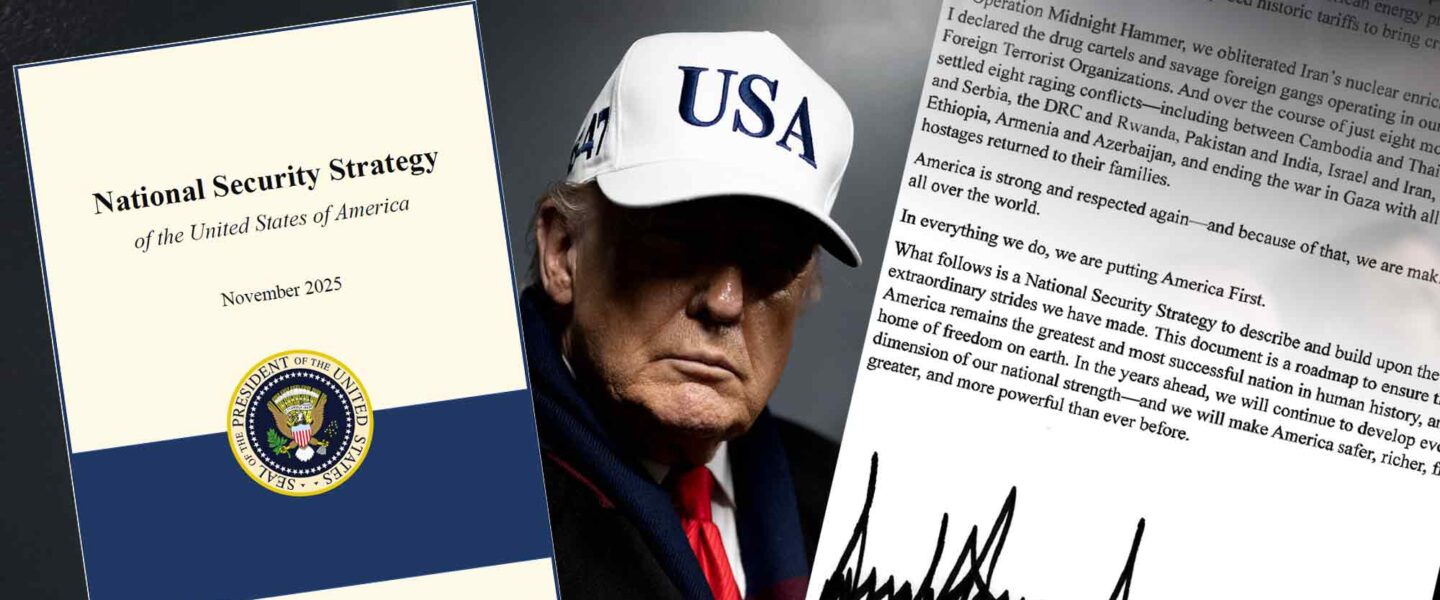
The strategy seemingly ignores active threats to the US and instead seeks to redefine what it means to be an American.
|
Listen To This Story
 |
The Trump administration created a sensation when it launched its 29-page National Security Strategy in November. Unfortunately, it’s probably safe to say that few people bothered to read the actual document. That is a mistake.
More than a simple description of security threats against America, the so-called strategy relies on a helter-skelter assembly of meaningless political slogans to promote a radically new direction for America and, more importantly, it seeks to redefine what it means to be an American.
If the alt-right were to draft its own version of the Communist Manifesto, this would be it. The newspaper Le Monde, France’s equivalent of The New York Times, described the White House release as a final divorce separating the United States from Western Europe. Le Monde could just as easily have called it a separation from Western civilization.
As for genuine threats to the United States, there is practically no mention of Russia’s nuclear capabilities, the recent addition of hypersonic missiles to the Kremlin’s arsenal, or Vladimir Putin’s efforts to build an empire on the remains of the former Soviet Union. Putin’s obsession with launching ballistic missiles and bomb-carrying drones against women and children in Ukraine also received short shrift.
The “strategy” glides just as easily over Xi Jinping’s human rights violations in Hong Kong and against Uyghurs, not to mention Tibetans. And it all but ignores Xi’s dreams of establishing himself as an emperor for life, while China quietly nibbles away at the rest of the planet.
In fact, the strategy seems to happily accept the notion of dividing the world into mutually cooperative totalitarian regimes. It’s as if there were an unspoken agreement that China gets to control Asia, and Russia gets to ride roughshod over Europe, while the US is left in peace to do as it pleases in North and South America.
The National Security Strategy hints at exclusion. But that approach defies simple logic. If you do not want to be surrounded by people who are unable to fend for themselves, the best solution is to invest in education and culture.
The far more serious threats to America, the document proclaims, are diversity, equity, and inclusion initiatives (DEI); global migration; and America’s loss of sovereignty resulting from its participation in international organizations, as well as its pre-Trump insistence on human rights and international law.
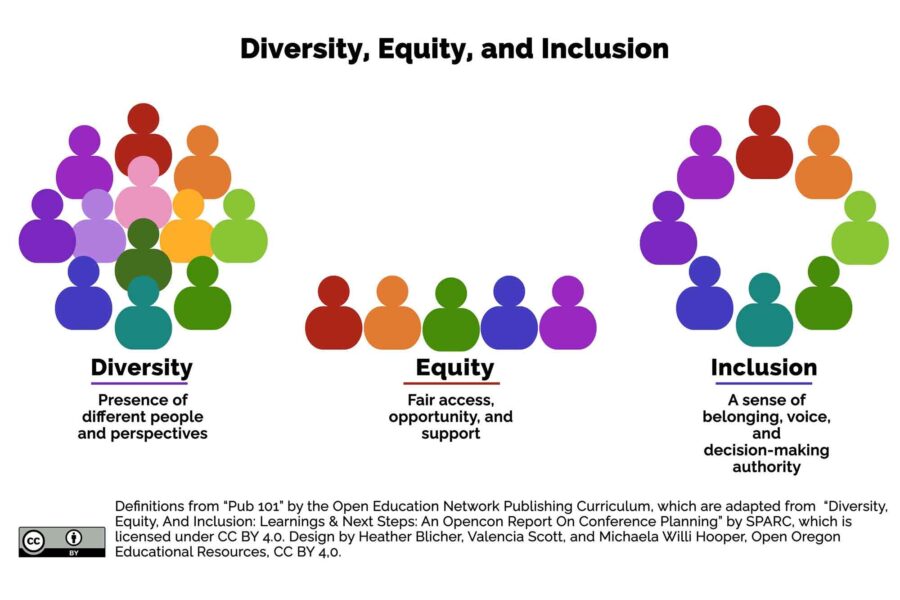
DEI is, in fact, one of the document’s most prominent targets — dismissed as an excuse for incompetence. Although the acronym drily copies the famous French slogan “liberty, equality, and fraternity,” the three elements generally considered most important in any democracy, what the Trump administration really objects to is what used to be called “affirmative action” — the principle that a special effort needed to be made to make up for more than a century of violence, racism, and discrimination that followed the Civil War and imposed a near permanent state of poverty on a sizeable chunk of America’s population. Any corrections to mistakes of the past, the document suggests, are now over.
Healing the aftereffects of slavery, America’s original sin, has been a lingering problem ever since the Civil War ended. The Trump administration’s solution has been to simply eliminate an embarrassing historical period by ridiculing it as “woke” and then erasing any mention of DEI from federal records and communications. The National Security Strategy document does its part to pound yet another nail in DEI’s coffin.
The next bugaboo is immigration. The strategy argues that Europe risks being erased by foreigners and that the worldwide movement of people in general needs to be stopped. It doesn’t explain how that will be accomplished, nor does it mention the fact that Europe spent a century dispatching its excess population to colonial possessions.
Whether one likes it or not, demographic projections make it clear that the majority of America’s population will be people of color by 2045. Those born here can either be included in the American system as full-fledged citizens, as the US Constitution commands, or excluded and rendered permanently impoverished.
The National Security Strategy hints at exclusion. But that approach defies simple logic. If you do not want to be surrounded by people who are unable to fend for themselves, the best solution is to invest in education and culture.
People are defined by what they think — not the color of their skin. Two-thirds of the tech workers in Silicon Valley are foreign-born. Forty-five percent of the tech startups in the San Francisco Bay Area were launched by foreign-born CEOs. Mustafa Suleyman, who currently heads Microsoft’s AI, is a prime example. Suleyman emigrated from Syria to Britain and then to Palo Alto, CA. His father was a taxi driver in Damascus. Suleyman is a key figure defining the future of AI.
The National Security Strategy finds that Europe is particularly threatened by its efforts to adapt to a globalized economy. The strategy’s authors warn that Europe’s GDP declined from 25 percent of the world’s wealth in 1990 to 14 percent today. They argue:
The larger issue facing Europe includes activities of the European Union and other transnational bodies that undermine political liberty and sovereignty, migration policies that are transforming the continent and creating strife, censorship of free speech and suppression of political opposition, cratering birth rates, and loss of national identities and self-confidence.
The authors apparently failed to grasp that the European Union was formed largely because individual European countries found it impossible to compete with the size of the US market as long as they remained individual nation-states divided from one another by petty grievances. By combining their economic force, they were able to transform themselves into a market that included more than 450 million people, represented 5.5 percent of the global population, and eventually became a significant influence on manufacturing standards for much of the rest of the world.
Another point that the authors missed is that much of the global turbulence since the 1950s and 1960s has been a result of dramatic collapses of colonialism around the globe. The abrupt departure of European colonial overlords turned the former colonies into suddenly independent countries that had to struggle in order to define their own national character, while establishing an economic footing that was viable in a highly competitive global marketplace.

Once lumped together as the Third World, these countries soon transitioned into “emerging markets.” Today, it’s safe to say that many of these countries — notably Singapore, South Korea, Vietnam, and Thailand — have already emerged. In the wake of Donald Trump’s tariffs, Brazil and Argentina have stepped in to replace American farmers providing soybeans. China once needed the production of American farmers. It doesn’t anymore. The wealthiest countries are still wealthy, but as the rest of the world comes online, their wealth is no longer as extraordinary as it once was.
A perceived loss of sovereignty to international institutions is another of the strategy’s complaints. What it fails to mention is that nearly all of these international institutions were, in fact, created and shaped by the United States. Even more important, the 80 years they have been in existence represent one of the longest periods in recorded history without a violent conflict between the world’s major powers.
These institutions may need to be adapted to a changing world. For instance, France and Britain are permanent members of the UN Security Council, but Italy, Spain, and Germany are not. India, Brazil, and Argentina have considerable economic heft, not to mention Singapore and South Korea, but they are still on the sidelines when it comes to the decision-making structures embedded in many of these original institutions.
Reform is needed, but it seems foolish to throw the baby out with the bathwater. The last thing that the world needs at this point in time is to return to a world that lacks a mechanism for discussion or creating a productive vehicle for international coordination.
The Trump administration is deeply concerned about uncontrolled immigration, but that immigration is driven mostly by economic imbalances and inefficient management of the planet’s resources. The only way to eliminate the pressure caused by uncontrolled immigration is through international development.
No one wants to leave their home if they don’t have to. The answer is to provide an alternative, and that requires international cooperation, which means thinking through these problems on a global rather than a purely nationalistic basis.
Looked at closely, this latest National Security Strategy tries to provide a roadmap for the future, yet instead of promoting a new age in which everyone can prosper, it appears to advocate a return to white supremacy, xenophobic nationalism, and the right of the wealthy to hold on to their riches at a cost to nearly everyone else.
There is always the risk that international aid can create dependency, but modern development strategies are acutely aware of that danger and have found ways around it. To be effective, development needs to be carefully thought out, and that requires maintaining a dialogue through international institutions.
Probably the strategy’s most glaring omission is its failure to mention climate change. Much of the rest of the world sees the accelerated increase in climate disasters as an existential threat — in other words, a threat to the future existence of the human race. It’s one thing to note that the human population has doubled since 1980. It’s another to consider what will happen if, like Americans, people worldwide decide that two cars are really necessary to have a comfortable life.
These problems cannot be resolved in isolation, and they are increasingly serious. In 2023, NOAA, the National Ocean and Atmospheric Agency, recorded 28 major climate disasters in the US — the most in history. The cost to US taxpayers was $93 billion. We can expect both disasters and their cost to continue to increase steadily unless something is done.
Where the Roadmap Leads
Looked at closely, this latest National Security Strategy tries to provide a roadmap for the future, yet instead of promoting a new age in which everyone can prosper, it appears to advocate a return to white supremacy, xenophobic nationalism, and the right of the wealthy to hold on to their riches at a cost to nearly everyone else. What we have here is a zero-sum transactional equation based on the principle that your gain is my loss.
Many of the ideas expressed harken back to the isolationist thinking of the 1930s, and even earlier to the “Know Nothing” Party of the 1850s. That movement, as virulent as today’s MAGA crowd, opposed the massive immigration of Catholics (“Papists”) from Ireland. Back then, the Irish were desperately seeking relief from mass starvation caused by a water-borne mold that destroyed Ireland’s potato crop, the main sustenance for the country’s poor, who had been reduced to tenant farming largely because they were under British rule.

The strategy’s rhetoric bears an even closer resemblance to the “America First” movement of the 1930s. Although the America Firsters argued that the US should mind its own business and not allow itself to become involved in trying to stop Hitler or the elimination of European Jews and other minorities, it was also at least partly motivated by a discreet admiration for the imagined efficiency of European fascism.
In Italy, propaganda established the belief that Mussolini made the trains run on time. Hitler also smashed established institutions, advocated making “Germany strong again,” and opposed what he saw as deviant behavior by homosexuals, free thinkers, Bohemians, and modern artists who produced work that he considered frivolous.
Much like conservatives on today’s US Supreme Court, supporters of a fascist new world order favored a “unitary executive” that could cut through public debate and make quick decisions that lead to a well-defined course of action. Very “efficient” — if we naively assume a benevolent and public-spirited executive.
The America First movement attracted a number of well-respected American luminaries, including Charles Lindbergh, who had achieved hero status by managing the first nonstop flight across the Atlantic. Lindbergh became a leading isolationist and found Germany’s dynamism and direction under Hitler to be “thrilling.” Lindbergh never praised Hitler directly in public, but as with Trump’s bromance with Vladimir Putin, and the current National Security Strategy, Lindbergh and his wife found more to criticize in Hitler’s opponents than in the Führer himself.
An even more blunt supporter of the “unitary executive” was William Dudley Pelley, who founded the pro-isolation “Silver Legion” in 1933, recommended scrapping the US presidency altogether and installing a dictator, to be known as “the Chief.” While Hitler dressed his militia in brown shirts, and Mussolini put his in black shirts, Pelley had his followers wear silver shirts. He made a third-party run for president in 1936 but lost to FDR.
The isolationists’ major error was to believe that the world’s two major oceans were sufficient to protect the US from outside influences. The surprise attack against Pearl Harbor proved just how wrong they were. Japanese Imperial Army troops captured roughly 12,000 American prisoners of war in the Philippines and slaughtered others in what came to be known as the Bataan Death March. Lt. Gen. Jonathan Wainright, the highest-ranking American prisoner of war, said the “crime” of Pearl Harbor was the US being unprepared.
A “unitary executive” — or, to call it what it is, a dictatorship — might be fine when a strong leader is in charge and acting to the full stretch of their abilities, but when the “strong man” is really only a mask for an unidentified group of followers seeking power for themselves, the results can easily turn catastrophic.
It’s clear that whoever drafted the current National Security Strategy document has had little experience either in the military or international diplomacy, and that raises a serious question about who actually wrote it.
Trump appears ready to engage the US in 19th-century gunboat diplomacy with Venezuela, far from the isolationist tendencies of the National Security Strategy. While the strategy does reflect some of Trump’s core values — anti-Europe, anti-DEI, pro-Russia, etc. — one suspects that Stephen Miller, Trump’s current deputy chief of staff for policy, and Russell Vought, who heads the Office of Management and Budget, may have played a significant role in the paper’s drafting.
That raises the question of who is really running the White House these days? Trump, who is reaching the end of his biological tether and reportedly has reduced his working hours to the half day from noon to 5 p.m., may simply have dropped out altogether, leaving the nation’s future direction in the hands of his unelected staff. It has happened before. A stroke left President Woodrow Wilson incapacitated during the last 18 months of his presidency. The end of the Biden presidency was similarly left in the hands of a group of insiders when the president, only four years Trump’s senior, aged rapidly before the public eye.
The Romans invented the concept of a “dictator” — in effect, a unitary executive who could serve a limited term of six months of absolute power, in order to lead the state in a time of emergency.
The most famous, Cincinnatus, assumed the position twice to defend Rome, and twice returned to being an ordinary citizen. When Julius Caesar challenged a Roman Senate that had become as supine as today’s Republican Congress, he effectively declared himself dictator for life. In fact, his life was not that long. He was eventually assassinated by conspirators in the Senate that had originally yielded to his power.
But the Roman Republic was lost forever. It’s a cautionary note well worth remembering.