What If the America We Think We Live in Never Existed?
We’re not one nation split by politics — we’re 11 regional cultures that have been at war since the colonies. And now the divisions are life and death.
What if the America we think we know has never actually existed?
The divisions tearing us apart aren’t new — they’re four centuries old, rooted in the very founding of this country. And now there’s data proving it.
On this week’s WhoWhatWhy podcast, we are joined by Colin Woodard, a bestselling author, George Polk Award winner, and director of the Nationhood Lab at Salve Regina University. His new book, Nations Apart: How Clashing Regional Cultures Shattered America, presents evidence that reframes everything we thought we understood about American identity.
We’re not one nation split by politics — we’re 11 distinct regional cultures that have been in conflict since the colonial era. For example, the Puritans of New England brought one vision of freedom. The Cavaliers of Virginia brought another. The Scots-Irish borderlanders, the Spanish colonizers moving north — each arrived with fundamentally different ideas about what government should do and who deserves to be called American.
These aren’t just historical curiosities. During COVID-19, some regions had death rates four times higher than others — not because of genetics or health care access, but because of cultural choices — anti-vaxxers, anti-maskers — rooted in settlement patterns from 300 years ago. Life expectancy varies by five years depending on which version of America you’re living in.
Gun violence, health outcomes, even how we respond to crises — it all tracks back to who your ancestors were and where they settled.
Yet Woodard’s research at the Nationhood Lab has also uncovered something that cuts against everything we’re seeing on the surface. And it might be the key to whether this whole experiment of American democracy survives.
 Apple Podcasts
 Google Podcasts
 RSS
RSS
Full Text Transcript:
(As a service to our readers, we provide transcripts with our podcasts. We try to ensure that these transcripts do not include errors. However, due to a constraint of resources, we are not always able to proofread them as closely as we would like and hope that you will excuse any errors that slipped through.)
Jeff Schechtman: Welcome to the WhoWhatWhy podcast. I’m your host, Jeff Schechtman. We’re living through what feels like America’s nervous breakdown. We can’t agree on basic facts. We can’t even agree on whether we should agree on basic facts. Every election feels existential. Every policy debate becomes a culture war. Every crisis, from pandemics to hurricanes to school shootings, seems to drive us further apart instead of bringing us together. And the question we keep asking ourselves is, how did we get here? When did we become so tribal, so polarized, so unable to find common ground?
But my guest today, Colin Woodard, would tell you that we’re asking the wrong questions. Because the truth is, we’ve always been here. These fault lines aren’t new. They’re as old as the colonies themselves. We’ve never been one nation with one story. We’ve been 11 separate nations, each with its own definition of freedom, its own vision of the good society, its own understanding of what America is supposed to be. And right now, those visions are in direct conflict in ways they haven’t been since the 1860s.
Here’s what makes this urgent. We’re not just arguing about politics anymore. The divisions are literally determining who lives and who dies. During COVID, some regions lost people at four times the rate of others, not because of genetics or random chance, but because of cultural choices rooted in settlement patterns from 300 years ago. Life expectancy differs by five years depending on which version of America you live in. Gun violence, health outcomes, education, it all tracks back to whether you’re part of the country that was founded by Puritans or Cavaliers, Quakers or Borderlanders.
And yet when you actually ask Americans what they believe we’re supposed to stand for, 97 percent agree. Ninety-seven percent say we’re bound together by a covenant to protect each other’s rights. So we have this paradox. We’re more divided than ever on the surface, but nearly unanimous on the ideas beneath. Which raises the question, can we find our way back to that common ground before the whole thing comes apart?
Colin Woodard has been mapping these divisions for 15 years. He’s a New York Times best-selling author and historian whose previous book, American Nation, changed how we understand this country’s origins. He’s also the director of the Nationhood Lab at Regina University, where he and his research team have published nearly 30 peer-reviewed studies documenting these regional differences in everything from voting patterns to life expectancy. His new book takes us from the colonial era to the present moment, showing us not just how we got here, but whether there’s a path forward.
It is my pleasure to welcome Colin Woodard back to this program to talk about Nations Apart: How Clashing Regional Cultures Shattered America. Colin, thanks so much for joining us here on the WhoWhatWhy podcast.
Colin Woodard: It’s such a pleasure to be back, Jeff. Thanks for having me on again.
Jeff: Well, it is great to talk to you once again. Before we dig into this, I want to talk a little bit about really what the core thesis of this is, the idea that America has never been a unified nation state, but this kind of awkward federation of 11 regional cultures. Talk about that idea first.
Colin: Yeah, you summarized it very well. It goes back to American Nations, which came out in 2011; and the central observation — which makes it much easier to understand American history and our current political cleavages and our constitutional arrangements, and much else besides — is that we were never one country, but this awkward federation of these, the legacies of rival colonial projects, different colonial projects that didn’t think that they were gonna end up in a continent-spanning federation together.
The Puritans in New England, and the lesser sons of the great English country manor families, and the Scots-Irish, and Lowland Scots moving into the back country, and certainly the Spanish Empire moving south to north into what’s now the Southwest of the United States, and so on: None of these different colonial projects thought they would end up in a country together, and yet they did by an accident of history. And the repercussions of that have been with us since.
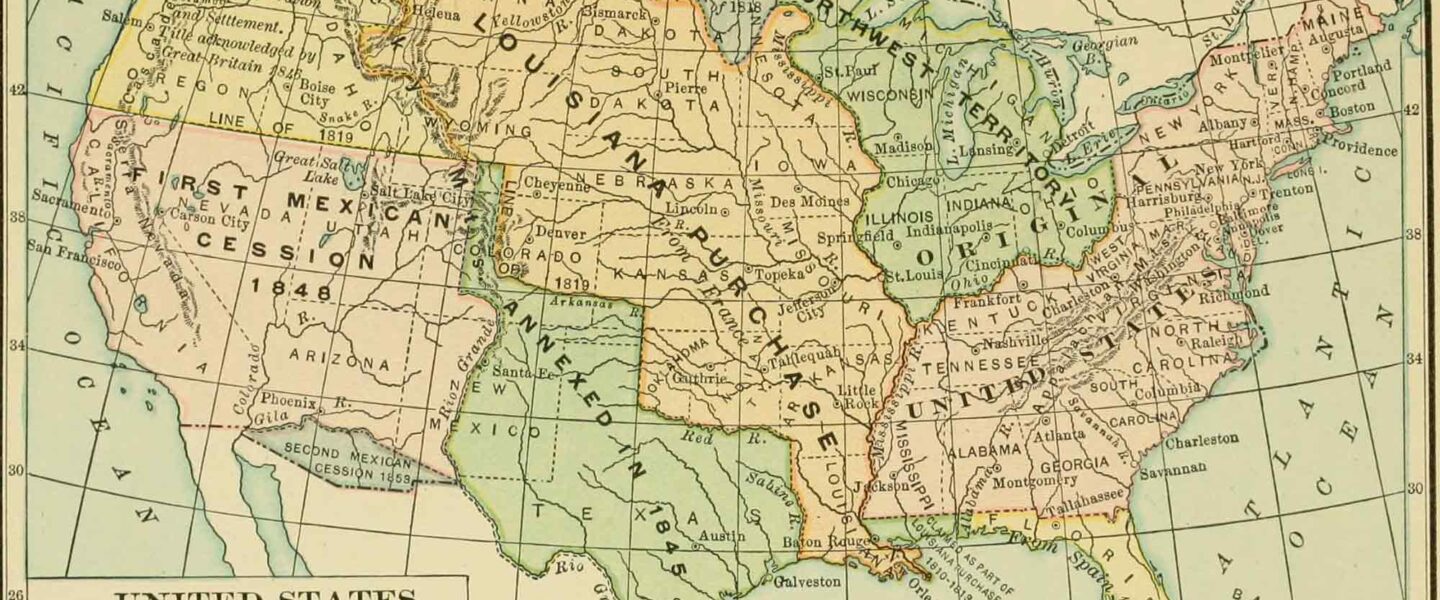
Each of these colonial projects colonized essentially an almost exclusive strip of the country out through the 1830s, avoiding one another, and they had various legal and other claims to different sections of states, and they migrated outwards. And once you realize those patterns, which don’t follow state or even international boundaries, you’ve mapped the tectonic plates of our cultural and national life.
And so bonding all of this together into one country, which we suddenly had to do after the fact, after the American Revolution, these colonies accidentally found themselves in a country together, the United States of America. But they didn’t have a shared history or religion or ethnography or anything else with which to build a nation state. And it took a generation and a half for them to really even begin trying to do so. And the results have always been contentious and contested. And we’re in another period where those rivalries are threatening to shatter the country apart and bring ruin to the Republic.
Jeff: And yet within that 300 years we have had multiple generational change, we have had people moving around the country, we’ve had migration, we’ve had so many things that one would think would reshape and alter the population and alter the regional cultures. Why hasn’t that happened more profoundly?
Colin: Yeah, you’d think it would, right? Mass migration, mass immigration, mass retailing, now mass media. How could we possibly see these cultural effects still at work given all of those things and many others besides that have happened?
But if you look at the data — if you map any phenomenon from elections to life expectancy to the mapping of psychologically authoritarian attitudes or not, all sorts of things — the differences between the regions are growing, not shrinking. So the question is, how could that possibly be?
A couple of data points. Social scientists who’ve looked at people who move around, who migrate internally in the country, have found that they take driver’s licenses of people who’ve canceled their licenses in one state and find them at the new state where they’ve re-registered, and then they pull them. And the general lesson has been that people who move, in aggregate, have their political beliefs resemble their destination, not their point of origin.
In other words, people, the place you grew up in, you feel like, oh, this is where I belong and people think the way I do, you might be quite satisfied. But if the place you were born and grew up in, all these people have all these unexamined assumptions you can’t stand, they all believe that A and B are true when you know it’s X and Y, then if you ever had the chance to move, if my company ever let me move somewhere I had any say in the matter, I would move somewhere where people believe X and Y, because I’ve had enough of this.
And that appears in aggregate to be what’s happening. People are self-sorting where those who— because every county and every part of the country among individuals has the full range of a political opinion. But if you’re frustrated by the dominant ethos where you are, you may want to move and try to move, and that’s part of what’s been happening.
And then secondly, immigration. We studied this quite a bit. States don’t just arrive randomly on the map. In the great 1880-to-1924 immigration wave, the one that so profoundly changed American ideas about who belongs and who could be a true American, Anglo-Protestant America kicking and screaming had to accept that henceforth Jews, Orthodox Christians, and Roman Catholics at least could be full-fledged Americans. That whole process was because you had a huge number of people who weren’t Protestant and weren’t from an Anglo-Saxon-Germanic background coming into the country in that wave.
But they didn’t go to all of the regions. We found the 1900 census data where census takers actually asked every single person, “Hey, you foreign born or not?” And scholars have computed all that, so we actually have full population-level data. We then sorted it by county and then crunched it by regional culture. And the results are pretty staggering.
Essentially, nobody from that immigration wave went to three of the enormous regions that take up the sort of Greater South, if you will, of the country. The deep or lowland south, the Chesapeake country, and the upland south settled by the Scotch-Irish and other lowland Scots. It extends all the way up into Southern Ohio, Kentucky, West Virginia, the lower parts of Illinois, Indiana, large parts of Missouri, that whole regional culture. And those other two were 1 percent and 3 percent foreign-born in 1900. whereas all the other regions were 20, 25, 30, more than 30 percent foreign-born. You’re talking 10-, 20-, 30-fold differences between the regional cultures. It also means that that forced rethinking and broadening of who’s really an American and who isn’t didn’t take place in those three southern regions in that time period.
Jeff: Why hasn’t generational change had a stronger effect? You would think that each generation that came along would water down some of that cultural attitude.
Colin: Well, anthropologists study cultural transmission. How do cultures and cultural ideas persist for hundreds and even thousands of years in recognizable ways when there is no culture as an organism, really? It’s just individuals passing information around.
But we transmit, as humans, culture very effectively. We do it in family units, schools, within religious communities. In the stories we tell, the statues, the symbols that we revere in each culture, you subconsciously and consciously transmit all kinds of cultural information over time and over generations. And humans have done it everywhere. How you can have Germany and France that have been sitting next door to each other and, for a thousand years now, fought various wars with one another, but they’re part of a free movement of peoples, the Schengen European Union zone. And yet, beyond just language, there are fundamental cultural differences and characteristics that one can plot out between France and Germany, even today, that are consistent back hundreds and hundreds of years.
Same thing here. I mean, the generational, yes, generations have different experiences and different stances, but for humans the world around, generations rarely change these fundamental, metronome-like foundational characteristics and differences and inclinations of the societies they’re in. Cultures change over time, but it’s slow in the deeper respects, and that the United States is no different is the only contribution that I’m making. Except we’re not one culture, we’re a federation of several, and that’s the only way you can make sense of it.
Jeff: Why are we seeing these cultural identities more pronounced now, seemingly more pronounced, than we have seen them at other times? Arguably, they were less pronounced, let’s say, in the 50s than they are today. Why does that seem to be the case?
Colin: Well, I think they were there, but latent and less activated by the great struggles and events that are defining the national stage. Part of it is that now with technology and the way the media and social media and live television, cable television that came before it, we’re all living in a now, in a shared story.
We know some news event that happens anywhere in the country and catches the public attention and we debate it. So we’re sort of all in each other’s faces in a way that in the 1940s or 1840s, it would be a little harder to have been. We still were, but it wasn’t quite as— the differences weren’t being pushed quite as strongly.
But we also have had a destabilizing of the social compacts. When I was on the first time with you, we were talking about my book, American Character, a follow-up from American Nations that talked about the big thing that we’ve been fighting over in this country and that the regions have been fighting over is how do you create a free society? Do you do it through maximizing individual freedom, personal autonomy, lack of restraint? If you had less government and less taxes and less regulation? Would it not be axiomatic that each of us as individuals would be more free, so that should be the goal?
Or is it that you’re trying to build and maintain the thousands of years of infrastructure, institutions, ideas, and legal frameworks that make it possible for individual humans to hope to all live in a free society together? In other words, you have to maintain the clinics and bridges and public universities and school systems and everything else that allows each person at birth to have some chance of being meaningfully free, of tapping their potential, of being able to get where they might be able to get, even if they were born in terrible circumstances.
So is it a community project, a cultivation of a Republican citizenry? That battle has always been there, but my take has been that, since about 1980, our country at a federal level has continually moved in the individualistic direction, and you need a balance between these forces. You are a free society, not when you run to the extreme in either direction, because if you run to the extreme in the individualism direction and you keep on going till there’s no government and no regulation, you don’t have a bunch of free individuals. A few families will take advantage of that, accrue and maximize their freedom and crush everyone else in an oligarchy of one form or another. Happened over and over in history.
In the other direction, if you only care about the common good and not about individual liberty, pretty soon individual thoughts and deviations and idiosyncrasies become a threat to those who see themselves as the keeper of the common good. You can be committing thought crimes, and it’s not long before you’re ending up in the world, if you keep on going that way, of Orwell and Hitler and the Nazis and Stalin and the Soviets.
So those are both bad, but you need a balance between the two. And since 1980, we’ve kept going down the individualism route in our tax policies, in reducing the public investments we make in things. And the 1950s were a high watermark of all those things. With a Republican trifecta under Eisenhower, the maximum marginal income tax rate was 92 percent. It’s now like 37 percent. We built public universities and interstate highways. We built the military industrial complex that allowed us to take on the Soviets on the national stage. We created the stuff that allowed us to send people into space and eventually onto the Moon, invested in basic science.
I mean, it was a totally different experience in the 1950s and early 1960s. Since 1980, we’ve gone the other way. We’ve reduced all of those investments and the result is a more and more oligarchic kind of drift to the point where your chances as an American at birth, if you’re born in the wrong place or to a poor family, your chance of getting out of that is greatly reduced, and reduced more and more. And the tax structures and our policies and our investments and lack thereof are ensuring that, and it’s broken the social contract. And once you break the social contract, then you’re opening up a whole— the world of demagogues, in a much more scary American conversation that’s behind all that about whether or not we should be trying to create a universally free society or maybe something else based on bloodlines.
Jeff: How much of this is about economics? How much is it about class or culture or both or conflict between the two?
Colin: I mean, human behavior, all these things are linked. That’s what makes society so fascinating to study. But I argue that culture is upstream of almost everything, even the practice of religion, and there’s a reason why we have Southern Methodists and Southern Baptists and Northern Methodists and Northern Baptists. It had to do with the regionalization of the churches, their practices and values, and the run up to the Civil War and much that’s happened beyond that.
Same with economics. Yeah, economics matter, but the reason that you have — and have had historically in some regions and with resource extraction economy — trying not to invest heavily in education for hundreds of years to sort of maximize the ruling class’s interests and not pay too much attention to the ordinary people in society, as the Deep South did for a very, very long time. That has all kinds of economic effects.
And if you’re a society where you’re descended from people like the Puritans in New England, who thought that they’d been chosen by God — they were a covenanted people like the Old Testament Hebrews, and God wanted them to go into the New England wilderness and build a more perfect Calvinist utopia, — and that they would be punished or rewarded as a group, and they had to act in this mission together through shared institutions. He would immediately go to the frontier and build a taxpayer-financed public school, because everyone had to read scripture in their way of seeing things. You’d have a town meeting house where the people would gather together and sort of pass every budget item directly and sort of a direct democracy.
Those are two very different systems, and they are going to result in entirely different results. One ends up with the highest literacy rate on the planet at the end of the 1600s, which allows one to have printing presses, libraries, colleges, universities, school systems, et cetera, building your way towards an innovation kind of economy. And the other is trying to emphasize the extraction of commodities for export from the very beginning, a plantation society built, in fact, modeled on the West Indies societies that the original planter families of the Deep South came from in Barbados.
So I’m saying, yes, economics matter, but they’re all downstream of these sort of original cultural emphases that placed these different regions in very different positions all the way through until at least the 1970s and 80s before you’re starting to really have innovation investments moving into other regions and taking advantage of lower wages in some cases or nonunionized environments. But in the end, the reason some regions have one set of characteristics and others another have to do with the deep underlying cultural assumptions and the political implications thereof.
Jeff: How much is this idea of really two different American stories, a kind of ethno-nationalist vision of America versus a more civic nationalist vision?
Colin: Yeah, well, that’s been our eternal struggle since the beginning. Since the moment that these different regional cultures — stateless nations, if you will — ended up in a federation together, that’s been the battle.
What is this United States thing? You know, in the 1790s, 1800, 1820, if you asked an American what country you’re from, they would have said, I’m a Connecticut, or I’m a South Carolinian, or what have you. They’d only say American in the way that a French or German person today would say they’re European, that they’re part of a broader community beyond their own nation.
Trying to define what the United States was became a hot issue by the 1830s, because it was clear they needed an answer for what a United Statesian was, or the whole project was going to fall apart. And there was one story that came out very quickly in the 1830s that said: We’re people devoted to a set of ideals, to making the propositions in the Declaration of Independence, our opening statement as a people, a possibility or a reality, a society where every individual has this natural and equal and inherent right to survive, to not be tyrannized, to pursue happiness as they understand it, and to access the representative self-government that makes it possible, and that we’re a society devoted to those ideals. We don’t have a shared history, we don’t have a shared ethnicity or religion, but that’s fine because we share this.
The other one, there was a counter-narrative that came instantly out of the Deep South from a circle of Southern intellectuals in the 1830s and 1840s that said no, and explicitly said the Declaration and Jefferson were wrong. Humans are not equal. Only the superior Anglo-Saxon race has the genius to secure the promises in the Declaration. We’re the ethnostates of the Anglo-Saxon race, protected by the wonderful foreign policy and defense umbrella of the United States, and we’re classical republics like ancient Greece and Rome, where a minority at the top of the pyramid have the liberty or privilege to practice democracy, and subjugation and slavery are the natural lot of the many, just as they were in the classical republics.
That was the battle, right? And this ethno-nationalist vision that we’re a state that belongs to a particular subset of people based on their “superior bloodlines,” in quotes, that had 2,000 years of history and political philosophy behind it in the 1830s, whereas the liberal democracy — small l, small d — natural rights propositions of the Declaration were the radical new idea. And this was the battle.
This was the battle of the antebellum period and the Civil War and Reconstruction and Southern Redemption and the Jim Crow period and the Civil Rights era. And it’s, again, the battle we’re in today. It’s the epic American struggle over the sort of soul of the country — between ideals and no, we’re just another society where bloodlines matter, where you have to be part of the right tribe or you have to inherit the liberties or privileges from on high granted down to you based on belonging to the right royal or aristocratic family or not.
[00:22:31] Jeff: Talk about the irony that this notion of geographic determinism, that geography is destiny, is in so many ways antithetical to so many of these American ideas.
[00:22:44] Colin: Well that’s the counter, that was the trick to it all, right? How do you hold this eclectic country together that doesn’t agree on things? And the proposition that what we share is trying to be a free society — that was held fairly broadly by the majority of the regional cultures at the time, during the antebellum period. Not all of them, and there was this enormous conflict that happened, and a battle over what the country should be that started then, with some regional cultures adamantly opposed to it.
And you see it at the political leader level today, the proclivity towards Vice President JD Vance’s point of view, laid out in formal speeches, including at the Claremont Institute this summer. I mean, he basically says the Declaration is insufficient. We’re not just a country based on ideals. In fact, we are a particular peoples with a particular history, specifically those whose ancestors either participated in the conquest of the continent from indigenous America, a process that ended around 1890, or whose ancestors fought in the Civil War, regardless of which side. And he finds the Declaration inadequate because it would seem to impugn or exclude those who fought against the Declaration’s ideals in the Civil War, and he finds this unacceptable. So I mean, that’s with us, and it’s now sort of a formal part of the battle today.
So yeah, it’s always been the challenge of the United States. But the only way you could possibly hold together a diverse country that lacks all of these other elements and building blocks of a nation-state, which other countries have created, is by a civic ideal. You cannot create an ethno-state in today’s America, because the chosen group is really small, and the only way you could keep everyone else in a state of subjugation is through authoritarian force and lack of democratic means.
That’s just a recipe for the country to collapse, whether it’s a civil war or something else. We have to double down on the Declaration’s ideals.
And that was the amazing thing. In the polling we did on which version people preferred, I actually thought at the outset that Americans would prefer the sort of ethno-national-adjacent stuff, that we’re tied together by our history and heritage and, you know, legacy and values and characters, Americans, things that you have to acquire, right? I thought that that would win out over the ideals, which sound kind of abstract and soupy. But no, the civic ideals are preferred by almost everybody!
And if you just ask people, as you pointed out, whether or not they believe that Americans are duty-bound to protect one another’s natural rights, as outlined in the Declaration, it’s 97 to 2, which is a polling margin you don’t see on anything ever. It was like the widest polling margin our pollsters had seen on any question they’d ever asked anybody about anything. Because if you ask Americans, say, is the earth round or flat — the Pew Research Center has — the answer comes out 80 to 10 with 10 percent undecided!
So there’s something to work with there. And even the even people living in the Deep South and Greater Appalachia, the super majorities of there agree, at least in principle, with the civic values in the Declaration. So there is hope that we can build something out of that.
But we need to be explicit about it. You need to actually be carrying the fight and saying, this is what the country is about. You can’t just be against Trumpism or JD Vance’s vision. You have to be for something and know how to talk about it. And that’s what, in Nations Apart, you can read the polling-tested and worked out way of talking about the civic story of our country tied to the American ideals and the American experiment.
[00:26:43] Jeff: In many ways, I mean, this strange thing has happened, that the more connected we are, the more we are in touch with every other region, the more we know about what’s going on in the rest of the country, the more divided we’ve become — that when we knew less about what was happening every day in other places and other regions, we were more united in some ways. Those key things that you’re talking about that polled so well had a higher value when we knew less about the details of every particular region?
[00:27:18] Colin: Yeah, or didn’t see it day to day. I mean, how long was the Jim Crow system in the South tolerated — a racial apartheid system backed by death squads? I mean, that’s pretty bad. But Americans in other regions of the country were aware it’s there. But it wasn’t sort of in their face the way it would be if everyone had cell phone cameras back then during lynchings and everyone would see it. I mean, imagine how fast the reaction would have been then. Instead, you know, it took the civil rights movement carefully, you know, provoking Gandhi-like, the responses, the crazy responses, fire hoses on, and dogs sicced on peaceful protesters, little children being screamed at by adults just because they’re trying to enter a school building to go to school.
I mean, those were the social media moments, if you were of that time period. Now it just is an accelerant. You know, same thing with the conflict over police brutality. Most people didn’t believe, most white people didn’t believe that police used excessive force until suddenly in the past 30 years you had ordinary citizens around with cameras capturing crazy incidents and brought it forward. So the technology enabled those things and allowed people to sort of see what’s going on.
But I think maybe even the bigger accelerant is that technology crossed with the fact that our constitutional system doesn’t have a parliamentary system where we’d have multiple parties representing different interests. We have this system designed so we end up with two parties all the time, which have to be these crazy, unwieldy coalitions. You have the Republicans — how do you have libertarians and the Christian Right in the same party together? Democrats, how do you have labor and the bankers together? I mean, it doesn’t make a lot of sense.
You know, in a parliamentary system, you’d have a fascist party and extremist party that’s not quite fascist, and a Green Party, and the Communists, and the Socialists, and a Christian right center, center-right party, Christian Democrats; you’d have the liberals who are the pro-business party; you’d have the farmers… And parties have to form coalitions together, but in a coherent way.
In our country, the incentive to try to hold the coalition together is to increase and polarize the difference between you and the other coalition, because you need an awful lot of difference to hold an unwieldy coalition together. And I think that that’s been a bad incentive when thrown together with the fact that everything is happening all at once in the palm of your hand and you’re seeing it.
[00:29:53] Jeff: It’s also interesting the impact that identity politics has had on all of this, that it has further accentuated some of these divides.
[00:30:02] Colin: Identity politics in some form has been with us all along — you know, the Jim Crow period was definitely a white identity politics, right? You have to be white and Protestant or else we’ll have, you know, gangs of people trying to round you up and burn down your house. So I mean, that’s been with us all along. It’s the reckoning, the sense that there had been a triumph of the civic democratic version of things. In the 1960s, for the first time in our country’s history, there was a federation-wide consensus that we were devoted to the ideals and the Declaration. It’s within living memory.
And then an African American was elected president not once, but twice. And I think that opened up the sense among many Americans that we can further an aggressive drive towards achieving the natural rights and equalities for everybody. And I think that it took a form that accelerated the counter-reaction of people who had been privileged: We had sort of affirmative action for white people for 250 years, and suddenly if that were taken away, your sense is that things aren’t gonna be as easy for you. If you don’t have those advantages, you’re not excluding everyone else. And the way that it was put together as a political movement, I think, maximized the opportunities to rouse up a counter-reaction, and we’re living through an enormous counter-reaction based on those things.
[00:31:30] Jeff: I want to talk about the alien invasion test, this idea that it has historically been enemy threats, threats to the country, threats to regions, that have allowed us to be unified, but that today that’s not necessarily true anymore.
[00:31:47] Colin: Yeah, I mean, if you’re fighting a Manichean struggle against the Nazis or against the Soviet domination of the planet, and those kind of ideas, it’s easy to get everyone together. I’ve always said that, yeah, the moment the space aliens arrive with their saucers overhead, suddenly, I mean, humanity’s going to be united for once in sort of defense of the planet.
But we’ve had times when we’ve been united without having a foreign threat or a foreign war. The fact that we haven’t had a threat against us for a long time probably helped further the divisions, but I think the big mistake was when we won the Cold War.
I was an exchange student living behind the Iron Curtain in my junior year abroad when communism collapsed; I saw that happen firsthand. I spent most of my 20s, most of the 1990s, covering that region in transition. It was an amazing time period, but it was noticeable that the United States and the West, so to speak, didn’t say— the narrative that came out from our leaders wasn’t, oh my gosh, liberal democracy, free societies have defeated a totalitarian Soviet system. It was communism was defeated by capitalism, go capitalism! We’re going to have globalization, we don’t need to talk about our ideals, our national stories anymore. Nation states are going to wither away. You don’t need to have a story of what your country is and who belongs. Only the primitive Balkan people are fighting each other and need those kind of things. We’ve all moved beyond it. Look at the EU, their borders, it’s going to be the free movement of goods and services. And we just ignored and dropped talking about who we’re supposed to be.
But it turns out that humans need those stories. We need them to have any kind of country, to have coherent public action. You need to have a shared sense of where we’re going and what mission it is that we are joined together in a community for. And by dropping that, it created this big vacuum, so that when the whole globalization thing started running aground on the shoals — the 9-11 attacks didn’t help, the forever wars, but especially the 2008 financial collapse that discredited that whole view — suddenly demagogues and people were able to move in like they always do into this vacuum and give people sort of scary blood, soil, and proto-fascist ideas.
And this happened, not just the United States, but all over the place. United Kingdom, the Netherlands, Poland, Hungary, you know, all over the Western world, there have been these challenges, India and elsewhere. So, yeah, I think that that was a terrible mistake, that led us down this path, you can’t stop and cede, stop discussing what your values are, or what your country is for, or else somebody is going to step into the vacuum and provide those answers.
Because people, humans need, in the way our psychological makeup is set up and our evolutionary biology, we need those stories of identity, and one had best provide good and constructive ones lest destructive ones come to the fore.
[00:35:02] Jeff: It does seem that history is not on our side in this regard, that it’s really tough to find nations with the kind of diversity that we have, the kind of cultural diversity that we’ve been talking about here that have also been successful at democracy?
[00:35:20] Colin: Yeah, democracy is a new thing for the whole world — a liberal democracy, meaning a society where you’re trying to have everybody be maximally free all at once. That was not what ancient Greece and Rome were doing. So this is like a 300-year-old idea and a 250-year-old experiment at best.
And no, we haven’t been great at it. But when you think about how did the United States, the first country trying to embark on this experiment. How did it turn out for us? I mean, we rose to become the preeminent superpower for a while on the entire planet. And these ideas, in our opening statement, these radical ideas in the 1770s, have since been exported semi-consciously by the United States to all kinds of other societies, where they weren’t the norms of their culture or their political environment, as late as the Second World War or afterwards.
You know, it’s now the liberal democratic ideas that are foundational in South Korea and Japan and Scandinavia and Eastern Europe and all over the place in different countries where that would not have been the case, and elsewhere in the world. So that track record, given how new it is, is actually really impressive. And I think, on balance, it has done enormous things for, you know, human happiness and possibility, compared to the 5,000 years of despotism that preceded it, where most people were sort of living in squalor of one form or another with little control over their lives and their destiny and what happens.
So I think it’s been transformative. In that sense, the timeline’s very short, but as to whether we should be optimistic or not about the odds, I think having it succeed is really, really important, not just for Americans, but for everybody out there. Because if the United States falls apart or becomes an autocracy, or both, the world stage out there is looking pretty bleak for everybody, because the most powerful would-be superpowers in the world are authoritarian countries like Russia and China and the world’s whole environment would probably go south pretty quickly.
[00:37:34] Jeff: But we talked about the 50s as this idyllic period. It does seem like we’ve only gone in one direction since then, and it has been towards greater and greater division. It’s hard to find any period where it’s gone back towards a more unified country.
[00:37:51] Colin: Well, the 50s were, in some way, I mean, if we were white and middle class, the 50s were probably pretty good. But for most people living in the Deep South, or if you were Latino, there’s, in effect, segregation and Jim Crow systems, and you’re being denied basic rights, the ability to participate in the political process. And the advances we have made since the 1950s towards the ideals and the Declaration have been dramatic.
So it may have caused dissension and division because you are fighting the authoritarian and illiberal deep wiring of some regions of the country that were always one-party states with an oligarchy and control and denying political freedoms to people as much as possible and constraining who can participate in politics. That’s a long and difficult battle. The American experiment is still a project working its way towards success. But I’d say we made some major advances from the 1950s until relatively recently.
In the past 10 years, it hasn’t been as optimistic. But you are facing, in some ways, a counter-reaction to the successes of the liberal democratic experiment against the counter-narrative of ethno-nationalism and certain people having greater rights than others based on their bloodlines and their birthrights.
[00:39:27] Jeff: Which brings us back to the idea of technology and the degree to which technology has played a role in connecting us in so many ways that have allowed us to see differences that exist within the country.
[00:39:40] Colin: Definitely. I think the advent of social media and mobile internet technology generally, and the ability to instantly take videos and pictures and upload them, the ability now to create completely invented images, and that people can create deep fakes of anything they want, efforts to algorithmically have people live in different bubbles and also to manipulate them — yeah, those are all things that make democracy for any country more difficult to practice.
Because in the end, if you think the people are supposed to be sovereign, then the people need to have the basic information, be educated enough as citizens to be able to make the key decisions about who should lead us and what policies they prefer. I mean, it would be nice if every citizen who was going to the voting box understood the various policies — the menu items available to them, and their implications — but at a very least that they know the difference between reality and complete fantasy. That is this kind of bottom-line low bar for a democracy to survive.
And all of this social media and the sort of lie machines being produced to convince people that two plus two equals five — that, you know, hey, don’t take a miraculous free vaccine that will protect you from a deadly airborne virus. Why don’t you take a horse dewormer instead? I mean, that’s pretty wild stuff, right? You know, the people believing in some vast conspiracy involving child pedophilia rings and a Jewish cabal that’s going to destroy the world, all based in the basement of a basement-less pizza restaurant near Tenleytown in D.C. I mean, it’s bonkers stuff, but millions of people believe that.
So yeah, that’s all corrosive to democracy, but there is the world we live in, and I always say the proof of concept is within all of that static, the ethno-nationalists have moved tens of millions of Americans to a place they weren’t 10 years ago, succeeded in a campaign at multiple levels through the internet and this machine to move people like that. That means that you can move tens of millions of people in the other direction if you at least are like joining the battle in the information space.
But you need to know what it is you’re arguing for, not just be countering that. And the Declaration, right, these ideals in the Declaration are amazing and inspiring ideals. The stuff writes itself. I mean, this is like what Frederick Douglass was arguing for in every speech he made. It’s Lincoln at Gettysburg. It’s Martin Luther King in the mall. I mean, it’s a slam dunk for creating rhetoric and messaging. It’s just people generally aren’t doing it.
[00:42:27] Jeff: But it’s also the realization, and you said this perfectly before, that politics is downstream from culture, and that culture wins out.
[00:42:37] Colin: Yes it is. And that explains a lot about our partisan differences, about how we could have a red state, blue state map to begin with, and purple states that are divided between regions. Yes, that’s all the case.
But ultimately, if you actually look at the polling of ordinary people’s opinions on things, there’s big polling sets out there like, hey, here’s a set of potential policies about this hot-button issue — gun control, abortion, or climate. They start with a really, really draconian measure, and they go through to a really, really tepid milquetoast one that wouldn’t make much difference. And they ask people, hey, would you support this policy or that policy?
And when you crunch all that data, even on hot-button political issues, there are differences that are significant between people in the different regions, you know, actual voters and citizens, but it’s on the order of like a 30 percent difference between the outlying regions on either side, not 99 to 1 or 1 to 99, like our political representatives are. And in the middle, the middle 70 percent of policy options on these different hot-button issues usually get about 70 percent of the public supporting them. You know, large pluralities or majorities in every single regional culture.
So what I’m saying is that Americans, if you let go of the sort of struggle of the tribes, the red tribe and the blue tribe, what do they actually want to see happen on a policy level? Most people actually have a lot of stuff in common to agree on. And the fact that most people actually, in principle, believe in the Declaration and the American Experiment, not in this ethno-national thing that’s being pushed through multiple media and through the current administration’s official social media accounts, that’s all very encouraging and has the potential to bring us to some common ground.
The regions are always gonna be different, but they don’t have to be different to the level that’s leading to a collapse of the republic, an abrogation of the Constitution, insurrectionists storming the Capitol and then being reelected to power. That’s not a great place to be in. And I don’t think that most Americans want to be there.
[00:44:51] Jeff: So I guess the question becomes how we separate policy from culture. And what’s the magic formula for that?
[00:44:56] Colin Woodard: I don’t think you can separate policy from culture, but I think the policy debates, there’s common ground at least across a supermajority coalition of the regional cultures that would give you a lock to be able to move forward at the federal level in legislation and at the state level and most of the country on top of that, which gives you this consensus.
You’ve had long periods in American history where there’s been a federal cross-regional consensus on one thing or another that’s allowed the country to move in one direction or another. The extended New Deal period wasn’t just FDR’s presidency, but Truman and Eisenhower and JFK and LBJ. And that’s a very long period of communitarian investments in regulation and infrastructure, investments to make it possible for the country to build the building blocks to move forward and make big bets on itself. And that era ended, but that was a long time period where that was all the case, despite the regional differences.
So I think you have to work with a knowledge of the regions’ existence, but enough of the regions agree on enough stuff, where you can govern this country in a successful and healthy way. In our current configuration, in the world at large, who are the most successful countries, whether you ask the Cato Institute, who are the best free-market economies, or you ask the UN happiness index, where people are happiest, what’s the best human development? They’re Denmark, Switzerland, Sweden, they’re countries that are highly communitarian, even social democratic, where they have free-market economies that are very free and free market, but they tax the bejesus out of it in order to build the infrastructure that, in their thinking, not only makes society work better, but also makes the economy work better.
We will never go to social democracy here because of our mix of cultures, right? There’s not every option available. But there’s this middle zone, where government is effective at making sure the rules are followed to stop cheaters, whether it’s monopolists or people cheating the welfare system at both ends. If you’re progressive or conservative, your feeling of who the cheaters are is different. But you need a government able to actually enforce the rules so that you have a free and fair marketplace of ideas and products and concepts, and that it’s free and fair in the sense that anybody at birth has a chance at participating and having their shot out there, which requires intergenerationally to make sure everyone has a chance.
You have to have a certain degree of these leveling mechanisms, so that people can live in a free society, and you can achieve the American experiment.
Can you do all that? You can. It’s not easy in these regional cultures, but there is a path forward where the math would work, so to speak, if you pushed forward this idea that our task is to achieve the American experiment, so how do we do it? Well, you know, the data all points that we need to be making much more communitarian investments than we have over the past 30 years, something resembling more of what we were doing in the previous 30 or 40 years.
[00:48:09] Jeff: And I guess the other part of it is it depends on where in the country you were born. Again, it comes back to that geographic determinism.
[00:48:16] Colin: Well, I mean, individuals can feel all kinds of things about wherever they’re born. But in aggregate, if you’re born in a culture where the norms are pushing towards the communitarian side of the agenda or towards civic nationalism, your likelihood of sharing those values, even if you’ve not even thought about it, is much greater than if you’re in a society where the opposite is the case. So yeah, it cultivates different proportions of people who share the dominant values or the not-dominant values of each regional culture.
[00:48:48] Jeff: And finally, I guess it brings us to the question, which is perhaps a subject for another day, whether the governmental system that exists today needs to adapt to the changing world we’ve been talking about. That if we take these regional differences and we take the idea of modernity and the way we connect with each other and all the changes that have taken place in the world, whether the current system itself doesn’t need to be dramatically changed.
[00:49:17] Colin: Yeah, well that’s, I mean, it does. I’m not sure that we’re in a position where we can do it.
But you’ll notice that all my discussion about our civic values is all talking about the Declaration of Independence, our opening statement as a people, our mission statement. Thereafter, we tried to write a couple of constitutions that were the business plans to make it happen. And the first one was a total mess, the Articles of Confederation, and then we created the 1787 Constitution, and they were trying to keep the slaveholding ethno-state regions aboard. So all kinds of compromises were made that were anathema to the Declaration’s mission statement. They had to pass 10 amendments before they could even get the thing passed.
And we had to— while the Deep South and Chesapeake country were still out of Congress after the Civil War, the other regions passed the 13th, 14th, and 15th Amendments, which, for the first time, operationalized the ideals in the Declaration and our Constitution.
So what I’m saying is, yeah, the Constitution has always been a mess. And there are obvious problems that everyone identifies. Take your pick, electoral college, the way that the Senate is apportioned, and many other things. So yeah, we could use a very different system. One even wonders if moving more towards an EU-like framework would be more conducive or not.
But we’re not at a state right now where the country is mature enough for that not to instantly devolve into some kind of total chaos. So I don’t think we can have a constitutional convention, and I think we need to heal a great deal and stabilize the patient over a couple generations before we’ll be in a mature enough space civically and politically to contemplate trying to open up the flawed Constitution and make the repairs. That’s my take.
[00:51:03] Jeff: Colin Woodard, his book is Nations Apart: How Clashing Regional Cultures Shattered America. Colin I thank you so much for spending time with us here today on the WhoWhatWhy podcast.
[00:51:13] Colin: Always a pleasure. Thanks so much for having me. Thank you.
[00:51:16] Jeff: And thank you for listening and joining us here on the WhoWhatWhy podcast. I hope you join us next week for another WhoWhatWhy podcast. I’m Jeff Schechtman. If you liked this podcast please feel free to share and help others find it by rating and reviewing it on iTunes. You can also support this podcast and all the work we do by going to whowhatwhy.org/donate. Thank you.