Iran’s Maximum Moment: Why This Uprising Is Different
The largest massacre in modern history happened in 48 hours. Shay Khatiri on what comes next in an Iran on the brink.
The numbers coming out of Iran stop you cold: 12,000 to 20,000 dead in 48 hours. Not across months of civil war or years of grinding conflict, but concentrated into two January nights of systematic slaughter.
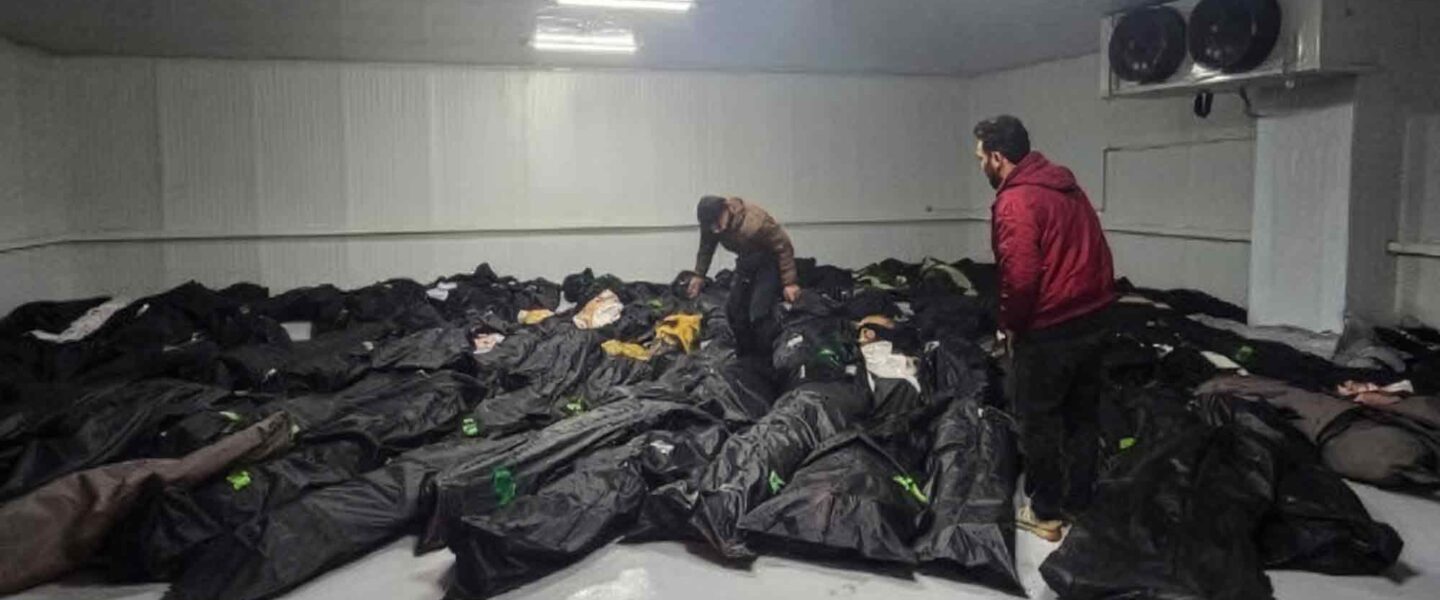
Body bags in makeshift morgues. Surgeons describing wounds they’d never imagined — internal organs hanging from bodies shot with military-grade weapons. Medical professionals saving lives in upscale clinics that would’ve been lost anywhere else.
But our guest on this week’s WhoWhatWhy podcast, Shay Khatiri, insists we’re focusing on the wrong horror. The real question isn’t what happened on January 8 and 9 — it’s what comes next. Because this wasn’t an economic protest that got out of hand. This was the maximum force Iranian civil society can muster on its own. And it wasn’t enough.
According to Khatiri — a leading Iran scholar at the Yorktown Institute focusing on US foreign policy toward Iran and Russia – every previous uprising (2009, 2019, 2022) left a residue of unfulfilled promise and mounting rage. This time, the pattern breaks. What Khatiri heard from every source inside Iran, from overworked surgeons to furious shopkeepers, was the same plea: We’ll do everything we can, but we need help from outside.
That word — “help” — carries freight we’ve spent two decades trying to unload. Iraq taught us intervention creates chaos. Syria taught us nonintervention does the same.
Now Iran poses an enormously difficult choice with nuclear stakes: a tottering but still powerful theocracy that has exported revolution and brutality for 47 years, facing an uprising that can’t succeed without us.
Khatiri explains why this moment differs from every previous uprising, what foreign intervention could actually accomplish, and why the aftermath might prove even more dangerous than the current tripwire situation.
 Apple Podcasts
 Google Podcasts
 RSS
RSS
Full Text Transcript:
(As a service to our readers, we provide transcripts with our podcasts. We try to ensure that these transcripts do not include errors. However, due to a constraint of resources, we are not always able to proofread them as closely as we would like and hope that you will excuse any errors that slipped through.)
[00:00:10] Jeff Schechtman: Welcome to the WhoWhatWhy podcast. I’m your host, Jeff Schechtman. The images filtering out of Iran through the digital blackout tells a story almost too horrific to process. Body bags stacked in makeshift morgues, surgeons working through the night on young people whose organs were literally blown from their bodies. Desperate pleas for help spray painted on walls in English. Between 12 and 20,000 dead in just two nights, if the reports are accurate. A massacre that would dwarf Tiananmen Square when adjusted for population and compressed into 48 hours of systemic slaughter. But numbers, even numbers this staggering, can numb us to the human reality underneath. The voices my guest has heard again and again from inside Iran were willing to do everything, but they needed help from the outside. This is the moment we’ve been warned about for years. The intersection of moral imperative and strategic necessity that makes us profoundly uncomfortable. Because intervention in the Middle East has become a dirty word, a trauma we carry from Iraq. Yet non-intervention in Syria created its own catastrophe. Hundreds of thousands dead, millions displaced, extremism metastasized, and Russian resurgence. Now Iran presents us with the same impossible choice, only with higher stakes, a nuclear threshold democracy that has spent 47 years exporting revolution, funding terror, and brutalizing its own people. My guest today, Shay Khatiri, has been arguing that we’re asking the wrong question. It’s not whether to intervene. Events are intervening on us whether we act or not. The real question is what kind of Iran emerges from this crisis and whether we’ll have any influence over that outcome. Because what comes after the Islamic Republic may be even more dangerous than the regime itself. The tragedy is that we’ve been here before. 2009, 2019, 2022, watching Iranians rise up, watching them get crushed, watching the window close. This time feels different though, both in scale and in willingness of protesters to explicitly ask for foreign help. But different doesn’t mean we know what to do. So we’re left with the essential question. What do we owe people fighting for their freedom against a regime we’ve opposed for nearly half a century? What are our actual interests in Iran’s future? And can we execute the kind of precision, intelligence-driven intervention that Shay Khatiri describes without it spiraling into something worse? Shay Khatiri is vice president of development and a senior fellow at the Yorktown Institute focusing on U.S. foreign policy, specifically Iran and Russia. As an Iranian political analyst and foreign policy analyst, he writes on topics for the Russian-Iran file and has been featured in numerous publications. It is my pleasure to welcome Shay Khatiri back here to the WhoWhatWhy podcast. Shay, thanks so much for joining us.
[00:03:22] Shay Khatiri: Hi, Jeff. Thanks for having me.
[00:03:23] Jeff Schechtman: I want to go back to January 8th and 9th and the events that took place in Iran. And I don’t think that there is a sense in this country at this moment as to how dramatic that was, how dramatic the massacre was. And really it compares to almost nothing else given how condensed and concentrated it was. Talk about that.
[00:03:47] Shay Khatiri: So, let’s actually go back a little further. Events started in late December when in the bazaar, cell phone shop owners began chanting against the regime because it was triggered by the collapse of currency in Iran. But that was not the reason that it became what it became. It began spreading from there. Revolutions don’t happen because of economic problems. Otherwise, we would have had a revolution during the Great Depression in the United States. Revolutions happen because of a sense of injustice and a lack of agency that people feel. Americans didn’t have a revolution in the 1920s and 30s because we have a democratic system. That people can express their grievances through. That’s not the case in Iran. So, I am emphasizing this because there’s a lot of talk about how this is caused by economic conditions in Iran, whereas it’s not. It’s triggered by it and it is magnified by it, but it is not caused by it. Inherently, this is a political revolution. It’s not out of simply economic problems. Same as people made the same mistake in 2022 when they said it was about social issues and the hijab, whereas it was triggered by that, but it was not about that. So, in December 2025, chants happen. They spread across the country and they’re growing. In the early first week of January, the son of the former Shah, the exiled crown prince, Reza Pahlavi, issues a call for nationwide protests at night on Thursday and Friday, January 8th and January 9th. And people responded to that call. Everybody went to the streets to protest and it became, for the regime, it immediately got out of hand. The crowds were simply too large to control and they immediately began attacking governments’ buildings and properties, as well as religious buildings and properties, such as seminaries and mosques, which were, several of them were attacked and burned down because of their association with the government. We still do not know the extent of the casualties. We know of the atrocities. We have received reports from inside Iran that people were shot with military-grade weapons, were shot at with military-grade weapons, that there were foreign proxies of Iran, likely the Hashd al-Shaabi, the popular mobilization forces came from Iraq to shoot at Iranians, at the people, likely because many of Iran’s own security forces were not willing to go that far to attack Iranians, possibly because they sympathize with their grievances. I’ve talked to medical professionals in Iran and the stories they say is just horrifying. One surgeon told me that people who were brought in, this is a literal description, not an exaggeration, had their internal organs like their wombs, stomachs, intestines hanging out of their bodies. So that’s part of it. They were being, people were being shot at with automatic rifles. Another person told me that in one scene, they attacked a government building and in one, in a blink of an eye, he saw seven or eight people shot dead in front of him. These stories are coming out. We know that about five, 6,000 are confirmed dead. These are human rights organizations in the United States that are going one by one, confirming the name of each deceased person. Estimates that we are getting from leaked government sources in Iran go as high as 40,000, give or take, and more are in detention, almost certainly going to be executed. It is the worst civilian massacre in modern history of the world, if these numbers are accurate. It’s the worst massacre in Iranian history since the invasion of the Mongols. And the last thing is, you talk about intervention, and it has become quite obvious that Iranians cannot do anything without foreign help at this point. So the question becomes whether we accept the current regime in its current form or help Iranians. Because at this point, to say that we wish that Iranians free themselves, but we should not do anything, is intellectually, quite honestly, at best stupid, at worst disingenuous, because it suggests that there is a path for Iranians to do it on their own. Now, it is a legitimate political argument to make that this regime, Iranians cannot overthrow the regime, and it’s none of our business to do it for them or help them do it. That is a valid point. I don’t agree with it. But to say that we hope that Iranians do it on their own implies that there is such a chance. Everybody who argues against intervention must acknowledge that regime change in Iran, democracy in Iran, freedom in Iran, is not attainable without foreign help.
[00:10:07] Jeff Schechtman: In the past, where there have been uprisings, has there been a desire for foreign help? Is there something different about this time?
[00:10:16] Shay Khatiri: Yes, there has always been. Going back to 2009, people chanted Obama either with them or with us, meaning the regime, and they turned against Obama because they believed that Obama chose the regime, and I think that’s correct. In fact, President Obama himself has nearly admitted as much. He said that he made a mistake not to help the Iranians. So yes, there has always been. The extent of how much foreign support they would like to receive and whom to receive it from has been changing. It used to be diplomatic and covert and things like that from the Americans and Europeans. In 2009, most people wanted help. They didn’t even know what kind of help, but they would assume that most of them would have opposed military intervention. Today, 17 years later, 16 and a half years later, everybody is in favor of military intervention. And even more interestingly, everybody will take it from anyone, not including, especially from the Israelis, because they think that they’re the most reliable partner they have against the regime, something that I don’t believe anybody would have signed up to in 2009. And this shift has been gradual, obviously. Throughout the past 16 years, a desire for foreign intervention and military intervention has gradually grown and has reached its pinnacle today.
[00:12:02] Jeff Schechtman: And what role does Pahlavi play in this right now? The extent to which his calling for this demonstration and his rise in profile has played a role in this. How does that impact the potential for intervention, in your view?
[00:12:20] Shay Khatiri: I don’t think that it changes the potential for intervention in any way, but the role he has has been mostly among Iranians in the diaspora, where he’s extremely popular and inside Iran, where he’s also quite popular. Not as popular as he’d like to be, but on the other hand, you saw, like, he gave the call for people to come out and millions went out. People who had never gone to protest went out for the first time to answer his call. He’s by far the most popular figure in Iran. Outside, I guess, maybe a soccer player might be more popular, but certainly the most popular political figure. We have one survey from 2021, so it is dated and a lot has changed. At the time, it showed that he had 35% popularity, but 35% was about 20 points larger than anybody else. He was still the most popular, and I think he has become even more popular since. Having said this, the role that he played in these protests might have been a mistake for him personally, because he has made the impression that he has a plan. He has been meeting with foreign officials for the past couple of years, publicizing those, and he’s become very close with the Israelis. Publicizing that, he has been boasting that he opened a channel in June. Late June 26th, he announced that he has opened his channel for regime insiders to become defectors, and a month later, he announced that he had received 50,000 applications. He’s recently said that it’s actually 100,000 applications, but they need to be verified. He has talked about, he and people around him have been boasting that they have cells inside Iran that stay among people, things like this. So, a lot of people were under the assumption that he has a plan when he issued the call to protest, and it’s absolutely obvious that he had no plan. When the dust settles, and if there’s no intervention by the United States, it might prove that he had one shot and he missed it, because people will turn against him that 40,000 of us died because we trusted you and that was a mistake. That remains to be seen. Might not happen. Trump might intervene. So, we don’t know what’s going to happen, but that is certainly a possibility. He was very popular by the time that he issued the call. Whether he will be popular at all or be relegated to a fringe leader whom everybody hates and blames for the massacre a year, two years from now, is an open question.
[00:15:28] Jeff Schechtman: In your view, what does U.S. intervention look like?
[00:15:33] Shay Khatiri: You need to appreciate that what necessarily is helpful to Iranians logistically is not encouraging politically. By which I mean, one of the most useful things we can do is cyber attacks and electronic warfare to disrupt Iran’s command communication and control systems. So, they cannot coordinate to crack down on the protests. The issue with that is that it’s covert and it’s not visible. So, Iranians have good reasons not to trust foreign help, since they have never received it. If we say that we have created a hospitable environment for you to return to the streets and protest, because there’s nothing verifiable by the eye, they probably will not come to the streets. So, the alternative becomes to, in addition to doing cyber attacks, to have some kinetic activity just to show them that we are actually supporting you. And as I like to say, things need to go boom for Iranians to be convinced. Now, that is itself helpful because there are key figures in the leadership that we should eliminate. People who are part of the command and control apparatus, especially people close to the supreme leader, Ali Khamenei. Take Ali Roulani, for instance, who has been with Khamenei since the 1990s and is possibly right now the second most powerful man in Iran. He was coordinating the recent crackdown, was in charge of coordinating the recent crackdown and gave the order for opening fire. So, killing him is very useful because, on the one hand, Khamenei loses a very trusted lieutenant and he doesn’t have many of them. On the other hand, a capable individual, a competent individual is eliminated. Another such figure is Khamenei’s son, Mushtaba Khamenei. And I mention him because he’s not a family member, though that he is. He is essentially the deputy supreme leader of Iran and he’s been the architect of crackdowns since 2009. So, he is a political actor. There are others like Shamkhani, also close to Khamenei, Gul Paheghani, who is the chief of staff to Khamenei, the chief justice Mohseni Ejei, certain hanging judges that are in Iran, prosecutor general, people like that who are the commanders both of the crackdowns that happen as well as prosecuting arrested protesters and giving them death sentences, as has become custom in recent years. So, eliminating people like that would be extremely helpful, as well as, obviously, police and military commanders. In fact, my colleagues at the National Union for Democracy in Iran have a comprehensive list of people who have been commanding crackdowns since 2017, 2019, and 2022. We could just go through the list and eliminate such figures. And also, this is now a bit trickier because a lot of these military bases are in urban areas and we have to be sensitive about that. But just generally, you don’t want to create an environment that, like the June war with Israel, the 12-day war, Iran’s skies are filled with fighter jets and every residential area might be getting hit, so people are scared and leave the city instead of coming to protest. We don’t want to create that environment, but having these in mind, you could hit a few military bases just to make armed forces scared of going to the base to pick up their weapons to go and do crackdown. And last, we need to figure out something about the Arab proxies. That probably requires working with the Iraqi government and the Syrian government, potentially, to prevent these forces from leaving Iraq and Syria and closing the border to them. Those are things that we could be doing. But at the end, we really need to, in addition to make it easier for Iranians to protest, we need to give them some assurance that we are going to support them.
[00:20:49] Jeff Schechtman: If these decapitations were to take place, if the regime, by some miracle, could fall, what does Iran look like post-regime?
[00:21:01] Shay Khatiri: So before we go there, I forgot to mention, since you mentioned decapitation, actually, the one person I don’t want to eliminate is Khamenei himself, precisely because of the question you asked. It is a long shot, but the best-case scenario is if Khamenei is cornered so much so that he has to surrender power. Again, it’s a long shot, probably not going to happen, but the best-case scenario is for us to force him to give up power to an individual like Pallavi or whoever. I don’t even care who’s gonna take over. Could be you, Jeff, as long as there’s someone. But ideally, we want Khamenei to be alive so he has to surrender power and legitimize his successor. As for how the regime will, or how Iran will look like after the Islamic Republic falls, your guess is as good as mine, I would say. But I mentioned that it’s a long shot, but we want to legitimize the successor by forcing Khamenei to give up power. That’s probably not going to happen. Keep in mind that Iran’s military is not a traditional kind of secular army that is going to just defend the homeland and get on with it. It is ideological, and on top of being ideological, it’s quite sizable. Contrast what happened in Russia after the fall of the Soviet Union with in Poland. Poland did not have a huge military. Its security was largely provided by the Soviet military, so there are not guys with guns you have to mind after the fall of the Soviet Union in Poland. Poland becomes a democracy. It’s one of the most prosperous and strongest liberal democracies in the world right now. Now, contrast that with Russia, which did have a huge military, and you had to worry about the guys with guns. And what happens? One of those guys with guns is the dictator of Russia today. So you have that issue. One outcome is one of the guys with guns would be in charge of the country, and they understand the politics of the military, and they’re going to keep it together. It will be a military dictatorship, a security dictatorship, somewhat different than the Islamic Republic, but not different enough for us to like it, and hostile to us. Another one is, which I think is much likelier, is disintegration of the country entirely into chaos and civil war. You get something like Iraq or Syria. Now, that is an issue we’re going to run into anyway. Whether we intervene today or wait until Khamenei dies, and there’s a food fight within the regime, and there are going to be protests again, and some of the security forces are going to side with the protesters, and there is no Khamenei to call the shots, and the regime turns against itself, and you get the civil war anyway. So it’s not a risk we’re running into with intervention. It’s a risk. It’s a near certainty that we’re going to run into that. Whether we intervene or not, intervention might prevent it. But that is probably something we’re going to run into anyway at some point in Iran. A third option is that you manage to negotiate something with the security forces for them to either disarm or be co-opted into Iran’s larger military, and you get somewhat a smooth transition into an acceptable regime, be it an American-style liberal democracy or a, well, not today’s Turkey, but yesteryear’s Turkey-flawed democracy, and somewhat a free country that is not good by our standards, but is very good by Middle Eastern standards. That could be an outcome too. But that would require that would require us to, us meaning both the U.S. government as well as the opposition, to work something with the IRGC, with the Islamic Revolution’s guardians corps.
[00:25:32] Jeff Schechtman: What kind of window are we talking about in terms of intervention? How long before intervention can actually have some impact following on the heels of the demonstration?
[00:25:45] Shay Khatiri: I don’t think that we’re ever going to run out of that window. Whenever we intervene, if we do it right and we tell people that, okay, we’re ready, come out, we’re going to support you, people are going to come out.
[00:25:56] Jeff Schechtman: And do you think that there’s a reason why, the reason for the U.S. or Israel to act more quickly at this point, or is there time to wait?
[00:26:05] Shay Khatiri: Well, I think that we’ve lost the momentum anyway. So there’s time to wait from the, we’ve lost the momentum in Iran, I should say. So we’ve lost the time in Iran, but that’s never, that’s not really the issue here. The actual problem is that we have a window in Washington, D.C. You cannot one day wake up in Washington. You’re familiar with our politics here. You cannot one day wake up and say, okay, we’re ready to go and intervene in Iran. Well, Mr. President, nothing has happened in Iran for six months. Why are you doing that? We have our, I don’t know, we have midterms coming up and we have bigger fish to fry. We have a political momentum in Washington right now that we kind of both missed, but the president is keeping alive by the force of his personality. So that window is there. And as long as the talks are ongoing, as long as Iran is in the headlines, we still have that window. Third option is, sorry, just really quick. The third option is that the talks don’t get anywhere and we forget everything and Israel decides to attack Iran’s ballistic missile program, which is a serious threat to Israel, and the window reopens. But I think the window is more about our politics than about Iran. People will come out.
[00:27:28] Jeff Schechtman: Talk a little bit about the degree to which Iranians would like to see U.S. intervention at this point. To what extent will that be seen as a positive development right now?
[00:27:40] Shay Khatiri: For my own intellectual curiosity, I spent the past two weeks, especially the past month, but especially the past two weeks that internet has reopened, trying to find someone who’s against it and I have failed. I have been asking people like, okay, so you’re for intervention. Do you have a friend who’s against it? Nope. I don’t have friends against intervention. Like, are you sure? Like there’s nobody in your circle who’s against it? Nope. Nope. Everybody’s for intervention. Arash Azizi, my friend, had a very interesting piece in The Atlantic where he talked to people about intervention. It’s a very interesting piece. There are some voices against intervention, but most people are in favor of it. But two things to consider here. People he’s talking to are all outside Iran and are all left-wing activists in the diaspora, a lot of them leading socialist groups. And imagine when you’re talking to Bernie Sanders to Leon Trotsky, that’s the span of people he’s talking to, right? And from Bernie Sanders to Leon Trotsky level of lefties, most people in the diaspora are in favor of intervention. Go figure, the rest of the country who have been shot and wounded, who are not ideologically anti-American, and also generally speaking, Iranians have become very right-wing and generally are right-wingers. I would be shocked if other than 15% of regime supporters, setting those aside, who are against intervention, obviously, I’d be shocked if there’s more than 10 to 15% of Iranians against it, if that many, if that many. I talked to someone who’s told me that they have construction going on in their neighborhood. So a lot of loud noises. And she said, every time I hear a big noise, everybody in the house jumps and like, oh my God, finally, they’re hitting it. And disappointment that, oh no, it’s just a construction. And still, the next time that it happens, they still get excited. She said, we’re never going to give up the hope for intervention. Well, not never, but for the foreseeable future, we’re not going to give up the hope. As many times as we’ve been disappointed that, no, it’s just the construction, we’re still getting as excited as the last time.
[00:30:05] Jeff Schechtman: Talk about the broader regional reverberations from a potential involvement on the part of the U.S. What happens with respect to Turkey, Saudi Arabia, Syria, et cetera?
[00:30:17] Shay Khatiri: So we have seen that there are Arab states, this is public reporting, Arab states and regional actors, including Turkey, are lobbying the president against intervention. I know that this excludes the Emiratis. I believe that Emiratis are in favor of intervention. It’s interesting about the Saudis because it appears that the Saudis are against intervention on the one hand, but we also saw a report that the Saudi minister of defense was in Washington arguing in favor of it, but they’re sending mixed messages. It might also be that that public reporting was just a PR thing to do image control. Turks are against it for good reasons, I would say. The Turks were really hit by the Syrian civil war. They cannot afford another refugee crisis, and Iran is three times the size Syria was at the time of the civil war, or even larger than three times. They are worried about possible refugee crisis and how people would go to Turkey trying to go to Europe, and Europeans are not going to let them in, so they’re going to be stuck in Turkey with, we just solved our Syrian refugee problem, what are we going to do with the Iranian refugees? So they have that issue, understandable. For both the Arabs and the Turks also, they like a weak Islamic Republic for a few reasons. One is that Iran’s foreign policy after the Islamic Republic falls, assuming it doesn’t go to some IRGC general, is going to be about its borders and its territorial integrity, and very nationalistic in not necessarily a good way, and that would cause conflicts with its neighbors, probably. So that’s an issue they don’t have right now, and they would not want to have. That’s just an international relations problem. The second issue is, imagine if it all goes well and Iran becomes the liberal democracy. Look at Poland, again, I mentioned Poland. Poland’s on the course to take over Britain, British GDP per capita, and is not too far from taking over its GDP altogether. This is in large part because of the foolish decisions the Brits have made and the Poles have not, economically. But things in Poland, 30 years, 30 something years after the fall of communism, look really good. And we’re talking about the United Kingdom. We’re not talking about Turkey, which… We’re talking about the United Kingdom after Thatcher left, which was in a really good economic condition. It will probably, in an ideal scenario for Iran, it will take a much shorter time to surpass the Saudis and the Turks and their neighbors economically. If you establish free enterprise, and keep in mind that Iran has a large, very large, young population with technical expertise, a lot of engineers, a lot of engineers, and a lot of people who have somehow made it work as entrepreneurs under this regime. So imagine how it will look like in a free market and a free free politics. So Iran could easily surpass its neighbors and then it will cause a domestic crisis for its autocratic neighbors that Iran was decades behind us just 20 years ago. And in 20… Or we thought that it was decades behind us, but just in 20 years it has become something we’re just jealous of. You know what? We want the same change. We also want a liberal democracy. And then the Al Saud family is going to start having to respond to its own population why their political model works better than liberal democracy. And that’s not a question they would like to answer. So that’s an interest they have against regime change. The last thing is… I mentioned that Saudis like a weak Iran, so do the Turks. Saudis are turning on Israel again. And the Turks have just gone wild against Israel. The Qataris have always been against Israel. A free Iran will at the worst be indifferent toward Israel. Much likelier they will be quite… Iran will be quite close with Israel, especially an Iran that returns to the monarchy of the Pahlavis. So if you’re trying to rebuild your legitimacy as Saudi Arabia or as Turkey in objection to Israel, do you prefer a weak Iran who’s going to supply you without being a threat to you? Or do you want a strong Iran that is going to be partners with Israel and supply Israel capably? The answer is that you want a weak Islamic Republic. In any way, a weak autocracy is in the interest of Iran’s autocratic neighbors. If the alternative is a flourishing liberal democracy, it is also in… I mean, actually, I cannot think of an alternative in which a weak autocracy is not preferred to. Civil war, weak autocracy is better. Liberal democracy flourishing, weak autocracy is better. A strong Islamic Republic, a weak Islamic Republic is better. This is the ideal situation for most of Iran’s neighbors.
[00:36:24] Jeff Schechtman: Given where we are now, to what extent do you think this is a different moment than 2009 or 2019 or 2022?
[00:36:34] Shay Khatiri: It’s different than 2009 in kind. In 2009, people came to the… came to protest for the regime to stick to its own contract with them, which is to say you have restricted elections. We agreed to that. We chose our guy within your parameters of politics, and you still cheated. So can we go back to the original contract we had? Restricted elections, but we get to have our say in this dynamic. That’s 2009. In 2010, the same green movement, but toward the end of it, or I guess late 2009, I should say. Sorry, the Persian calendar is different than the American calendar, so I get confused when it’s the new year and when it’s not. It becomes quite obvious that that’s not going to be the case. So Iranians move on from chanting on the street, where is my vote? And demanding a recount to saying death to the dictator. Then you have the green movement begins as pro-reform and closes as we have a system problem. 2017, when there are small protests and riots, that’s anti-regime. So that’s a difference of kind that we are talking about. Since 2017 and 2019 and 2022 and 2026, they have been different in as a matter of degree, not of kind. You have an increase in the size of the protests, in the willingness to engage in violence against the regime. You have had different demographics joining the protests, but they’ve all been anti-regime. This is different as a matter of degree, which is, it’s probably as large and as violent as you’re ever going to get. I cannot imagine how it could be any more radical and any larger than it already is in the future, because this, I think that this was the maximum strength of the Iranian people without foreign help. But again, it’s a difference of degree this time, not of kind than in the past. But it’s a difference of kind than 2009. That’s my answer.
[00:39:16] Jeff Schechtman: Sheikh Attari, I thank you so very much for spending time with us today. My pleasure. Thanks for having me, Jeff. Thank you. And thank you for listening and joining us here on the WhoWhatWhy podcast. I hope you join us next week for another WhoWhatWhy podcast. I’m Jeff Schechtman. If you like this podcast, please feel free to share and help others find it by rating and reviewing it on iTunes. You can also support this podcast and all the work we do by going to whowhatwhy.org/donate.