Iran in 2026 Is Not the Iran of 1979
Change in Iran is likely to come from within the current government, unlike in 1979, when it required an overthrow of the monarchy.
|
Listen To This Story
 |
Images of the mass anti-government protests in Iran may recall the popular revolt that toppled Shah Mohammad Reza Pahlavi in 1979, but that is where the similarities stop.
Based in Tehran at the time, I covered the revolution that was the Islamic Republic’s midwife.
Then, as now, the government mowed down protesters, even if the shah stopped short of employing the kind of indiscriminate violence that Iran’s current Islamist leaders have unleashed.
That is not to say that hard-line supporters of the shah and senior military commanders rejected a brutal crackdown. On the contrary.
Men like Ardeshir Zahedi, the shah’s influential son-in-law and storied ambassador to the United States; Maj. Gen. Manouchehr Khosrodad, the founder and commander of the army’s airborne wing; Nematollah Nassiri, the head of SAVAK, Iran’s feared intelligence agency; Maj. Gen. Reza Naji, the tough Isfahan martial law commander; and Tehran police chief and martial law administrator Mehdi Rahimi had little compunction about killing thousands to salvage the shah’s regime.
They made that clear at a dinner hosted by Zahedi that I attended.
February 11, 1979, was make-or-break for the government of the shah, who had left the country two weeks earlier with his then-16-year-old son, Reza Pahlavi.
Millions of Iranians, egged on by Ruhollah Khomeini, who had returned to Iran from exile days earlier, defied a curfew imposed by the shah-appointed prime minister, Shapour Bakhtiar.
Even as Khosrodad’s helicopter gunships hovered in the air, the demonstrators seized governmental buildings, military bases, and the state radio headquarters. The shah could either pave the streets of Tehran with thousands of corpses, or acknowledge defeat.
Khosrodad, despite the military officially declaring its neutrality, waited in vain for the green light to open fire. The shah never gave him the go-ahead, fearing that a massacre would prevent his son from ever succeeding him.
Khosrodad, Nassiri, Naji, and Rahimi were executed on a school rooftop days after the Islamists led by Khomeini replaced the shah on February 11.
One major difference from today was that elements of the military, which might have been expected to remain solidly loyal to the shah, had already gone over to the insurgents. On the night of February 10, air force recruits at the Farahabad base in east Tehran began ferrying weapons out of the base in ambulances, to join the revolutionary forces.
Contrast that situation with today’s positioning of the military and the Islamic Revolutionary Guard Corps (IRGC), the powerful force created by the Islamic Republic to keep the remnants of the shah’s distrusted military in check.
Both institutions have proven to be cohesive, ideologically committed, and invested in Iran’s repressive regime. Neither has displayed any signs of disaffection in their ranks. Nor have the Basij, a volunteer IRGC paramilitary militia, the police, or the intelligence services.
The IRGC is believed to be primarily responsible for the deaths of protesters, estimated in the hundreds, if not thousands, as the regime resorts to widespread killing of civilians in its efforts to quell the protests.
Iran, earlier this week, held funerals for more than 100 members of the IRGC and other security forces who were killed in clashes with protesters. The government declared three days of mourning.
Back in 1979, Khomeini relied on the support of an extensive network of mosques and charities that provided him with the in-country infrastructure he needed not only to topple the shah but also to put a new administration in his place.
As soon became clear, Khomeini’s revolution was backed by a cross-section of society, including conservative Iranians, labor unions, secularists, technocrats, and leaders of ethnic minorities, who believed, however naively, that the charismatic cleric would need them to govern Iran in the long term once the shah was toppled.
Even before Khomeini appointed him as the revolution’s first prime minister, Mehdi Bazargan and his son-in-law, Mohammad-Hossein Baniasadi, feverishly worked to map out what an Islamic Republic would look like structurally and organizationally.
By contrast, today’s protests are spontaneous and leaderless.
True, the younger Pahlavi aspires to succeed his father in the unlikely event that the protests produce radical regime change.
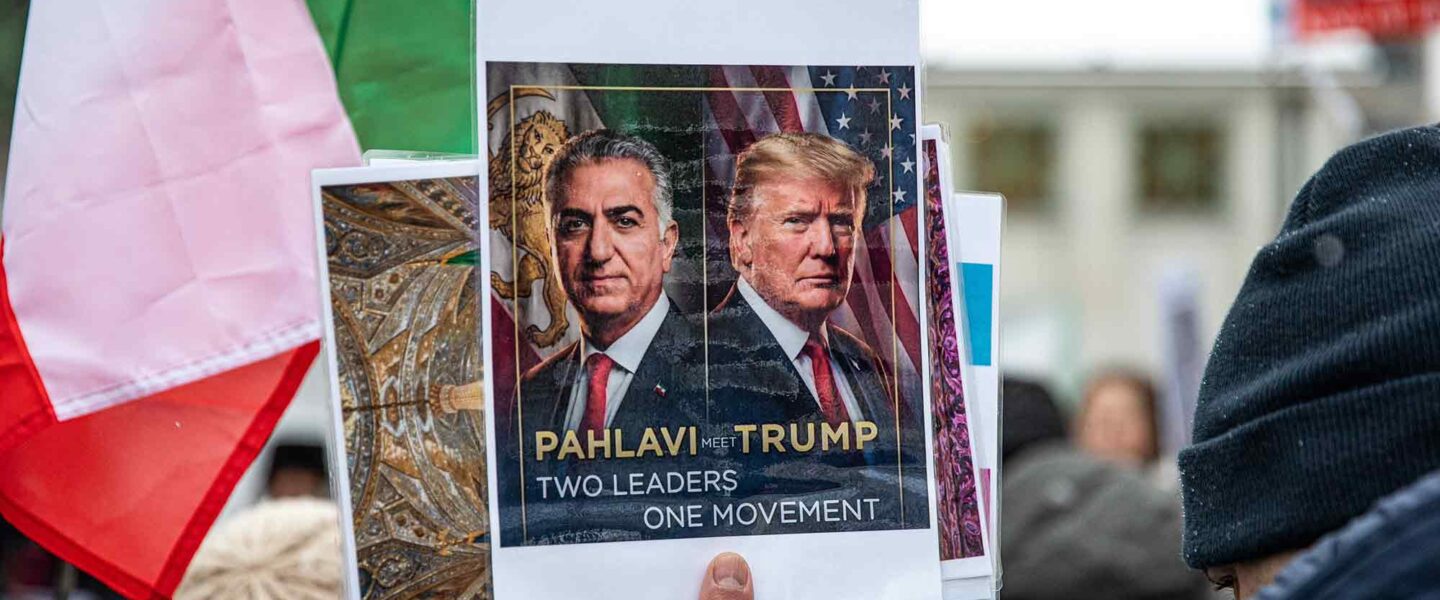
The former shah’s son, who has not visited Iran in the last 47 years, is a “brand name” that some protesters have latched on to. He is the best-known opposition figure and attracts support among those who favor a monarchy; some street marchers have even been displaying his picture and chanting his name. But few expect him to rally a majority of anti-government demonstrators to his banner.
Moreover, Pahlavi lacks access to the infrastructure Khomeini had at his disposal. Nor has he articulated a vision for a future Iran, beyond platitudes extolling a restoration of the monarchy.
Similarly, the pillars of the 1979 revolution that came together to overthrow the shah under Khomeini’s leadership — including the country’s merchant community and the clergy — are internally divided.
No doubt, today’s protesters will be able to claim credit for the inevitable change in Iran when all is done and dusted, even if the result may not be what any of them had in mind.
Change is likely to come from within the current government, with today’s supreme leader, 86-year-old Ayatollah Ali Khamenei, either being sidelined, passing away, or being replaced by an IRGC-dominated regime.
What that means for the future of Iran and the entire Middle East is anybody’s guess.
An IRGC-dominated regime could prove to be intractably hardline. Or it might follow Venezuela’s example and be more amenable to a rapprochement with the United States and other Western powers.
In 1979, Khomeini rejected US feelers for diplomatic cooperation. After the revolution, supporters of the ayatollah occupied the US embassy and held 52 Americans hostage for 444 days.
Today, without the United States lifting crippling sanctions, Iran cannot resolve the mounting economic crisis that will spark further protests, provoke splits in the regime, and ultimately bring it down.
James M. Dorsey is an adjunct senior fellow at Nanyang Technological University’s S. Rajaratnam School of International Studies in Singapore, contributing editor to WhoWhatWhy, and the author of the syndicated column and podcast, The Turbulent World with James M. Dorsey.