Given the stakes and given the vulnerabilities of US elections, it’s nuts not to look under the hood. I did — and I haven’t slept well since.
|
Listen To This Story
 |
Back in November 2016, after the shocking win by Donald Trump over Hillary Clinton, despite her having been consistently ahead in the polls, I listened to pundits and commentators tripping over each other to explain the outcome. The “silent Trump voter” theory — as impassioned as they are, they just don’t like talking to pollsters — was floated for nods. It must have been her damn emails, said others, though the tracking polls did not support that theory.
While the media was busy rounding up the usual suspects, a tiny knot of conspiracy theorists quietly posted an alternative view — that the election was stolen — but that scary thought never left the closet. It was relegated to books, released long after they could make any difference; thin Twitter threads; and Volume I, Chapter II, Section C of the Mueller report.
It was years later, after I had made a name for myself among my friends as one of those conspiracy theorists, that one of my emails to my favorite radio talk show was selected to be read on the air, a rare occurrence. I asked the panelists to consider whether some of the dark money they had been talking about all morning could have been directed toward rigging the vote?
There was no pause. No, they said. And their tone of voice said no, too. No.
Because elections are run by the states, and the election commissioners are bipartisan (in New York), and they are sworn to uphold the Constitution, and it would take a massive effort, and anyway somebody would have reported it. So, no, they said.
Besides that, said one of the regular commentators on the show, “They do audits, don’t they?”
“Yes, and they very, very rarely find problems,” asserted the host, ending discussion.
No Worries!
Back in 2016, when I was raising my eyebrows at the pundits, I had asked that very question. They do do audits, answered the internet, specifically a page hosted by Verified Voting that listed by state whether and how they audit the vote.
New York audits the vote — they report, when you click on my state — by a random 3 percent sampling of the voting machines, using a manual count of the ballots. If disparities are found, the audit is escalated to 5 percent, then 12 percent. And if there are still disparities, it escalates to a full statewide manual recount, which is binding and can change the outcome of the election. New York is one of the few states where the audit is called “binding.”
I was comforted.
But if reading the Mueller report taught me anything, it was not to trust the internet (see Volume I, Chapter V, Section A: “‘Russian Active’ Measures Social Media Campaign”). Even Verified Voting might be short on verification.
So I went down to the Rensselaer County Board of Elections (RCBOE), a mere hundred yards from where I work, and asked the clerk to see the audit sheets. I think she was a bit perplexed — there was hardly a steady stream of citizens coming in with that request — but she fetched them for my review.
So they really did do an audit! I was relieved of my dark suspicions.
“Can I take photos?” I asked. “Sure,” she said, not seeing why not.
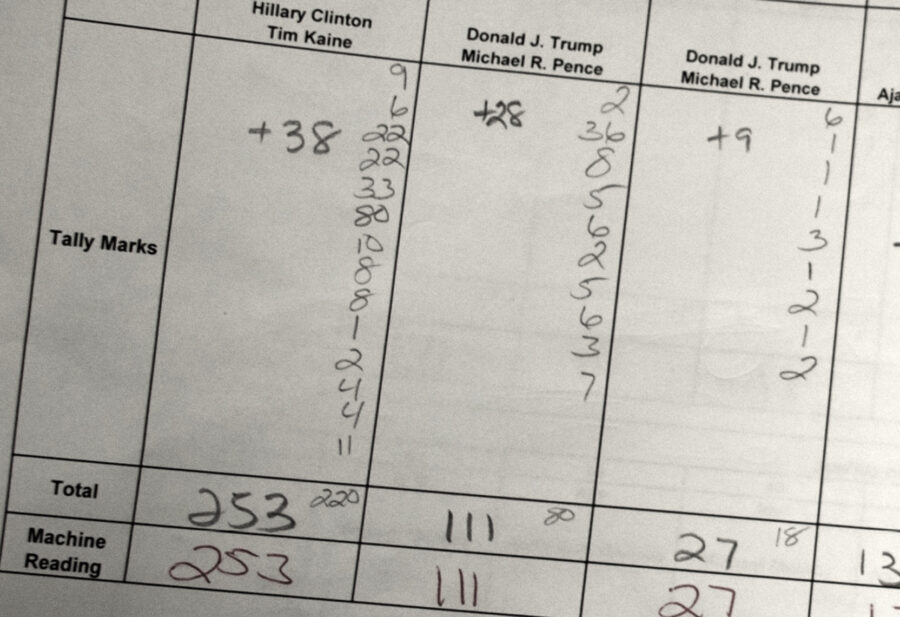
So I recorded every page — including pages where the numbers did not match up, pages where the numbers were not filled in, and pages where the manual count was faithfully reproduced from the tick marks above it only to be superseded by another number, written bigger and right in the center of the box, that matched the electronic count but not the tick-mark tally.
Not even close. How was I to interpret that?
And I photographed the signed certification page with the box checked that read “No discrepancies were found.”
If Thine Eye Offends Thee …
The next time I attended the postelection audit in Rensselaer County was four years later, the 2020 general election. In the meantime, between teaching college classes in biophysics and running a research lab that developed a new vaccine platform, I shopped the startling audit-sheet images around to lawmakers, who either played dead or cheered me on with moral support: “Good luck with your work!”
They were doing the audit in a new way, by passing the ballots through a scanner and recording the scanned numbers. No tally sheet, no tick marks. Problem solved!
And I sent them up the chain to the New York State Board of Elections (NYSBOE). I’m not sure whether there was any connection, but in 2020 I found that the RCBOE was no longer using audit sheets. They were doing the audit in a new way, by passing the ballots through a scanner and recording the scanned numbers. No tally sheet, no tick marks. Problem solved!
This is allowed by law, they explained. And sure enough, since 2014, New York election law §9-211 has the provision:
Such audits may be performed manually or via the use of any automated tool authorized for such use by the state board of elections which is independent from the voting system it is being used to audit. [Emphasis added.]
I have copied the full sentence for later reference in this article. It comes back to haunt.
Not being able to observe any counting, I left with my head hanging low, but not before taking pictures of the internet routers and cables decorating the walls of the audit room.
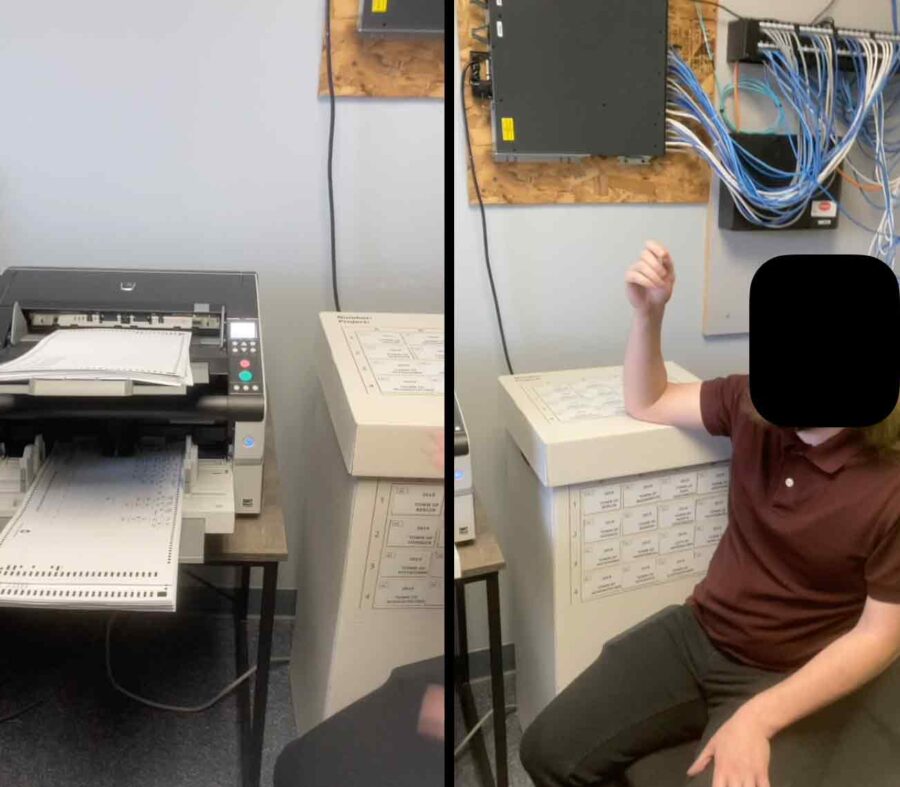
“Is the scanner connected to the internet?” I asked. “No” was the emphatic reply. “How do I know?” was my comeback — because, you know, the video instruction manual for the scanner emphasizes that it must be connected to a router. “I guess you’ll have to trust us” was theirs. Which, just to be clear, translates to this: “You can trust the vote counts because we audit them; you can trust the audits — all those routers and cables be damned — because, well, because we say so.” The logic is impeccable.
Even without the possibility of actually observing the count, I attended the midterm postelections audit in 2022 and was faced with the same situation, an automated audit. I would have to trust them, again.
They graciously allowed me to video the event, as my friend Hugh and I shadowed the election workers and asked questions.
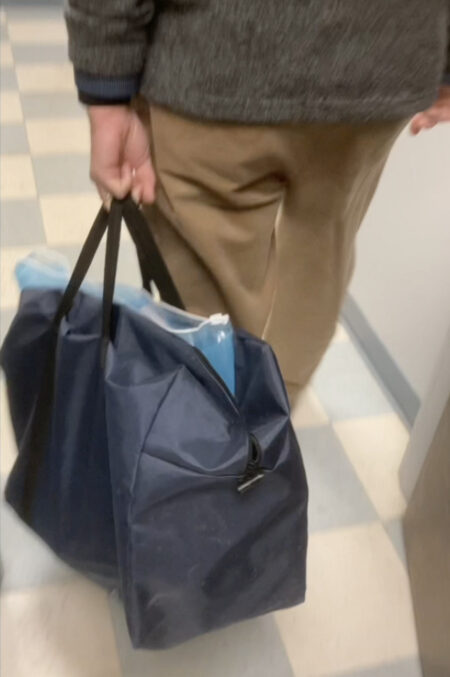
It was two years later, in 2024, that I first watched that video. In it I saw the ballot bags being brought into the counting room from the “vault” — a room with two locks, one for each commissioner (there is one Democratic and one Republican commissioner).
I froze the video as the bag passed the camera. It was open. The bag was open. Even the big, blue ziplock bag within it was open. There were no seals. Why had I not noticed this? Ballot bags are supposed to be sealed. It’s a critical component of what is known as the chain of custody.
Two years before that — in 2020, when I was attending on my own — one of the election commissioners told me they had selected the machines to be audited the day before. “For convenience,” he said. Was he testing my knowledge of election law? What could I say? I would have to put on the “I trust you, that’s fine” face.
It’s not fine. It’s not legal. And with good and obvious reason: If a prospective rigger can control — or know ahead of time — which machines will be audited, all they need to do to escape detection is to make sure those machines are untouched. No auditor of a business or a bank would ever telegraph in advance which books or dates they were going to ask to examine, right?
Two years later, the same commissioner, Jason Schofield, was convicted of identity fraud. He used the names and dates of birth of voters to fraudulently apply for absentee ballots. Was that why the ballot bags were open?
Is There a Lawyer in the House?
But that’s just the backstory. The real action started in November 2024, specifically November 19, the day of the 3 percent audit for the latest presidential election. On this day I was not alone, but I do not have permission to publish the names of the folks who joined me in observing the counting and shared in taking the adversarial barbs from the commissioners: “Be quiet. Sit over there. No, you can’t sit closer. No questions. No talking. You are just watchers.” Welcome, everyone, to post–Stop the Steal election monitoring.
Remember the “automated tool” law that I brought up before? Notice where it says “which is independent from the voting system it is being used to audit”? That was the year my county bought new voting machines — from the same company, Clear Ballot, that produces the audit tool.
So they couldn’t use the audit tool for 2024. They had to do a manual count. I was making my way down the calf of Achilles.
On that day I recorded several violations of election laws, rules, and regulations. I spent the next 15 days trying, to no avail, to find a lawyer who would take up my case for a recount of the vote, which must be requested within 30 days of the election. The basis of my case was that the ballot bags were not sealed and the selection of voting machines to be audited was not random.
Moreover, I was told by one of the commissioners, Henry Zwack, that two election workers (whom he named but whose identities I will protect) broke the custody of the ballots to “retrieve manilla envelopes and privacy sleeves” from the bags.
What else might have been removed from the ballot bags? What might have been added?
Later, as I built my New York Supreme Court case (the trial court in New York is so named), I googled case law and found a case (State Ex Rel. Dreamer v. Mason, 2007) where a board of elections in Ohio had “stuffed” ballots to reconcile the audit with a tampered electronic vote count.
Given the unsealed ballot bags, might RCBOE be stuffing the ballot bags to match the corrupted electronic count? This became a “hypothesis” in my complaint letter, which was dismissed as “hypothetical” by the defendant (at this point the defendant was the NYSBOE).
Just Go Away!
How did I get to the point of suing the NYSBOE? Well, it didn’t start out that way. I sent them only a complaint letter. I told them what I just told you, plus the story of the commissioners cherry-picking the machines to be audited by adding their own extra “random numbers” (who knows where they came from?) after first using the bingo ball method, which by itself is legitimate.
Each of the five Republican candidates in that precinct received from 21 to 26 more votes from the machine than they did from the ballots — about 10 percent of the total for the precinct, which used only that one machine.
In addition to which, during the ensuing count of the ballots, my numbers did not match the board’s numbers in five contests in one precinct. Each of the five Republican candidates in that precinct received from 21 to 26 more votes from the machine than they did from the ballots — about 10 percent of the total for the precinct, which used only that one machine.
Where did those ballots go? Did they escape from the ballot bag? Or did they simply not exist? I’m betting on the latter. In either case, it counts as a discrepancy, but the RCBOE did not check the “discrepancy” box on the certification page, just as they had failed to do in 2016.
My complaint letter was dismissed out of hand by the Division of Election Law Enforcement (DELE) of the NYSBOE.
They didn’t dispute the evidence that I presented. They simply dismissed my right to observe the audit in the first place. I had to have been appointed by a candidate on the ballot, they claimed, to be counted as an “observer.” Because I was not so appointed, I was designated a “watcher.”
Nowhere in election law, by the way, is there a distinction between “observer” and “watcher”; the terms are used interchangeably. But by demoting me to “watcher,” rather than “observer,” my observations could be safely ignored.
It struck me as odd behavior that the DELE, charged with enforcing elections law, would choose to attack the messenger instead of the violators. It was almost as if they felt that I was charging them.
So I charged them.
Not Exactly My Cousin Vinny
New York state law provides a mechanism, called an Article 78 proceeding, to contest a decision by a state agency where there are no other options for redress. This case fit that description.
In August 2025, I was a pro se litigant, suing the NYSBOE for “arbitrary and capricious behavior” (e.g., word games like “observer” vs. “watcher”) in dismissing my complaint against the RCBOE.
The tactic of the defendants was, yet again, strictly procedural. They filed a motion to dismiss with a long list of claims, not one of which mentioned any of the facts of the case: “lack of capacity,” “lack of standing,” “lack of timeliness,” “failure to join parties,” and something called the “doctrine of laches.”
Of course, this is what litigants do — and what they’re supposed to do, given the way our legal system is designed. The problem is such tactics make it awfully hard to get down to the merits of a case. Election-related cases seem to fare especially poorly in this regard, whether brought by novices like me or, given the dismissal on such grounds of nearly all Trump’s “Stop the Steal” cases in 2020, the president of the United States.
There’s a learning curve in dealing with the law. You get tripped up early because you don’t know the legal ropes, beginning with the language.
As I quickly found out, civil procedure is no joke. My case was dismissed. I was tripped up.
There is the possibility of an appeal: The judgment against me relies on some shaky reading of election law and even on willful avoidance of my arguments. But it would be, at best, an uphill battle.
Why This Is Such a Big Deal
Audits are the last best hope for an accurately counted and honest election. A room full of monkeys, or voting computers, could count the vote. It wouldn’t matter. The audit — done correctly, by humans, in public — would be a check on the monkeys (or computers). They would have to get it right or they would be caught.
They don’t do audits, not real audits, just feel-good audits: Make the numbers match, or perhaps “fix” them if they don’t, and move on. Above all, refuse to regard any discovered disparities as a red-flag imperative to dig deeper and expand the audit process. No, that would be asking for trouble.
When a levelheaded radio commentator turned to audits as her fallback against suspicions of foul play, she was recognizing the need and the power of manually double-checking the vote count, out in the open, with public eyes on the ballots and on the counters. My follow-up to her question — “They do audits, don’t they?” — was an odyssey through counting rooms and courtrooms, ending in a cul-de-sac with one word written on the wall: No.
No, they don’t do audits, not real audits, just feel-good audits: Make the numbers match, or perhaps “fix” them if they don’t, and move on. Above all, refuse to regard any discovered disparities as a red-flag imperative to dig deeper and expand the audit process. No, that would be asking for trouble. And the last thing election officials want — my long, bitter experience has taught me — is trouble.
Moreover, the agencies and high-level officials whose mission statements swear they will protect us from those low-level officials who pick and choose which audit laws to follow and which ones to skirt are themselves in on it, it seems, erecting barriers to investigation instead of calling for investigations.
I’ve seen how it works — or doesn’t work — in one county, one state. My own. I’ve heard, and can imagine, that it’s not much better elsewhere, in many places even worse. Our decentralized electoral system is supposed to protect us, but with its patchwork of grossly inadequate verification protocols — ranging from poorly designed audits to well-designed audits poorly executed — how protected are we?
“They do audits” should not be the end of the conversation but the beginning. If we’re serious about protecting our elections — which, finally, truly have become “existential” — from error and/or fraud, we’ve got a great deal of work to do, massive inertia to overcome, a mountain to move.
At this point, my own path forward is blocked. I can only go backward, march upstream, turn around, look back at what happened, and ask the question: How did I wind up at a dead end?
The answer is all too clear: I was being quixotic, going it alone. Next time, if there is a next time, there must be a groundswell. There must be boots on the ground.
Every state, every county. Passing good audit laws — and then demanding that they be followed. It seems to me that that is the one thing about which all voters — from Lib to MAGA and everyone in between — should be in violent agreement.
We have 11 months.
Chris Bystroff teaches biophysics and computational biology at Rensselaer Polytechnic Institute in Troy, NY. He is an active member of SMART Elections.