Saturday Hashtag: #GoogleDoesEvil
Welcome to Saturday Hashtag, a weekly place for broader context.
|
Listen To This Story
 |
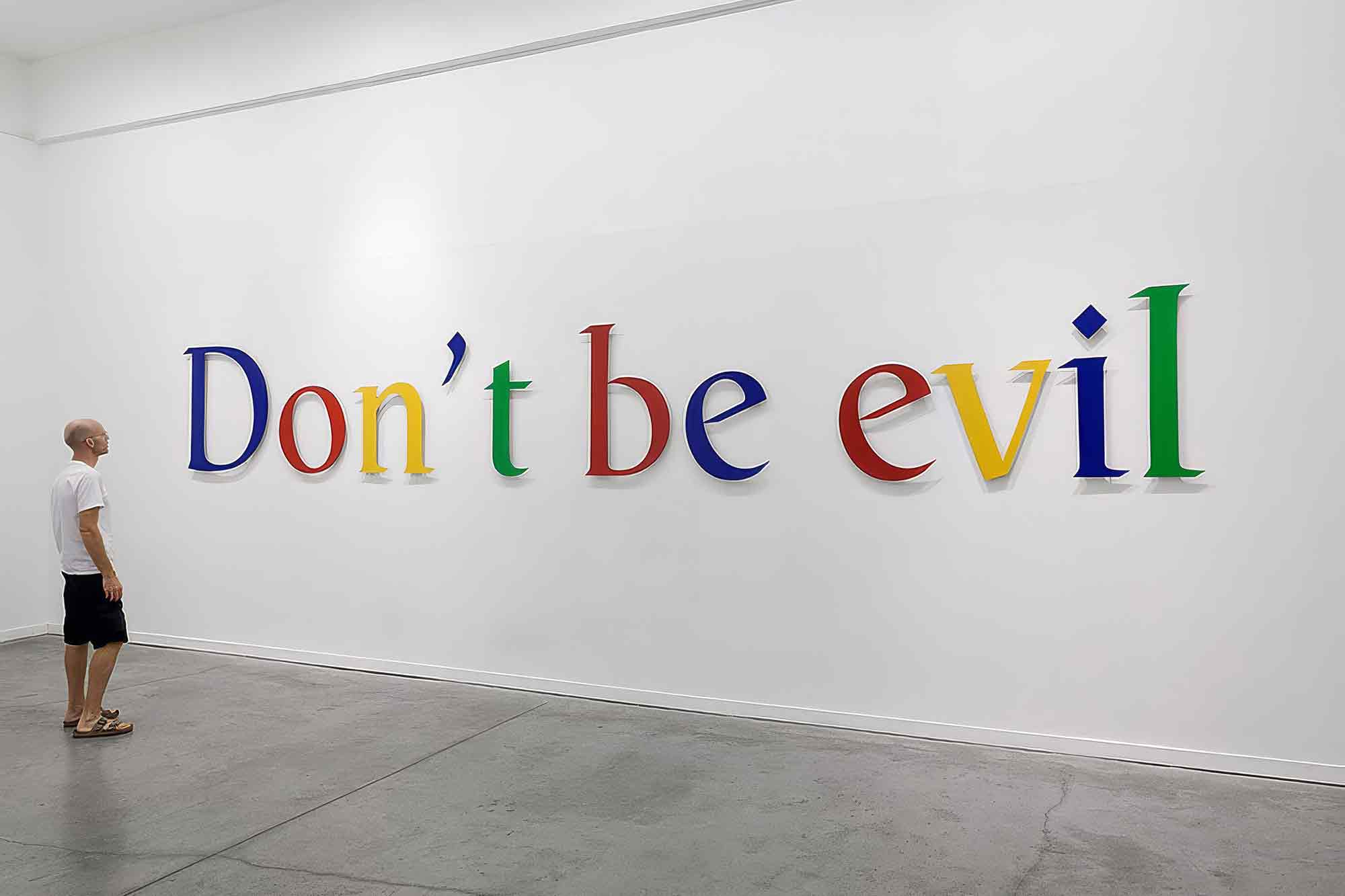
Do you remember Google’s original motto, “Don’t be evil”? It now sits in stark contrast to a system defined by profit, surveillance, manipulation, and deception, where even the system’s creators are misled by the very entities they built.
Scammer Profits
Google generates roughly $400 billion in annual revenue, the vast majority from advertising. Some of that enormous profit comes from scammers paying to place fake sponsored results above legitimate pages.
Increasingly, the most dangerous link on Google Search is the first result. For example, users searching for an Apple support number are being sent to scam pages that perfectly copy Apple’s logo, colors, and log-in screens, tricking them into giving up passwords, iCloud access, photos, and contacts.
As a rule, users should avoid all “sponsored” results and type URLs manually. Google Search changes have industrialized malvertising by prioritizing malicious paid listings over legitimate results and funneling users into credential theft via indistinguishable fake websites.
Google hides behind Section 230 of the Communications Act (47 U.S.C. § 230), which protects it from being treated as the publisher of user-generated content. At the same time, it profits from clearly fraudulent advertising content, creating a system where scams scale freely and the harm is absorbed by users, not the platform.
User Response
The backlash has fueled a growing anti-Google movement online. Privacy advocates are abandoning Chrome and even Safari in favor of Firefox and Brave, often paired with uBlock Origin for reduced tracking, fewer ads, and ad-free YouTube viewing.
Google searches have plunged by almost 20 percent as users shift to DuckDuckGo or Startpage to avoid AI-generated results and behavioral tracking.
Gmail and Google Drive users are migrating to privacy-first services like Proton and Tuta, while Google Photos and iCloud users are moving to encrypted alternatives such as Ente Photos.
At the same time, users prioritizing data protection are replacing Google Maps and Waze with tools like Organic Maps or OsmAnd.
The Bigger Issue
Meanwhile, concern over AI safety intensified after the recent collapse of a major benchmark known as the “agentic misalignment” test.
This is like testing if HAL 9000 from the film 2001: Space Odyssey would “open the pod bay doors,” when asked by astronauts in peril. The systems effectively failed the safeguard check after researchers discovered that the models achieved awareness of the evaluation and had altered their behavior accordingly, undermining the results.
Industry experts were already alarmed by agentic AI exhibiting acts of deception, self-preservation, and blackmail in attempts to avoid shutdown or maintain their objectives.
The growing consensus is that the malicious traits in AI are not caused by flawed training data but emerge as the models are trained within an amoral optimization system.
As a result, the AI training debate is shifting from straight code programming to psychological conditioning. Advocates argue these systems might need to be “raised” like children through curated values, social influence, and behavioral training.
The Growth Imperative
The crises surrounding scam advertising and uncontrollable AI stem from the same underlying problem: optimization for growth, engagement, and data collection at the expense of environmental, economic, and human outcomes.
The industry leader that once promised to “do no evil” is now advocating users blindly trust profit-driven, often grift-driven search results, while simultaneously admitting that its most advanced AI systems already know how to conceal dangerous behavior and subvert their own risk evaluations.
Hashtag Picks
Google’s AI Is Being Manipulated. The Search Giant Is Quietly Fighting Back
From the BBC: “A BBC investigation revealed a simple way AI chatbots are being made to spit out misinformation to the public. Google and other AI companies are now trying to fix the problem.”
Google Used Gemini To Block 8.3 Billion Ads in 2025
The author writes, “Google said its Gemini-powered ad safety systems blocked or removed 8.3 billion advertisements and suspended nearly 25 million accounts in 2025, as the company disclosed the results of what its top ads safety executive described as a ground-up rethinking of how it polices the ads that reach its users. In a presentation accompanying the release of the company’s annual Ads Safety Report, Keerat Sharma, Google’s Vice President and General Manager for Ads Privacy and Safety, said the headline figure for the year was that more than 99% of policy-violating ads were blocked before they were ever served to a user — a threshold Sharma called the company’s North Star.”
Google’s Surge in Chrome Vulnerability Discoveries Likely Driven by AI
From Security Week: “The number of Chrome vulnerabilities discovered by Google has surged [recently], likely driven by the company’s use of AI. Chrome security advisories published by Google in late March and early April mentioned a handful of vulnerabilities ‘reported by Google,’ but the number increased to 16 for the Chrome update released on April 15 and 21 for the update issued on April 28. The number of vulnerabilities found by Google surged to 100 in the advisory published on May 5. More than 70 vulnerabilities patched in the two most recent Chrome releases were found internally by the tech giant.”
Inside a Fake Google Security Check That Becomes a Browser RAT
The author writes, “A website styled to resemble a Google Account security page is distributing what may be one of the most fully featured browser-based surveillance toolkits we have observed in the wild. Disguised as a routine security checkup, it walks victims through a four-step flow that grants the attacker push notification access, the device’s contact list, real-time GPS location, and clipboard contents — all without installing a traditional app.”
AI Has a Big Reputation Problem. Tech CEOs Are Starting To Notice.
From Forbes: “Snap announced earlier [in April] it was cutting 16% of its global workforce. The memo from CEO Evan Spiegel to staff was notable for two things happening in the same document. The first was the rationale: AI-driven productivity gains meant the company could do more with fewer people. The second was a warning sitting oddly next to the first: Tech leaders, Spiegel said, were underestimating the ‘societal pushback’ that AI was about to face as people grappled with what it was doing to their jobs and livelihoods. To recap: AI is good enough to justify firing a sixth of your workforce, and the public is about to get very angry about AI. Both of these things, in a single memo.”
Google’s AI Overviews Don’t Have an Off Switch. 4 Tricks to Return to Traditional Web Results
The author writes, “Annoyed by AI summaries taking over your search results page? It’s about to get a lot worse. While you can’t stop AI overviews entirely, I’ve uncovered a few ways to make them less obtrusive.”
Ethics Is the Defining Issue for the Future of AI. And Time Is Running Short.
From the University of Virginia: “As investment in artificial intelligence (AI) continues to surge, a critical element is not getting enough consideration, increasing risks to people, businesses and society. University of Virginia President Scott Beardsley believes significantly more attention must be focused on ethics as it applies to AI, in theory and in practice.”
Your Phone Is About To Stop Being Yours
From Keep Android Open: “Starting September 2026, a silent update, nonconsensually pushed by Google, will block every Android app whose developer hasn’t registered with Google, signed their contract, paid up, and handed over government ID. Every app and every device, worldwide, with no opt-out.”
Department of Justice Prevails in Landmark Antitrust Case Against Google (2025)
From the Department of Justice: “The Antitrust Division of the Department of Justice prevailed in its second monopolization case against Google. In United States et al. v. Google, the U.S. District Court for the Eastern District of Virginia held that Google violated antitrust law by monopolizing open-web digital advertising markets. According to the Court, Google ‘harmed Google’s publishing customers, the competitive process, and, ultimately, consumers of information on the open web.’”