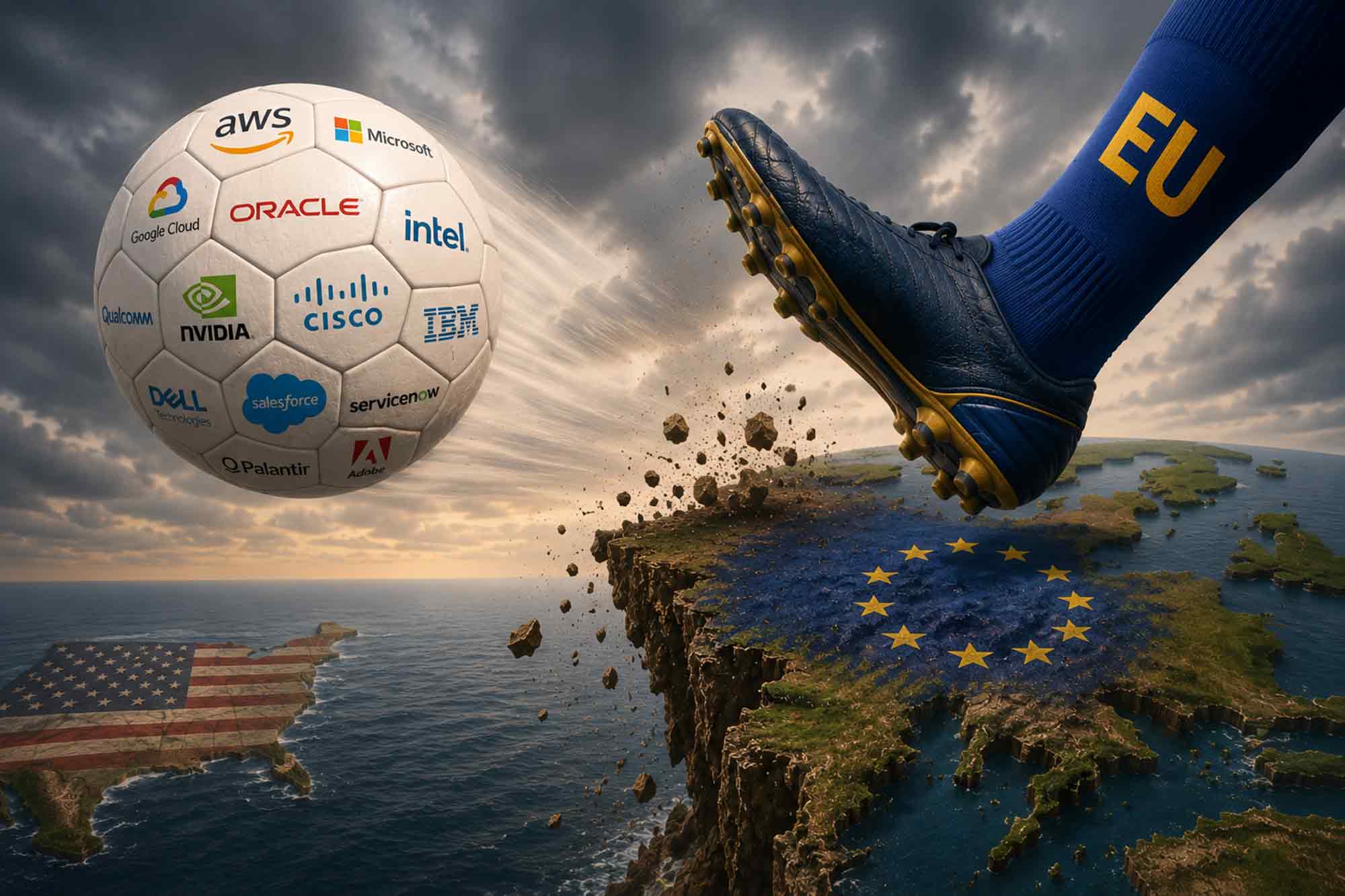
Saturday Hashtag: #EuropeExitsUSTech
Welcome to Saturday Hashtag, a weekly place for broader context.
|
Listen To This Story
 |
While the global media were reporting Donald Trump’s Beijing photo op, Europe was hitting the brakes on US tech dependence.
European governments are rapidly abandoning US technology infrastructure:
- France: 2.5 million government devices are leaving Windows.
- Denmark: The entire government is transitioning to Linux.
- Other European Union countries uncoupling from US tech include Germany, Austria, Italy, and the Netherlands.
The reason isn’t software preference — it’s digital sovereignty.
Governments are realizing that if their infrastructure runs on US clouds, an American administration can cut off access to emails, cloud storage, and banking in a heartbeat, as International Criminal Court judges have already experienced.
These dynamics also extend beyond cloud and software into broader AI compute and semiconductor dependencies, particularly NVIDIA-controlled infrastructure and US-centric artificial intelligence training capacity, which represents the deeper structural bottleneck of digital sovereignty.
This risk goes even beyond servers and cloud infrastructure, reaching into security tools, login systems, and everyday platforms like Microsoft, Google Workspace, and AWS. Together, these layers determine where data is stored, who can access it, and whether core operations continue running.
Meanwhile, Trump’s Beijing meeting with Xi yielded no policy agreements, only a weird handshake and vague promises of “settled problems.”
Strategic Shift
Europe is steadily developing a plan B digital infrastructure and sovereign capabilities, reducing long-term dependence on US-controlled cloud, software, and data ecosystems.
This shift is being driven by digital autonomy concerns (greater control over data, infrastructure, and operational resilience); rising geopolitical vulnerability (where sanctions and export controls have highlighted how digital infrastructure can be weaponized); and strategic diversification, as allied economies hedge risk by building domestic capability and alternative suppliers.
This will ripple across the global economy, reshaping:
- Technology supply chains
- Corporate revenue models
- Capital flows and market valuations
- The balance of digital and geopolitical influence
These actions are not isolated to Europe. They sit within a broader three-way industrial policy race among the US CHIPS Act framework, EU industrial strategy, and China’s parallel tech stack, each competing for control over compute, semiconductors, and AI infrastructure.
US Economic Implications
Europe’s push for tech independence could carry major economic and strategic consequences for the United States. These include:
- Revenue Exposure: Microsoft, Amazon, and Google face rising risk to billions in European public-sector and enterprise contracts, long considered stable, strategic revenue streams.
- Market Repricing Risk: Equity markets may not yet fully reflect a structural shift away from US cloud and digital infrastructure, leaving valuations exposed to regulatory and competitive pressure.
- Trade and Currency Impact: Reduced European reliance on US digital infrastructure could weaken cloud exports, slow growth in software as a service (SaaS), and shift broader tech trade flows, with knock-on effects for capital flows and currency strength.
- Erosion of Strategic Influence: US geopolitical leverage, partly anchored in global technology infrastructure, may gradually decline as Europe builds sovereign digital systems and diversifies supply chains.
- Dollar-System Spillover: International Monetary Fund (IMF) discussions on geoeconomic fragmentation highlight how shifting trade and industrial policy agendas are reshaping global integration, with implications for cross-border capital flows and financial stability.
Why Now?
The EU’s exodus from US tech was instigated by Trump’s destruction of the post-WWII establishment order through his attacks on NATO, lawless sanctions, and defiance of court rulings, reinforcing concerns that American tech and finance are being weaponized. This exposed reliance on US infrastructure as a national security risk.
Digital infrastructure has dangerously now become an instrument of state power, where sanctions, export controls, and platform access function as geopolitical leverage.
Europe’s response is clearly defensive, aimed at foreign-controlled and embedded systems that are increasingly politicized. The shift will be slow, owing to institutional and contractual lock-in; but it is now irreversible, with major geopolitical consequences.
Hashtag Picks
Europe’s Digital Independence: From Rhetoric to Reality
The author writes, “Digital technology is the infrastructure of modern economies, the backbone of military operations, and the medium through which democratic societies are increasingly attacked. It is where all of Europe’s vulnerabilities converge, and where the continent is most dangerously exposed. Whoever controls digital infrastructure controls security, competitiveness, and democracy. Today, that is not Europe.”
Build AI, Don’t Block Access: The European Union’s Digital-Sovereignty Trap
From the International Center for Law & Economics: “On May 27, the European Commission is expected to propose the Cloud and AI Development Act (CAIDA), the centerpiece of its Tech Sovereignty package. The proposal arrives at a pivotal moment for artificial intelligence. The gap between frontier AI systems and the next-best alternatives is widening, and access to frontier compute and model APIs increasingly determines who can train, serve, and use the most capable systems. That makes CAIDA’s treatment of frontier AI compute the package’s most consequential issue for European users.”
Digital Sovereignty in Europe Rests on Antitrust Battles Against US Tech
The author writes, “The European Union has a new weapon in its bid for digital sovereignty: antitrust enforcement. The 27-country bloc is seeking to gain greater control over many of its digital services, including those related to artificial intelligence, cloud computing and social media, that are currently dominated by American tech giants. Amid a generational breakdown in relations between Washington and Brussels, EU leaders now view these dependencies — similar to the bloc’s reliance on American military hardware and support — as a potential weak point in the bloc’s position on the global stage.”
European Tech Exodus: Companies Are Turning Their Backs on the EU
From Innovation Origins: “It is a battle that has been going on for years. While Brussels sees legislation as a way to protect citizens, entrepreneurs often feel it is a stifling blanket that hinders their growth. Some tech giants are turning their backs on Europe. Stricter regulations, higher costs, and geopolitical tensions are forcing companies to reconsider their position on the continent — or even to discontinue their services here. Some have already left, while others are threatening to follow suit. Which big names have had enough of Europe, and why? We list a few notable examples.”
Anduril Raises $5 Billion, as Push to Modernize the Military Accelerates
The author writes, “Anduril, the defense tech company that makes artificial-intelligence-backed weapons, said [this month] that it had raised $5 billion in new funding, as modernizing the U.S. military has become a priority for the Trump administration. The financing values Anduril at $61 billion, double the $30.5 billion that it was valued at in June in its last funding round. The latest fund-raising was led by the longtime investors Thrive Capital and Andreessen Horowitz amid talk that Anduril could try to go public in the next year. In total, the company has raised $6.82 billion through eight funding rounds from investors including Founders Fund and Lux Capital.”
Obsolescence Is the Point
From The Inflection Economy: “Technology changes quickly. Products decay. Competitive advantages can disappear. Yesterday’s winner can become tomorrow’s warning label. That’s all true, but the conclusion doesn’t follow that technology is therefore structurally bad. Obsolescence is a risk to weak technology businesses. For strong technology businesses, it can also be an offensive weapon.”
European Software and Cyber Dependencies (2025)
The authors write, “Europe’s digital ecosystem remains heavily dependent on nonEU software and cloud providers. This study maps these dependencies, as well the geopolitical and economic risks they raise. It finds that US firms dominate all major software layers, exposing Europe to strategic vulnerabilities. The report also outlines policy options and areas of action to strengthen Europe’s technological autonomy and resilience.”
The Weaponization Of US Tech Threatens Europe (2025)
From The National Interest: “As Donald Trump and Elon Musk aggressively leverage technology, intelligence, and military aid, Europe should act accordingly in defense of its interests.”