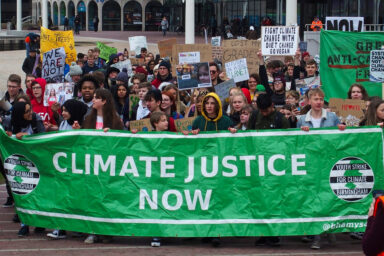
New Ways To Remove CO2 From Atmosphere Must Grow Faster, Report Warns
PICKS are stories from many sources, selected by our editors or recommended by our readers because they are important, surprising, troubling, enlightening, inspiring, or amusing. They appear on our site and in our daily newsletter. Please send suggested articles, videos, podcasts, etc. to picks@whowhatwhy.org.
|
Listen To This Story
 |
New Ways To Remove CO2 From Atmosphere Must Grow Faster, Report Warns (Maria)
The author writes, “Humanity must suck carbon out of the atmosphere with new technologies even faster than the breakneck speed with which it has deployed solar panels if it is to limit global heating to 1.5C, a report has found. Novel forms of carbon dioxide removal must grow at ‘highly ambitious rates’ to bridge the gap between what governments have pledged to clean up and what is needed to comply with the Paris climate agreement, according to researchers.”
Georgia Town’s Novel Strategy To Fight ICE Jail Plan Impresses Legal Experts (Russ)
From The Guardian: “A small Georgia town’s federal lawsuit opposing the Trump administration’s plans to turn a warehouse into one of the largest immigration detention centers in the US has the potential to create a wide impact as it uses novel legal arguments, experts said. The town of Social Circle’s complaint goes further than other recently filed lawsuits around the same issues, which assert that the US federal government has not carried out environmental impact assessments for proposed detention centers, as required by the National Environmental Policy Act (Nepa).”
Economists Set the Record Straight on Millionaire Tax Migration in New York (Dana)
From amNY: “For many weeks, a high profile debate over the economic impacts of millionaire tax migration on New York has played out in the realm of public opinion: When legislators propose tax increases for high-income earners and profitable corporations, pundits and politicians sound the alarm that New York City’s wealthy will leave. Debate on this issue reached a fever pitch with the election of Zohran Mamdani to the mayor’s office. … Recent evidence suggests the out-migration tradeoffs of raising income taxes on high earners are minimal.”
The Human Brain Consumes About 20 Percent of the Body’s Total Energy Every Day — And That Consumption Barely Changes Whether You Are Solving Differential Equations or Staring at a Wall (Reader Jim)
The author writes, “The number that gets repeated in pop-science columns is the 2/20 split (that the brain is 2% of body weight but consumes 20% of energy) — a small organ, enormous appetite — and I think it’s fair to suggest that many people are led to believe that ‘thinking’ is hard work. A recent study complicates the way that number is often understood. Neuroscientist Sharna Jamadar and her colleagues at Monash University reviewed studies of the brain’s metabolism and concluded that effortful, goal-directed tasks burn about five percent more energy than the resting state. The math just doesn’t move much when you start solving a problem. The engine is already running.”
Gray Whales Are Declining at an Alarming Rate. Why? (Reader Steve)
From The Seattle Times: “If you feel like you’ve been seeing a lot of reports lately about whales dying and washing up on Washington beaches — you’re not imagining it. Something unusual is happening. And it’s even been alarming the researchers who’ve spent their careers studying these animals. So far this year, 25 gray whales have been found dead in Washington, making this year’s count the third-highest in a half century, and the migration season is not over yet.”
In the ‘Biggest Book Giveaway in History’ WWII Soldiers Received Pocket-Sized Reads (Angelle)
The author writes, “When I was growing up, many of the dads in my neighborhood had served in World War II. True to stereotype, none of them talked much about the war. Information came sideways. My best friend’s dad, who’d been in the Air Force in China, taught us how to say ‘hot water’ in Mandarin. Another dad, an Army vet, let slip that he’d burned his uniform upon returning home, which puzzled us. And my own dad, a Navy vet, once said something about the ‘funny paperbacks’ around during the war. It wasn’t until I began researching my book on The Great Gatsby that I realized my father had been one of the millions of servicemen on the receiving end of what’s been called the ‘biggest book giveaway in history.’”