“While the future’s there for anyone to change, still you know it seems, it would be easier sometimes to change the past.” — Jackson Browne, “Fountain of Sorrow”
|
Listen To This Story
 |
Not long ago, someone asked me whether I believed people could change. Having answered “Of course they can!” I started thinking, and rethinking — and, eventually, writing. This is my answer to that deceptively simple question.
Yes, people can change — in ways ranging from the smallest and easiest (“I used to be a Met fan and now I root for the Red Sox. … I used to prefer vanilla and now I like chocolate. … I used to go to bed late and now I go to bed early…”) to the biggest and hardest (“I used to believe in the literal truth of the Bible and now I accept a scientific interpretation of the cosmos and human evolution. … I used to be an addict and now I am clean. … I used to lie to my partner about important things and now I tell the truth even if I believe a lie will protect me…”).
The world is teeming with empirical proof of this assertion. And if people couldn’t change, in ways big and small, human life would lose much of its meaning.
But — and it’s a massive but — the bigger and deeper the change, the harder the change. We often claim to have changed, or that we will change, out of fear of disapproval or abandonment. Or in order to get something. Or because we are ashamed and urgently want to change.
How often has someone said — after infidelity, abuse, theft, dishonesties of all sorts — “That will never happen again”? Only for it to happen again. The road to Hell is always getting freshly paved.For whatever reason, our claims are often aspirational and premature.
This should justify a healthy skepticism about promises of change — especially when they are instant and absolute, offered transactionally, and/or made under pressure.
We know enough to take new year’s resolutions with a grain of salt — including our own. We have reason to look for signs and await developments. Perhaps it is just a change of clothes. We’ll want to ask: If there is change, will it be enduring?
Recognize that the very changes that we want the most are likely to be the most difficult to achieve and sustain. We have agency, but we face surprisingly massive inertias. That calls for patience with and kindness to oneself as well as others — which is very different from denial or delusion. It also calls for an understanding that certain changes may be discrete leaps, while others are inherently continuous and incremental, sometimes barely perceptible.
And, of course, not all changes will be willed or for the better. Energy may give way to exhaustion, innocence to cynicism, determination to resignation, tolerance to hatred, caring to a shrug.
A life is full of growth and opportunity, but many of life’s processes are erosive — engendering changes that we may wish to resist. If we find ourselves, for example, being ground down and wearied into a chronic boredom or bitterness, how important is it to recognize that we are changing, gradually but profoundly — so we have a chance to at least put up a fight?
On the Way to Mount Doom
If you will indulge me in what may seem, at first, to be a lengthy digression, consider the following passage from Book IV of Tolkien’s The Lord of the Rings.
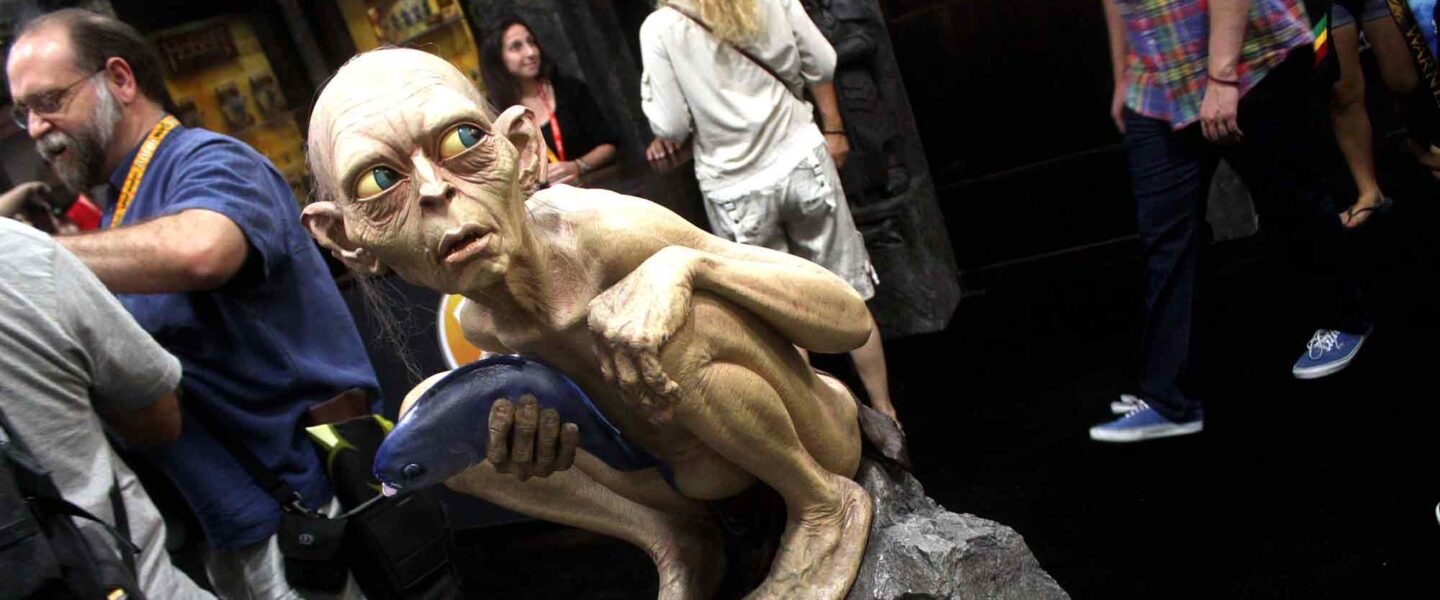
Gollum — who was “tamed” and became Frodo and Sam’s guide, leading them on their way to Mordor, still in thrall to the Ring but held by his promise on that very Ring to serve and not harm its “master” (Frodo) — has contrived a plot to lead the hobbits unawares into the den of the monstrous spider Shelob. He thinks that when the spider has killed and consumed them, he may find the Ring among her leavings — but, in his twisted, rationalizing mind, he will not have hurt Frodo.
Gollum is a near-lifelong slave to the Ring — one of its powers being to prolong its keeper’s life indefinitely without the capacity to grow or change — and one might understandably write him off as wholly evil and not to be trusted. And yet the wise wizard Gandalf has applauded the hobbit Bilbo for sparing the miserable creature when he had the chance to stab and kill him many years before — saying, mysteriously, that even Gollum might yet have a part to play, for good or ill, before the end. It is oracular advice that Frodo has kept close in mind.
We find the trio on the slopes of the mountains of Mordor heading, as Gollum knows but they don’t, toward Shelob’s Lair, a pitch-dark tunnel opening on a lofty pass. Sam and Frodo are sharing a reflective moment; things look so bleak they can’t help wondering how after-ages will remember them, if even their tale will survive.
Frodo says:
We’re going on a bit too fast. You and I, Sam, are still stuck in the worst places of the story, and it is all too likely that some will say at this point: “Shut the book now, dad; we don’t want to read any more.”
Sam answers:
Maybe, but I wouldn’t be one to say that. Things done and over and made into part of the great tales are different. Why, even Gollum might be good in a tale, better than he is to have by you, anyway. And he used to like tales himself once, by his own account. I wonder if he thinks he’s the hero or the villain? … Gollum! Would you like to be the hero — now where’s he got to again?
It’s at that point that they realize the poor, mangy, starving creature has slipped off on one of his little side trips — where, they never know. The hobbits fall asleep (they’re both completely exhausted), Frodo with his head in Sam’s lap, and that is how Gollum finds them on his return, we suspect from a meeting with Shelob. Tolkien narrates the encounter:
And so Gollum found them hours later, when he returned, crawling and creeping down the path out of the gloom ahead. Sam sat propped against the stone, his head dropping sideways and his breathing heavy. In his lap lay Frodo’s head, drowned deep in sleep; upon his white forehead lay one of Sam’s brown hands, and the other lay softly upon his master’s breast. Peace was in both their faces.
Gollum looked at them. A strange expression passed over his lean, hungry face. The gleam faded from his eyes, and they went dim and grey, old and tired. A spasm of pain seemed to twist him, and he turned away, peering back up towards the pass, shaking his head, as if engaged in some interior debate. Then he came back, and slowly putting out a trembling hand, very cautiously he touched Frodo’s knee — but almost the touch was a caress. For a fleeting moment, could one of the sleepers have seen him, they would have thought that they beheld an old weary hobbit, shrunken by the years that had carried him far beyond his time, beyond friends and kin, and the fields and streams of youth, an old starved pitiable thing.
But at that touch Frodo stirred and cried out softly in his sleep, and immediately Sam was wide awake. The first thing he saw was Gollum — “pawing at master,” as he thought.
“Hey you!” he said roughly. “What are you up to?”
“Nothing, nothing,” said Gollum softly. “Nice Master!”
“I daresay,” said Sam. “But where have you been off to — sneaking off and sneaking back, you old villain?”
Gollum withdrew himself, and a green glint flickered under his heavy lids. Almost spider-like he looked now, crouched back on his bent limbs, with his protruding eyes. The fleeting moment had passed, beyond recall.
At the Core of Modern Politics
Beyond recall. It is a crucial passage in the plot development but just as crucial a window on the author’s worldview. One is left to question the counterfactual: What if Sam had addressed Gollum kindly?
How fated is our own character — which is not subject to an author’s plan or whim? How does a child, who once played in the fields and streams, become evil and twisted? What lies behind such changes — for better or worse? One incident, an instant? Or are they so gradual as to escape notice? How does one become good or evil? And, if evil, is there any hope of rescue?
Habits and traits are demonstrably changeable, but what about at the very deepest levels, in our core? Does everyone, even a doer of great evil, deep down want to be a hero? Can, say, a Hitler see himself as anything but a hero? Are there genuine nihilists, without a gram of belief in heroism, who truly don’t care? If yes, when and how did they become so? And are even they capable of some awakening and change? Tolkien, through the ruined Gollum, seems to suggest that the capacity for change can die, but that it dies hard.
Empathy — which the protofascist Elon Musk has condemned as the weakness of Western civilization — is, I would submit, at the very core of modern politics, the most fundamental dividing line between right and left.
It’s a tough gig to be mortal and conscious — as profoundly self-aware, and aware of our own mortality, as our sapient brains make us. Nihilism exerts a strong pull, one that does not necessarily diminish with age and life experience: Our acceptance of the bargain of life, in no way self-evidently a fair one, requires periodic and indeed frequent affirmation. It requires effort and energy — as does empathy, both for others and for oneself. And we’ve seen what comes of it when nihilism wins, when a just-chuck-the-whole-thing mentality begins to prevail.
Empathy — which the protofascist Elon Musk has condemned as the weakness of Western civilization — is, I would submit, at the very core of modern politics, the most fundamental dividing line between right and left.
Where that empathy — and the effort, energy, and moral attunement it requires — is lacking, it is far easier to become evil, to inflict harm without compunction. A kind of laziness is endemic in those who have taken that path. They opt out of the hard work of life — substituting boundless wealth, fortification, imagined glories, supposed golden ages, control, and power for life’s nuances, riddles, and half-tones. Not for everyone the “dappled things” in which the poet-priest Gerard Manley Hopkins exulted. There are those for whom diversity, difference, brings terror.
Donald Trump — ironically a man of constant, convenient reversals — comes vividly and quintessentially to mind as an individual incapable of genuine change, a man to whom dapples are an anathema and nuances a threat.
He is, it would appear, an extreme example. But that is not to deny the challenge, the struggle, for the rest of us. Life is — I’ll just come right out and say it — hard. Received knowledge can take you only so far. For the rest, it’s lesson upon lesson, and lots of work. We offer what encouragement we can, whether to others or self, and we rightfully celebrate the heroism when sought changes are achieved and sustained against the corrosive forces so often encountered in life.
What About Everyone, All Together?
A very different but related question is whether humanity itself can change — that is, whether we can achieve collectively the kind of growth and development that we believe possible in individuals. And just what about us, as a species, can change?
The fate of humanity — and, given our current dominance, the very nature of the planet — rides on the answer.
When it comes to this question, there are optimists and pessimists. Harvard professor Steven Pinker is perhaps the most devoted optimist. In his 2011 book The Better Angels of Our Nature, Pinker lays out the case that human affairs have become progressively less violent over the centuries, a trend he projects will continue. He cites all kinds of statistics — and indeed there is a decline in looting and pillaging, and you are less likely to be run through by some marauding Hun, Viking, or Cossack.
But there are all those nukes (not to mention bioweapons) to work around. So it’s an intriguing view but one that does not especially comport with casual observation. In their 2016 book Do Humankind’s Best Days Lie Ahead? The Munk Debates, Pinker and climate change skeptic Matt Ridley take on Malcolm Gladwell and Alain de Botton, who hold the gloomier view that we’re pretty much screwed.
Anyone familiar with my writing can hazard a wild guess as to which side I come down on.
I go with Isaac Asimov, the great humanist-futurist who lamented, “The saddest aspect of life right now is that science gathers knowledge faster than society gathers wisdom.”
Would anyone care to argue that our species’s collective wisdom is growing at more than a creeping pace, if at all?
To me, that’s it in a nutshell. Humanity is changing at an ever-accelerating rate (geometric in some areas, exponential in others) when it comes to technological advances. Many of these bring more comfort, convenience, and indeed more life (i.e., longevity). But others — whether the invention of gun powder, the splitting of the atom, or the synthetic biology of bioweapons — bring immensely greater power to destroy.
Often enough, the same advance brings both, with the upside being irresistibly seductive.
And still other “advances,” not directly destructive, are so powerful as to upset natural balances on a large scale and threaten habitats and survival for countless other species that share our planet. Think combustion engines, chemical fertilizers and pesticides, rainforest decimation, plastics in the ocean, carbon dioxide and methane in the air, etc.
And then, of course, there’s artificial general intelligence (AGI) — which some declare is “inevitable,” others just “unavoidable.”
The constant here seems to be a relentless growth pressure. A stable equilibrium does not seem to be among our options.
And when push comes to shove, we still seem perfectly capable of (if a bit more circumspect about) slaughter — with weapons and devices that threaten it on a mass scale that the Dorians, Huns, Vikings, Prussians, and all the other tribes that have been, could not hope to come close to matching.
We talk in terms of forever and eternity, but it is hard — verging on impossible — to imagine how perpetuity and technological acceleration jibe.
Pinker cannot wave away Hiroshima and Nagasaki, and although he might suggest that we learned a great lesson there, it is a stretch to assume that that lesson will stay learned, forever amen. It’s been a mere fourscore years since those bombs fell, and we have teetered on the brink of a reprise several times in the wake of that horror — a reprise on cataclysmic steroids.
Because what we did in the Nuclear Age is build more bombs and vastly more powerful bombs (not to mention bioweapons) — enough to destroy civilization many times over. You can all but feel the biosphere holding its breath.
We are comforted by the concept of mutual assured destruction (MAD), but that constraint requires fully rational actors all acting with the global interest first in mind. Does Vladimir Putin fit that bill? How about Trump? Perhaps we should ask Dr. Strangelove. What are our chances of making it through another century? Another millennium?
We talk in terms of forever and eternity, but it is hard — verging on impossible — to imagine how perpetuity and technological acceleration jibe.
Power seems too often to favor the driven, the ruthless — to favor testosterone. And to get to our sought-for state of human perfection — a world at peace, in which humanity assumes a benign and ministerial rather than magisterial role on Earth — it’s pretty clear we’re going to have to get through centuries of that power dynamic, with ever-increasing capacities to destroy in the hands of all-too-fallible individuals.
I have wondered since my college days whether this is the inevitable fate of all life-forms — that once they evolve into consciousness, their days are numbered.
Does consciousness, for all its glories, bear within itself the seeds of its own destruction?
Fermi’s Glib Question
The cosmic evidence for that trajectory is sobering. The great physicist and cosmologist Enrico Fermi once brought a roomful of his colleagues out of their afternoon naps with a “playful” question: Where are they?
The Fermi paradox asks why, if the cosmos is teeming with life as many scientists believe, we have observed not a single sign of it: no visitors, no artifacts or signatures, no decipherable or undecipherable radio waves bearing traces of coded information — nada.
One highly plausible explanation is that the interval between a life-form’s first capacity to broadcast its existence through space to its loss of that ability, in what would have to be something like a “bombed back to the Stone Age” scenario, is a cosmic blink — leaving an extremely small proportion of civilizations on the billions of viable planets “visible” to us (in the sense of capable of projecting their existence out into the cosmos in any discernible manner) during this equally brief blink during which we have the capacity to detect.
What if, one might logically respond to Fermi, the cosmos is teeming, but in the very evolutionary instant that any of that teeming becomes cosmically visible, it is fated to self-extinguish?
What if — to put some numbers to it — after 4 billion years of leisurely terrestrial evolution, a planet’s Cosmic Age, during which its inhabitants could pitch coherent signals out to its galactic neighbors, lasted, say, a thousand years? That would mean, if such were the cosmic norm, that out of 4 million “Earths” out there, at varying stages of evolution, we’d “see” signals from only a single one.
We’d be looking for a needle in a cosmic haystack. (Those interested in more precise calculations may wish to reference the Drake equation and the Kardashev scale.)
And indeed, in the case of Earth, life has been evolving for billions of years, while our ability to broadcast our existence is less than a century old. How much longer will it last?
The two capacities — to communicate cosmically and to destroy terrestrially — seem fated to co-evolve virtually in lockstep.
Because the exact same discoveries and technological breakthroughs that are giving us the capacity to send information-bearing electromagnetic radiation out to the stars (and receive it) have also given us the nuclear bombs (and bioweaponry and global warming) and the capacity to destroy ourselves and end that brief moment of cosmic visibility.
The two capacities — to communicate cosmically and to destroy terrestrially — seem fated to co-evolve virtually in lockstep.
How quick will our blink be? And is there any good reason to assume that Earth is atypical in this respect? Because if we are not typical — if civilizations, having finally reached our level of first individual consciousness and then collective technological advancement, stuck around for a long time, long enough to far exceed, at the current geometric rate of advance, our current capacities — wouldn’t we see them?
Call this the dark side of the Fermi paradox, the grimmest of answers for anyone taking bets on humanity’s future.
What a Piece of Work
We know that, collectively, we can achieve huge changes in knowledge and the powers that it brings. But it’s hard, based on everything we see, to argue with Asimov’s observation that wisdom lags far behind.
Will we somewhere, somehow find the wisdom to understand and subdue our hostilities, our collective greed, our seeming addiction to limitless growth, our territorialism, our tribalism, our blinders, our seeming death wish? Will we begin to value the balances of nature or simply continue to manipulate them for our own immediate comfort and convenience and entertainment?
The signs are not good:
We continue to kill — and dominate by the threat of mass killing.
We continue to pollute and heat the planet, while those whose self-interest drives them to deny it seem to prevail politically in slowing and crippling our response to the mounting crisis.
We continue collectively to shrug as species die off at a rate rivaling if not far exceeding every previous mass die-off.
And we continue — with periodic profound artistic exceptions — to applaud ourselves for being such advanced beings, such deep thinkers, such good stewards, such clever inventors, such decent sorts.
The planet’s most powerful and “advanced” nation elected one of its very stupidest and most psychologically deficient citizens to lead it and wield its vast powers, and then — having seen him at work for four years and having witnessed his attempt to overthrow the government and its very basis in electoral democracy — reelected him. Make of that what you will.
I don’t often turn to quotes from observers unknown to me, but I don’t think I can put it better than did one Anthony j. Santo in the course of a comment posted to a Steve Schmidt piece on the perfidy of CBS News Editor-in-Chief Bari Weiss:
We humans, extolling ourselves as the special creations of an omnipotent God, are the cruelest and most destructive life form to evolve on this planet. Our capacity for evil seems unlimited.
Sadly, reluctantly — and with the marginally relevant gloss that we also have an immense capacity for good, and the good we do is far more apt to be taken for granted — I agree.
Leave it to Shakespeare, that keenest of observers of all things human, to put it better, more ironically, musing through an embittered Hamlet: “What a piece of work is man, how noble in reason, how infinite in faculties.”
Try swapping “man” out for AI, now being developed at breakneck speed and abetted by an administration actively seeking to prevent regulation, as Silicon Valley billionaires vie to become trillionaires, vast data centers drive up energy costs, nations prep for wars over “rare earths,” video deep-fakes turn facts and reality into whatever suits one’s agenda or worldview, mass job displacement and unemployment loom, and experts argue whether sapient computers will ultimately decide they’re better off altogether without us humans. (I don’t know about you, but it’s enough to make me, like Hamlet, lose all my mirth.)
You’ve got to wonder whether life anywhere in the universe is any smarter — or any “gooder.”
What solution is there for our core problem: centrifugality, our relentless need to expand — ironically, to change?
To some of our rolling and pending technological disasters there may indeed be technological solutions (though our track record is that many such “solutions” serve only to engender new problems).
But what solution is there for our core problem: centrifugality, our relentless need to expand — ironically, to change?
Does a chronic, subliminal discomfort (I have long wondered whether it might be rooted in the physical imbalances and tensions concomitant with bipedalism — intimately linked, as it is, with the development of consciousness — which is a subject for another column) drive us outward, forward, upward, away from ourselves at rest? Is that the life principle? Having eaten of the biblical apple, is that our fate? Is it, like AI, “inevitable”?
We seem to need ever more room in every dimension. Will that mean following Musk’s vision and getting off the Earth? And won’t we just take our ways with us?
Is it fundamental to human nature that this will never change? Or, to paraphrase John Wilkes Booth, Sic semper hominibus?
Well, it’s 2026. Ring in the whatever!