Why I Think Most Media Stink
From watchdog to lapdog, the media traded their bite for a leash.
|
Listen To This Story
 |
— OPINION —
Et tu, Atlantic?
All sentient beings know that the legacy media have failed us and failed us big-time. This is the most fraught period in American history, save for the Civil War.
Everything we have held dear is at risk. The situation calls for alarm. It calls for action. It calls for every decent corner of the country to thwart the menace.
But what have the legacy media given us? Tiresome drivel about the Democratic Party in “disarray” and its need to moderate (you want to talk about moderation, how about the fascist party in the White House, Congress, and the Supreme Court?), and scarcely a peep about our sleepy, corrupt, lying, ignorant, felonious, hateful, and vengeful president, or about what should be the biggest story of the era, blasted from headlines daily: the ruination of America.
This is our Hitler era. And yet, you read the papers and magazines or watch television news, all of which were in paroxysms of hysteria over Joe Biden, and it seems like business as usual.
While many Substackers and organs on the left are doing their jobs, the big media are asleep at the wheel.
Some stories just disappear. Whatever happened to the Epstein files? Why haven’t the unredacted files been released, despite a law ordering the Department of Justice to do so? Whatever happened to the tales of Trumpian grift and of the pardons issued to criminals who in one way or another assisted Trump in his depredations?
What has been happening in Gaza since the so-called “truce”? When was the last time you read about American attacks on Venezuelan fishing boats or about Venezuela at all, for that matter? Why haven’t the media followed up on the Haitians denied Temporary Protective Status, other than reports that they have been outfitted with ankle monitors?
And why have the media lost interest in the deaths flowing from Trump’s termination of the US Agency for International Development, an action that, according to estimates, cost 750,000 lives in its first year and will cost 9.4 million lives by 2030? There should be a ticker on the front page of our newspapers each day recording the toll. This is blood on Trump’s hands and ours.
And those are just a few of the stories that have vanished. Other stories — important stories — aren’t even covered.
Still, I was unprepared for this month’s cover story in the modestly liberal Atlantic titled “Why I Quit the Tenure Track.” Its author, a young Black former academic named Tyler Austin Harper, complains about Bates, his small liberal arts college in Lewiston, Maine, for indulging all the awful excesses of liberalism — what, in a follow-up piece in The Atlantic Daily, he would call “incandescent liberal hypocrisy,” not least of which was tokenizing him and the worst of which was threatening to tenure unqualified minorities. (Having spent a good deal of my life in academia, I have some news for Harper: It was never a citadel of meritocracy; it was only that whites were allowed to be incompetent because there were no minorities on the faculties.)
By article’s end, Harper’s sally included the comparative dearth of conservatives on those college faculties, as if minority representation and ideological representation were somehow equivalent.
It was an article that could have come directly from the Trump administration — an article that played to every conservative, MAGA prejudice about DEI, sounded by a man who seems to want kudos for displaying the extraordinary courage to leave his tenured position because he just couldn’t tolerate wokeness. The world is coming apart at the seams under the fury of fascism, and liberalism is the problem? In The Atlantic!
Pawning a Backbone for a Backstage Pass
I don’t mean to pick on The Atlantic. (Actually, I do, but it is unfair.) I mean to cite it as an example of the deficiencies and misplaced priorities of our most influential media and the way in which those media have abdicated what I see as one of their primary responsibilities: to serve the public interest.
I could just as easily have cited numerous derelictions and distractions by The New York Times, The Washington Post, the major television news outlets, and any number of magazines. (Forget social media, where the sins stretch to infinitude.) To put it honestly, if indelicately, they pretty much all stink when you consider what’s at stake — which is, as I said, everything.
We know some of the reasons they stink, even when the urgency is so apparent. The media are largely owned by oligarchs who appease Trump either because he is one of them and will let them skirt the democracy that threatens them or because they are afraid of what Trump would do to them if they were to cover him the way he deserves to be covered: ruthlessly.
Think Jeff Bezos or David Ellison, one of whom eviscerated The Washington Post, and the other of whom eviscerated CBS News and will soon, no doubt, eviscerate CNN — should his takeover of Warner Bros., within which CNN resides, pass judicial muster.
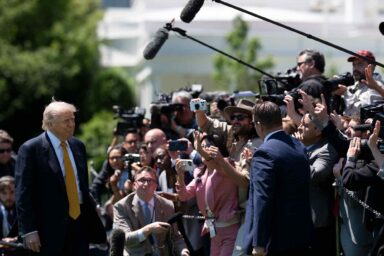
And it isn’t just the oligarchs. There are the reporters themselves, many of whom are no less eager to capitulate to Trump than their overlords are. Reporters need access. Trump and his sycophants are unlikely to grant access to challenging journalists. So journalists are afraid, too, of being ostracized.
I don’t remember who said it, but one press critic called upon some intrepid reporter to stand up and ask Trump, “What the f**k is wrong with you?” Don’t hold your breath waiting for that.
Related: “What Everyone Wants to Know About Donald Trump but Is Afraid to Ask”
But none of this, I think, really explains why a paper like the Times — which is easily the most powerful and influential media organization in the world and one that surely has enough muscle to go toe-to-toe in a slugfest with Trump — instead treats him so gingerly, basically following the Supreme Court’s modus operandi of rapping Trump’s knuckles on one or two things (say, in the Court’s case, tariffs), knowing full well that Trump can find a workaround, so that they have some form of plausible deniability against being perceived as in his pocket.
The Times, to its credit, has its occasional investigative pieces on Trump — their form of rapping his knuckles — but in its day-to-day news coverage he usually escapes. Nothing he says or does — however heinous, however outrageous, however psychotic — ever seems to merit the headlines it so clearly warrants and would warrant for any other president.
TRUMP INSANE. Nope, I don’t recall that headline.
But while the media that create the narratives that most of us follow, and the narratives that largely define Trump and his Republican accomplices, may accede to him to get Trump’s rewards and avoid his retaliation, I think what may really explain their timidity is not necessarily fear of Trump. It is another kind of fear — one that many of them seem to take more seriously even than that of Trump (and this may be even truer of a publication like The Atlantic than of the Times): fear of right-wing accusations that they are hopelessly partisan, which would imperil the sacred pretense of objectivity.
No self-respecting journalist wants to seem to be in the tank for one side or the other. And the key is “self-respecting.” Because the legacy media are nothing if not self-respecting; they like to tell themselves that they are pristine.
In short, the real media problem may not be Trump or even the right wing. It may be journalistic above-it-all hubris.
Saving Face Instead of the Country
One way of looking at it is that it wasn’t so much the media that changed as the culture. Though we may think of the pre-Trump Times and the Post as having been liberal papers, and though we like to think of broadcast network news as left-centrist, they all usually gravitated toward the middle — what was called the “liberal consensus” — not liberal in the political sense but in the looser sense that nearly everyone, among politicians and citizens, accepted certain basic precepts of a liberal democracy and shared a certain sense of what constituted facts.
The middle was safe, and it was soft. Self-respecting journalists — again — didn’t want to be labeled as partisan. Neither did most self-respecting newspapers or magazines or broadcast news networks. (There was a place for partisanship in the tabloids and on the editorial pages and later in cable television.) As an economic proposition as well as a political and cultural one, the middle was where the audience was.
It would take a major scandal like Watergate to move the needle — that is, to get the media to take an active rather than passive role in news coverage, to take a stand — and it was largely because Richard Nixon’s transgressions were viewed negatively by the middle.
As long as the center held, so did public trust in the media. CBS News anchor Walter Cronkite was frequently called the “most trusted man in America,” not because he pontificated but precisely because he didn’t. He read the news. He didn’t comment. He seemed to operate with objectivity. What he said was accepted as fact.
When he finally questioned the path of the Vietnam War in February 1968, it was a signal moment in both the conduct of the war and in American news. Cronkite took a position! Afterward, President Lyndon B. Johnson was said to have lamented, “If I’ve lost Cronkite, I’ve lost middle America.” Exactly. A month later, Johnson announced that he would not seek reelection.
But, as we are now all too cognizant, under the pressures of an aggressive conservatism and other social forces, the liberal consensus cracked. The country divided. The middle disappeared.
The post-Johnson years were fractious. The Reagan years even more fractious. And the Trump years most fractious of all — resulting now in what can only be called a cold Civil War. And it wasn’t only our political life that Trump disrupted. Or even our moral life — the morals that had held the consensus together.
The basic rules of journalism were disrupted too.
That’s because, as we are also all too cognizant, Trump isn’t like any other president. He doesn’t operate within the traditions of either the presidency or politics. He disdains decorum. He has contempt for the very institutions of government. He actively demonizes a sizable portion of the country — women, Blacks, Hispanics, immigrants, liberals, Democrats — and reads them out of the national family.
And he hates the press, presumably because he thinks he might not be able to control them. Like most dictators — and Trump certainly thinks of himself as a dictator — he regards the press as his enemy. So do his fellow Republicans, who keep insisting that the press has a liberal bent when basically it is “reality,” as Stephen Colbert once quipped, that has a “well-known liberal bias.”
The legacy media were flummoxed by Trump. They didn’t have any real precedent for this kind of president and this kind of political and cultural ecosphere, and they didn’t have many options for dealing with it.
They could keep doing what they had always done — hew to the middle, even though now there was no middle to which to hew.
Or they could normalize Trump, treat him as if what he did was not so far outside the political bounds — as if he were just another president with another set of priorities and policies — and when he did something especially reprehensible, just ignore it.
Or they could acknowledge Trump’s abnormality but balance it against the missteps of his opposition, always keeping an equivalence between our contending political forces. If Trump had mismanaged the economy and the war and deportations, well then, Democrats were in “disarray” and were drifting dangerously toward “socialism”; if Trump was mentally unstable and deteriorating, well then, Biden had been feeble and senile (a veritable mantra at the Times in 2024); if Trump was racist and misogynistic, well then, Democrats were “woke.”
Or they could take Trump on, note all the ways in which he wreaked destruction and meted out cruelty, and report the undeniable fact that he was a narcissistic megalomaniac who was determined to destroy democracy and impose dictatorship.
As it turned out, the legacy media tried the first three serially and alternately (they still do) but not the last — never the last. That would have been rank partisanship. That would have broken the rules to which the legacy media had long adhered. That would have been descending into the battle rather than remaining above it. That would have been taking sides — the great journalistic sin.
And the media had to stay above the battle, even when the battle was for the soul of America, as it would be.
But in doing so, they confused objectivity with neutrality and fairness with “both-siderism.”
I suspect that is what happened at The Atlantic when they decided to publish Harper’s piece on the foolishness of DEI, and I can only imagine the editorial meeting at which that decision was made.
They surely realized that they were playing right into MAGA’s hands. They surely realized that they were going to get blowback from a liberal readership. They are anything but stupid. But by playing into MAGA’s hands, they were demonstrating their superiority to MAGA — and to liberals — by showing that they are evenhanded, able to scold both sides, especially since they had spent a lot of ink deriding Trump; and by showing their willingness to give conservative arguments their due.
I have a feeling they felt they were brave running that piece. I have a feeling they were proud of publishing it, that they took every brickbat that was sure to come, like mine, with an assurance that they had done the right thing, the principled thing — even though, by the standards of public service, which is to save the country from the dangers of MAGA, they were doing the wrong thing. (This isn’t even addressing the argument of the piece, which I think is self-serving and dubious.)
And I imagine that same scenario playing out in lots of newsrooms. Are we picking on Trump and letting liberal Democrats off the hook? More, are we damaging our own reputations? Liberals, admittedly, may be given to self-righteousness. But so are editors and reporters. Better to save their self-respect than their country.
Rewriting the Rules of Engagement
So what do we do? I try to resist prescriptions in this space, preferring analysis; but our current media crisis requires not just criticism but a stab at correction. Here is mine.
Clearly, the old rules don’t apply anymore. Americans scarcely agree on facts, much less truth. Balance doesn’t work, either, when you have two sides that are in no way balanced — one that promotes fascism, the other that promotes democracy. And, God knows, you can’t just pretend that Trump is normal, though the media do.
So the first thing I would recommend is that the legacy media actually choose a damn side for a change.
Dante reserved a vestibule outside hell for what he called “trimmers” — people who wouldn’t take a stand and are so indecisive that they are neither in hell nor in heaven. Hence the vestibule.
Right now, our legacy media would belong in that vestibule. They are like idle bystanders on the grass watching the house burn down. Since Trump is indefensible, it shouldn’t be too hard to cast away neutrality for articles that show his weaknesses, his duplicity, his cruelty, his greed without also having to cast away facts. It should actually be pretty easy. The facts tell the story. There aren’t two sides here.
Second, I would say that the media should be relentless.
Not a day passes when Trump doesn’t commit some unconscionable action or say something deplorable. The media should never shy away from covering these. They should declare them boldly, every single day, in headlines if need be. They should never give him a pass. (Nor, I might add, any public figure who deserves opprobrium.)
I realize this kind of coverage may exhaust Americans. I realize it because it exhausts me. I have to brace myself for Trump’s daily abuses. But if we may be excused for being exhausted, the media must never claim exhaustion in exposing the ills and the threats and the dangers of this government. That is their job. That is their duty. That is their reason for being when times demand it.
Third, the legacy media should embrace what so many of the small, adversarial media have: passion.
Passion Over Posture
We don’t need detachment. This is no time for detachment. This is a time to care. Passion, however, is more than taking sides. It is showing that the media are invested in what is going on, and it is expressing that what Trump is doing to the country matters to them as much as it matters to us.
I am sure that in newsrooms across the nation, editors and reporters disdain passion, as if it would undermine their cherished objectivity and neutrality and balance. Without passion, however, the news is listless and heartless. Without passion, we have AI.
And alongside passion, I would say, finally, that we need a heavy dose of morality in our media.
I am sure that the idea that morality should infuse every article that is published would be anathema to the custodians of the legacy media as well. Again, I strongly disagree.
In a new journalism, morality should always be a subtext. Every reporter should ask himself or herself what are the moral consequences of the subjects and incidents about which he or she writes.
And to those who say this would be impossible, that there is no single morality, I say that is an excuse for not embracing the kind of journalism one should be doing. There is a morality, and just about every one of us knows what it is. And if you are working in a newsroom, you should certainly know what it is or you should find another job.
Just imagine a journalism that held Trump to account for his unnecessary war or his savage treatment of immigrants or his unprecedented grift or his racist attacks on DEI. These aren’t just news issues. These are matters of high moral import. They should be treated that way.
If these rules — or call them attitudes — had been in place in 2016, perhaps there never would have been a Trump presidency, and America would have been all the better for it.
The media stink, but it isn’t too late for a reckoning and redemption, however naïve that may sound. We don’t need self-righteousness. We don’t need trimming. What we need is a media that are honest, passionate, and moral, and one that might help us recover a nation that was once honest, passionate, and moral too.