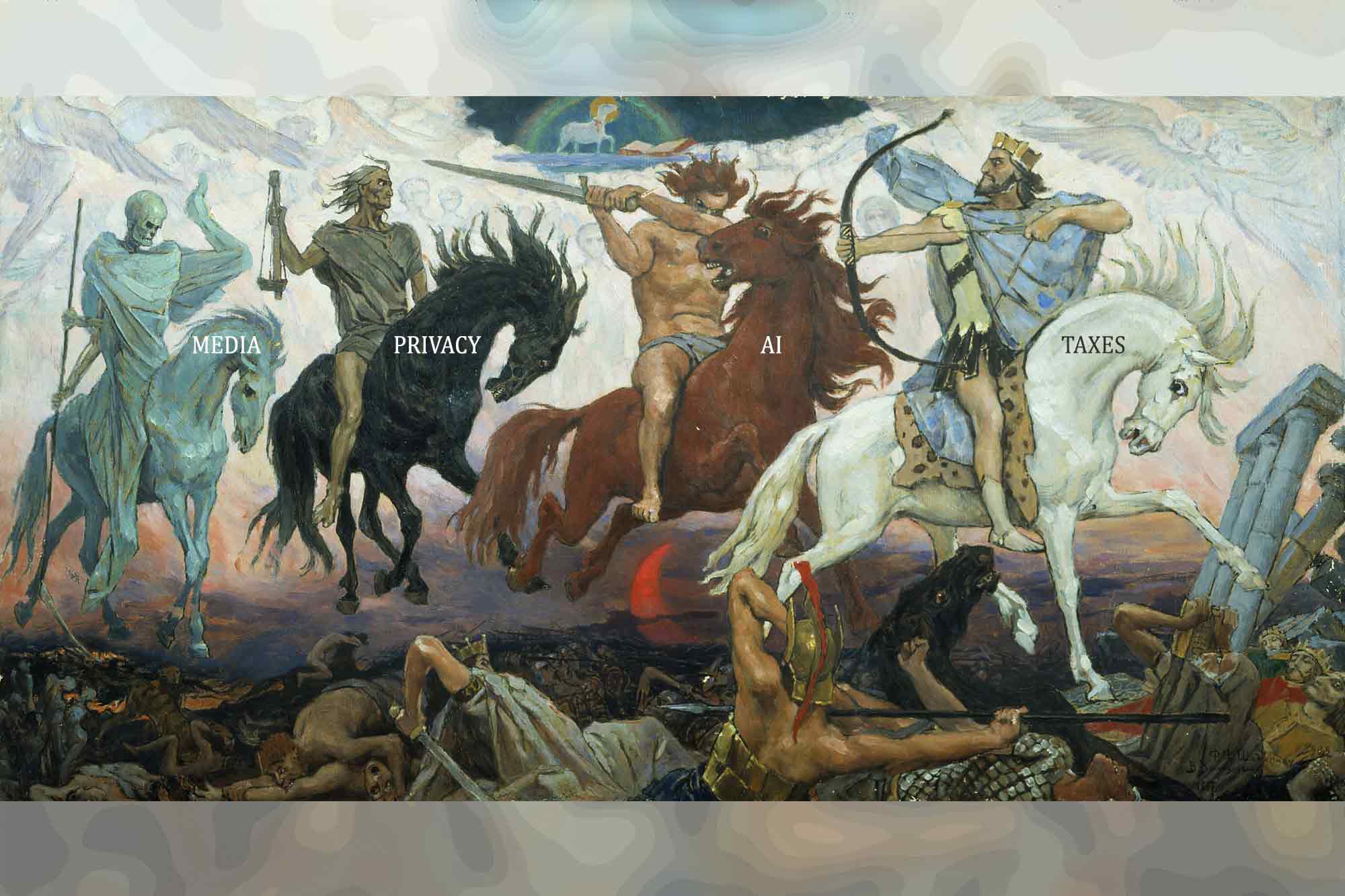
Saturday Hashtag: #4HorsemenOfInequity
Welcome to Saturday Hashtag, a weekly place for broader context.
|
Listen To This Story
 |
The pending elections offer an opportunity to consider several of the most important questions about the role of government in a changing technological and economic landscape.
Although these questions arise in different policy areas, they share underlying tensions that merit closer examination.
- Media regulation in the age of social media
- Privacy regulation in the age of total surveillance
- Artificial intelligence regulation in the age of publicly funded infrastructure and technology
- Income taxation in the age of preferentially treated asset-based income
The fundamental questions at the core of these issues concern systemic structure and the spirit of the law — both shaped by the regulatory frameworks governing them.
Examining the existing legislation in each of these four areas reveals how their purposes have been subverted and how the system’s underlying structures have been altered.
1. Media
The original media laws were intended to place the mass dissemination of information within a framework of public oversight and accountability, guided by the public interest.
- Communications Act of 1934
- Fairness Doctrine (1949)
- Public Broadcasting Act of 1967
- Telecommunications Act of 1996
Private commercial interests have used public funds, infrastructure, and technology to create a private media ecosystem that is now integral to the function of modern life.
The entities controlling it are allowed to operate outside the publicly regulated framework that has historically governed mass media.
These entities have created the appearance of a free, publicly regulated forum and marketplace, when, in reality, it is privately controlled.
Commercial interests, rather than public regulators, now determine not only how businesses operate and the scope of free speech but also what information is disseminated to the public.
2. Privacy
The original privacy laws were intended to protect the private lives of US citizens from unwarranted intrusion by governmental or commercial interests.
- Fourth Amendment
- Omnibus Crime Control and Safe Streets Act — Title III (1968)
- Privacy Act of 1974
- Electronic Communications Privacy Act of 1986
In the surveillance economy, ordinary life generates a record of all your behavior. Commercial interests have turned publicly funded infrastructure and technologies into systems that strive to penetrate every aspect of private life.
For example: Muse, Meta’s AI agent, builds detailed profiles of you and all the people you know. It collects where they live, their birthdays, interests, and relationships; updates that information; and even guesses goals you haven’t said out loud.
From toasting bread and driving a car to walking a grocery aisle or standing in your own yard, basic life now requires countersurveillance measures.
Privacy has been transformed from a protected sphere into a source of perpetual data to be collected, analyzed, and monetized — practices that defy the tenets of the Fourth Amendment.
The goal of both corporations and government, in the Information Age, appears to be information for me (Big Brother), but not thee.
3. AI and Copyright Law
The original copyright and intellectual property laws were intended to protect creators’ rights and establish a framework for the use and ownership of intellectual works.
- Copyright Act of 1790
- Copyright Act of 1909
- Copyright Act of 1976
- Digital Millennium Copyright Act of 1998
And in the age of AI, commercial interests have used publicly funded research, technology, and infrastructure to capture the bulk of human-developed knowledge and cultural production, converting it into privately controlled and monetized content, in violation of existing copyright laws.
4. Income Taxation
The original income-tax laws were intended to broadly tax all earnings to regulate economic power and create publicly managed funds for the benefit of the domestic population.
- Revenue Act of 1913 (The Underwood Tariff)
- Revenue Act of 1935
- Internal Revenue Code of 1954
- Tax Reform Act of 1986
- One Big Beautiful Bill Act of 2025
Over time, financial interests have developed structures that shield enormous amounts of accumulated wealth from the tax system by deliberately distinguishing between forms of earnings, even when they produce the same outcome: economic power.
The spirit of these earlier laws is no longer reflected in today’s legal system. This disconnect is particularly evident and consequential in taxation, where modern tax policy favors wealth accumulation over the original legislation’s public-welfare objectives.
The Erosion of the Public Interest
Across media, privacy, AI, and taxation, laws meant to put the public first have been hijacked by commercial and covert financial interests, turning public resources into instruments of private profit.
Donald Trump and his oligarch acolytes have supercharged this corruption, accelerating the privatization of public interests while dismantling accountability and protections.
The problem is systemic: Laws are being subverted by political agendas, corporate greed, and technological power.
These midterm elections present a choice: Will we continue to let financial and political interests manipulate government for private gain, or will we reclaim the law to protect the public interest, individual rights, and economic fairness?
Hashtag Picks
Reinvention Blueprint No. 3: To Unmake the Surveillance State, Rethink the Privacy Act
From Just Security: “Federal, state, and local law enforcement agencies now operate against a backdrop of nearly limitless access to data. Networked cameras, sensors, and applications can keep tabs on our locations and identify our faces. Social media, search engines, and other online service providers capture records of our communications and relationships. Retailers and airlines collect information about what we buy and where we travel. All of these sources are useful to — and increasingly used by — law enforcement agencies. Federal privacy law has been of surprisingly little help to those hoping to constrain surveillance abuses.”
Trump’s AI Accord: Can Voluntary Self-Regulation and Independent Audits Protect Against Frontier AI Risks?
The author writes, “On September 29, President Trump brought together many of the leading executives in artificial intelligence for a White House meeting focused on the risks associated with increasingly powerful ‘frontier’ AI systems. The meeting produced a one-page document entitled the ‘White House Accord on Super Intelligence, Joint Commitment on Frontier Responsibilities.’ The accord was signed by Trump and executives from Anthropic, Google, Meta, OpenAI, Nvidia, and xAI. … The agreement is noteworthy not because it creates a new legal requirement, it does not, but because it represents a significant endorsement by some of the world’s largest technology companies of a familiar regulatory concept: companies should establish internal controls, subject those controls to independent testing, and have their boards oversee the process.”
State Laws for Social Media
From the Age Verification Providers Association: “As of August 2026: at least 21 states have enacted laws addressing minors’ social media access, addictive feeds, age-appropriate design, or closely related online-safety obligations but litigation has left the landscape split between (a) laws currently enforceable, (b) laws enjoined, and (c) laws enacted but not yet in force (or awaiting rulemaking).”
2026 Copyrighted Content Usage Trends Report
The author writes, “Copyright awareness inside large organizations has stopped improving for the first time in a decade, just as AI has become the fastest route for third-party content to move beyond its licensed use. Outsell’s 2026 research for CCC quantifies the new exposure and what content owners can do about it.”
Markets Drive Record Wealth As AI Raises the Stakes
From the Allianz Group: “The 17th edition of the Allianz ‘Global Wealth Report,’ which puts the asset and debt situation of households in almost 60 countries under the microscope, shows that global household wealth hit a new record in 2025, while market gains and the rise of AI are making asset ownership increasingly important in determining who benefits from future wealth creation.”
Inflation Is Outpacing Wage Growth Again, Squeezing Americans’ Paychecks
The author writes, “Americans face a renewed squeeze on their paychecks as inflation once again rises faster than wage growth, putting further pressure on consumer wallets. ‘A substantial number of Americans are worse off, their incomes are not keeping up with the price increases right now,’ Heather Long, chief economist at Navy Federal Credit Union, told CNBC. Consumer prices rose 3.4% in August from a year earlier, according to data released [in September] by the U.S. Bureau of Labor Statistics.”
Distressed US Leveraged Loans Hit Pandemic-Era High, With Tech Leading the Way
From Quartz: “Distressed U.S. leveraged loans have climbed to levels not seen since the early months of the pandemic, with technology companies accounting for the largest share of the pressure.”