Rare earth minerals, weapons, consumer goods, and chips join oil as sources of the kingdom’s regional and global leverage.
|
Listen To This Story
 |
When Saudi Crown Prince Mohammed bin Salman visited Washington, he shifted multiple paradigms.
In an increasingly multilateral world, Prince Mohammed, backed by US President Donald Trump, suggested that the kingdom is claiming its place at the table as a geopolitical and geoeconomic powerhouse.
US support “gives [Prince Mohammed] more room to negotiate with big powers — US, China, and even Israel — on his own terms,” said analyst Hesham Alghannam.
Seen through a geopolitical lens, Prince Mohammed’s commercial dealings are about more than diversifying the kingdom’s oil-dependent economy and turning it into a 21st-century, cutting-edge knowledge society.
In Prince Mohammed’s mind, the dealings are about putting Saudi Arabia on near-par with the United States, China, and India in a world that is multilateral — rather than bipolar, with the US and China as the dominant powers, or tripolar, with India eventually added into the mix.
Chinese analyst Cheng Wang noted that Saudi Arabia’s positioning of itself was reflected in the kingdom’s increasingly assertive language.
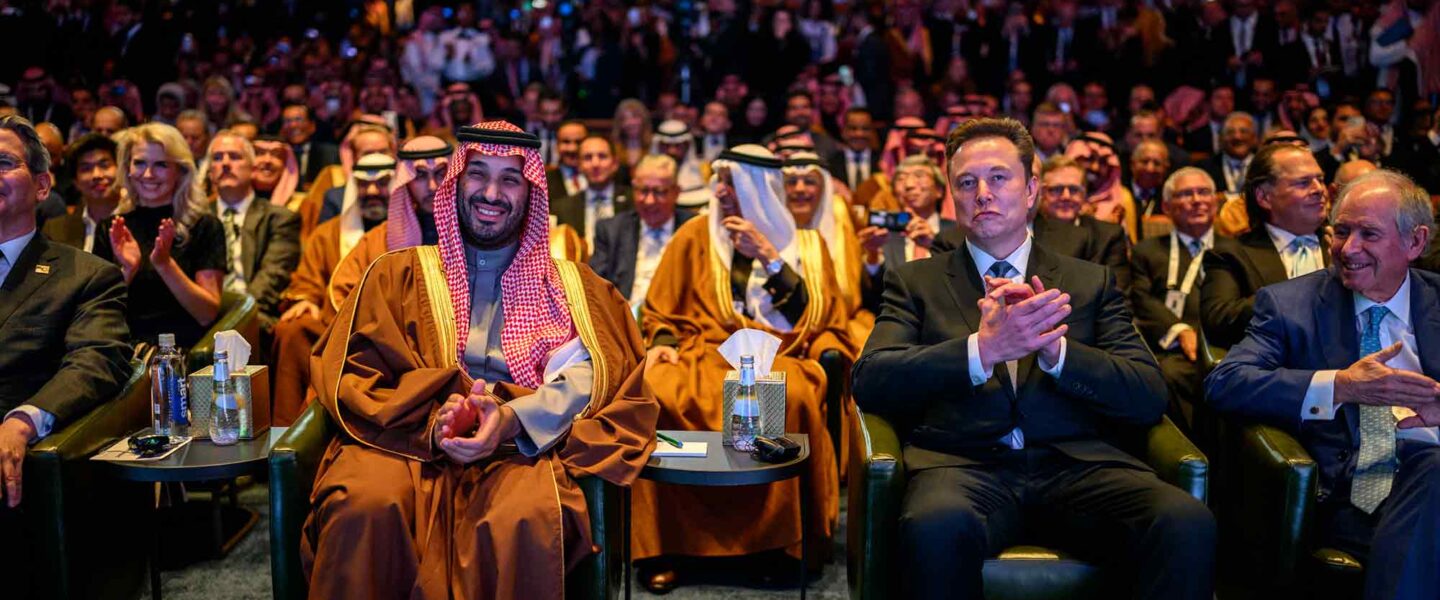
Opening this year’s Future Investment Initiative — Saudi Arabia’s premier annual investment conference, dubbed Davos in the Desert — Yasir Al-Rumayyan, the head of the Public Investment Fund (PIF), the kingdom’s almost $1 trillion sovereign wealth fund, declared, “We have brought Saudi Arabia to the world, and now the world is moving towards Saudi Arabia.”
Similarly, Energy Minister Abdulaziz bin Salman told the conference, “I want to say to the Chinese — pay attention! We’re going to have a lot of competition in the battery space next year.”
The energy minister’s calling China, Saudi Arabia’s foremost oil customer, to attention and positioning Saudi Arabia as the People’s Republic’s competitor in the Chinese-dominated battery industry was a far cry from its past emphasis on cooperation, win-win arrangements, and mutual benefit.
Wang suggested that Saudi Arabia and the United Arab Emirates’ move from selling oil in exchange for imported industrial products to locally manufacturing items such as chips, weapons, and consumer goods — including cars, batteries, and hydrogen energy — undergirds the kingdom’s newly found assertiveness.
In a further indication of the kingdom’s posturing, Saudi Arabia has opened four anti-dumping investigations into Chinese products, including stainless steel tubes, titanium dioxide, easy-open aluminum ends, and electrical fittings.
Furthermore, Saudi Arabia demonstrated its perceived positioning when it recently signed a defense agreement with Pakistan, the Islamic world’s only nuclear-armed state, that declares that “any aggression against either country shall be considered an aggression against both,” despite Indian concerns.
Saudi Arabia’s new assertiveness didn’t stop Prince Mohammed from inking agreements in Washington that link the kingdom’s positioning as more than a regional power to ever closer relations with the United States in an environment in which global status is increasingly defined not only by hard and/or soft power but also technological prowess and access to critical minerals.
Prince Mohammed’s acceptance of his dependence on the US is unlikely to prevent him from hedging his bets by maintaining close economic ties to China, even if it involves limiting his room to maneuver.
“The Saudis … didn’t really have export control regimes. … Their pitch to us was, let us know what we need to do. There was zero resistance. They understood that we saw deployment of … technology not just in economic terms, but in security terms,” said Michael Ratney, the last US ambassador to Saudi Arabia, who stepped down when Trump entered the White House in January.
Trump has yet to nominate a new ambassador.
A Global Actor
Trump catered to Prince Mohammed’s ambitions by defining the US-Saudi relationship as “one of the most consequential in the world.”
Echoing Prince Mohammed’s positioning of the kingdom, Saudi political analyst Ahmed Alibrahim asserted that “Saudi Arabia is no longer a junior partner. It’s no longer a passive player. It’s a global actor.”
Ali H. Tulbah, a Middle East business consultant with longstanding high-level contacts in Saudi Arabia and a former George W. Bush administration official, described Prince Mohammed as seeing “himself as an absolutely transformational figure, not just for the kingdom, but for the kingdom’s ability to influence the global economy. He sees himself as an innovator, a la Steve Jobs,” the co-founder of Apple.
Trump, Alibrahim, and Tulbah may not be wrong.
A White House statement said agreements signed during Prince Mohammed’s visit aimed to achieve “nuclear energy, critical minerals, and technology dominance.”
Trump claimed that US and Saudi entities had signed contracts worth $270 billion this week during a one-day Saudi-hosted Saudi-US Investment Forum in Washington.
With Prince Mohammed hiking his pledge to invest in the United States from $600 billion to $1 trillion, he and Trump signed in the White House several agreements related to critical minerals, artificial intelligence, and the kingdom’s acquisition of F-35 fighter jets, which testify to the kingdom’s positioning.
The artificial intelligence memorandum of understanding “gives the kingdom access to world-leading American systems while protecting US technology from foreign influence,” a reference to China, and “ensuring that American innovators will shape the future of global AI.”
Barely 24 hours later, the administration approved the sale of advanced Nvidia chips to Saudi Arabia’s Humain, the kingdom’s Saudi artificial intelligence company established by the Public Investment Fund.
Last month, Humain launched the kingdom’s first AI computer operating system, which it believes will eventually compete with Microsoft’s Windows and Apple’s MacOS.
In another reference to China and US insistence that Saudi Arabia limit Chinese involvement in its technology infrastructure, the US Commerce Department said Humain, like the UAE’s G42, another Gulf recipient of advanced chips, would have to meet “rigorous security and reporting requirements.”
Meanwhile, Elon Musk, CEO of xAI and Tesla, announced a massive new data center project in Saudi Arabia that would be among the world’s largest.
At the same time, Saudi Arabia signed a memorandum of understanding with D-AI, a European leader in advanced artificial intelligence and high-performance computing infrastructure, to build data centers for “AI training, cybersecurity operations, securing computational workloads for government agencies,” and “creating sovereign cloud computing systems that store and process data under Saudi jurisdiction.”
It Does Compute
The kingdom’s quest to become a regional computing hub leverages the fact that the United States cannot meet the growing global demand for computing power, particularly in the Global South.
“So, who is going to be servicing Africa and South Asia and the Middle East. This is where Saudi Arabia comes in and says, ‘We want to be this computing hub.’ … The Crown Prince made the case very clearly,” said analyst Mohammed Soliman.
Critical minerals, like computing, are another pillar of Saudi Arabia’s projection of the kingdom.
“If oil was [the Saudis’] natural resource wealth of the first whatever, 80 years, minerals is the future. And minerals will continue to be in demand even if there’s a tapering off of demand for fossil fuels. So, for them, it’s this vast, untapped wealth,” Ratney said.
Extraction is one thing, separating rare earths another. Separation consumes between 9–13 times more energy than extraction.
That’s where Saudi Arabia has a competitive edge, given its significant investments in renewable energy and fossil fuel reserves, making it a country with some of the world’s lowest energy costs.
In addition, Saudi Arabia has the needed cash to invest, despite losing money on multibillion-dollar giga projects that it is forced to scale back. The kingdom also has large swaths of relatively unregulated land on which to build refineries and processing plants.
Signalling Saudi ambitions, the kingdom’s Future Minerals Forum, launched in 2022, has become the go-to industry gathering. It has put Saudi Arabia at a crossroads in a world obsessed with the nexus of critical minerals, technology, and the military-industrial complex.
Saudi Arabia, alongside the UAE, plays a critical role in the US competition with China for access to critical minerals through its investments in Africa’s critical mineral industry.
“These countries are poor and they’re gonna want a partner to help exploit their natural resources. If we, and a country like Saudi Arabia, could do that in place of the Chinese, better for us. It provides us with access to strategic minerals that fuel our own tech ambitions,” Ratney said.
Once its infrastructure is up and running, Saudi Arabia will be a vital link in the global rare earths supply chain, positioning itself as the closest processing hub to countries that received the highest share of investment in rare earths exploration in 2024 — Malawi, Namibia, South Africa, Uganda, and Saudi Arabia itself.
Geologists value Saudi critical mineral reserves — the world’s fourth largest, including rare earth elements, base metals, gold, phosphate, and titanium — at $2.5 trillion.
As a result, Saudi Arabia has rapidly emerged as a top global destination for exploration, attracting more than $140 million in investment in 2024. Exploration licensing rose nearly fourfold, from 224 licenses in 2015 to 816 in 2023.
By 2030, Saudi Arabia aims to be one of the world’s top seven mineral processors and in a position to challenge China’s dominance in midstream processing.
The US Department of Defense said this week that it will finance a 49 percent equity stake in a new rare earths refinery in Saudi Arabia, in partnership with MP Materials and Maaden, the kingdom’s flagship mining company.
Saudi processing ambitions could prove a tall order, given China’s control of nearly 70 percent of global rare-earths ore production and some 90 percent of processing capacity, making it the only country currently able to meet global demand at scale.
Rare earths are critical components for the United States’ Virginia- and Columbia-class submarines, F-35 fighter jets, Tomahawk missiles, radar systems, Predator drones, and precision-guided weapons, as well as for civilian technologies, from automotive semiconductors to MRI machines and cancer-treatment technologies.
As a result, Saudi Arabia’s computing and critical minerals ambitions have profound implications not only for the competition with China but also for international relations in a 21st century world order.
“The 21st century will see Saudi Arabia not only as an energy powerhouse, but also as a central node in the global diplomatic and economic balance,” said Hana Jalloul Muro, vice chair of the European Parliament’s Committee on Foreign Affairs and the parliament’s rapporteur for Saudi Arabia.
James M. Dorsey is an adjunct senior fellow at Nanyang Technological University’s S. Rajaratnam School of International Studies, and the author of the syndicated column and podcast, The Turbulent World with James M. Dorsey.